Detective Fiction · Catalogue entry
Émile Gaboriau: In L'Affaire Lerouge, Lecoq Only Assists
Genre Fiction Lineage Published
In Émile Gaboriau's L'Affaire Lerouge (1866 in the 1911 Britannica), the amateur Père Tabaret, not Lecoq, solves the case. Lecoq, a policeman whose name appears in only four of its 20 chapters by this page's count, investigates on his own in Le Crime d'Orcival (1867, same source) and receives a new background in Monsieur Lecoq (1869).
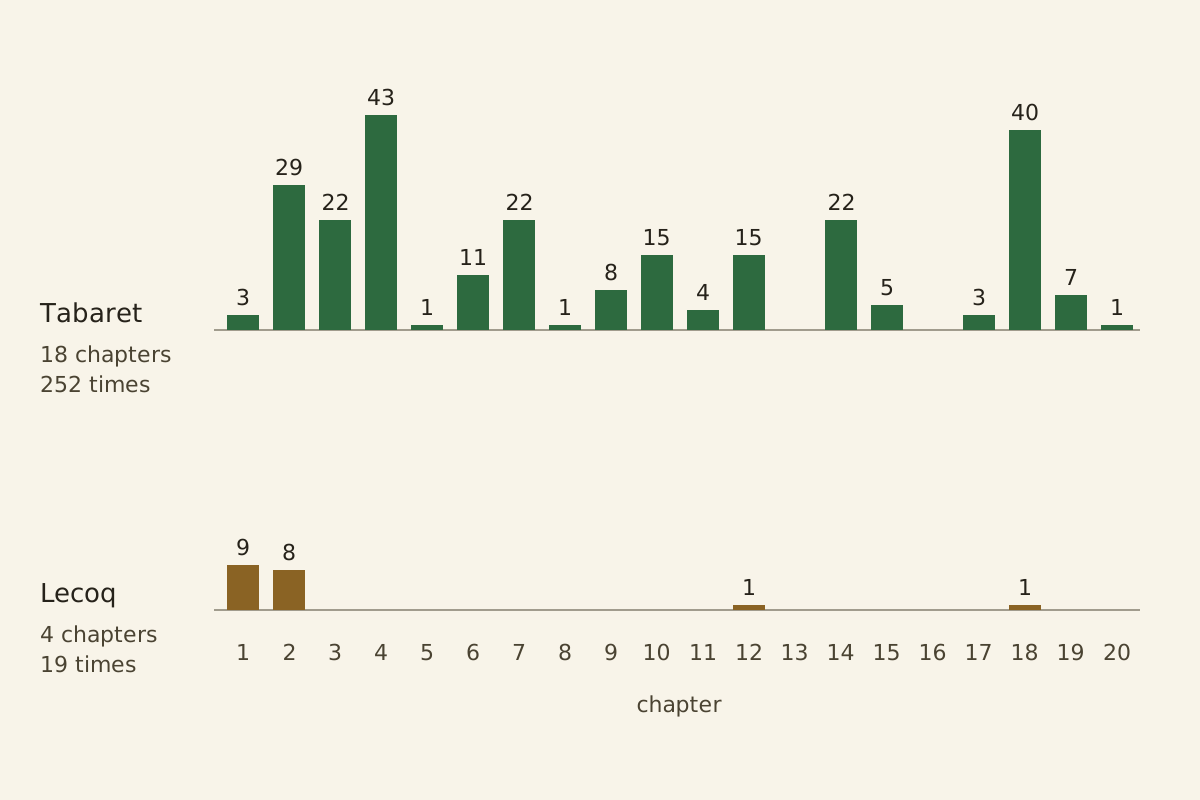
Who is on the page — the names Tabaret and Lecoq counted chapter by chapter in the Dentu printing of L'Affaire Lerouge.
L'Affaire Lerouge: Tabaret and Lecoq by chapter · Genre Fiction Lineage · CC BY 4.0
Reuse credit (CC BY)
"L'Affaire Lerouge: Tabaret and Lecoq by chapter" by Genre Fiction Lineage, https://genrefictionlineage.com/detective-fiction/emile-gaboriau/, licensed under CC BY 4.0 (https://creativecommons.org/licenses/by/4.0/)
Texts: Émile Gaboriau, L'Affaire Lerouge (Paris: E. Dentu; catalogued at fr.wikisource as 1870) and Monsieur Lecoq, vol. 1 (Paris: E. Dentu, third edition, 1869), fr.wikisource transcriptions; Le Crime d'Orcival, Project Gutenberg eBook #44620
Lecoq enters on page 12 of that printing, and the sentence that introduces him also gives his past: “L’aide de camp de Gévrol était, ce jour-là, un ancien repris de justice réconcilié avec les lois” (“Gévrol's aide that day was a former offender who had made his peace with the law,” Genre Fiction Lineage translation). Gévrol is the chief of the detective police, and the next sentence is “On le nommait Lecoq” (“His name was Lecoq,” Genre Fiction Lineage translation). The counts for every chapter are in a CSV of names by chapter CSV · provenance note Texts: Émile Gaboriau, L'Affaire Lerouge (Paris: E. Dentu; catalogued at fr.wikisource as 1870) and Monsieur Lecoq, vol. 1 (Paris: E. Dentu, third edition, 1869), fr.wikisource transcriptions; Le Crime d'Orcival, Project Gutenberg eBook #44620.
Who solves the case in L'Affaire Lerouge?
The novel opens on “Le jeudi 6 mars 1862” (“On Thursday 6 March 1862,” Genre Fiction Lineage translation), when neighbours in La Jonchère, a hamlet above the Seine near Bougival, report that nobody has seen the widow Lerouge for two days. She is discovered stabbed in her cottage, Gévrol's men find nothing, and Lecoq asks half aloud why “le père Tirauclair” is not there (chapter I, page 18).
Gévrol then explains who that is: a retired employee of the municipal pawnshop, “un vieux richard dont le vrai nom est Tabaret” (“a rich old man whose real name is Tabaret”). He adds, “Il fait de la police, comme Ancelin était devenu garde du commerce, pour son plaisir” (“He does police work, the way Ancelin became a debtors' bailiff, for his own pleasure,” both Genre Fiction Lineage translation; page 19). Here père, French for father, is a friendly title for an old man.
From chapter II onward Tabaret leads the search of the cottage: “Lecoq le suivait, portant avec mille précautions un grand panier” (“Lecoq followed him, carrying a large basket with endless care,” Genre Fiction Lineage translation; page 35). By this page's count, Lecoq's name appears 19 times, all in chapters I, II, XII and XVIII. Tabaret's name appears 252 times and is absent only from chapters XIII and XVI. The Project Gutenberg French text gives the same counts, chapter for chapter.
Does Tabaret get it right?
Not at first. In chapter VI he tells the examining magistrate, M. Daburon, that “l’assassin de la veuve Lerouge est le bâtard, le vicomte Albert de Commarin” (“the murderer of the widow Lerouge is the illegitimate son, the Viscount Albert de Commarin,” Genre Fiction Lineage translation; page 151). Daburon issues a warrant against Albert (chapter X, page 283). Questioned in chapter XII, Albert keeps saying he is innocent.
Tabaret later turns against his own charge. The magistrate at first refuses to listen. Chapter XIV states that “Il avait poussé un innocent dans l’abîme” (“He had pushed an innocent man into the abyss,” Genre Fiction Lineage translation; page 407), and that it was now up to him to save the man. In chapter XVIII the old man rushes into Daburon's office with the solution: “nous tenons l’assassin véritable ! C’est lui, c’est mon fils d’adoption, mon héritier, c’est Noël !” (“we have the real murderer! It is him, my adopted son, my heir, it is Noël!” Genre Fiction Lineage translation; page 556).
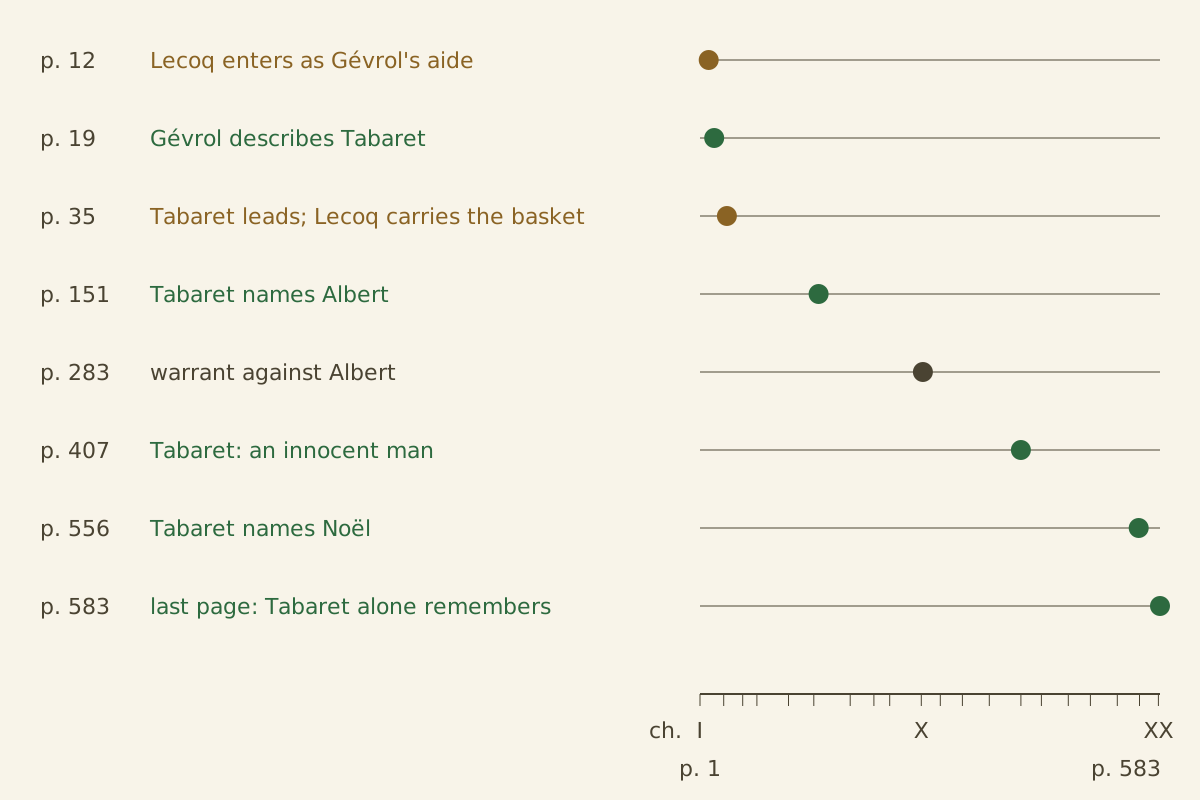
The case by printed page — eight moments in the Dentu printing, from Lecoq's entrance to the last page.
L'Affaire Lerouge: the case by printed page · Genre Fiction Lineage · CC BY 4.0
Reuse credit (CC BY)
"L'Affaire Lerouge: the case by printed page" by Genre Fiction Lineage, https://genrefictionlineage.com/detective-fiction/emile-gaboriau/, licensed under CC BY 4.0 (https://creativecommons.org/licenses/by/4.0/)
Texts: Émile Gaboriau, L'Affaire Lerouge (Paris: E. Dentu; catalogued at fr.wikisource as 1870) and Monsieur Lecoq, vol. 1 (Paris: E. Dentu, third edition, 1869), fr.wikisource transcriptions; Le Crime d'Orcival, Project Gutenberg eBook #44620
Lecoq's part in the ending is small. Tabaret recruits a dozen assistants to search Bougival house by house, “secondé par son séide Lecoq” (“seconded by his henchman Lecoq,” Genre Fiction Lineage translation; page 529). The final page belongs to Tabaret rather than Lecoq: “Seul, le père Tabaret se souvient” (“Old Tabaret alone remembers,” Genre Fiction Lineage translation), and he now organizes petitions for the abolition of the death penalty (chapter XX, page 583).
The widow Lerouge's cottage — an illustration of an isolated cottage above the Seine with its door ajar, not a book illustration or a historical record.
Illustration: Genre Fiction Lineage. Generated scene illustration — not a book illustration, photograph or historical record. No copyright is claimed in the generated imagery; if you reuse it, please credit "Genre Fiction Lineage".
How did Lecoq change between L'Affaire Lerouge and Monsieur Lecoq?
Lecoq returns in Le Crime d'Orcival, which the 1911 Encyclopaedia Britannica dates to 1867. The Project Gutenberg text of that novel is a sixth edition dated 1869. In it he arrives from the Sûreté, the detective department of the Paris police, to investigate the crime. In chapter VII he calls himself “l'élève chéri du père Tabaret” (“old Tabaret's favourite pupil,” Genre Fiction Lineage translation).
Monsieur Lecoq gives him a different past. The copy transcribed at Wikisource is a third edition, published in Paris by E. Dentu and dated 1869 on its title page. In its second chapter Lecoq is “un débutant” (“a beginner,” Genre Fiction Lineage translation), the junior man to whom Gévrol had abandoned an investigation he thought useless (page 21).
The two novels give different accounts of his past. In L'Affaire Lerouge he is a former offender, while in Monsieur Lecoq, “Fils d’une riche et honorable famille de Normandie, Lecoq avait reçu une bonne et solide éducation” (“The son of a rich and respectable family from Normandy, Lecoq had received a good, solid education,” Genre Fiction Lineage translation; page 21). He loses his parents and his inheritance, copies out calculations for the astronomer baron Moser, and is dismissed for explaining a scheme that could have collected five or six hundred thousand francs.
Moser's parting advice is “Quand on a vos dispositions et qu’on est pauvre, on devient un voleur fameux ou un illustre policier” (“When a man has your gifts and is poor, he becomes a famous thief or a celebrated policeman,” Genre Fiction Lineage translation; page 23). The same page describes Lecoq as “ce garçon, admirablement honnête” (“this admirably honest young man,” Genre Fiction Lineage translation).
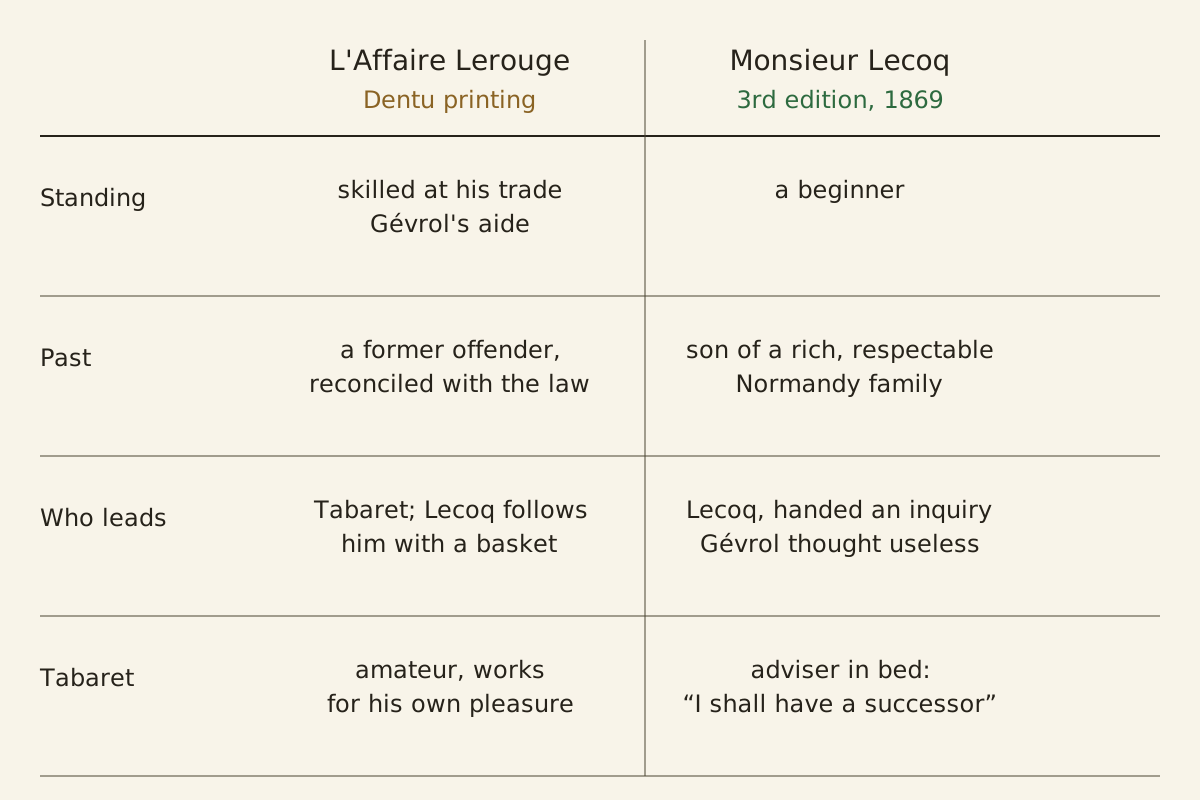
Two Lecoqs — the same policeman as the Dentu printing of L'Affaire Lerouge and the 1869 third edition of Monsieur Lecoq present him.
Two Lecoqs: L'Affaire Lerouge and Monsieur Lecoq · Genre Fiction Lineage · CC BY 4.0
Reuse credit (CC BY)
"Two Lecoqs: L'Affaire Lerouge and Monsieur Lecoq" by Genre Fiction Lineage, https://genrefictionlineage.com/detective-fiction/emile-gaboriau/, licensed under CC BY 4.0 (https://creativecommons.org/licenses/by/4.0/)
Texts: Émile Gaboriau, L'Affaire Lerouge (Paris: E. Dentu; catalogued at fr.wikisource as 1870) and Monsieur Lecoq, vol. 1 (Paris: E. Dentu, third edition, 1869), fr.wikisource transcriptions; Le Crime d'Orcival, Project Gutenberg eBook #44620
| Aspect | L'Affaire Lerouge, Dentu printing | Monsieur Lecoq, third edition, 1869 |
|---|---|---|
| Lecoq's standing | Gévrol's aide, skilled at his trade (ch. I, p. 12) | a beginner (ch. II, p. 21) |
| Lecoq's past | a former offender (ch. I, p. 12) | son of a rich Normandy family, then an astronomer's clerk (ch. II, pp. 21–23) |
| Who leads the inquiry | Tabaret, with Lecoq carrying his basket (ch. II, p. 35) | Lecoq, on a case Gévrol left to him (ch. II, p. 21) |
| Tabaret | an amateur working for his own pleasure (ch. I, p. 19) | an adviser in bed who expects a successor (ch. XLI, p. 406) |
In chapter XLI of Monsieur Lecoq, Lecoq brings his difficulties to Tabaret, who is confined to bed with gout, and the old man tells him, “je puis mourir, j’aurai un successeur” (“I can die; I shall have a successor,” Genre Fiction Lineage translation; page 406). Every passage quoted on this page is in a CSV of passages with chapter and page CSV · provenance note Texts: Émile Gaboriau, L'Affaire Lerouge (Paris: E. Dentu; catalogued at fr.wikisource as 1870) and Monsieur Lecoq, vol. 1 (Paris: E. Dentu, third edition, 1869), fr.wikisource transcriptions; Le Crime d'Orcival, Project Gutenberg eBook #44620.
Inside the stories, the two cases run in a different order. L'Affaire Lerouge gives its year, 1862, while Monsieur Lecoq opens on “Le 20 février 18..” (“20 February 18..,” Genre Fiction Lineage translation; page 3), with the year left incomplete. Because Monsieur Lecoq presents Lecoq as a beginner and L'Affaire Lerouge calls him “un gaillard habile dans son métier” (“a fellow skilled at his trade,” Genre Fiction Lineage translation), this page reads the case in Monsieur Lecoq as the earlier one in his career. Where this page puts L'Affaire Lerouge first, it means publication order.
Who was Émile Gaboriau?
The German national authority file (GND) gives his years as 1832 to 1873. The 1911 Britannica records his birth on 9 November 1833 at Saujon, in the Charente-Inférieure department. It places his death in Paris on 28 September 1873.
According to the Britannica, he worked as secretary to the novelist Paul Féval and published other writing before L'Affaire Lerouge, which “was published in the Pays and at once made his reputation.” The story was adapted for the stage in 1872, and “a long series of novels dealing with the annals of the police court followed.” Among the novels the Britannica lists, L'Affaire Lerouge is the earliest, so among those novels Lecoq's career in print begins there, in a supporting role.
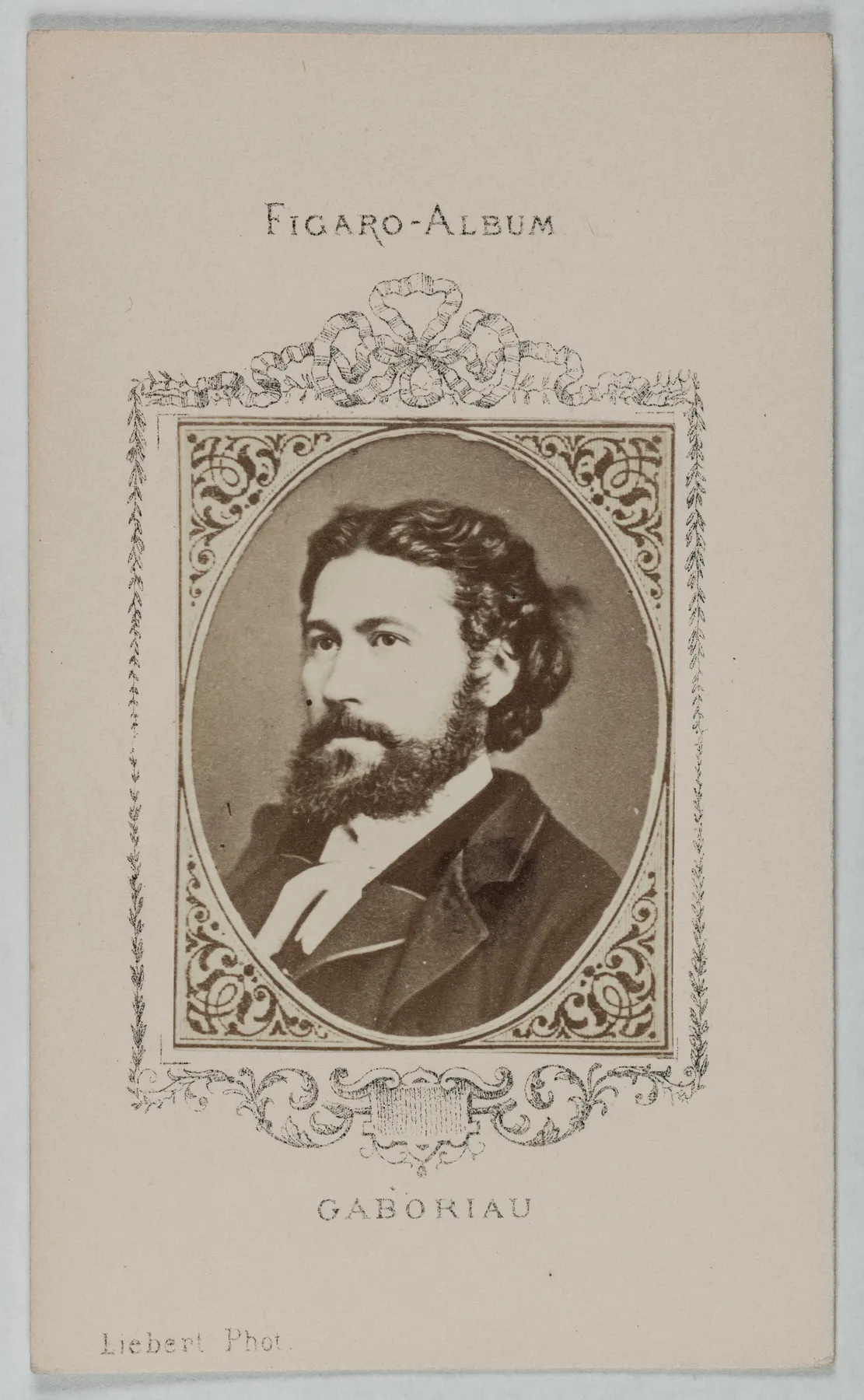
Émile Gaboriau — a carte-de-visite portrait by Alphonse Liébert for the Figaro-Album series, before 1879, Musée Carnavalet PH50811.
"Portrait d'Émile Gaboriau (Figaro-Album)" by Alphonse Liébert, 1878 — https://commons.wikimedia.org/wiki/File:Portrait_d'Emile_Gaboriau_(1832-1873),_(romancier),_PH50811.jpg — CC0 1.0 (https://creativecommons.org/publicdomain/zero/1.0/)
Where does L'Affaire Lerouge sit in print order?
The year 1866 comes from the 1911 Britannica. It says the novel was published in the newspaper Le Pays but gives no dates for that publication. The Dentu printing quoted on this page is catalogued at Wikisource as 1870, but its title page is not among the transcribed pages, so that year could not be confirmed from the book itself. The CSV of dated texts CSV · provenance note Texts: Émile Gaboriau, L'Affaire Lerouge (Paris: E. Dentu; catalogued at fr.wikisource as 1870) and Monsieur Lecoq, vol. 1 (Paris: E. Dentu, third edition, 1869), fr.wikisource transcriptions; Le Crime d'Orcival, Project Gutenberg eBook #44620 records each year next to the source that gives it.
Counted from 1866, L'Affaire Lerouge appeared 25 years after Edgar Allan Poe's “The Murders in the Rue Morgue” (Graham's Magazine, April 1841). The names Poe and Dupin do not occur in the French texts of L'Affaire Lerouge, Le Crime d'Orcival or the first volume of Monsieur Lecoq, so the strip connects Poe's story to Gaboriau's by date alone.
The Moonstone began in All the Year Round in January 1868. That was two years after L'Affaire Lerouge, but nothing examined for this page shows that Wilkie Collins knew Gaboriau's novel. Monsieur Lecoq followed in 1869, three years after L'Affaire Lerouge.
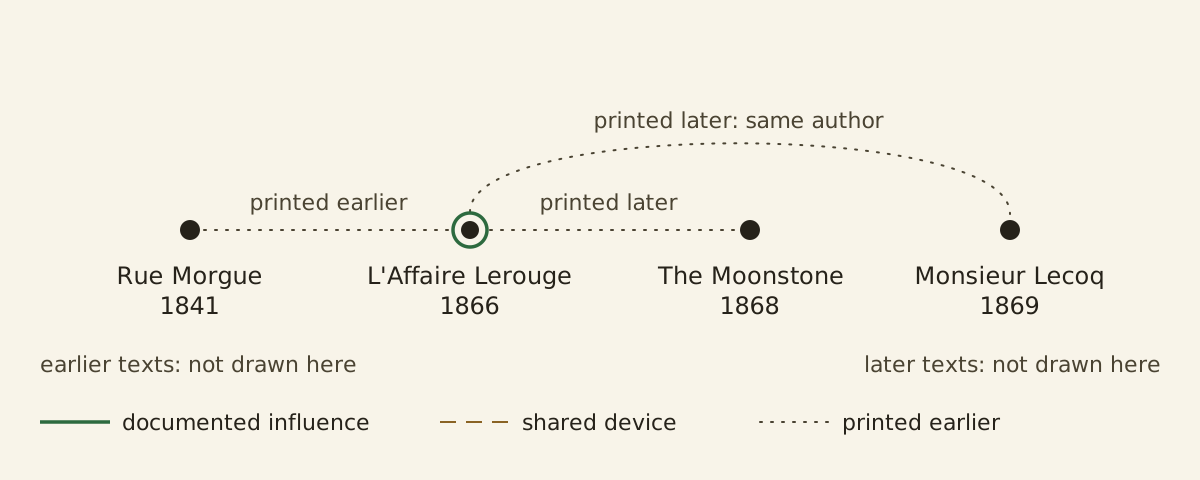
- Solid: documented influence (the later author's own statement, letter, review or note)
- Dashed: shared device (similar texts, no borrowing claimed)
- Dotted: dates only (publication order or other dates; no link claimed)
Lineage strip — four texts in print order; every line is dotted, for publication order only, and the arc marks a later novel by the same author.
Lineage strip: The Murders in the Rue Morgue to Monsieur Lecoq, 1841 to 1869 · Genre Fiction Lineage · CC BY 4.0
Reuse credit (CC BY)
"Lineage strip: The Murders in the Rue Morgue to Monsieur Lecoq, 1841 to 1869" by Genre Fiction Lineage, https://genrefictionlineage.com/detective-fiction/emile-gaboriau/, licensed under CC BY 4.0 (https://creativecommons.org/licenses/by/4.0/)
Texts: Émile Gaboriau, L'Affaire Lerouge (Paris: E. Dentu; catalogued at fr.wikisource as 1870) and Monsieur Lecoq, vol. 1 (Paris: E. Dentu, third edition, 1869), fr.wikisource transcriptions; Le Crime d'Orcival, Project Gutenberg eBook #44620
Another French novel, published as a book in 1873 according to SFE, seven years after Gaboriau's, is dated day by day in Around the World in 80 Days (printed later).
Sources
- 1Émile Gaboriau, L'Affaire Lerouge (Paris: E. Dentu; catalogued at Wikisource as 1870), transcribed at Wikisource, https://fr.wikisource.org/wiki/L%E2%80%99Affaire_Lerouge https://fr.wikisource.org/wiki/L%E2%80%99Affaire_LerougeRead: full text, all 20 chapters (transcription with printed page numbers)
- 2Émile Gaboriau, L'affaire Lerouge, Project Gutenberg eBook #15579, https://www.gutenberg.org/ebooks/15579 (source edition not stated) https://www.gutenberg.org/ebooks/15579Read: full text
- 3Émile Gaboriau, Le Crime d'Orcival, sixth edition (1869), Project Gutenberg eBook #44620, https://www.gutenberg.org/ebooks/44620 https://www.gutenberg.org/ebooks/44620Read: full text, searched; chapter VII read
- 4Émile Gaboriau, Monsieur Lecoq, vol. 1, L'Enquête, third edition (Paris: E. Dentu, 1869), transcribed at Wikisource, https://fr.wikisource.org/wiki/Monsieur_Lecoq https://fr.wikisource.org/wiki/Monsieur_LecoqRead: title page and dedication; part 1, chapters I, II and XLI
- 5Émile Gaboriau, Monsieur Lecoq, vol. 1, Project Gutenberg eBook #8650, https://www.gutenberg.org/ebooks/8650 (source edition not stated) https://www.gutenberg.org/ebooks/8650Read: full text, searched
- 6"Gaboriau, Émile," Encyclopaedia Britannica, 11th edition (1911), transcribed at Wikisource, https://en.wikisource.org/wiki/1911_Encyclop%C3%A6dia_Britannica/Gaboriau,_%C3%89mile https://en.wikisource.org/wiki/1911_Encyclop%C3%A6dia_Britannica/Gaboriau,_%C3%89mileRead: full entry
- 7Gemeinsame Normdatei (GND) record for Émile Gaboriau (120439409), via lobid-gnd https://d-nb.info/gnd/120439409Read: the record
- 8Graham's Magazine, vol. 18, no. 4 (April 1841), Internet Archive record sim_grahams-illustrated-magazine_grahams-magazine_1841-04_18_4 https://archive.org/details/sim_grahams-illustrated-magazine_grahams-magazine_1841-04_18_4Read: bibliographic record and the text of "The Murders in the Rue Morgue" in this issue
- 9All the Year Round, vol. 19, no. 454 (4 January 1868), Internet Archive record sim_all-the-year-round_1868-01-04_19_454 https://archive.org/details/sim_all-the-year-round_1868-01-04_19_454Read: text of the first instalment of The Moonstone in this issue (scanned issue)
- 10"Verne, Jules," in John Clute, David Langford and Graham Sleight (eds), The Encyclopedia of Science Fiction, https://sf-encyclopedia.com/entry/verne_jules, accessed 2 November 2026 https://sf-encyclopedia.com/entry/verne_julesRead: full entry (updated 27 July 2026), text and bibliography lines for Le Tour du monde
- 11Jennifer Jenkins and James Boyle, "Public Domain Day 2026," Center for the Study of the Public Domain, Duke Law School https://web.law.duke.edu/cspd/publicdomainday/2026/Read: full pageText licence: CC BY 4.0
- 12Urheberrechtsgesetz § 64 (Allgemeines), gesetze-im-internet.de https://www.gesetze-im-internet.de/urhg/__64.htmlRead: full text of the section
Cite this page
Genre Fiction Lineage. “Émile Gaboriau: In L'Affaire Lerouge, Lecoq Only Assists.” Genre Fiction Lineage, published 3 November 2026. https://genrefictionlineage.com/detective-fiction/emile-gaboriau/. Accessed [the date you read it].
Next shelf over:
- The Moonstone: an English detective serial of 1868, two years after L'Affaire Lerouge (printed later).
- Locked Room Mystery: the sealed-room device in print by 1838, and Poe's Paris tale of 1841 (printed earlier).
- Read the text: L'Affaire Lerouge (1866), Dentu printing catalogued as 1870, in French at Wikisource
Related entries
More from Detective Fiction.

Lineage essay
Locked Room Mystery: A Sealed-Room Murder in Print by 1838
A sealed-room murder was in print by 1838 in a Le Fanu tale, before Poe's 1841 Rue Morgue. Five rooms dated to 1907, who named whom, and a CSV.
Picture credit
Illustration: Genre Fiction Lineage. Generated scene illustration — not a book illustration, photograph or historical record. No copyright is claimed in the generated imagery; if you reuse it, please credit "Genre Fiction Lineage".
Catalogue entry
The Moonstone: A Case-File Serial Began Five Years Earlier
The Notting Hill Mystery began in Once a Week on 29 November 1862, five years before The Moonstone. Both serials dated and compared, with a CSV.
Picture credit
Illustration: Genre Fiction Lineage. Generated scene illustration — not a book illustration, photograph or historical record. No copyright is claimed in the generated imagery; if you reuse it, please credit "Genre Fiction Lineage".