Detective Fiction · Lineage essay
Locked Room Mystery: A Sealed-Room Murder in Print by 1838
Genre Fiction Lineage Published
A murder behind a door double-locked on the inside was in print by 1838, in a Sheridan Le Fanu tale. Alfred Perceval Graves dated its magazine printing to “1837 or 1838” in the 1880 collection quoted on this page, so the tale came before Edgar Allan Poe's “The Murders in the Rue Morgue” of April 1841.
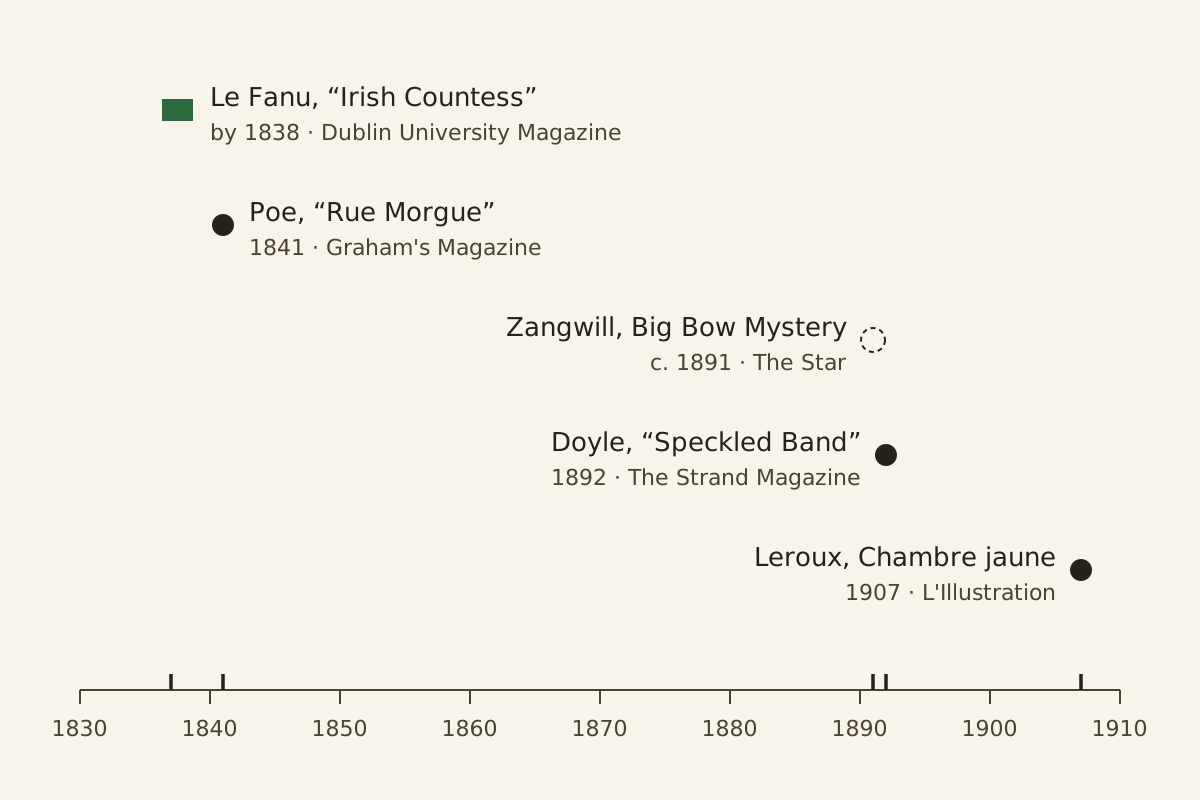
Five sealed rooms in print — first printings from the Le Fanu tale, by 1838, to Leroux's serial of 1907, with Zangwill's undated serial placed at about 1891.
Sealed-room mysteries by first printing, by 1838 to 1907 · Genre Fiction Lineage · CC BY 4.0
Reuse credit (CC BY)
"Sealed-room mysteries by first printing, by 1838 to 1907" by Genre Fiction Lineage, https://genrefictionlineage.com/detective-fiction/locked-room-mystery/, licensed under CC BY 4.0 (https://creativecommons.org/licenses/by/4.0/)
Dates and passages checked against the public-domain texts and records listed on the entry page
The 1880 text sets out the room in one sentence: “The door had been double-locked upon the inside, in evidence of which the key still lay where it had been placed in the lock.” All five tales on this page are in a CSV of the sealed-room lineage CSV · provenance note Dates and passages checked against the public-domain texts and records listed on the entry page, with dates, venues, how each room was sealed and how it was opened.
What is the earliest known locked-room murder in print?
A locked-room mystery is a crime story in which a body is found in a room that, it seems, nobody could have entered or left. This site calls the earliest known print record inside a stated range the patient-zero text. The range here is fiction printed in English, limited to the texts this page could read. Inside that range, the patient-zero text for the sealed-room murder is Le Fanu's “Passage in the Secret History of an Irish Countess.”
The date rests on one witness, Graves, who wrote the memoir for The Purcell Papers, a collection published after Le Fanu died in 1873. He says the tale “first appeared in the ‘Dublin University Magazine’ of 1837 or 1838.” The 1838 magazine was not read for this page, so the month is left open and the year stays a range.
The text quoted here comes from the second volume of The Purcell Papers, published in London by Richard Bentley and Son in 1880. That reprint came 42 years after the latest year Graves allows. Differences between the magazine text and the 1880 text, if any, have not been checked.
The gap to Poe is short. “The Murders in the Rue Morgue” appeared in Graham's Magazine for April 1841, three years after 1838 and four after 1837. Nothing read for this page shows that Poe knew the Irish tale, so the two are linked here by date and by shared features, not by influence. A wider search could still move the record: tales in other languages and unsigned stories in newspapers were not searched.
Being earliest in this range says nothing about descent. The term marks a dated record. Whether any later writer used Le Fanu's tale is a separate question, taken up further down this page.
What happens in Le Fanu's story?
Le Fanu's tale is a woman's letter, and no detective appears in it. The narrator, Margaret, recalls the case that ruined her uncle, Sir Arthur, before she was born. A gambling guest, Hugh Tisdall, was found dead in a bedroom whose door had to be forced open.
An inquest searched the walls, ceiling and floor for a trap-door and found none. Even the chimney was ruled out, because “the ashes, too, which lay in the grate, and the soot, as far as it could be seen, were undisturbed.” The window was closed but not fastened, and it sat on the second story above a courtyard whose old entrance had been walled up.
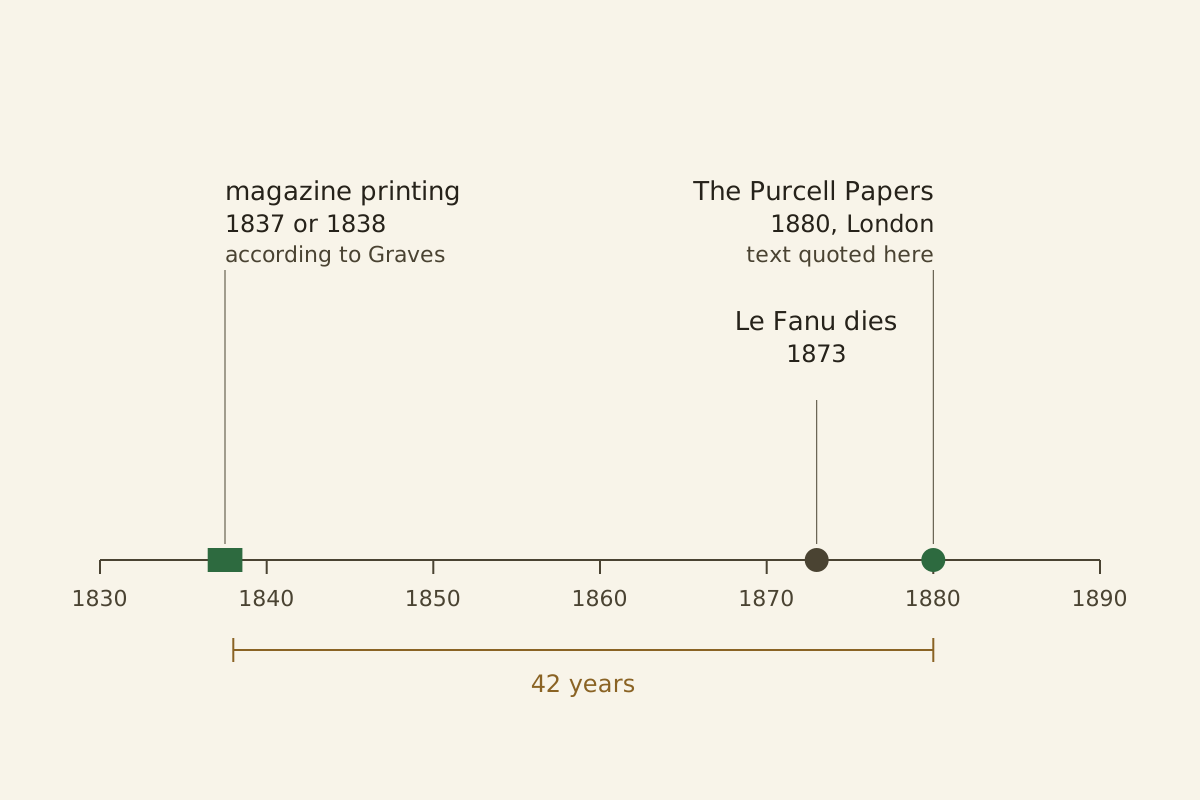
One tale, three dates — the magazine printing Graves gives as 1837 or 1838, Le Fanu's death in 1873, and the 1880 London reprint quoted on this page.
Le Fanu's Irish Countess tale: three dates · Genre Fiction Lineage · CC BY 4.0
Reuse credit (CC BY)
"Le Fanu's Irish Countess tale: three dates" by Genre Fiction Lineage, https://genrefictionlineage.com/detective-fiction/locked-room-mystery/, licensed under CC BY 4.0 (https://creativecommons.org/licenses/by/4.0/)
Dates and passages checked against the public-domain texts and records listed on the entry page
Le Fanu plants the answer well before it arrives. Margaret once walks into her own bedroom and finds her uncle and Edward “examining the fastenings of the casement,” and her uncle hides “some iron instrument” behind his back. A reader who remembers the Tisdall inquest can guess where the window will matter.

A key on the inside — an illustration of a door locked from within, not a book illustration or a scene from any one story.
Illustration: Genre Fiction Lineage. Generated scene illustration — not a book illustration, photograph or historical record. No copyright is claimed in the generated imagery; if you reuse it, please credit "Genre Fiction Lineage".
The answer comes years later and is never announced as a solution. Hidden in the shadow by the door, Margaret watches her cousin Edward come down a rope to the window, where “the whole frame, containing casement and all, slipped from its position in the wall.” His blows kill her cousin Emily, who is asleep in Margaret's bed. A housekeeper later confesses that she “had a hand in making Hugh Tisdal's bed,” and the reader is left to connect the sliding frame to the first death.
Graves calls the tale “the germ of Uncle Silas.” In his account, it was reprinted as “The Murdered Cousin” in a collection of Christmas stories and then grew into the novel Uncle Silas. The three dates in the timeline above are in a CSV of the tale's dates CSV · provenance note Dates and passages checked against the public-domain texts and records listed on the entry page.
How does Poe's room compare?
Set the two rooms side by side and the overlap is close. Poe's narrator reports that the door of a fourth-story back chamber, “being found locked, with the key inside, was forced open.” Sweeps go up and down the chimneys, the police search floors, ceilings and walls, and a razor “besmeared with blood” lies on a chair. Le Fanu's room has a pair of open razors near the bed, a ruled-out chimney and a search for a trap-door.
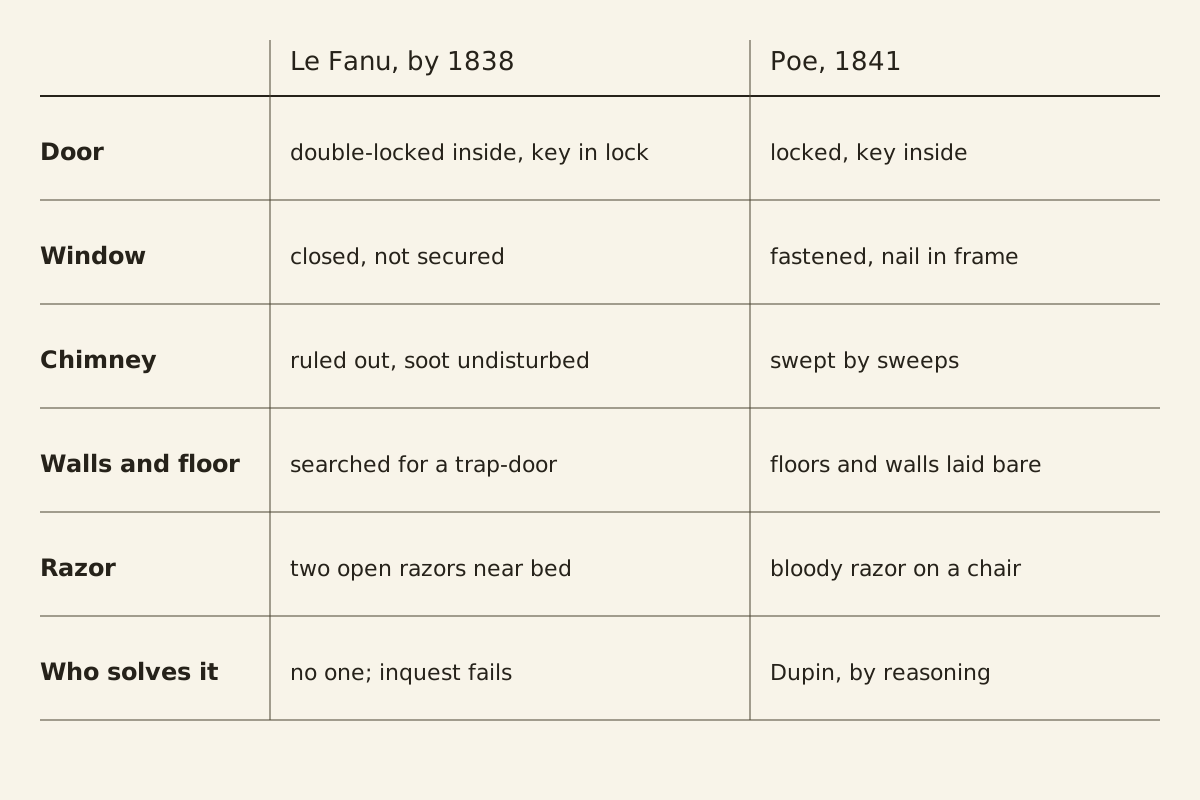
Two rooms compared — door, window, chimney, walls, razor and solver in the Le Fanu tale and in Poe's 1841 story, as each text describes them.
Two sealed rooms: Le Fanu and Poe · Genre Fiction Lineage · CC BY 4.0
Reuse credit (CC BY)
"Two sealed rooms: Le Fanu and Poe" by Genre Fiction Lineage, https://genrefictionlineage.com/detective-fiction/locked-room-mystery/, licensed under CC BY 4.0 (https://creativecommons.org/licenses/by/4.0/)
Dates and passages checked against the public-domain texts and records listed on the entry page
| Feature | Le Fanu, by 1838 (1880 text) | Poe, April 1841 |
|---|---|---|
| Door | double-locked inside, key in lock | locked, key inside |
| Window | closed, not secured | fastened, nail in frame |
| Chimney | ruled out, soot undisturbed | swept by sweeps |
| Walls and floor | searched for a trap-door | floors and walls laid bare |
| Razor | two open razors near bed | bloody razor on a chair |
| Who solves it | no one; inquest fails | Dupin, by reasoning |
Shared features do not show that one writer read the other. This page records the pair as a shared device: the same door, window and chimney, with no written trace of contact. The real difference is the solver. Le Fanu's inquest ends with nothing “in any degree conclusive,” while Poe gives the room to C. Auguste Dupin, who reasons that the killer must have left by a window and then finds a hidden spring and a broken nail.
In the Raven Edition of 1903, Dupin states his method in a single sentence: “It is only left for us to prove that these apparent ‘impossibilities’ are, in reality, not such.” That line, not the room, is what the Irish tale lacks. Its inquest examines the chimney and the walls as carefully as Poe's police do, but nobody in it argues from the sealed room to the one exit left unexplained. The wording behind each cell of the table is in a CSV comparing the two rooms CSV · provenance note Dates and passages checked against the public-domain texts and records listed on the entry page.
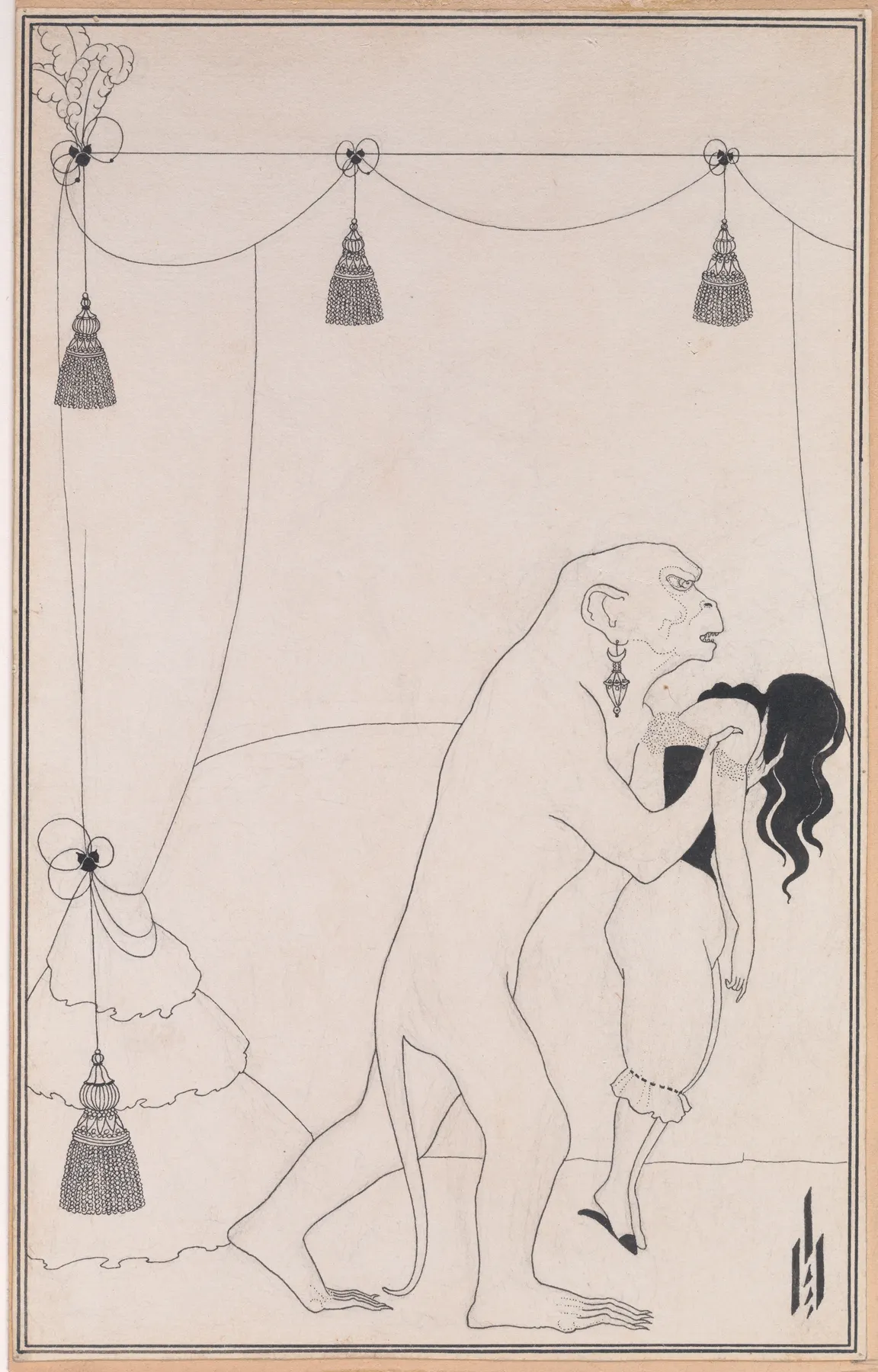
Beardsley's Rue Morgue — Aubrey Beardsley's pen-and-ink drawing of 1894, made for a Chicago edition of Poe's tales dated 1895–96.
"The Murders in the Rue Morgue, for Poe's Tales of Mystery and the Imagination, Chicago, 1895-96" by Aubrey Beardsley, 1894 — https://commons.wikimedia.org/wiki/File:The_Murders_in_the_Rue_Morgue,_for_Edgar_Allan_Poe%E2%80%99s_%E2%80%9CTales_of_Mystery_and_the_Imagination,%E2%80%9D_Chicago,_1895-96_MET_DP-21095-001.jpg — CC0 1.0 (https://creativecommons.org/publicdomain/zero/1.0/)
Name the edition before quoting Poe. The April 1841 magazine text opens: “It is not improbable that a few farther steps in phrenological science will lead to a belief in the existence, if not to the actual discovery and location of an organ of analysis.” The Raven Edition of Poe's Works, published in New York by P. F. Collier & Son in 1903 and the text at Project Gutenberg, starts later, with the words “The mental features discoursed of as the analytical.” The passages about the room quoted here read the same in both, except Dupin's method sentence, which in 1841 says only that “these ‘impossibilities’ are not such.”
Who named Poe in print?
On this page, influence needs a written trace, such as a later writer naming the earlier work. For the sealed room, two such traces lead to Poe. None lead to Le Fanu.
Israel Zangwill wrote The Big Bow Mystery as a serial, a story printed in parts, for the London evening paper The Star. In an introduction dated September 1895, he said the book was written “some four years ago,” which puts the serial at about 1891. He also recalled telling himself “that no mystery-monger had ever murdered a man in a room to which there was no possible access.”
The same introduction sets out a rule of fair play: the reader is given every clue the detective uses. “The indispensable condition of a good mystery,” Zangwill wrote, “is that it should be able and unable to be solved by the reader.” He added that “all its data must be given in the body of the story,” so the writer may not spring a new person on the reader at the end.
His own novel shows he knew of an earlier room. In Chapter IV, a “professional paradox-monger” points to the “somewhat similar situation” in “the murder in the Rue Morgue,” and a reader writes in with “Poe's solution,” an organ-grinder's monkey with a razor. Zangwill's note says the 1895 book stands “almost to a letter” as the Star printed it, so the naming most likely dates from the serial.
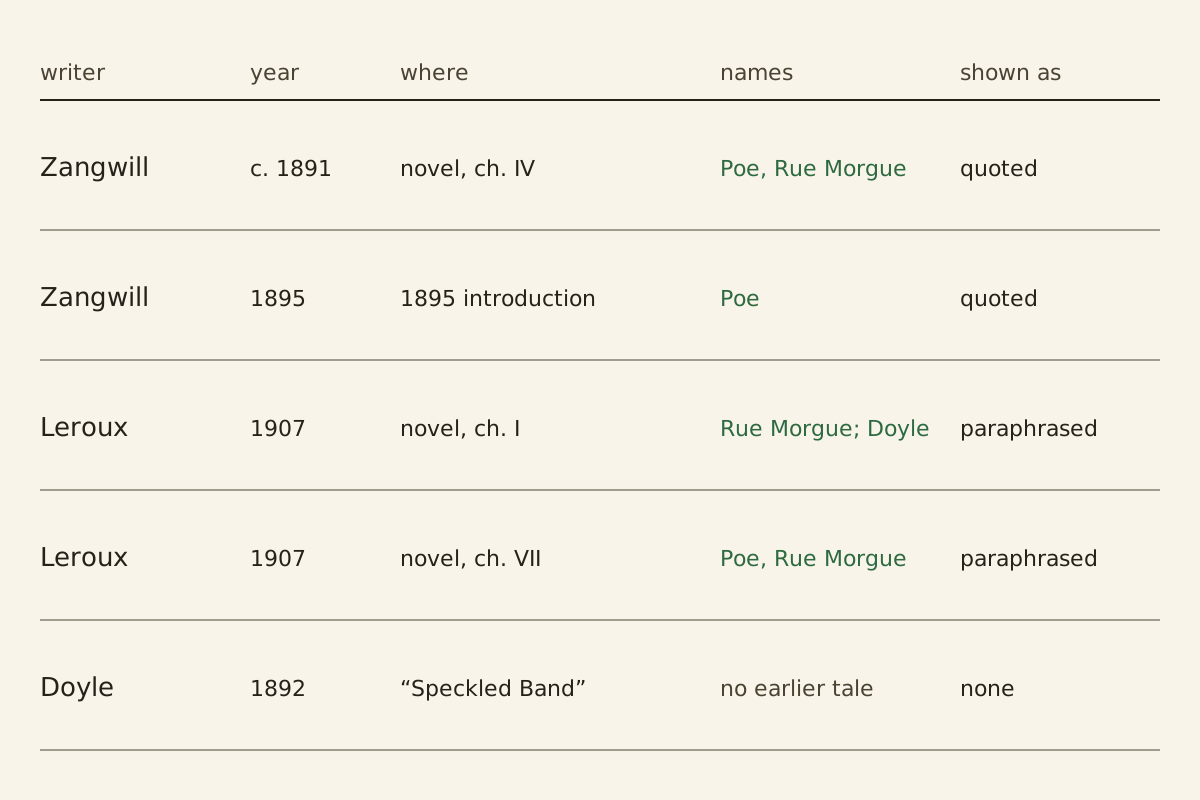
Who named Poe — five places where a later sealed-room text names, or does not name, an earlier one; Leroux is paraphrased.
Later sealed-room texts that name Poe · Genre Fiction Lineage · CC BY 4.0
Reuse credit (CC BY)
"Later sealed-room texts that name Poe" by Genre Fiction Lineage, https://genrefictionlineage.com/detective-fiction/locked-room-mystery/, licensed under CC BY 4.0 (https://creativecommons.org/licenses/by/4.0/)
Dates and passages checked against the public-domain texts and records listed on the entry page
Gaston Leroux named Poe in Le Mystère de la chambre jaune, which SFE dates to a serial in L'Illustration from September to November 1907. In Chapter I, the narrator ranks the mystery of the Yellow Room above anything in the author of the Rue Morgue murders, or in Conan Doyle. In Chapter VII, he says Poe invented nothing like it: Poe's room still had a window an ape could slip through, and the Yellow Room had no opening at all. Both chapters were read in the French text at Project Gutenberg, which does not name its source edition, so the wording of the 1907 serial itself has not been checked.
This page paraphrases Leroux and does not quote him, because the copyright status of his text in France could not be settled. SFE calls the novel “an early locked-room mystery highly praised by John Dickson Carr and others.” Carr's own books are still in copyright and are not quoted here.
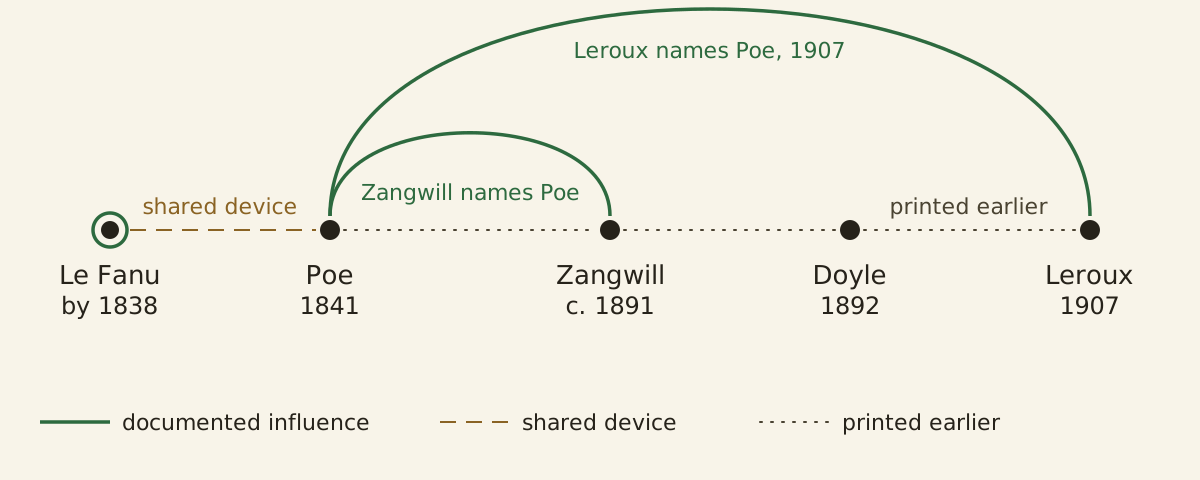
- Solid: documented influence (the later author's own statement, letter, review or note)
- Dashed: shared device (similar texts, no borrowing claimed)
- Dotted: dates only (publication order or other dates; no link claimed)
Lineage strip — five sealed-room tales in print order; the two solid arcs rest on Zangwill's and Leroux's own texts naming Poe, the dashed line on the door, window and chimney shared by Le Fanu's and Poe's rooms, the dotted lines on dates alone.
Lineage strip: Le Fanu to Leroux, by 1838 to 1907 · Genre Fiction Lineage · CC BY 4.0
Reuse credit (CC BY)
"Lineage strip: Le Fanu to Leroux, by 1838 to 1907" by Genre Fiction Lineage, https://genrefictionlineage.com/detective-fiction/locked-room-mystery/, licensed under CC BY 4.0 (https://creativecommons.org/licenses/by/4.0/)
Dates and passages checked against the public-domain texts and records listed on the entry page
| Writer | Year | Where | Names | Shown here as |
|---|---|---|---|---|
| Israel Zangwill | about 1891 | The Big Bow Mystery, Chapter IV | Poe, “the murder in the Rue Morgue” | quotation |
| Israel Zangwill | 1895 | introduction, September 1895 | Poe | quotation |
| Gaston Leroux | 1907 | Le Mystère de la chambre jaune, Chapter I | the Rue Morgue author; Conan Doyle | paraphrase |
| Gaston Leroux | 1907 | Le Mystère de la chambre jaune, Chapter VII | Poe and the Rue Morgue room | paraphrase |
| Arthur Conan Doyle | 1892 | “The Adventure of the Speckled Band” | no earlier sealed-room tale | none |
Leroux also names Conan Doyle, but no story by him. The strip therefore links Doyle to Leroux by date alone. The passage behind each row of the table is in a CSV of who named Poe CSV · provenance note Dates and passages checked against the public-domain texts and records listed on the entry page.
How are the rooms opened?
The five rooms are opened in five different ways, and that spread is the useful part of the lineage.
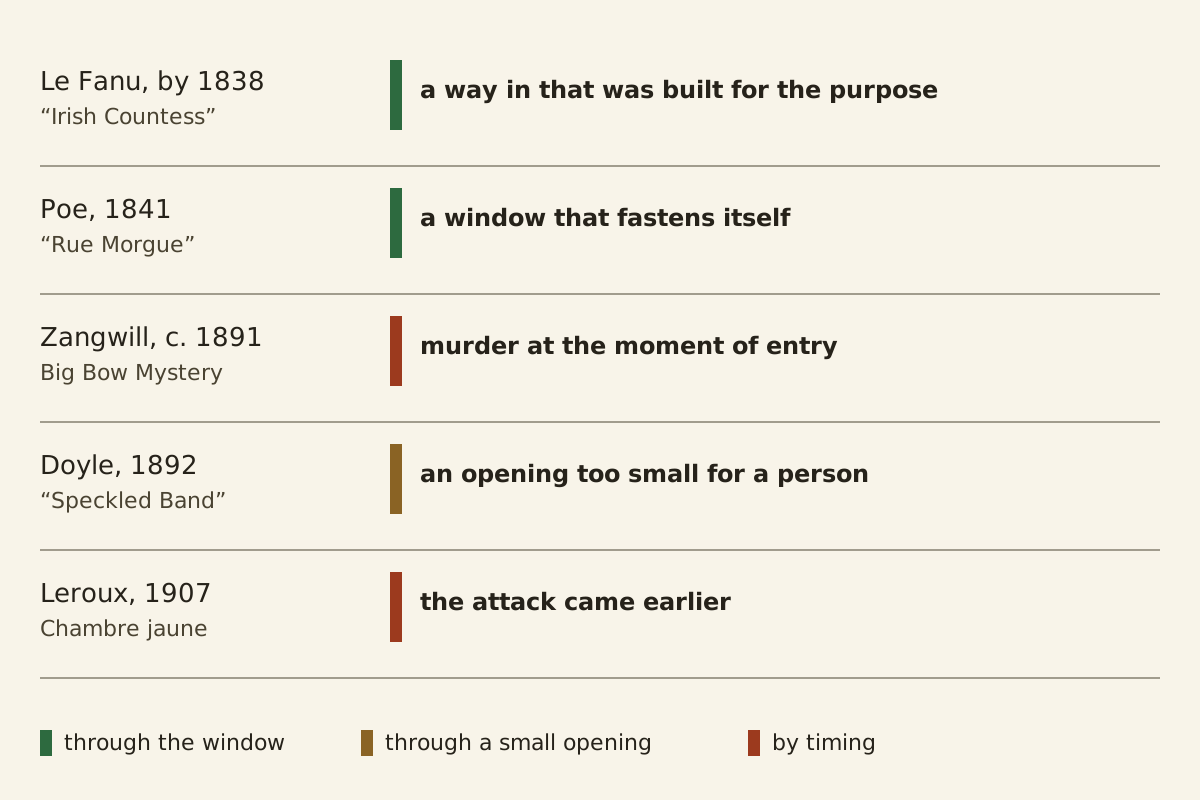
How the rooms open — the five solutions grouped by route: through the window, through a small opening, or by timing.
How the five sealed rooms are opened · Genre Fiction Lineage · CC BY 4.0
Reuse credit (CC BY)
"How the five sealed rooms are opened" by Genre Fiction Lineage, https://genrefictionlineage.com/detective-fiction/locked-room-mystery/, licensed under CC BY 4.0 (https://creativecommons.org/licenses/by/4.0/)
Dates and passages checked against the public-domain texts and records listed on the entry page
| Tale | First in print | How the room was sealed | How it is opened |
|---|---|---|---|
| Le Fanu, “Irish Countess” | by 1838 | door double-locked, key inside | the whole window frame slides out of the wall |
| Poe, “The Murders in the Rue Morgue” | April 1841 | door locked, key inside; windows nailed | a hidden spring and a broken nail; the killer climbed a lightning rod |
| Zangwill, The Big Bow Mystery | about 1891 | door locked and bolted | the man who breaks the door down kills the sleeper |
| Doyle, “The Adventure of the Speckled Band” | February 1892 | door fastened, shutters barred | a ventilator and a dummy bell-rope give a snake a path |
| Leroux, Le Mystère de la chambre jaune | 1907 | door locked and bolted, window barred | the attack came hours before the room was locked |
Le Fanu and Poe both send the killer through a window that only looks shut. Doyle shrinks the gap to a ventilator too small for a person. Zangwill and Leroux move the crime in time instead of space. In The Big Bow Mystery, the murder happens as the door is broken in, while Leroux's victim was attacked hours before she locked herself in, and the midnight cries came from a nightmare.
Where does Holmes's sealed room fit?
“The Adventure of the Speckled Band” appeared in The Strand Magazine for February 1892, volume 3, number 14. Its dead woman, Julia Stoner, was attacked at night in her bedroom, a room where, in the evidence her sister Helen gives, “the door had been fastened upon the inner side, and the windows were blocked by old-fashioned shutters with broad iron bars, which were secured every night.” She reached her open door before she collapsed. The chimney, as in the two earlier rooms, is ruled out: it “is wide, but is barred up by four large staples.”
Holmes finds the way in through what he calls “dummy bell-ropes, and ventilators which do not ventilate.” The rope, he explains, was “a bridge for something passing through the hole, and coming to the bed.” The story names no earlier sealed-room tale, so the strip places it by date alone.
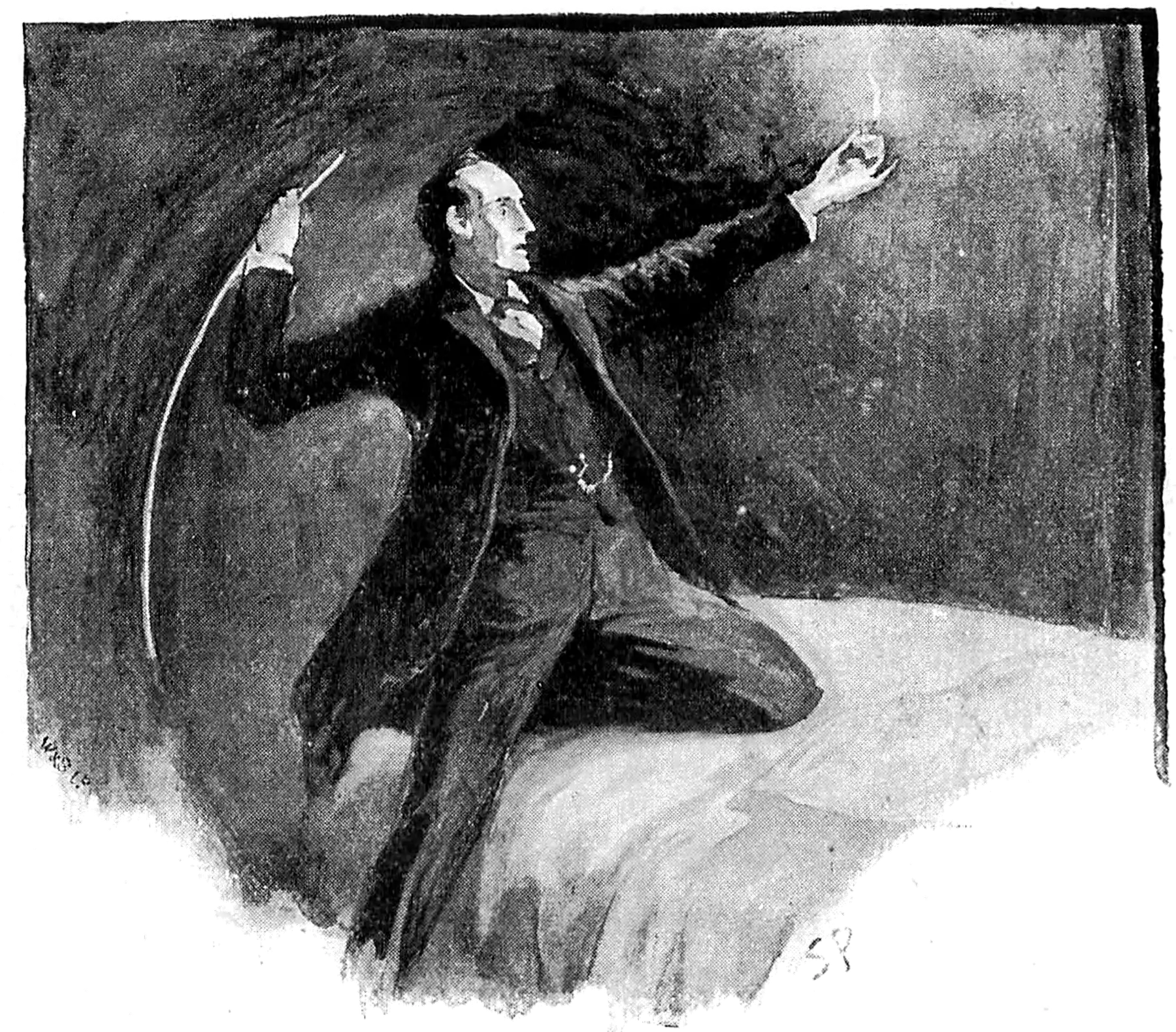
Holmes strikes at the bell-rope — Sidney Paget's illustration for “The Adventure of the Speckled Band” in the Strand of February 1892, signed SP.
Holmes lashed furiously (The Adventure of the Speckled Band) · Sidney Paget · public domain
Full credit
"Holmes lashed furiously (The Adventure of the Speckled Band)" by Sidney Paget, 1892 — https://commons.wikimedia.org/wiki/File:Strand1892-V3_0154_(cropped).png — Public domain (US: published in The Strand Magazine, February 1892 (published before 1931); Germany and France: Paget died 1908 (GND 114595541X), so 70 years after death have run out (UrhG §64; CPI L123-1, general rule, not checked against Légifrance); he was British and died before 1914, so the French 'mort pour la France' extension does not apply; the halftone block maker's mark (W&S Co.) is a firm, active by 1892 (presumed out of copyright))
The story came about a year after Zangwill's serial and fifteen years before Leroux's. Holmes was already in print before “The Speckled Band”; the Baker Street rooms of that earlier Holmes novel, still a later book than Le Fanu's tale, are traced in 221B Baker Street, the address in A Study in Scarlet (printed later).
Sources
- 1J. Sheridan Le Fanu, "Passage in the Secret History of an Irish Countess" (The Purcell Papers, vol. 2, London, 1880), transcribed at Wikisource https://en.wikisource.org/wiki/Passage_in_the_Secret_History_of_an_Irish_CountessRead: full text (transcription of the 1880 reprint)
- 2Alfred Perceval Graves, "Memoir of Joseph Sheridan Le Fanu," in J. Sheridan Le Fanu, The Purcell Papers, vol. 1 (1880), Project Gutenberg eBook https://www.gutenberg.org/ebooks/509Read: full memoir
- 3J. Sheridan Le Fanu, The Purcell Papers, vol. 2 (London, Richard Bentley and Son, 1880), Internet Archive record purcellpapers02lefa (University of Illinois Urbana-Champaign copy) https://archive.org/details/purcellpapers02lefaRead: bibliographic record and the text of the scanned volume
- 4Graham's Magazine, vol. 18, no. 4 (April 1841), Internet Archive record sim_grahams-illustrated-magazine_grahams-magazine_1841-04_18_4 https://archive.org/details/sim_grahams-illustrated-magazine_grahams-magazine_1841-04_18_4Read: bibliographic record and the text of "The Murders in the Rue Morgue" in this issue
- 5Edgar Allan Poe, The Works of Edgar Allan Poe, vol. 1 (The Raven Edition), Project Gutenberg eBook https://www.gutenberg.org/ebooks/2147Read: full text of "The Murders in the Rue Morgue"
- 6Edgar Allan Poe, The Works of Edgar Allan Poe, vol. 1 (The Raven Edition; New York, P. F. Collier & Son, 1903), Internet Archive record worksofedgarallanpoe01poeeiala (University of California Libraries copy) https://archive.org/details/worksofedgarallanpoe01poeeialaRead: bibliographic record and the text of the scanned volume (title page, pp. 191 and 224)
- 7Israel Zangwill, The Big Bow Mystery (Chicago and New York, Rand, McNally, 1895), Project Gutenberg eBook https://www.gutenberg.org/ebooks/28164Read: full text, with the September 1895 introduction and note
- 8Gaston Leroux, Le Mystère de la chambre jaune, Project Gutenberg eBook https://www.gutenberg.org/ebooks/13765Read: full text (paraphrased on this page, not quoted)
- 9"Leroux, Gaston," in John Clute, David Langford and Graham Sleight (eds), The Encyclopedia of Science Fiction, https://sf-encyclopedia.com/entry/leroux_gaston, accessed 2 November 2026 https://sf-encyclopedia.com/entry/leroux_gastonRead: full entry (updated 23 June 2025)
- 10Arthur Conan Doyle, "The Adventure of the Speckled Band," The Strand Magazine, vol. 3, no. 14 (February 1892), transcribed at Wikisource https://en.wikisource.org/wiki/The_Strand_Magazine/Volume_3/Issue_14/The_Adventure_of_the_Speckled_BandRead: full text and the issue page
- 11"Poe, Edgar Allan," in John Clute, David Langford and Graham Sleight (eds), The Encyclopedia of Science Fiction, https://sf-encyclopedia.com/entry/poe_edgar_allan, accessed 2 November 2026 https://sf-encyclopedia.com/entry/poe_edgar_allanRead: full entry (updated 10 August 2026)
- 12"Zangwill, Israel," in John Clute, David Langford and Graham Sleight (eds), The Encyclopedia of Science Fiction, https://sf-encyclopedia.com/entry/zangwill_israel, accessed 2 November 2026 https://sf-encyclopedia.com/entry/zangwill_israelRead: full entry (a short cross-reference entry)
- 13Gemeinsame Normdatei records for Arthur Conan Doyle (11852710X), Alfred Perceval Graves (1048161684) and Sidney Paget (114595541X), via lobid GND https://lobid.org/gnd/11852710XRead: authority records (life dates)
- 14Jennifer Jenkins and James Boyle, "Public Domain Day 2026," Center for the Study of the Public Domain, Duke Law School https://web.law.duke.edu/cspd/publicdomainday/2026/Read: full pageText licence: CC BY 4.0
- 15Urheberrechtsgesetz § 64 (Allgemeines), gesetze-im-internet.de https://www.gesetze-im-internet.de/urhg/__64.htmlRead: full text of the section
Cite this page
Genre Fiction Lineage. “Locked Room Mystery: A Sealed-Room Murder in Print by 1838.” Genre Fiction Lineage, published 3 November 2026. https://genrefictionlineage.com/detective-fiction/locked-room-mystery/. Accessed [the date you read it].
Next shelf over:
- The Moonstone: after the Le Fanu and Poe tales, two English serials told in documents, dated 1862 and 1868 (printed later).
- Émile Gaboriau: after Poe's Paris tale, a Paris detective of 1866 who began as somebody else's assistant (printed later).
- Read the text: The Murders in the Rue Morgue (1841), Raven Edition text of 1903, Project Gutenberg
Related entries
More from Detective Fiction.
Catalogue entry
The Moonstone: A Case-File Serial Began Five Years Earlier
The Notting Hill Mystery began in Once a Week on 29 November 1862, five years before The Moonstone. Both serials dated and compared, with a CSV.
Picture credit
Illustration: Genre Fiction Lineage. Generated scene illustration — not a book illustration, photograph or historical record. No copyright is claimed in the generated imagery; if you reuse it, please credit "Genre Fiction Lineage".
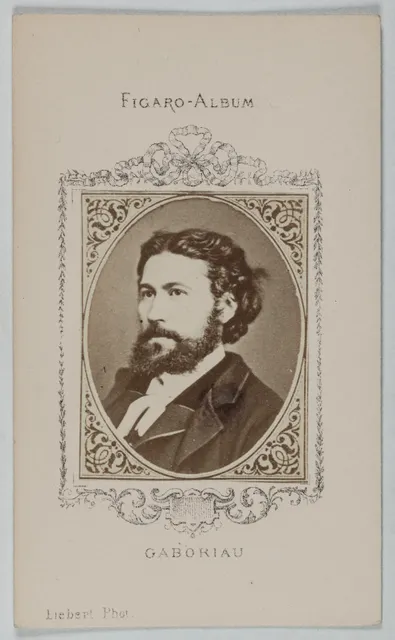
Catalogue entry
Émile Gaboriau: In L'Affaire Lerouge, Lecoq Only Assists
In Gaboriau's L'Affaire Lerouge (1866 in the 1911 Britannica), the amateur Père Tabaret solves the case and Lecoq assists. His two pasts compared.
Picture credit
"Portrait d'Émile Gaboriau (Figaro-Album)" by Alphonse Liébert, 1878 — https://commons.wikimedia.org/wiki/File:Portrait_d'Emile_Gaboriau_(1832-1873),_(romancier),_PH50811.jpg — CC0 1.0 (https://creativecommons.org/publicdomain/zero/1.0/)