Detective Fiction · Catalogue entry
The Moonstone: A Case-File Serial Began Five Years Earlier
Genre Fiction Lineage Published
The Notting Hill Mystery began in the magazine Once a Week on 29 November 1862, five years before The Moonstone. Both tell a crime through documents: an investigator's case papers in the earlier serial, and the written accounts of several witnesses in Wilkie Collins's novel, which began in All the Year Round on 4 January 1868.
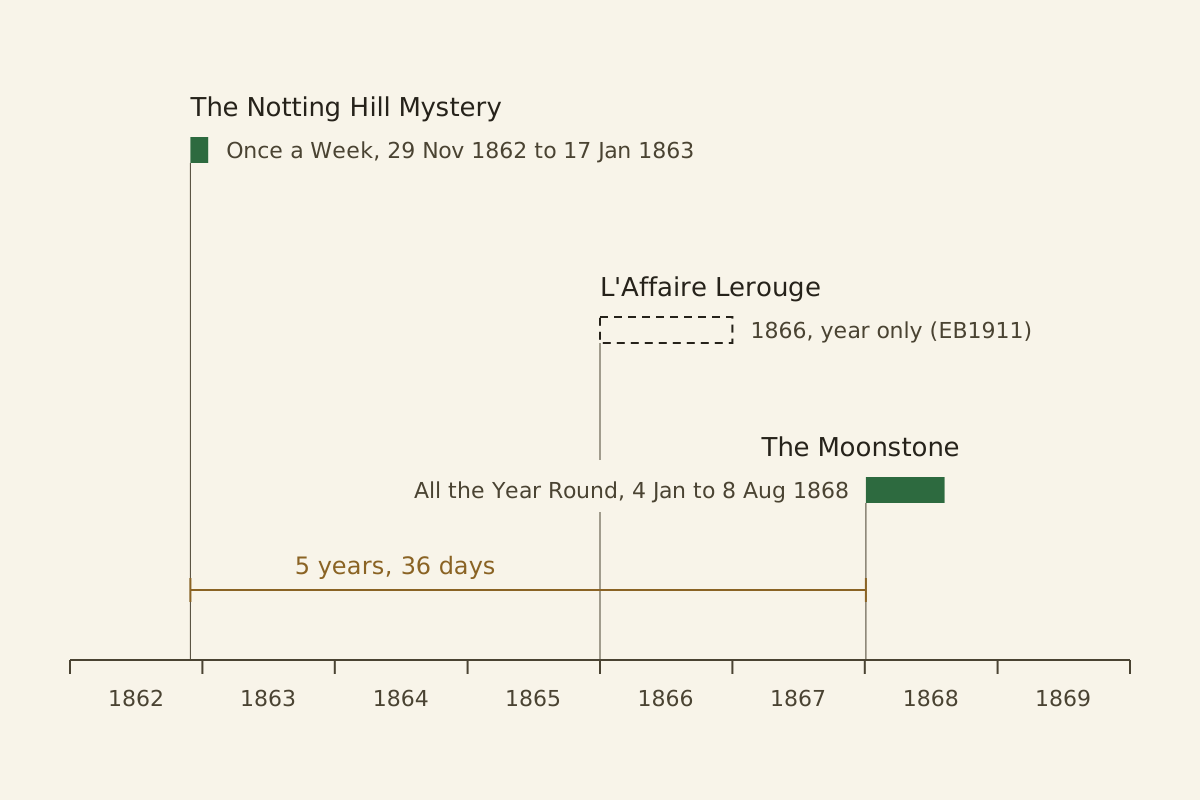
Three dated texts — the two English serials placed by the dates printed in their issues, and Gaboriau's French novel by the year EB1911 gives.
Three dated texts, November 1862 to August 1868 · Genre Fiction Lineage · CC BY 4.0
Reuse credit (CC BY)
"Three dated texts, November 1862 to August 1868" by Genre Fiction Lineage, https://genrefictionlineage.com/detective-fiction/moonstone/, licensed under CC BY 4.0 (https://creativecommons.org/licenses/by/4.0/)
Dates, bylines and documents checked against the public-domain texts and records listed on the entry page
The first paper in the 1862 serial is a letter from R. Henderson, of a “Private Enquiry Office” in Clement's Inn. He writes to a life assurance office about a claim. Inside the story, the letter is dated 17 January 1858. Whether The Moonstone counts as the first English detective novel depends on three words: detective, novel and English. This entry dates both serials and tests each word; the dates, venues and bylines are in a CSV of the three dated texts CSV · provenance note Dates, bylines and documents checked against the public-domain texts and records listed on the entry page.
Was The Moonstone the first English detective novel?
Take the claim one word at a time, starting with the date. The Moonstone's first instalment appeared 5 years and 36 days after the first part of The Notting Hill Mystery, or 62 months counted by calendar month. The earlier serial ran in eight weekly parts and ended on 17 January 1863. Collins's ran until the issue of 8 August 1868.
Length is another matter. The two are not the same kind of book. The Project Gutenberg text of The Notting Hill Mystery runs to about 50,000 words, against about 198,000 for The Moonstone, by this page's count of the two eBooks. Collins's novel also came out in 1868 as a book in three volumes from Tinsley Brothers, London, with a preface dated 30 June.
On the word detective, both qualify on their own terms. The Notting Hill Mystery includes a statement by “a sergeant on the detective staff of the Metropolitan Police,” and in the 1868 book Collins's Sergeant Cuff introduces himself as “of the Detective Police.” The 1911 Encyclopaedia Britannica calls The Moonstone “a capital detective story.”
Henderson also works like a detective. In Section V he fixes the night of the first attack on the baron's wife by elimination, striking out dates one by one from the witnesses' statements until “the only day” left is 5 April 1856.
The word English narrows the field. The same encyclopedia calls Émile Gaboriau's L'Affaire Lerouge of 1866 “a detective novel,” published in the paper Le Pays, two years before The Moonstone.
This site calls the earliest known print record inside a stated range the patient-zero text. Here the range is novel-length crime stories told through a case file in English magazine serials, limited to the texts read for this page. Inside it, the patient-zero text is The Notting Hill Mystery. Shorter detective tales were in print decades earlier, and other English serials of the 1850s and 1860s were not searched, so a wider search could move the record.
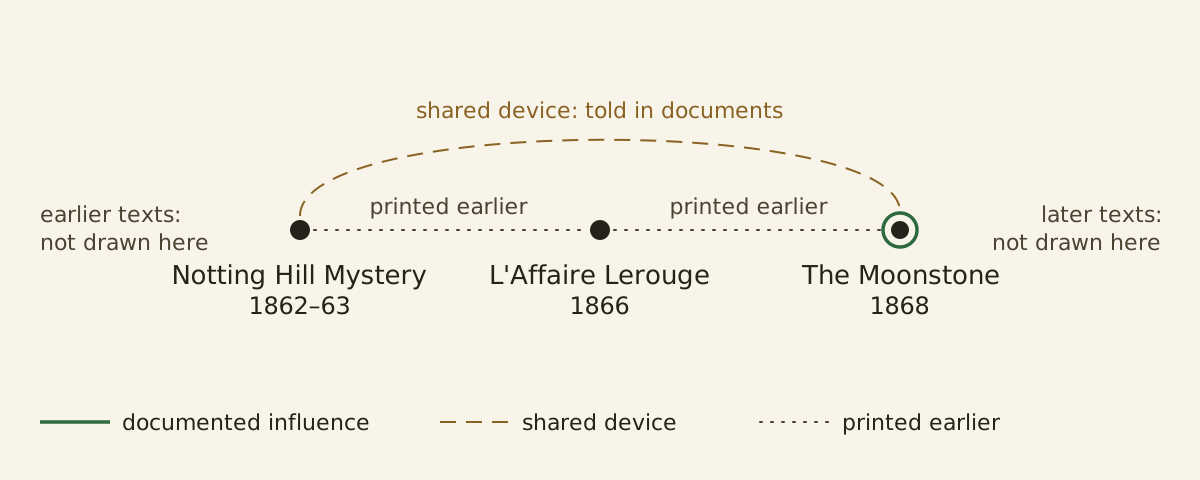
- Solid: documented influence (the later author's own statement, letter, review or note)
- Dashed: shared device (similar texts, no borrowing claimed)
- Dotted: dates only (publication order or other dates; no link claimed)
Lineage strip — three texts in print order; the dotted lines rest on dates alone, and the dashed arc on the case told in documents that the two English serials share.
Lineage strip: The Notting Hill Mystery to The Moonstone, 1862 to 1868 · Genre Fiction Lineage · CC BY 4.0
Reuse credit (CC BY)
"Lineage strip: The Notting Hill Mystery to The Moonstone, 1862 to 1868" by Genre Fiction Lineage, https://genrefictionlineage.com/detective-fiction/moonstone/, licensed under CC BY 4.0 (https://creativecommons.org/licenses/by/4.0/)
Dates, bylines and documents checked against the public-domain texts and records listed on the entry page
Nothing read for this page shows that Collins knew either earlier book, so the strip links them by date and by shared form, not by influence. Later texts are left off the strip. The Dracula map (shared device) covers another novel assembled from the papers of several narrators, printed 29 years after The Moonstone.
What was The Notting Hill Mystery?
The serial began in Once a Week, volume 7, number 179, and its eight parts appeared on consecutive Saturdays. An unsigned note at its head warned that the case would “extend to some seven or eight numbers” and needed “a very close attention to names and dates.” The same note said the pictures were “simply added to make the reader's task more agreeable.” The Project Gutenberg catalogue names George du Maurier as their illustrator, and his monogram, DM, is cut into one of the other pictures in the same eBook.
The case starts with a death in March 1857. A baron, named in the text only by an initial, had insured his wife's life with five offices for 25,000 pounds in all, and she died from acid “taken, it is supposed, in her sleep” from his laboratory. Henderson's inquiry for the insurers leads him to an earlier death at Notting Hill, of a woman he comes to identify as her sister.
The note also hedged: “If the compiler has really discovered a new species or description of crime, it is natural that the evidence of it, which is circumstantial, should be somewhat difficult of acceptance.” That crime runs through mesmerism, which Henderson calls “Mesmeric Agency” and claims not to believe in. He never settles the case. His last paper hands it to the insurers: “your judgment of its result will be as good as mine.”
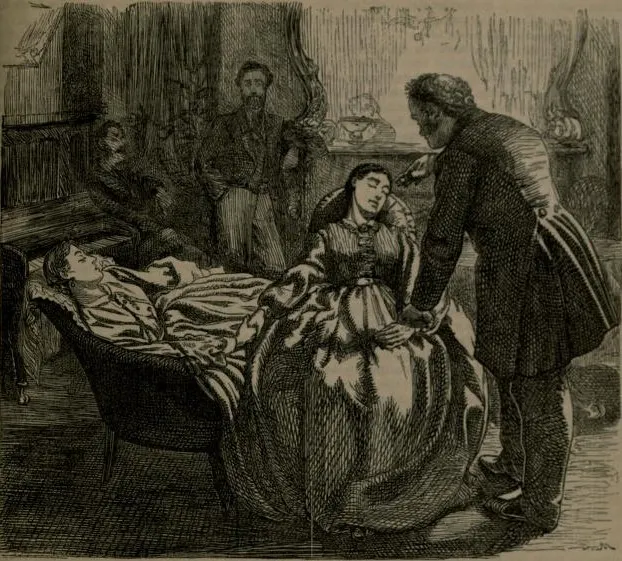
A séance at Notting Hill — George du Maurier's illustration for the second weekly part, 6 December 1862, printed with a witness's account of the baron putting his medium to sleep beside Mrs. Anderton's sofa.
The séance at Notting Hill (The Notting Hill Mystery, Section II) · George du Maurier · public domain
Full credit
"The séance at Notting Hill (The Notting Hill Mystery, Section II)" by George du Maurier, 1862 — https://www.gutenberg.org/ebooks/46153 — Public domain (US: published in Once a Week, December 1862 (published before 1931); Germany and France: du Maurier died 1896 (GND 118672673), so 70 years after death have run out (UrhG §64; CPI L123-1, general rule, not checked against Légifrance); he died before 1914, so the French 'mort pour la France' extension does not apply; the wood engraver's mark at lower right cannot be read and is presumed out of copyright from working years (the block was cut by 1862))
How are the two serials built?
Henderson explains his method in the opening letter. He has arranged the depositions “in the form in which they would be laid before counsel,” sending the originals with his summary. By this page's count of the Project Gutenberg text, the serial is made of 53 papers, from 24 witness statements and 14 letters to a closing summary.
The Moonstone has 13 parts. They run from a family paper in the Prologue, through Betteredge's long account and eight narratives in the Second Period, to three statements in the Epilogue.
Collins announces his plan through his first narrator, the house-steward Gabriel Betteredge. In the instalment of 4 January 1868, Franklin Blake tells him that “the lawyer's idea is that we should all write the story of the Moonstone in turn—as far as our own personal experience extends, and no farther.” The 1868 book reads “the idea is that,” and names the lawyer as Mr. Bruff a few lines earlier, where the serial says only “the lawyer.”
Papers in turn — an illustration of a bundle of case papers and weekly parts with a diamond, not a book illustration or a historical record.
Illustration: Genre Fiction Lineage. Generated scene illustration — not a book illustration, photograph or historical record. No copyright is claimed in the generated imagery; if you reuse it, please credit "Genre Fiction Lineage".
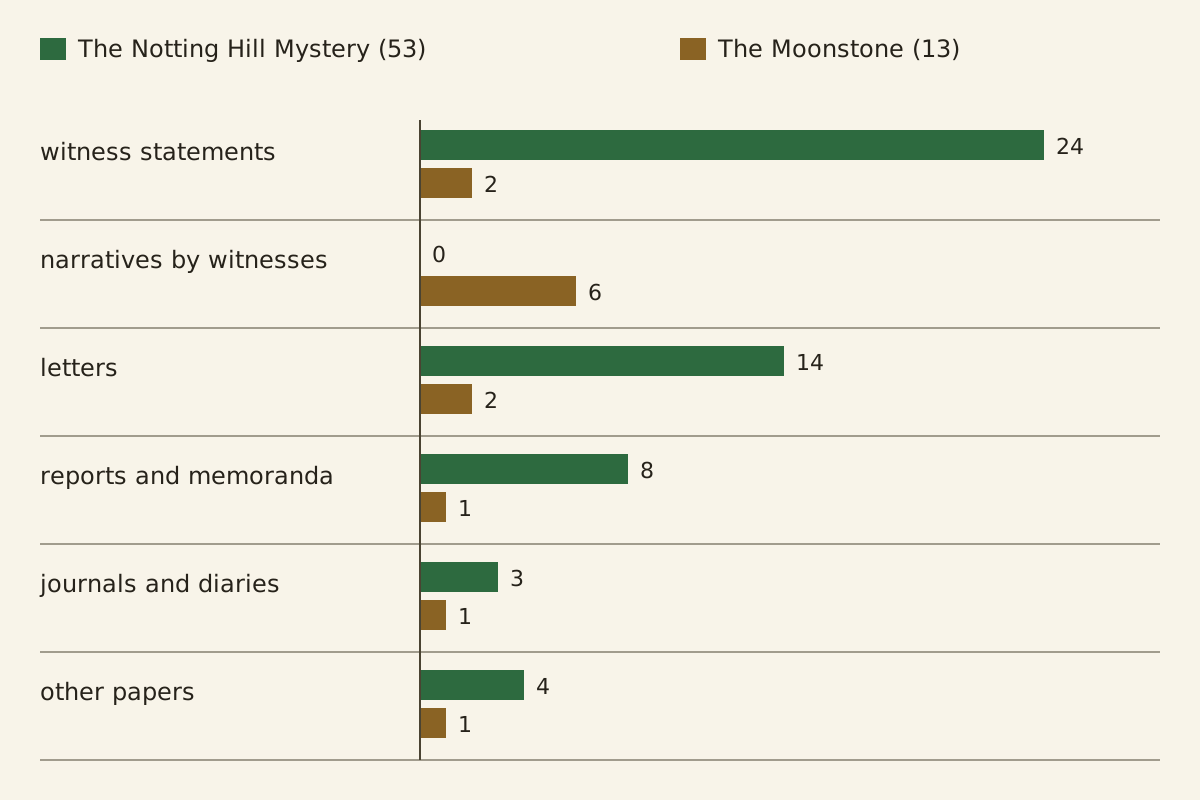
The papers each story is made of — the headed papers and parts of the two Project Gutenberg texts, counted by kind.
The papers each story is made of · Genre Fiction Lineage · CC BY 4.0
Reuse credit (CC BY)
"The papers each story is made of" by Genre Fiction Lineage, https://genrefictionlineage.com/detective-fiction/moonstone/, licensed under CC BY 4.0 (https://creativecommons.org/licenses/by/4.0/)
Dates, bylines and documents checked against the public-domain texts and records listed on the entry page
| Kind of paper | The Notting Hill Mystery | The Moonstone |
|---|---|---|
| witness statements | 24 | 2 |
| narratives by witnesses | 0 | 6 |
| letters | 14 | 2 |
| reports and memoranda | 8 | 1 |
| journals and diaries | 3 | 1 |
| other papers | 4 | 1 |
| total | 53 | 13 |
The 1911 encyclopedia saw a cost and a gain in Collins's method. Telling a story through several characters could be “irritatingly disconnected,” it said, but it gave “an air of actual evidence and reality to the elucidation of a mystery.” Henderson's papers are shorter and more numerous, the record of one investigator rather than a family's account in turns.
The endings differ too. Henderson leaves his verdict open. Collins closes his case on paper, with a report from Sergeant Cuff dated 30 July 1849 and an Epilogue that follows the diamond back to a shrine in India. The headed papers of the earlier serial and the 13 parts of The Moonstone are listed in a CSV of the papers and parts CSV · provenance note Dates, bylines and documents checked against the public-domain texts and records listed on the entry page; letters copied out inside a part are not listed separately.
Who wrote The Notting Hill Mystery?
No author's name appears in the scanned Once a Week pages read for this page. The name Charles Felix comes from the Project Gutenberg catalogue, which lists the author as “Felix, Charles, 1833-1903” and George du Maurier as the illustrator. Who used the name is a matter of later attribution, and no readable source for it was found, so this entry stops at the catalogue record.
The Moonstone also began without its author's name. The first instalment is headed “By the Author of ‘The Woman in White,’ &c. &c.,” and the name Wilkie Collins appears on the title page of the 1868 book.
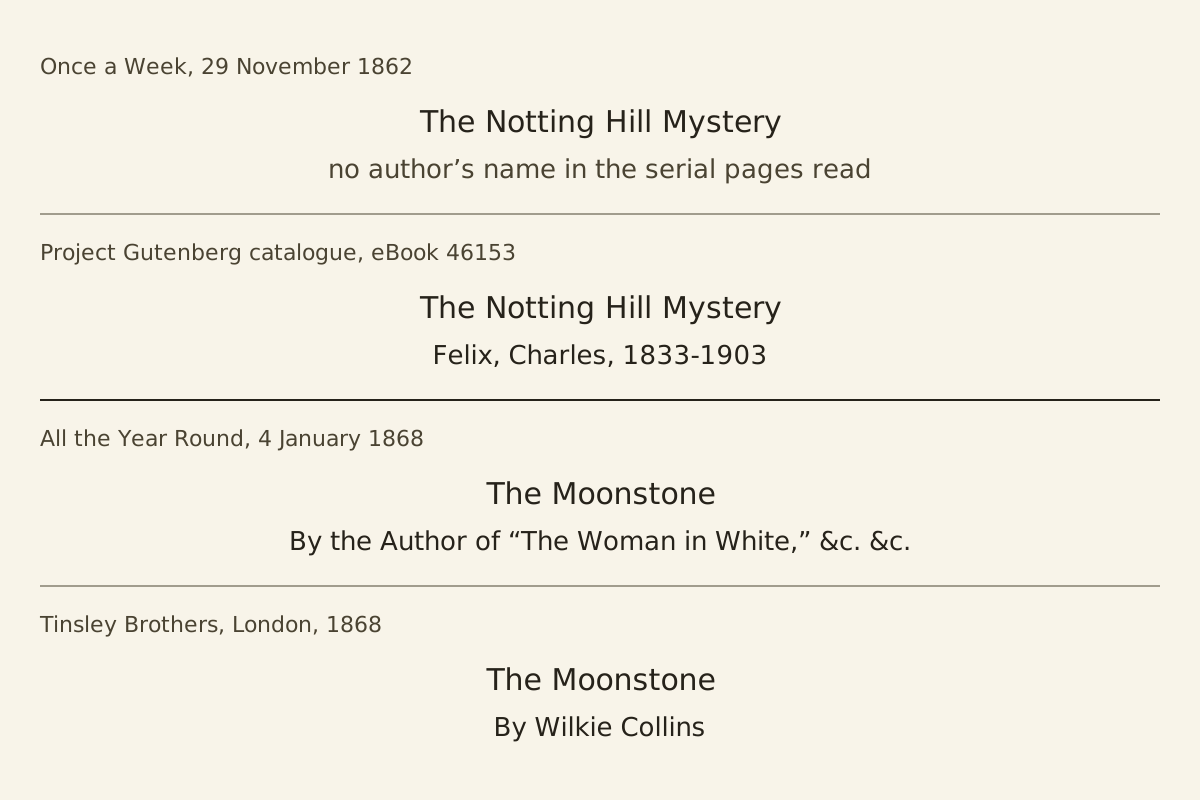
Four bylines — what the two serials printed, what the 1868 book printed, and what a modern catalogue records for the earlier serial.
Four bylines for two stories · Genre Fiction Lineage · CC BY 4.0
Reuse credit (CC BY)
"Four bylines for two stories" by Genre Fiction Lineage, https://genrefictionlineage.com/detective-fiction/moonstone/, licensed under CC BY 4.0 (https://creativecommons.org/licenses/by/4.0/)
Dates, bylines and documents checked against the public-domain texts and records listed on the entry page
The data file keeps the byline at first printing and the later attribution in separate columns, so a catalogue name is never read as a printed one.
Sources
- 1All the Year Round, vol. 19, no. 454 (4 January 1868), Internet Archive record sim_all-the-year-round_1868-01-04_19_454 https://archive.org/details/sim_all-the-year-round_1868-01-04_19_454Read: text of the first instalment of The Moonstone in this issue (scanned issue)
- 2All the Year Round, vol. 20, no. 485 (8 August 1868), Internet Archive record sim_all-the-year-round_1868-08-08_20_485 https://archive.org/details/sim_all-the-year-round_1868-08-08_20_485Read: text of the last instalment of The Moonstone in this issue (scanned issue)
- 3Once a Week, vol. 7, no. 179 (29 November 1862) to vol. 8 (17 January 1863), pages of The Notting Hill Mystery, Internet Archive item 1862thenottinghillmysterybycharlesfelixonceaweekpts1862novdec63jan https://archive.org/details/1862thenottinghillmysterybycharlesfelixonceaweekpts1862novdec63janRead: text of all eight parts (scanned serial pages)
- 4Charles Felix (as catalogued), The Notting Hill Mystery, illustrated by George du Maurier, Project Gutenberg eBook https://www.gutenberg.org/ebooks/46153Read: full text, with the illustrated HTML file
- 5Wilkie Collins, The Moonstone, Project Gutenberg eBook https://www.gutenberg.org/ebooks/155Read: full text
- 6Wilkie Collins, The Moonstone: A Romance, vol. 1 (London, Tinsley Brothers, 1868), Internet Archive record moonstoneromance01coll (University of Illinois Urbana-Champaign copy) https://archive.org/details/moonstoneromance01collRead: text of volume 1 (scanned copy), with the title page and preface
- 7"Collins, William Wilkie," Encyclopaedia Britannica, 11th edition (1911), transcribed at Wikisource, https://en.wikisource.org/wiki/1911_Encyclop%C3%A6dia_Britannica/Collins,_William_Wilkie https://en.wikisource.org/wiki/1911_Encyclop%C3%A6dia_Britannica/Collins,_William_WilkieRead: full entry
- 8"Gaboriau, Émile," Encyclopaedia Britannica, 11th edition (1911), transcribed at Wikisource, https://en.wikisource.org/wiki/1911_Encyclop%C3%A6dia_Britannica/Gaboriau,_%C3%89mile https://en.wikisource.org/wiki/1911_Encyclop%C3%A6dia_Britannica/Gaboriau,_%C3%89mileRead: full entry
- 9Bram Stoker, Dracula, Project Gutenberg eBook #345, https://www.gutenberg.org/ebooks/345 (base text: a Grosset & Dunlap reprint, New York, with no printing year; title page: Copyright, 1897) https://www.gutenberg.org/ebooks/345Read: full text, all 27 chapters
- 10"Stoker, Bram" (entry signed JE/DRL), in John Clute, David Langford and Graham Sleight (eds), The Encyclopedia of Science Fiction, https://sf-encyclopedia.com/entry/stoker_bram, accessed 2 November 2026 https://sf-encyclopedia.com/entry/stoker_bramRead: full entry (updated 29 September 2025)
- 11Gemeinsame Normdatei (GND) records for Wilkie Collins (118638432) and George du Maurier (118672673), via lobid-gnd https://d-nb.info/gnd/118638432Read: the two records
- 12Jennifer Jenkins and James Boyle, "Public Domain Day 2026," Center for the Study of the Public Domain, Duke Law School https://web.law.duke.edu/cspd/publicdomainday/2026/Read: full pageText licence: CC BY 4.0
- 13Urheberrechtsgesetz § 64 (Allgemeines), gesetze-im-internet.de https://www.gesetze-im-internet.de/urhg/__64.htmlRead: full text of the section
Cite this page
Genre Fiction Lineage. “The Moonstone: A Case-File Serial Began Five Years Earlier.” Genre Fiction Lineage, published 3 November 2026. https://genrefictionlineage.com/detective-fiction/moonstone/. Accessed [the date you read it].
Next shelf over:
- Locked Room Mystery: a sealed-room murder in print by 1838, 24 years before the earlier serial (printed earlier).
- Émile Gaboriau: a French novel that EB1911 calls a detective novel and dates 1866, two years before The Moonstone (printed earlier).
- Read the text: The Moonstone (1868), Project Gutenberg
Related entries
More from Detective Fiction.
Lineage essay
Locked Room Mystery: A Sealed-Room Murder in Print by 1838
A sealed-room murder was in print by 1838 in a Le Fanu tale, before Poe's 1841 Rue Morgue. Five rooms dated to 1907, who named whom, and a CSV.
Picture credit
Illustration: Genre Fiction Lineage. Generated scene illustration — not a book illustration, photograph or historical record. No copyright is claimed in the generated imagery; if you reuse it, please credit "Genre Fiction Lineage".
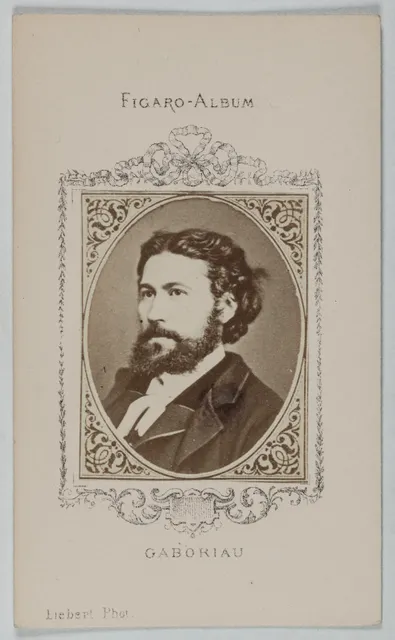
Catalogue entry
Émile Gaboriau: In L'Affaire Lerouge, Lecoq Only Assists
In Gaboriau's L'Affaire Lerouge (1866 in the 1911 Britannica), the amateur Père Tabaret solves the case and Lecoq assists. His two pasts compared.
Picture credit
"Portrait d'Émile Gaboriau (Figaro-Album)" by Alphonse Liébert, 1878 — https://commons.wikimedia.org/wiki/File:Portrait_d'Emile_Gaboriau_(1832-1873),_(romancier),_PH50811.jpg — CC0 1.0 (https://creativecommons.org/publicdomain/zero/1.0/)