Scene Maps · Scene map
Dracula Map: Counted Here, Most Chapters Stay in England
Genre Fiction Lineage Published
By this page's count, 19 of the 27 chapters of Dracula (1897) are set mainly in England. The count records where each journal entry, letter and press cutting was written, in the Project Gutenberg transcription of an undated Grosset & Dunlap reprint that was not compared word by word with the 1897 London first edition.
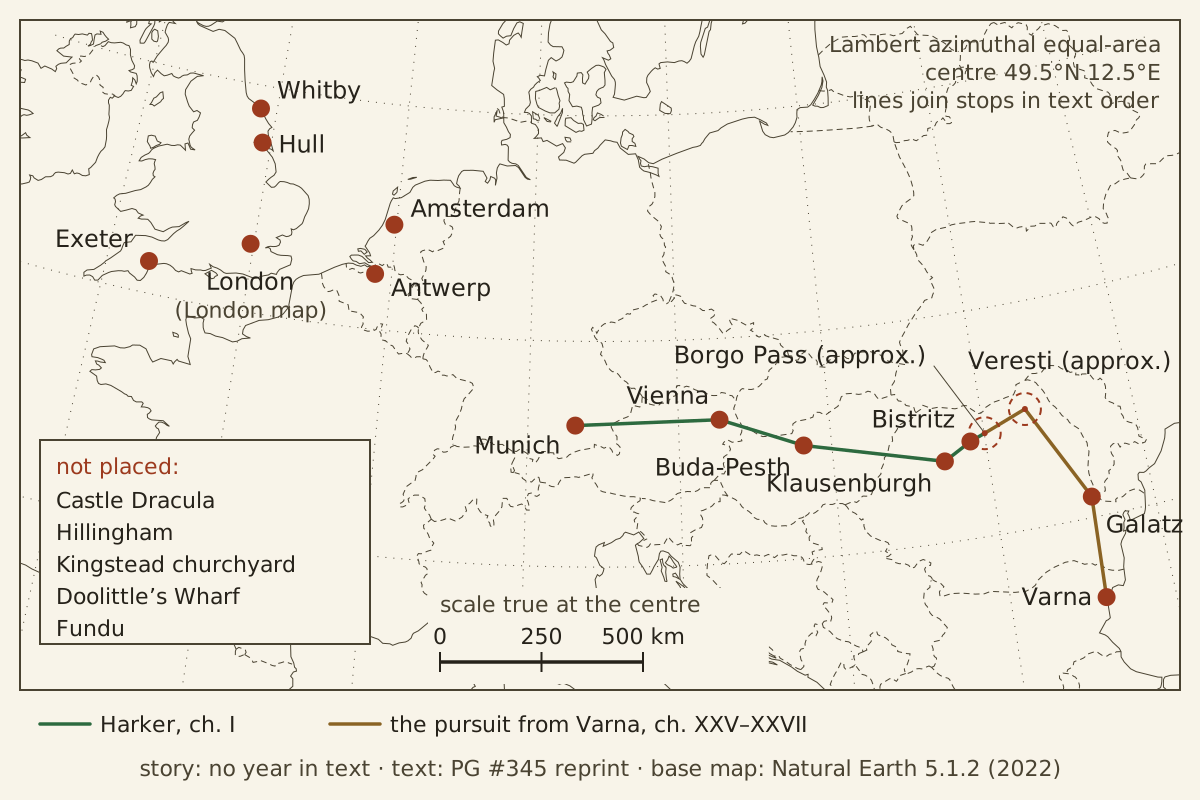
Places in the text — towns drawn to scale on a Natural Earth base map; straight lines join each journey's stops in text order, not the roads or railways taken, Carfax and the other London places are on the London map, and the Demeter's voyage is not drawn.
Dracula: places named in the text · Genre Fiction Lineage · CC BY 4.0
Reuse credit (CC BY)
"Dracula: places named in the text" by Genre Fiction Lineage, https://genrefictionlineage.com/scene-maps/dracula-map/, licensed under CC BY 4.0 (https://creativecommons.org/licenses/by/4.0/)
Places, chapters and quotations from Bram Stoker, Dracula, Project Gutenberg eBook #345 (Grosset & Dunlap reprint), and the other sources listed on the entry page; Base map: Natural Earth (public domain), vector data version 5.1.2, retrieved 2026-11-02; Place coordinates: Natural Earth and Wikidata (CC0), retrieved 2026-11-02
Seven chapters are set on the Continent, and chapter V names no town at all. Castle Dracula is not on the map, because the novel never fixes where it stands. The counts come from a CSV of all 211 dated entries and where each was written CSV · provenance note Places, chapters and quotations from Bram Stoker, Dracula, Project Gutenberg eBook #345 (Grosset & Dunlap reprint), and the other sources listed on the entry page, and the places from a CSV of the places on the map, each with its sentence and coordinates CSV · provenance note Places, chapters and quotations from Bram Stoker, Dracula, Project Gutenberg eBook #345 (Grosset & Dunlap reprint), and the other sources listed on the entry page; Base map: Natural Earth (public domain), vector data version 5.1.2, retrieved 2026-11-02; Place coordinates: Natural Earth and Wikidata (CC0), retrieved 2026-11-02.
| Date kept apart | What this map uses |
|---|---|
| Story date | No year: the entries carry days and months, from 3 May to 6 November |
| Text followed | A Grosset & Dunlap reprint, New York, with no printing year (Project Gutenberg eBook #345) |
| Base map | Natural Earth vector data, version 5.1.2 (2022), public domain; place coordinates from Natural Earth or Wikidata |
Where does Dracula take place, chapter by chapter?
The novel is a stack of documents, so the count starts with them. Each dated diary entry, letter, telegram, memorandum and press cutting is placed where its writer is when writing, as its heading states or its text shows. An entry that names no new place keeps its writer's last one. A chapter's setting is the place of most of its placed entries.
The text holds 211 such entries. By that rule, 136 were written in England, 64 on the Continent, and 11 give no place. The first four chapters are Jonathan Harker's journal on the road to the castle and inside it, and chapters XXV to XXVII follow the pursuit from Varna back into the mountains. Chapters VI to XXIV, nineteen in a row, are English.
Harker's journal on the Continent runs from 3 May to 30 June, 58 days. No chapter is set on the Continent again until chapter XXV.
Most chapters mix documents, which is why the count runs entry by entry. Chapter VIII carries a letter from a hospital in Buda-Pesth among Mina's Whitby pages, and chapter XXV opens in England on 11 October before its entries move to Varna. Chapter V, made of letters, a telegram and Dr. Seward's diary, names a street but no town, so it stays unplaced. Counted by words instead of entries, the same 19 chapters come out English, and the CSV of chapter settings CSV · provenance note Places, chapters and quotations from Bram Stoker, Dracula, Project Gutenberg eBook #345 (Grosset & Dunlap reprint), and the other sources listed on the entry page carries both counts.
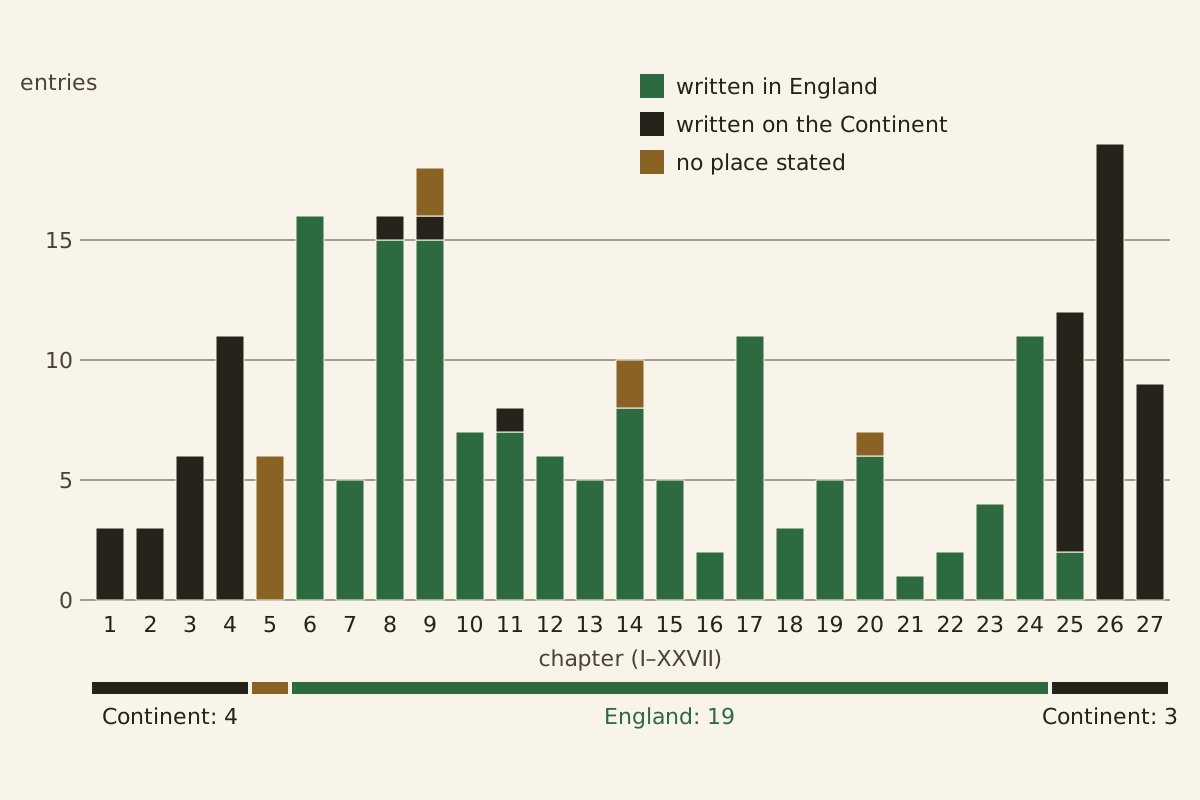
Entries by chapter — the 211 dated entries, letters and cuttings in each chapter, coloured by where each was written.
Dracula: entries by chapter and place written · Genre Fiction Lineage · CC BY 4.0
Reuse credit (CC BY)
"Dracula: entries by chapter and place written" by Genre Fiction Lineage, https://genrefictionlineage.com/scene-maps/dracula-map/, licensed under CC BY 4.0 (https://creativecommons.org/licenses/by/4.0/)
Places, chapters and quotations from Bram Stoker, Dracula, Project Gutenberg eBook #345 (Grosset & Dunlap reprint), and the other sources listed on the entry page
| Chapter | Entries | England | Continent | No place stated | Setting |
|---|---|---|---|---|---|
| I | 3 | 0 | 3 | 0 | Continent |
| II | 3 | 0 | 3 | 0 | Continent |
| III | 6 | 0 | 6 | 0 | Continent |
| IV | 11 | 0 | 11 | 0 | Continent |
| V | 6 | 0 | 0 | 6 | no town named |
| VI | 16 | 16 | 0 | 0 | England |
| VII | 5 | 5 | 0 | 0 | England |
| VIII | 16 | 15 | 1 | 0 | England |
| IX | 18 | 15 | 1 | 2 | England |
| X | 7 | 7 | 0 | 0 | England |
| XI | 8 | 7 | 1 | 0 | England |
| XII | 6 | 6 | 0 | 0 | England |
| XIII | 5 | 5 | 0 | 0 | England |
| XIV | 10 | 8 | 0 | 2 | England |
| XV | 5 | 5 | 0 | 0 | England |
| XVI | 2 | 2 | 0 | 0 | England |
| XVII | 11 | 11 | 0 | 0 | England |
| XVIII | 3 | 3 | 0 | 0 | England |
| XIX | 5 | 5 | 0 | 0 | England |
| XX | 7 | 6 | 0 | 1 | England |
| XXI | 1 | 1 | 0 | 0 | England |
| XXII | 2 | 2 | 0 | 0 | England |
| XXIII | 4 | 4 | 0 | 0 | England |
| XXIV | 11 | 11 | 0 | 0 | England |
| XXV | 12 | 2 | 10 | 0 | Continent |
| XXVI | 19 | 0 | 19 | 0 | Continent |
| XXVII | 9 | 0 | 9 | 0 | Continent |
When does Whitby first appear in Dracula?
Whitby enters the novel as a ring on a map. In chapter II, Harker finds the Count's atlas lying open at England, with little rings marked: “one was near London on the east side, manifestly where his new estate was situated; the other two were Exeter, and Whitby on the Yorkshire coast.” All three places later become settings. Exeter, the second ring named, is where Mina writes from in chapters XII to XIV, after she and Jonathan come home.
Mina Murray's journal reaches the town in chapter VI, under the heading “24 July. Whitby.” Twenty-five entries are written there, all in chapters VI to IX: twenty by Mina, three in the Dailygraph cutting, one from a Whitby solicitor and one letter from Lucy. The map keeps the East Cliff churchyard and Tate Hill Pier inside the single Whitby point, since at this scale they could not be drawn apart from the town. Mina's own exit goes through Hull, another English point on the map: her letter in chapter IX says she “got to Hull all right, and caught the boat to Hamburg” on the way to Buda-Pesth.
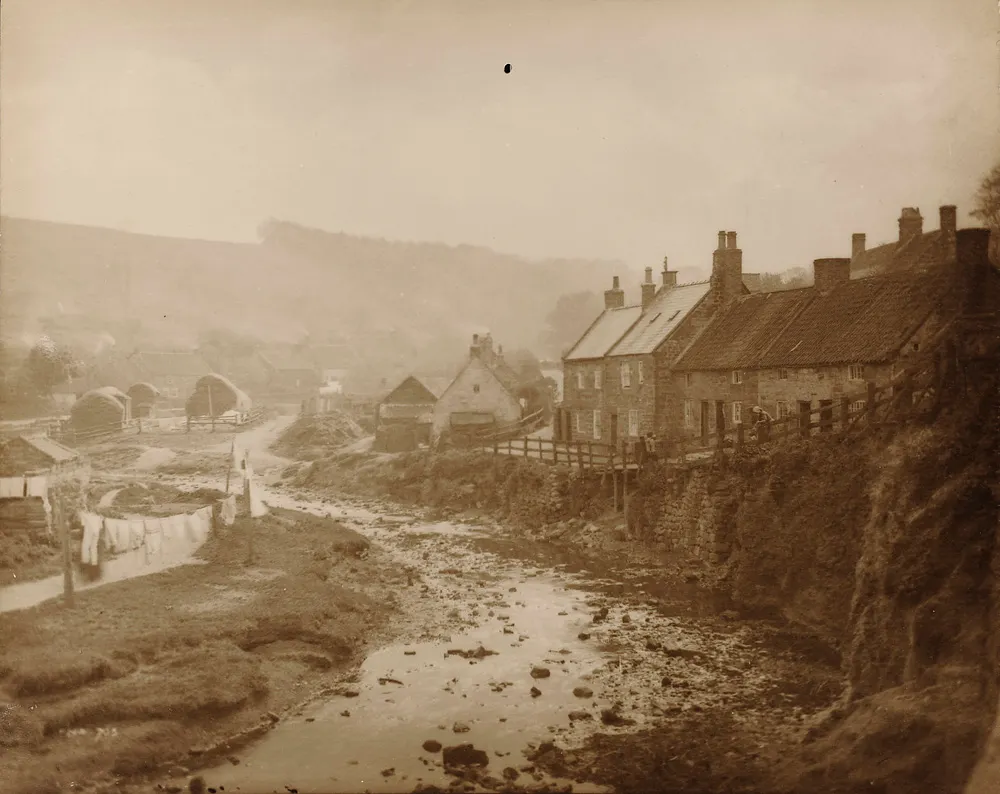
Houses by a beck — Frank Meadow Sutcliffe's photograph, catalogued by the Preus Museum as Whitby II and titled Sandsend Beck when it was shared, is filed under the town the novel names but shows no scene from it.
Houses by a beck (Whitby II) · Frank Meadow Sutcliffe · public domain
Full credit
"Houses by a beck (Whitby II)" by Frank Meadow Sutcliffe, undated — https://commons.wikimedia.org/wiki/File:Sutcliffe,_Frank_Meadow_(5226243318).jpg — Public domain (US: Sutcliffe (1853-1941) worked as a commercial photographer; the print is presumed published in his working life, before 1931 (presumption, not checked); Germany: 70 years after his death in 1941, expired 2011 (UrhG §64); France: 70 years after death, CPI L123-1 general rule, not checked against Légifrance; he was English, so the died-for-France extension does not apply (not checked))
How did the Count get from Varna to Whitby?
By sea, in a log quoted inside a newspaper report. The Dailygraph cutting in chapter VII prints the log of the Russian schooner Demeter, headed “Varna to Whitby.” Its first note records that on 6 July the crew “finished taking in cargo, silver sand and boxes of earth,” and the ship passed the Dardanelles on 12 July. The last entry is dated 4 August, and the cutting places the wreck on the sand by Tate Hill Pier, below the East Cliff.
The cargo then turns inland. A Whitby solicitor's letter of 17 August, in chapter VIII, sends the boxes by the Great Northern Railway to be delivered at Carfax. Mina's journal stays above the harbour, and in chapter VIII “the shadow of a cloud obscured St. Mary’s Church” as she searched the cliff for Lucy at night.
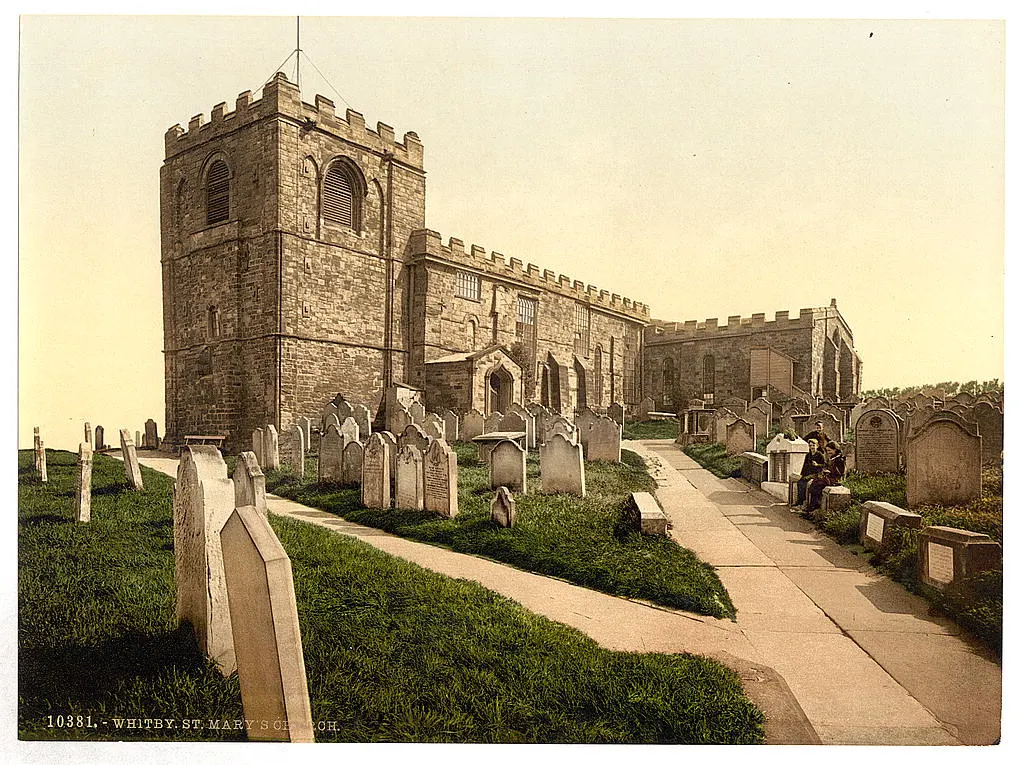
St Mary's Church, Whitby — a photochrom print of about 1890 to 1900, showing the church and churchyard that Mina's journal names in chapter VIII.
Whitby, St. Mary's Church, Yorkshire, England · Detroit Publishing Company · public domain
Full credit
"Whitby, St. Mary's Church, Yorkshire, England" by Detroit Publishing Company, c. 1890–1900 — https://commons.wikimedia.org/wiki/File:(Whitby,_St._Mary%27s_Church,_Yorkshire,_England)_(LOC)_(16615232768).jpg — Public domain (US: published by 1905 (print no. 10381 in the Detroit Publishing Company catalogue J, 1905); Germany and France: anonymous work, protected 70 years from publication, so expired by the end of 1975 (UrhG §66; CPI L123-3; general rule, not checked against Légifrance))
Where are the Count's London houses?
The ring “near London on the east side” is Carfax. Harker describes the estate to the Count in chapter II: “At Purfleet, on a by-road, I came across just such a place as seemed to be required.” His notes add that one of the few houses near it has been “formed into a private lunatic asylum.” In chapter VIII, Dr. Seward chases an escaped patient over “the high wall which separates our grounds from those of the deserted house” and into the grounds of Carfax, so the asylum where his diary is kept stands next door.
Chapter XX adds three more addresses. A carrier, Joseph Smollet, tells Harker he took six boxes from Carfax to “197, Chicksand Street, Mile End New Town” and six more to “Jamaica Lane, Bermondsey.” A solicitors' letter in the same chapter reports the sale of “No. 347, Piccadilly” to a foreign nobleman, Count de Ville.
Every London point on this map is marked approximate. The text names districts and streets, not positions, so each point stands at the Wikidata coordinate for the town, district, street or zoo the text names, and the house numbers were not checked against any street directory. The hunters' own stops in chapter XXII, Fenchurch Street and Piccadilly, are marked approximate for the same reason. Lucy's house at Hillingham, the churchyard at Kingstead and Doolittle's Wharf have no position in the text, so they are listed as not placed.
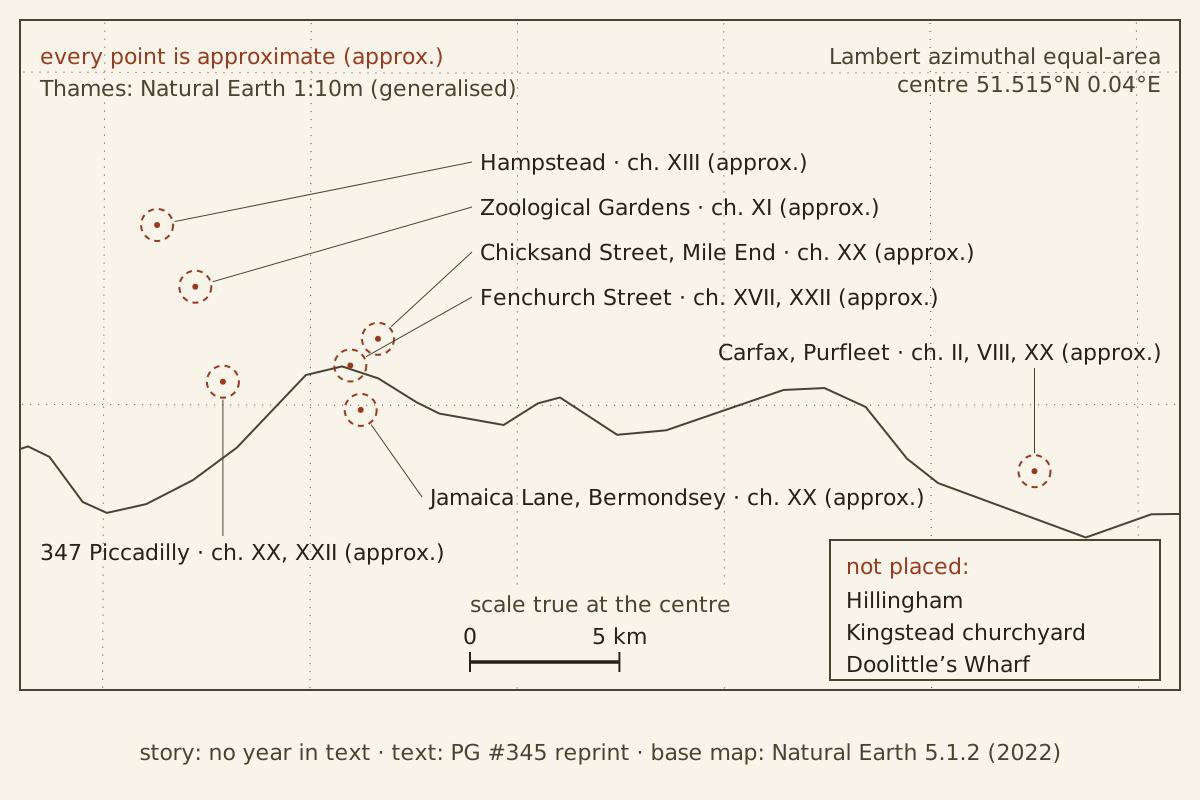
London places — the Count's houses and the other London settings on a Natural Earth base map with a scale bar, each marked approximate, with chapter numbers and three places the text never locates.
Dracula: London places · Genre Fiction Lineage · CC BY 4.0
Reuse credit (CC BY)
"Dracula: London places" by Genre Fiction Lineage, https://genrefictionlineage.com/scene-maps/dracula-map/, licensed under CC BY 4.0 (https://creativecommons.org/licenses/by/4.0/)
Places, chapters and quotations from Bram Stoker, Dracula, Project Gutenberg eBook #345 (Grosset & Dunlap reprint), and the other sources listed on the entry page; Base map: Natural Earth (public domain), vector data version 5.1.2, retrieved 2026-11-02; Place coordinates: Natural Earth and Wikidata (CC0), retrieved 2026-11-02
Where is Castle Dracula?
Harker could not find it on any map. Before leaving London he searched the British Museum and wrote in chapter I: “I was not able to light on any map or work giving the exact locality of the Castle Dracula, as there are no maps of this country as yet to compare with our own Ordnance Survey maps.” He places the district only “in the extreme east of the country, just on the borders of three states, Transylvania, Moldavia and Bukovina.”
What the text does fix is the approach. Harker travels by Klausenburgh to Bistritz, and the coach carries him into the Borgo Pass, where the Count's calèche takes him on. In chapter XXVI, the hunters reckon the Count's crossing will be “somewhere about the 47th degree, north latitude,” which is a line, not a point. The approach map draws it as the 47°N parallel.
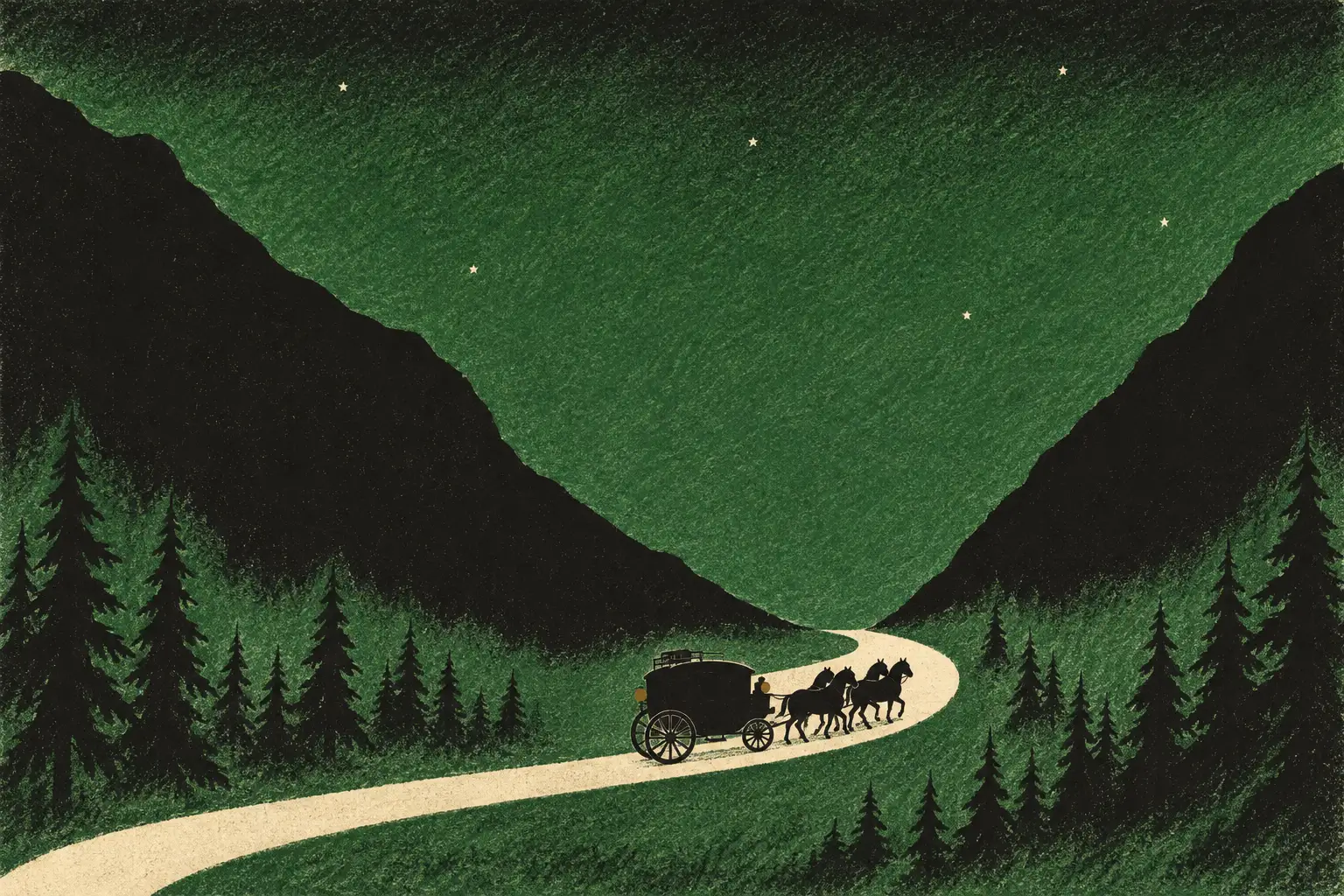
At the pass — an illustration of the road into the Borgo Pass at night, where chapter I has the Count’s calèche meet the coach, not a book illustration and not a picture of the castle.
Illustration: Genre Fiction Lineage. Generated scene illustration — not a book illustration, photograph or historical record. No copyright is claimed in the generated imagery; if you reuse it, please credit "Genre Fiction Lineage".
From Veresti, Mina's entry for 31 October counts “something more than 70 miles before us” to the pass. The pursuit leaves Charing Cross on 12 October and ends at the castle in Mina's entry for 6 November, 25 days later.
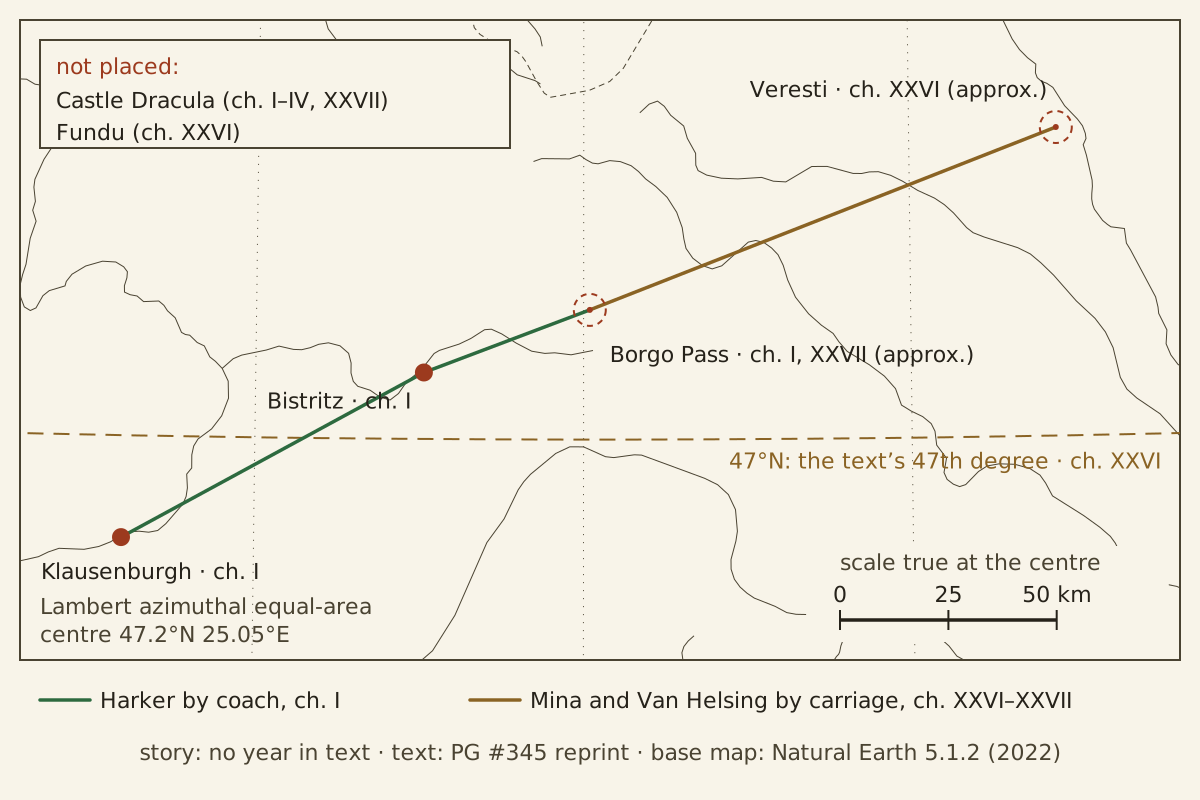
The approach — Klausenburgh, Bistritz, the Borgo Pass and Veresti on a Natural Earth base map, joined by straight lines in text order rather than by the roads, with the pass marked approximate and the castle left in the not-placed box.
Dracula: the approach to the Borgo Pass · Genre Fiction Lineage · CC BY 4.0
Reuse credit (CC BY)
"Dracula: the approach to the Borgo Pass" by Genre Fiction Lineage, https://genrefictionlineage.com/scene-maps/dracula-map/, licensed under CC BY 4.0 (https://creativecommons.org/licenses/by/4.0/)
Places, chapters and quotations from Bram Stoker, Dracula, Project Gutenberg eBook #345 (Grosset & Dunlap reprint), and the other sources listed on the entry page; Base map: Natural Earth (public domain), vector data version 5.1.2, retrieved 2026-11-02; Place coordinates: Natural Earth and Wikidata (CC0), retrieved 2026-11-02
What came before and after Dracula?
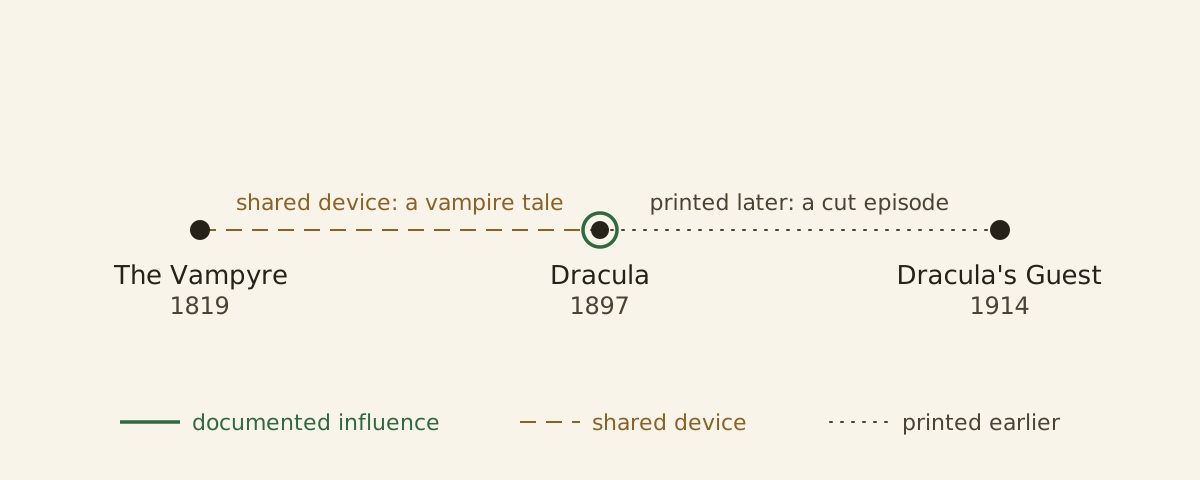
Vampire tales were in print long before Stoker's. According to SFE, John Polidori's “The Vampyre” appeared in the New Monthly Magazine in April 1819, printed as by Lord Byron, 78 years before Dracula. The two share a device, a vampire, but nothing read for this page shows Stoker naming Polidori's tale, so the strip draws a shared device only.
The later text is the same author's work, printed later. SFE dates Stoker's death to 1912, and his widow's preface to Dracula's Guest (1914) says she added “an hitherto unpublished episode from Dracula,” which “was originally excised owing to the length of the book.” An episode cut from the same novel is not an influence, so the strip draws it in print order only. The story opens on a drive out of Munich, the city that Harker's first entry leaves on 1 May.
The three works and the evidence for each link are in a CSV of the lineage strip CSV · provenance note Places, chapters and quotations from Bram Stoker, Dracula, Project Gutenberg eBook #345 (Grosset & Dunlap reprint), and the other sources listed on the entry page.
The way the novel is told also has company. Dracula's closing note admits that the record is “nothing but a mass of typewriting,” apart from a few notebooks and a memorandum. The Moonstone (shared device) is another novel assembled from the papers of several narrators.
- Solid: documented influence (the later author's own statement, letter, review or note)
- Dashed: shared device (similar texts, no borrowing claimed)
- Dotted: dates only (publication order or other dates; no link claimed)
Lineage strip — three texts in print order; the dashed line marks a shared device only, and the dotted line marks the 1914 story as printed later, an episode cut from Dracula as Florence Stoker's preface says.
Lineage strip: The Vampyre to Dracula's Guest, 1819–1914 · Genre Fiction Lineage · CC BY 4.0
Reuse credit (CC BY)
"Lineage strip: The Vampyre to Dracula's Guest, 1819–1914" by Genre Fiction Lineage, https://genrefictionlineage.com/scene-maps/dracula-map/, licensed under CC BY 4.0 (https://creativecommons.org/licenses/by/4.0/)
Places, chapters and quotations from Bram Stoker, Dracula, Project Gutenberg eBook #345 (Grosset & Dunlap reprint), and the other sources listed on the entry page
Which text does this map follow?
A chapter and a sentence only mean something in a named text. This map follows the Project Gutenberg transcription of a Grosset & Dunlap reprint from New York, whose title page carries “Copyright, 1897” and no printing year. SFE gives the book's first publisher as Archibald Constable and Company, London, 1897, and lists a Constable edition of 1901 “rev with cuts,” so the wording can change from one edition to the next. This reprint was not compared word by word with the 1897 text.
The story year is a separate question, and the text leaves it open. The only years printed are on Whitby gravestones read out in chapter VI, the latest of them 1873, and the closing note looks back only to “Seven years ago.” No story year is given here. The base map has a date of its own: Natural Earth's vector data, version 5.1.2, released in 2022.
Wikisource transcribes another reprint, a Modern Library edition, which was not used here. Each mapped place was matched to a present-day place in Natural Earth's populated places or in a Wikidata item, and the places CSV gives its latitude, longitude and source. Veresti is matched by name only. The CSV also repeats the edition in every row, so a row read on its own still says which text it quotes.
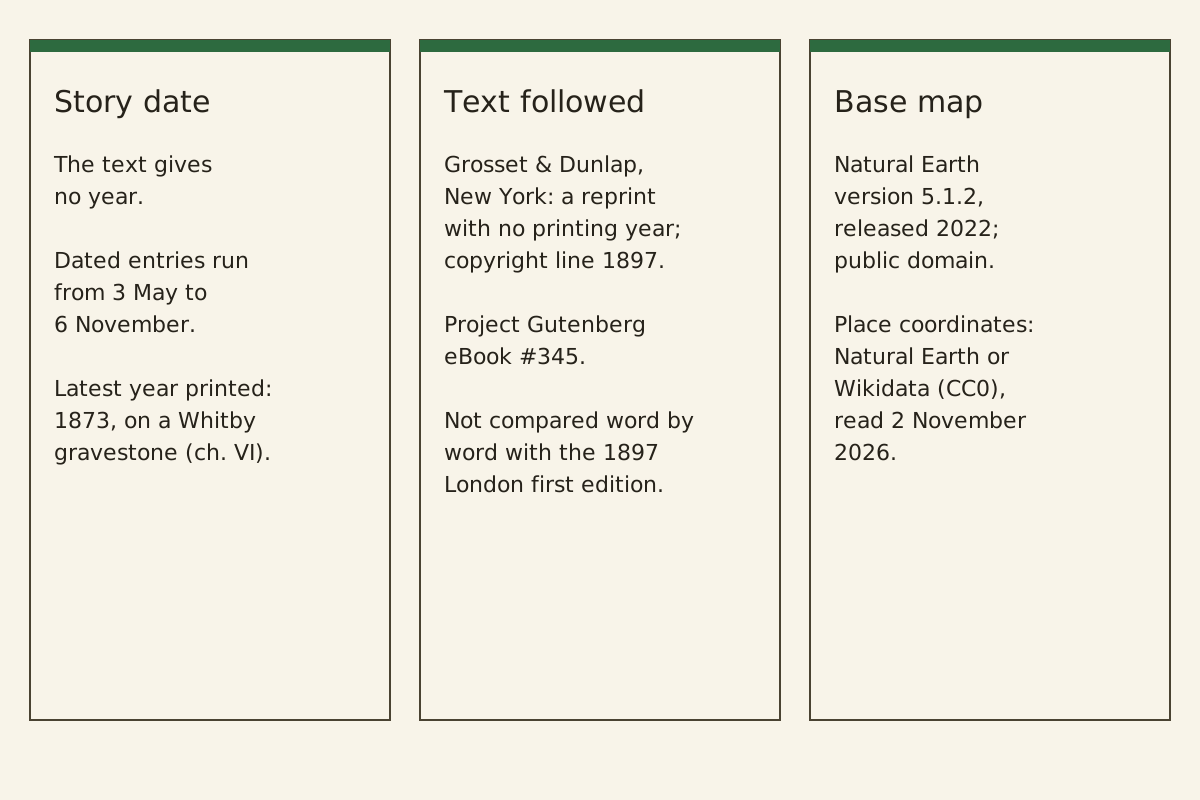
Three dates — the story year, the edition followed and the base map, kept apart as the cataloguing rules require.
Dracula map: the three dates · Genre Fiction Lineage · CC BY 4.0
Reuse credit (CC BY)
"Dracula map: the three dates" by Genre Fiction Lineage, https://genrefictionlineage.com/scene-maps/dracula-map/, licensed under CC BY 4.0 (https://creativecommons.org/licenses/by/4.0/)
Places, chapters and quotations from Bram Stoker, Dracula, Project Gutenberg eBook #345 (Grosset & Dunlap reprint), and the other sources listed on the entry page; Base map: Natural Earth (public domain), vector data version 5.1.2, retrieved 2026-11-02; Place coordinates: Natural Earth and Wikidata (CC0), retrieved 2026-11-02
Places on the map
- Munich: chapter I, “Left Munich at 8:35 P. M., on 1st May” (exact)
- Vienna: chapter I, “arriving at Vienna early next morning” (exact)
- Buda-Pesth: chapter I, “Buda-Pesth seems a wonderful place” (exact)
- Klausenburgh: chapter I, “came after nightfall to Klausenburgh” (exact)
- Bistritz: chapter I, “It was on the dark side of twilight when we got to Bistritz, which is a very interesting old place.” (exact)
- The Borgo Pass: chapter I, “we were entering on the Borgo Pass” (approximate)
- Castle Dracula: chapter I, “I was not able to light on any map or work giving the exact locality of the Castle Dracula” (not placed)
- London: chapter I, “Having had some time at my disposal when in London” (exact)
- Carfax, at Purfleet: chapter II, “At Purfleet, on a by-road, I came across just such a place as seemed to be required” (approximate)
- Whitby, ringed in the Count's atlas: chapter II, “the other two were Exeter, and Whitby on the Yorkshire coast” (exact)
- Whitby: chapter VI, “24 July. Whitby.” (exact)
- The East Cliff churchyard: chapter VII, “some of the gossips who frequent the East Cliff churchyard” (approximate)
- Tate Hill Pier: chapter VII, “known locally as Tate Hill Pier” (approximate)
- Varna, where the Demeter sailed from: chapter VII, “the schooner is a Russian from Varna, and is called the Demeter” (exact)
- Hospital of St. Joseph and Ste. Mary, Buda-Pesth: chapter VIII, “Letter, Sister Agatha, Hospital of St. Joseph and Ste. Mary, Buda-Pesth, to Miss Wilhelmina Murray.” (approximate)
- Hull: chapter IX, “I got to Hull all right, and caught the boat to Hamburg” (exact)
- Hillingham: chapter IX, “Hillingham, 24 August.” (not placed)
- Amsterdam: chapter IX, “Professor Van Helsing, of Amsterdam” (exact)
- The Zoölogical Gardens: chapter XI, “the keeper of the section of the Zoölogical Gardens in which the wolf department is included” (approximate)
- Antwerp: chapter XI, “Telegram, Van Helsing, Antwerp, to Seward, Carfax.” (exact)
- Exeter: chapter XII, “when we arrived at Exeter there was a carriage waiting for us” (exact)
- Hampstead: chapter XIII, “The neighbourhood of Hampstead is just at present exercised with a series of events” (approximate)
- The churchyard at Kingstead: chapter XV, “the churchyard at Kingstead” (not placed)
- No. 347, Piccadilly: chapter XX, “the sale and purchase of No. 347, Piccadilly” (approximate)
- 197, Chicksand Street, Mile End New Town: chapter XX, “197, Chicksand Street, Mile End New Town” (approximate)
- Jamaica Lane, Bermondsey: chapter XX, “Jamaica Lane, Bermondsey” (approximate)
- Fenchurch Street: chapter XXII, “Just before we reached Fenchurch Street Lord Godalming said to me” (approximate)
- Doolittle’s Wharf: chapter XXIV, “she sail from Doolittle’s Wharf for Varna” (not placed)
- Varna: chapter XXV, “15 October, Varna.” (exact)
- Galatz: chapter XXVI, “We are near Galatz now” (exact)
- Veresti: chapter XXVI, “Arrived at Veresti at noon.” (approximate)
- Fundu: chapter XXVI, “at Fundu, where the Bistritza runs into the Sereth” (not placed)
- About the 47th degree, north latitude: chapter XXVI, “somewhere about the 47th degree, north latitude, would be the place chosen” (approximate)
Sources
- 1Bram Stoker, Dracula, Project Gutenberg eBook #345, https://www.gutenberg.org/ebooks/345 (base text: a Grosset & Dunlap reprint, New York, with no printing year; title page: Copyright, 1897) https://www.gutenberg.org/ebooks/345Read: full text, all 27 chapters
- 2"Stoker, Bram" (entry signed JE/DRL), in John Clute, David Langford and Graham Sleight (eds), The Encyclopedia of Science Fiction, https://sf-encyclopedia.com/entry/stoker_bram, accessed 2 November 2026 https://sf-encyclopedia.com/entry/stoker_bramRead: full entry (updated 29 September 2025)
- 3"Vampires" (entry signed DRL/PN), in John Clute, David Langford and Graham Sleight (eds), The Encyclopedia of Science Fiction, https://sf-encyclopedia.com/entry/vampires, accessed 2 November 2026 https://sf-encyclopedia.com/entry/vampiresRead: full entry
- 4Bram Stoker, Dracula's Guest, Project Gutenberg eBook #10150, https://www.gutenberg.org/ebooks/10150 (transcription notes: first published 1914; includes the preface by Florence Bram Stoker) https://www.gutenberg.org/ebooks/10150Read: preface and the opening of the title story
- 5Natural Earth, vector map data version 5.1.2 (released 13 May 2022), public domain, https://www.naturalearthdata.com/; files from the publisher's repository https://github.com/nvkelso/natural-earth-vector (tag v5.1.2) https://www.naturalearthdata.com/Read: seven GeoJSON layers in full: 1:50m land and land borders; 1:10m coastline, land borders, rivers and lake centrelines, European rivers, populated placesText licence: Public domain
- 6Wikidata items Q852778 (Whitby), Q1972020 (Purfleet-on-Thames), Q1473795 (Tihuța Pass), Q12725255 (Verești), Q25610 (Hampstead), Q270263 (London Zoo), Q1124023 (Piccadilly), Q6851072 (Mile End New Town), Q822040 (Bermondsey), Q3068338 (Fenchurch Street), https://www.wikidata.org/, accessed 2 November 2026 https://www.wikidata.org/Read: each item's EntityData JSON: English label, aliases and coordinate location (P625)Text licence: CC0 1.0
- 7Jennifer Jenkins and James Boyle, "Public Domain Day 2026," Center for the Study of the Public Domain, Duke Law School https://web.law.duke.edu/cspd/publicdomainday/2026/Read: full pageText licence: CC BY 4.0
- 8Urheberrechtsgesetz § 64 (Allgemeines), gesetze-im-internet.de https://www.gesetze-im-internet.de/urhg/__64.htmlRead: full text of the section
Cite this page
Genre Fiction Lineage. “Dracula Map: Counted Here, Most Chapters Stay in England.” Genre Fiction Lineage, published 3 November 2026. https://genrefictionlineage.com/scene-maps/dracula-map/. Accessed [the date you read it].
Next shelf over:
- Around the World in 80 Days: another novel whose route can be drawn leg by leg from its own dates (for comparison).
- 221B Baker Street: the same late-Victorian London, placed from Doyle's text (shared device).
- Read the text: Dracula (1897), Project Gutenberg
Related entries
More from Scene Maps.
Scene map
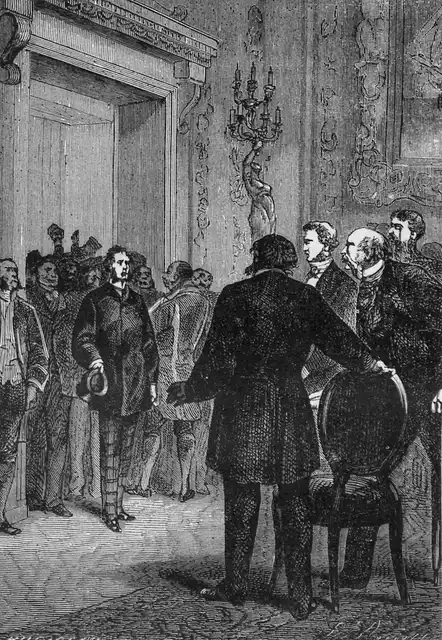
Around the World in 80 Days: Fogg's Route, Dated by the Text
Verne's text dates Fogg's departure to 2 October 1872 and his deadline to 21 December. A map of the 21 legs, with counted dates and unplaced stops marked.
Picture credit
"The return to the Reform Club" by Alphonse de Neuville or Léon Benett, 1874 — https://commons.wikimedia.org/wiki/File:%27Around_the_World_in_Eighty_Days%27_by_Neuville_and_Benett_(139390668).jpg — Public domain (US: published in Paris by Hetzel by 1874 (National Library of Poland record "Paris: Hetzel, [1874]"), before 1931; Germany: Alphonse de Neuville died 1885 and Léon Benett 1917, so 70 years after death have run out (UrhG §64); France: the same, 70 years after death, CPI L123-1 general rule, not checked against Légifrance; Benett was French and died in 1917, the died-for-France extension was not checked, and 100 years after 1917 have also passed; the wood engraver is not identified and is presumed out of copyright from working years in the 1870s (presumption)); modified: cropped from the book page, desaturated and contrast adjusted on Wikimedia Commons before download
Catalogue entry
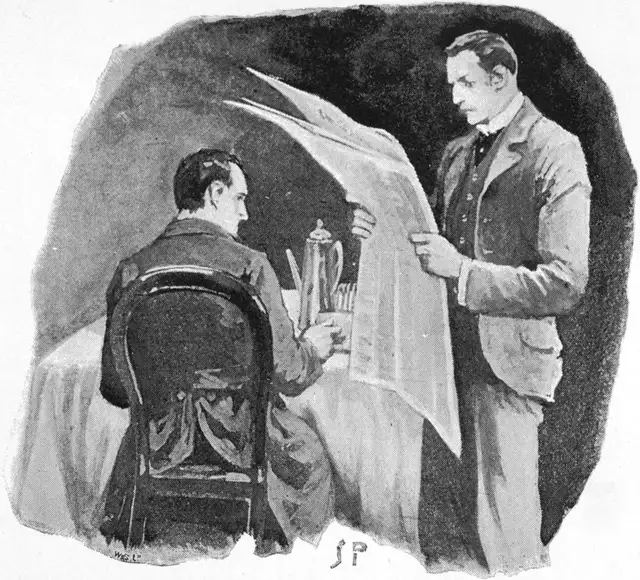
221B Baker Street: Holmes's Rooms in the Stories, 1887–1903
Holmes's address as Doyle's text gives it: No. 221B, Baker Street in 1887, then the steps, windows and the house opposite, story by story, with a CSV.
Picture credit
"Breakfast in the rooms (The Five Orange Pips)" by Sidney Paget, 1892 — https://commons.wikimedia.org/wiki/File:Sidney_Paget_-_The_Five_Orange_Pips_01.jpg — Public domain (US: published 1891 in The Strand Magazine and 1892 in the Harper book edition (published before 1931); Germany and France: Paget died 1908 (GND 114595541X), so 70 years after death have run out (UrhG §64; CPI L123-1, general rule, not checked against Légifrance); he was British and died before 1914, so the French 'mort pour la France' extension does not apply; the halftone block maker's mark (W&S Ld) is a firm active by 1892 (presumed out of copyright))