Scene Maps · Scene map
Around the World in 80 Days: Fogg's Route, Dated by the Text
Genre Fiction Lineage Published
Verne's text dates Phileas Fogg's departure to Wednesday 2 October 1872 and his deadline to Saturday 21 December. This map dates each leg only as far as the novel itself does, chapter by chapter, in an undated Hetzel illustrated printing of the French text.
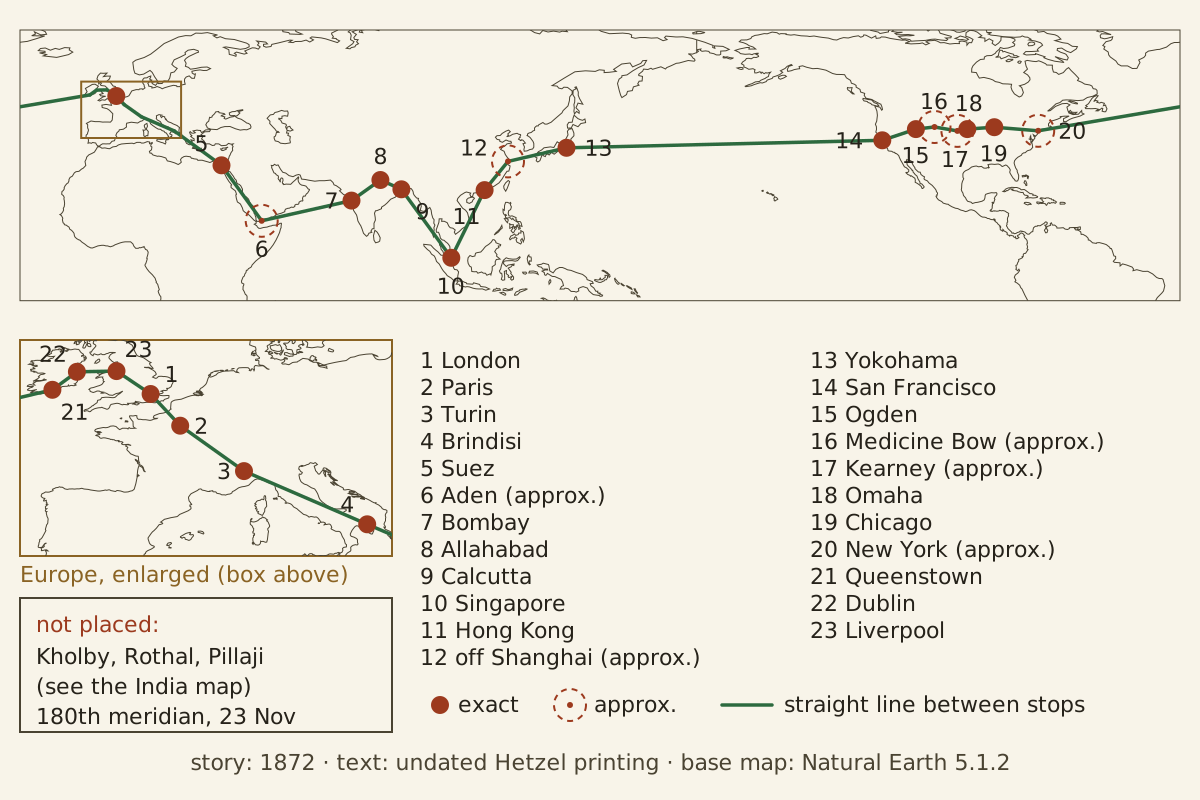
Fogg's route — the places the Hetzel text dates, set at their coordinates on a Natural Earth world map, joined by straight lines that stand in for tracks and sea lanes the text does not give.
Around the World in Eighty Days: Fogg's route by the text's dates · Genre Fiction Lineage · CC BY 4.0
Reuse credit (CC BY)
"Around the World in Eighty Days: Fogg's route by the text's dates" by Genre Fiction Lineage, https://genrefictionlineage.com/scene-maps/around-world-80-days/, licensed under CC BY 4.0 (https://creativecommons.org/licenses/by/4.0/)
Dates, places and quotations from Jules Verne, Le Tour du monde en quatre-vingts jours, Project Gutenberg eBook #46541 (Hetzel illustrated edition), and the other sources listed on the entry page; Base map: Natural Earth (public domain); Place coordinates: Natural Earth (public domain) and Wikidata (CC0)
Each city stands at its Natural Earth or Wikidata coordinates. The lines between them are approximate. The dates and hours of all 21 legs are in a CSV of Fogg's legs, with the French sentence for each CSV · provenance note Dates, places and quotations from Jules Verne, Le Tour du monde en quatre-vingts jours, Project Gutenberg eBook #46541 (Hetzel illustrated edition), and the other sources listed on the entry page, and the places are in a CSV of the places on the maps CSV · provenance note Dates, places and quotations from Jules Verne, Le Tour du monde en quatre-vingts jours, Project Gutenberg eBook #46541 (Hetzel illustrated edition), and the other sources listed on the entry page; Base map: Natural Earth (public domain); Place coordinates: Natural Earth (public domain) and Wikidata (CC0).
| Date kept apart | What this map uses |
|---|---|
| Story date | 1872, printed in chapter I |
| Text followed | Hetzel illustrated edition, Paris, with no year on the title page (Project Gutenberg eBook #46541) |
| Base map | Natural Earth version 5.1.2 (public domain), released in 2022 |
What route does Fogg take, by the novel's own dates?
The novel fixes its start to the minute. In chapter I, Fogg tells his new servant that he is in service “à partir de ce moment, onze heures vingt-neuf du matin, ce mercredi 2 octobre 1872” (“from this moment, twenty-nine minutes past eleven in the morning, this Wednesday 2 October 1872,” Genre Fiction Lineage translation). At the Reform Club that day, he bets that he will be back in the same room on “le samedi 21 décembre, à huit heures quarante-cinq du soir” (“Saturday 21 December, at a quarter to nine in the evening”).
Fogg's notebook in chapter VII logs the first legs to the minute. He leaves London at 8.45 p.m. on 2 October, reaches Paris at 7.20 the next morning, crosses the Mont Cenis to Turin on the 4th, and arrives at Brindisi on the 5th and at Suez on Wednesday 9 October at 11 a.m.
After Suez, the dates arrive less often. The steamer Mongolia reaches Bombay on 20 October, and rail and an elephant carry Fogg to Calcutta by the 25th. Ships take him by Singapore and Hong Kong to Yokohama on 14 November, and the General Grant reaches San Francisco on 3 December. Trains and a sledge under sail bring him to New York on the 11th, and he lands at Liverpool on 21 December.
The page counts 21 legs. Fifteen of them end on a date the text prints. The other six end on a date counted from words such as “le lendemain” (“the next day”), and the CSV marks which is which.
How long is each leg?
Before Fogg leaves, a club member reads out a reckoning from the Morning Chronicle in chapter III. It allows seven days from London to Suez, 13 to Bombay, three to Calcutta, 13 to Hong Kong, six to Yokohama, 22 to San Francisco, seven to New York and nine to London, “Total 80 jours.” Set against the arrival dates the novel prints, the total holds. The legs do not.
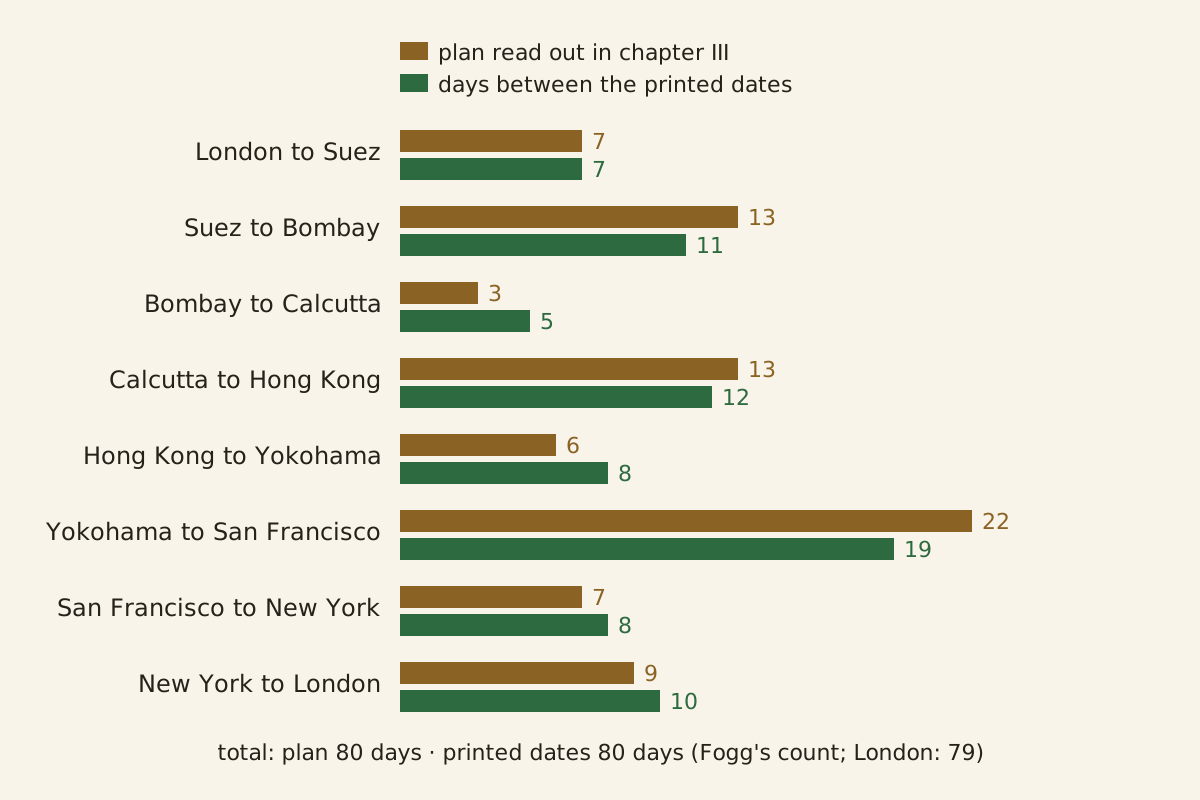
Plan and printed dates — the eight legs of the chapter III reckoning, each beside the days between the arrival dates the text gives.
Around the World in Eighty Days: planned days and printed dates · Genre Fiction Lineage · CC BY 4.0
Reuse credit (CC BY)
"Around the World in Eighty Days: planned days and printed dates" by Genre Fiction Lineage, https://genrefictionlineage.com/scene-maps/around-world-80-days/, licensed under CC BY 4.0 (https://creativecommons.org/licenses/by/4.0/)
Dates, places and quotations from Jules Verne, Le Tour du monde en quatre-vingts jours, Project Gutenberg eBook #46541 (Hetzel illustrated edition), and the other sources listed on the entry page
| Leg | Plan (chapter III) | Arrival printed | Days by printed dates |
|---|---|---|---|
| London to Suez | 7 | 9 October (VII) | 7 |
| Suez to Bombay | 13 | 20 October (IX) | 11 |
| Bombay to Calcutta | 3 | 25 October (XIV) | 5 |
| Calcutta to Hong Kong | 13 | 6 November (XVIII) | 12 |
| Hong Kong to Yokohama | 6 | 14 November (XXIV) | 8 |
| Yokohama to San Francisco | 22 | 3 December (XXIV) | 19 |
| San Francisco to New York | 7 | 11 December (XXXI) | 8 |
| New York to London | 9 | 21 December (XXXIV, XXXVII) | 10 |
| Total | 80 | 80 |
The Mongolia gains two days on the plan, and India takes those two days back. The Pacific crossing runs three days under the reckoning, and every leg after it runs one day over. The gaps were computed two ways from the CSV of the plan and the printed dates CSV · provenance note Dates, places and quotations from Jules Verne, Le Tour du monde en quatre-vingts jours, Project Gutenberg eBook #46541 (Hetzel illustrated edition), and the other sources listed on the entry page, counting whole calendar days between the arrival dates.
Fogg's own arithmetic is not quite exact either. His notebook totals the London to Suez leg as “158 1/2” hours, while the clock times he logs, 8.45 p.m. on the 2nd to 11 a.m. on the 9th, are 158 hours and a quarter apart.
Where does the railway stop in India?
The Morning Chronicle figure of 80 days assumes that “la section entre Rothal et Allahabad” (“the section between Rothal and Allahabad”) is open. In chapter XI, on 22 October at eight in the morning, the train stops in a clearing “à quinze milles en avant de la station de Rothal” (“fifteen miles short of Rothal station”). The guard names the hamlet as Kholby and says about fifty miles of line are still to be laid before Allahabad.
Fogg buys an elephant and leaves at nine. After a night at a ruined bungalow and a night at the pagoda of Pillaji, the guide announces Allahabad station “vers dix heures” (“towards ten o'clock”), and the train reaches Calcutta at seven the next morning. Chapter XIV prints that date as 25 October, so the Allahabad date, 24 October, is counted back from it.
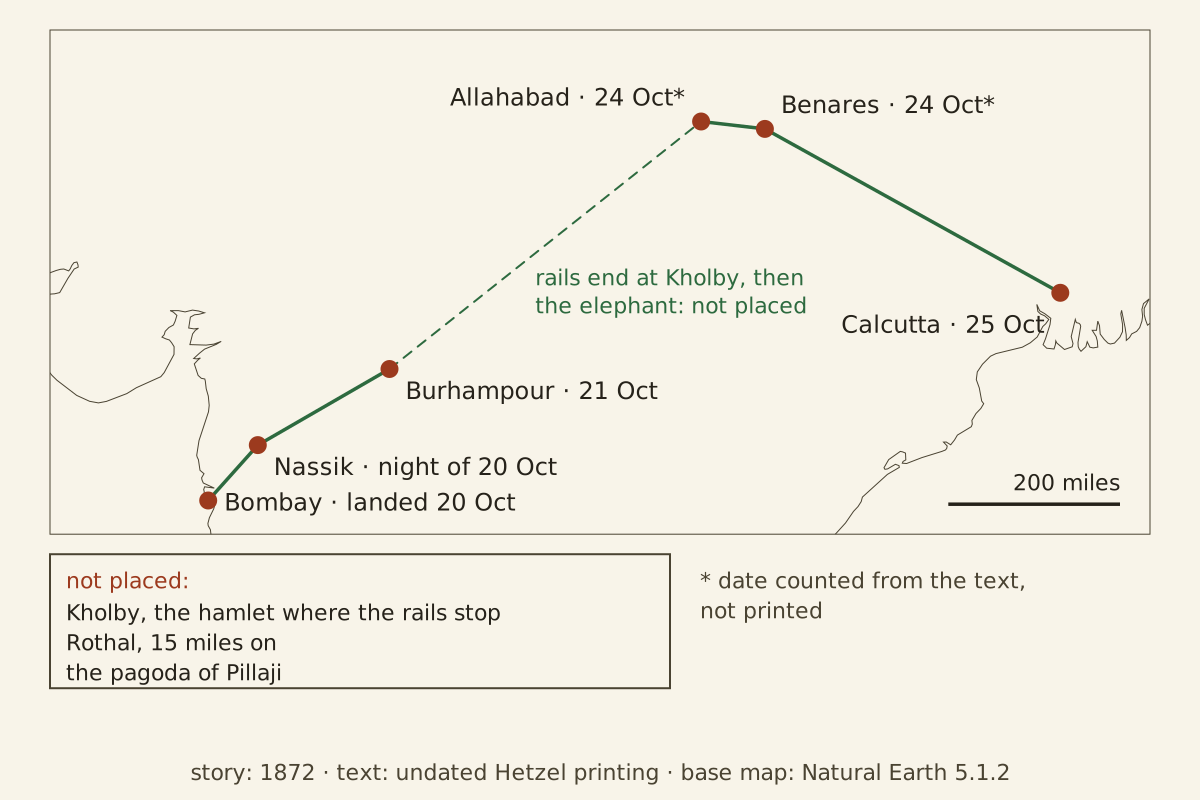
The Indian leg — Bombay to Calcutta on Natural Earth, with the gap where the rails end left as a dashed line and three places this map cannot locate.
Around the World in Eighty Days: the Indian leg, to scale · Genre Fiction Lineage · CC BY 4.0
Reuse credit (CC BY)
"Around the World in Eighty Days: the Indian leg, to scale" by Genre Fiction Lineage, https://genrefictionlineage.com/scene-maps/around-world-80-days/, licensed under CC BY 4.0 (https://creativecommons.org/licenses/by/4.0/)
Dates, places and quotations from Jules Verne, Le Tour du monde en quatre-vingts jours, Project Gutenberg eBook #46541 (Hetzel illustrated edition), and the other sources listed on the entry page; Base map: Natural Earth (public domain); Place coordinates: Natural Earth (public domain) and Wikidata (CC0)
Neither Kholby nor Rothal appears in Natural Earth, and the text gives the pagoda only a distance from the elephant's path. All three are listed as not placed, so the dashed line from Burhampour to Allahabad stands for a stretch the novel describes but does not map.
Where do the printed dates disagree?
Twice, the text gives two dates for one event. In chapter XIX, a clerk tells Passepartout that the Carnatic will sail for Yokohama “le soir même à huit heures” (“that same evening at eight”), which is the evening of 6 November, and in chapter XX Fogg learns the next morning that it left “depuis la veille” (“the day before”). Chapter XXII, which follows Passepartout on board, has the ship leaving Hong Kong “le 7 novembre, à six heures et demie du soir” (“on 7 November, at half past six in the evening”).
The Pacific crossing has the second, aboard the General Grant, which chapter XXIV describes as a large paddle steamer with a beam rocking above its deck. The same chapter puts the ship on the 180th meridian on 23 November, and then, “Onze jours après, le 3 décembre” (“eleven days later, on 3 December”), in San Francisco. Eleven days after 23 November is 4 December.
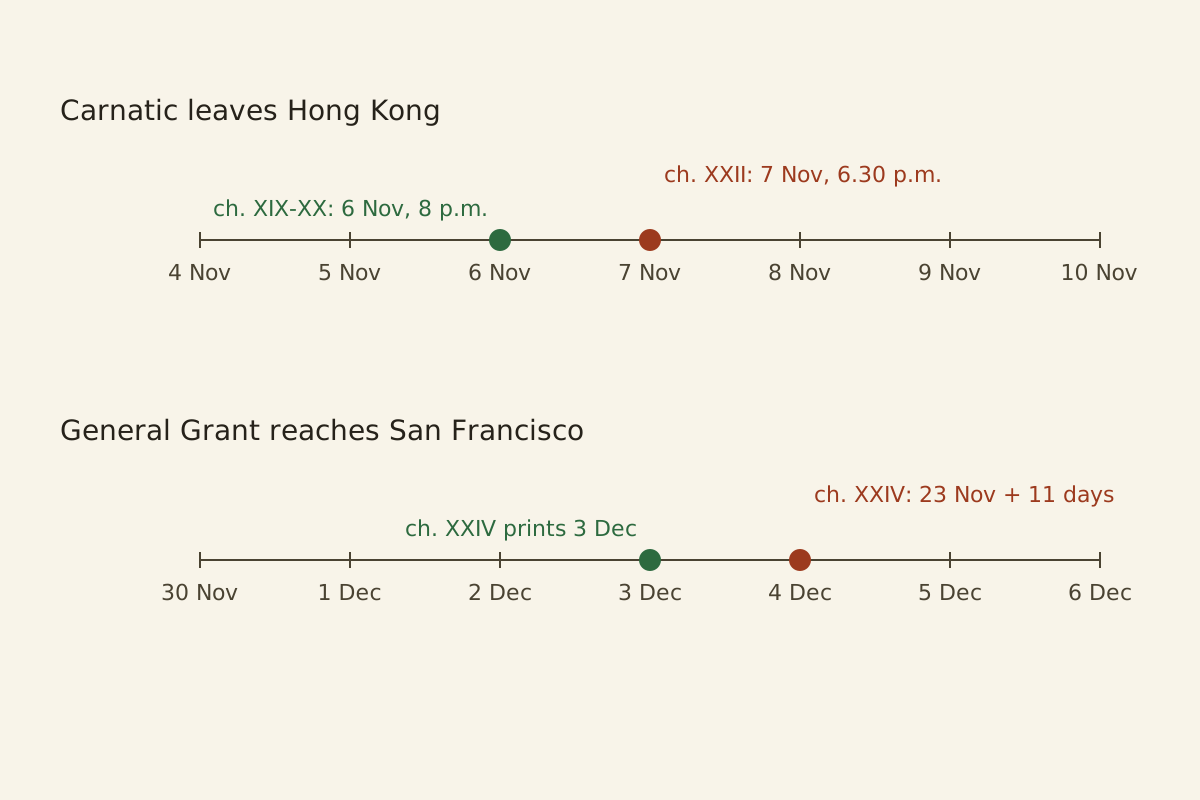
Two dates for one event — the Carnatic's sailing as chapters XIX to XXII give it, and the Pacific arrival as printed and as counted.
Around the World in Eighty Days: two dates for one event · Genre Fiction Lineage · CC BY 4.0
Reuse credit (CC BY)
"Around the World in Eighty Days: two dates for one event" by Genre Fiction Lineage, https://genrefictionlineage.com/scene-maps/around-world-80-days/, licensed under CC BY 4.0 (https://creativecommons.org/licenses/by/4.0/)
Dates, places and quotations from Jules Verne, Le Tour du monde en quatre-vingts jours, Project Gutenberg eBook #46541 (Hetzel illustrated edition), and the other sources listed on the entry page
The map uses the printed date in each case. The Carnatic carries Passepartout, not Fogg, so its sailing changes none of Fogg's legs, and San Francisco keeps the 3 December the text prints.
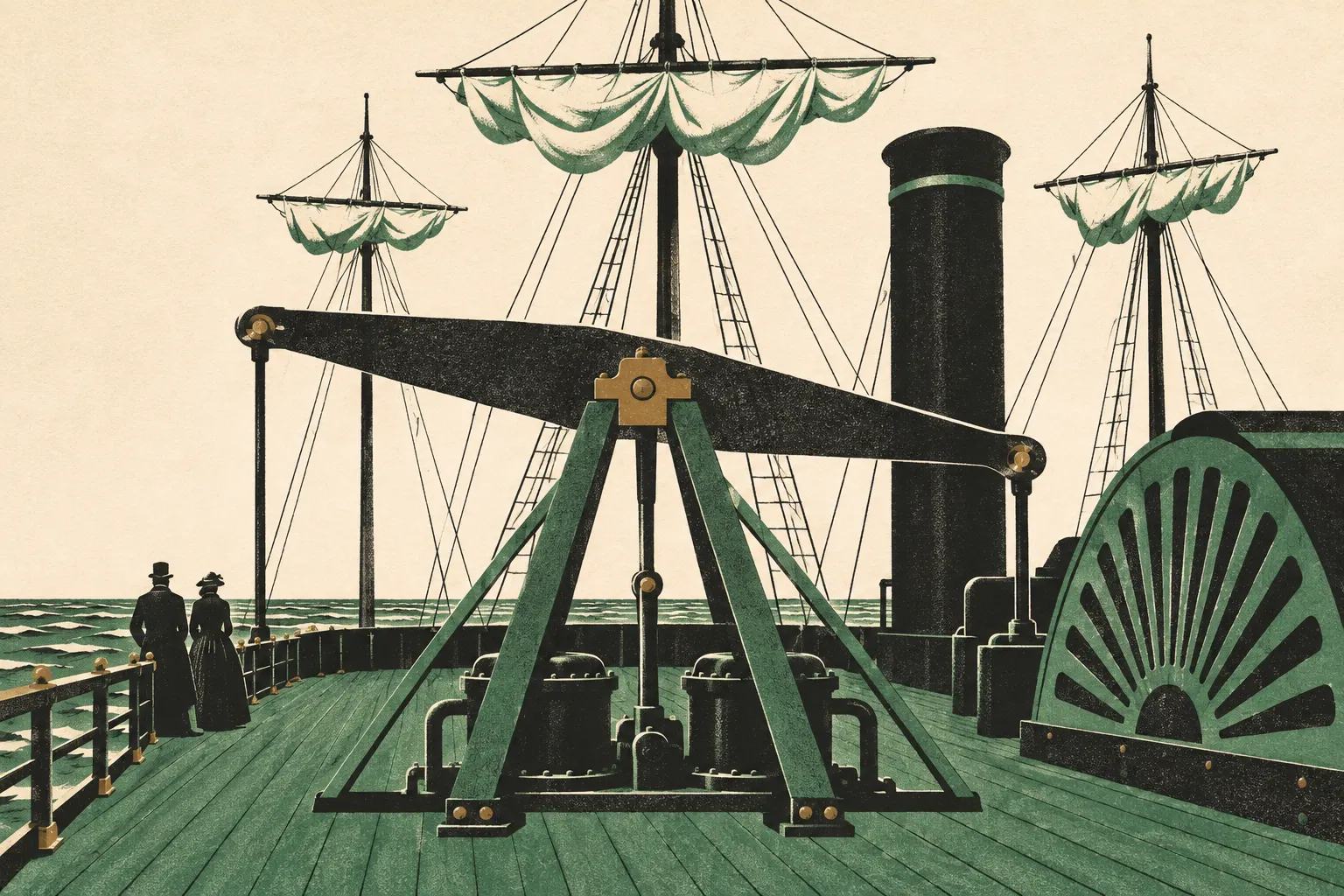
On the Pacific — an illustration of a paddle steamer's deck like the one chapter XXIV describes, not a book illustration and not a picture of the General Grant itself.
Illustration: Genre Fiction Lineage. Generated scene illustration — not a book illustration, photograph or historical record. No copyright is claimed in the generated imagery; if you reuse it, please credit "Genre Fiction Lineage".
How does Fogg gain a day?
Verne explains it himself in chapter XXXVII. Travelling east, Fogg met the sun, and each day was shorter by four minutes for every degree he crossed; 360 degrees times four minutes make 24 hours. In his words, while Fogg “voyait le soleil passer quatre-vingts fois au méridien, ses collègues restés à Londres ne le voyaient passer que soixante-dix-neuf fois” (“saw the sun pass the meridian eighty times, his colleagues left in London saw it pass only seventy-nine times”). So when Fogg landed in London thinking it was Saturday 21 December, it was Friday 20 December, 79 days after he left.
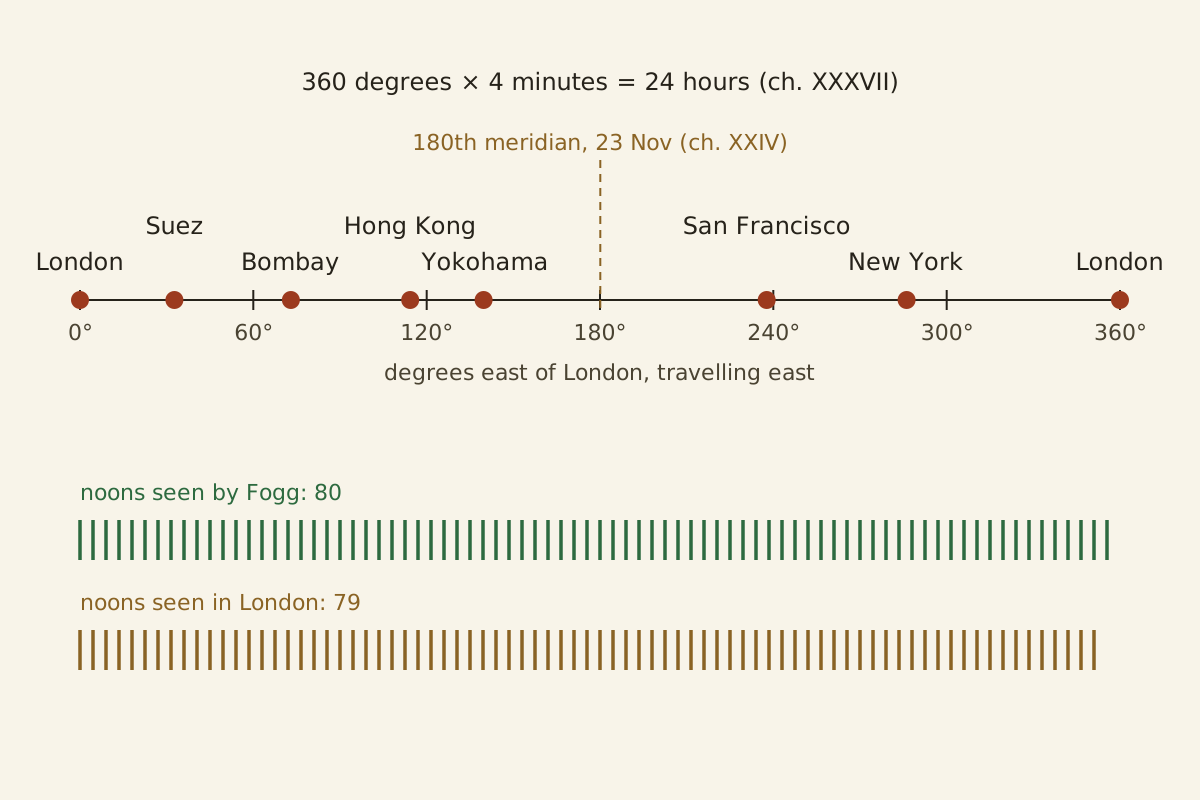
Eighty noons and seventy-nine — the stops by longitude east of London, with Verne's own count of noons from chapter XXXVII.
Around the World in Eighty Days: longitude and the gained day · Genre Fiction Lineage · CC BY 4.0
Reuse credit (CC BY)
"Around the World in Eighty Days: longitude and the gained day" by Genre Fiction Lineage, https://genrefictionlineage.com/scene-maps/around-world-80-days/, licensed under CC BY 4.0 (https://creativecommons.org/licenses/by/4.0/)
Dates, places and quotations from Jules Verne, Le Tour du monde en quatre-vingts jours, Project Gutenberg eBook #46541 (Hetzel illustrated edition), and the other sources listed on the entry page; Base map: Natural Earth (public domain); Place coordinates: Natural Earth (public domain) and Wikidata (CC0)
That changes how the last dates read. The CSV keeps every date as the text prints it, and the final leg carries the London date beside Fogg's count.
Where does the journey start and end?
Both ends are in London. Fogg lives at No. 7 Saville Row, and in chapter III he walks to the Reform Club in 575 steps of the right foot and 576 of the left. Passepartout is hired at the house that same Wednesday morning, at 11.29.
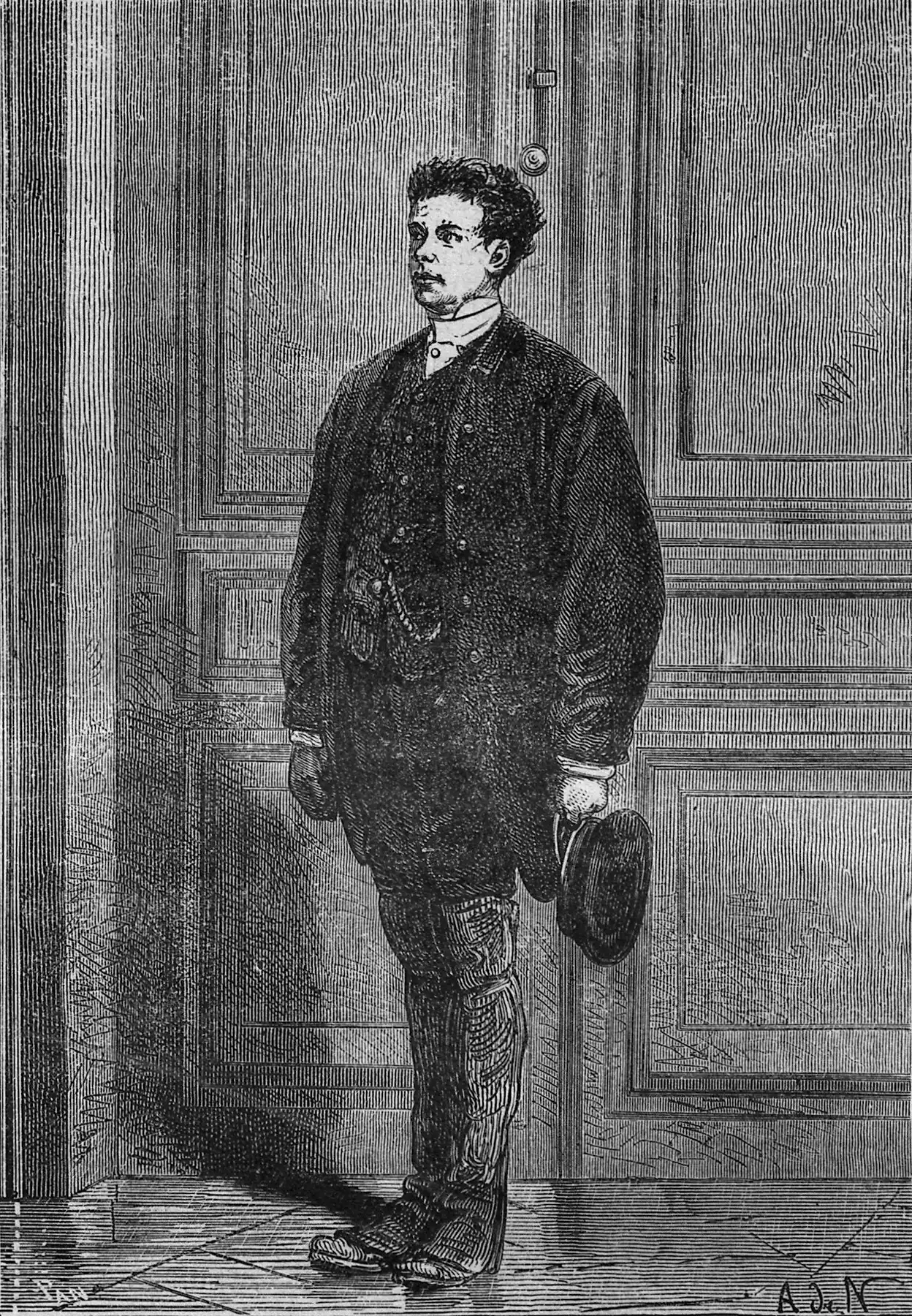
Jean Passepartout — the new servant as Alphonse de Neuville drew him, signed A. de N. at lower right, from a Hetzel illustrated edition.
Jean Passepartout · Alphonse de Neuville · public domain
Full credit
"Jean Passepartout" by Alphonse de Neuville, 1874 — https://commons.wikimedia.org/wiki/File:%27Around_the_World_in_Eighty_Days%27_by_Neuville_and_Benett_(139390156).jpg — Public domain (US: published in Paris by Hetzel by 1874 (National Library of Poland record "Paris: Hetzel, [1874]"), before 1931; Germany: Alphonse de Neuville died 1885 and Léon Benett 1917, so 70 years after death have run out (UrhG §64); France: the same, 70 years after death, CPI L123-1 general rule, not checked against Légifrance; Benett was French and died in 1917, the died-for-France extension was not checked, and 100 years after 1917 have also passed; the wood engraver is not identified and is presumed out of copyright from working years in the 1870s (presumption)); modified: cropped from the book page, desaturated and contrast adjusted on Wikimedia Commons before download
Chapter XXXVI ends in the club's salon. As the clock reaches 8.45 on Saturday 21 December by London's calendar, Fogg walks in, followed by a crowd, and says “Me voici, messieurs” (“Here I am, gentlemen”).
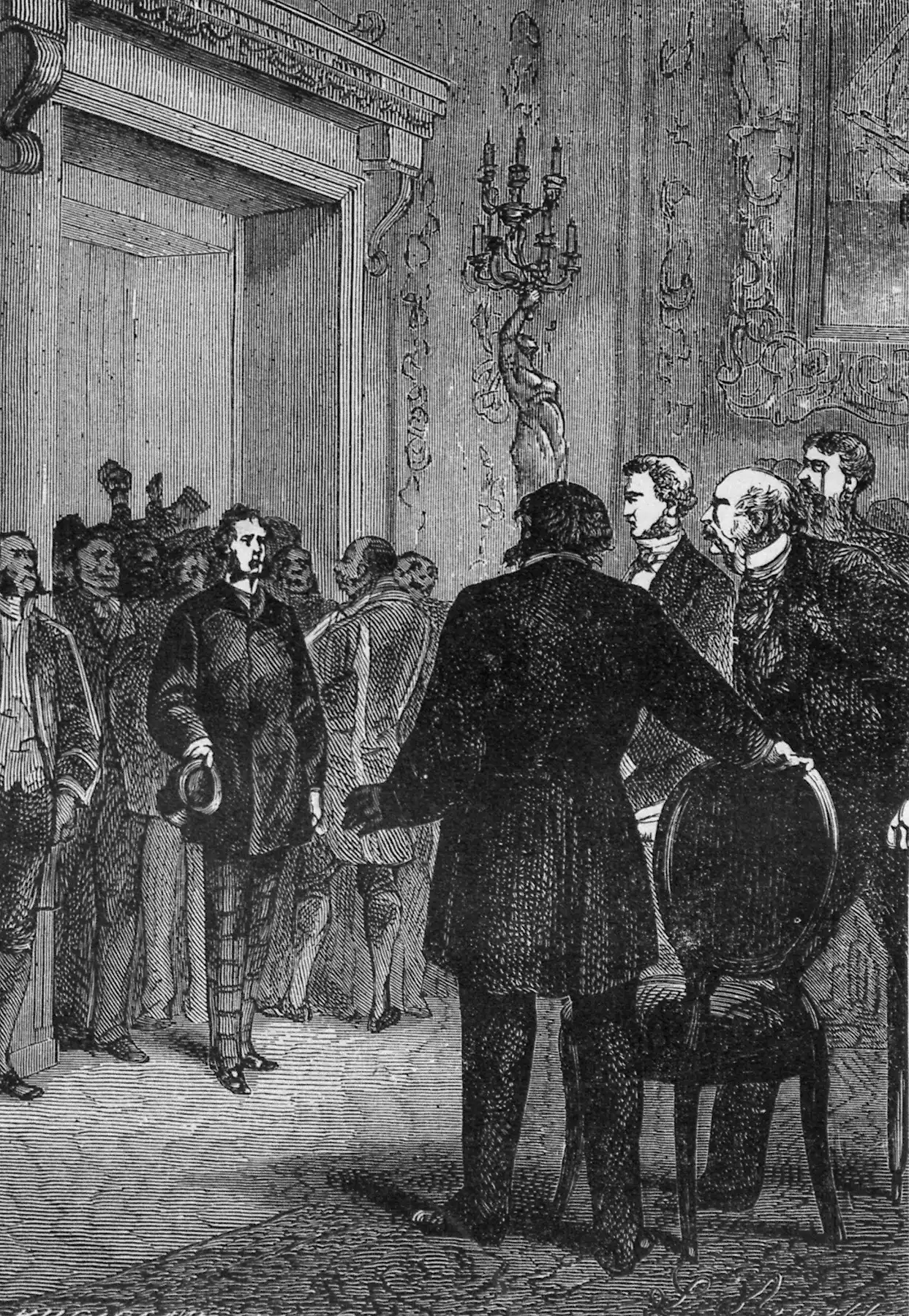
The return — Fogg in the doorway of the Reform Club salon with the crowd behind him, from a Hetzel illustrated edition.
The return to the Reform Club · Alphonse de Neuville or Léon Benett · public domain
Full credit
"The return to the Reform Club" by Alphonse de Neuville or Léon Benett, 1874 — https://commons.wikimedia.org/wiki/File:%27Around_the_World_in_Eighty_Days%27_by_Neuville_and_Benett_(139390668).jpg — Public domain (US: published in Paris by Hetzel by 1874 (National Library of Poland record "Paris: Hetzel, [1874]"), before 1931; Germany: Alphonse de Neuville died 1885 and Léon Benett 1917, so 70 years after death have run out (UrhG §64); France: the same, 70 years after death, CPI L123-1 general rule, not checked against Légifrance; Benett was French and died in 1917, the died-for-France extension was not checked, and 100 years after 1917 have also passed; the wood engraver is not identified and is presumed out of copyright from working years in the 1870s (presumption)); modified: cropped from the book page, desaturated and contrast adjusted on Wikimedia Commons before download
How did the novel reach English readers?
According to SFE, the novel first ran as a newspaper serial in Le Temps in 1872, before the 1873 Hetzel book. The newspaper itself was not checked for this page. SFE's bibliography lists George M. Towle's translation, The Tour of the World in 80 Days, as published in Boston by J. R. Osgood in 1873, while the main text of the same entry gives 1874 for it. The CSV of the lineage strip CSV · provenance note Dates, places and quotations from Jules Verne, Le Tour du monde en quatre-vingts jours, Project Gutenberg eBook #46541 (Hetzel illustrated edition), and the other sources listed on the entry page keeps both.
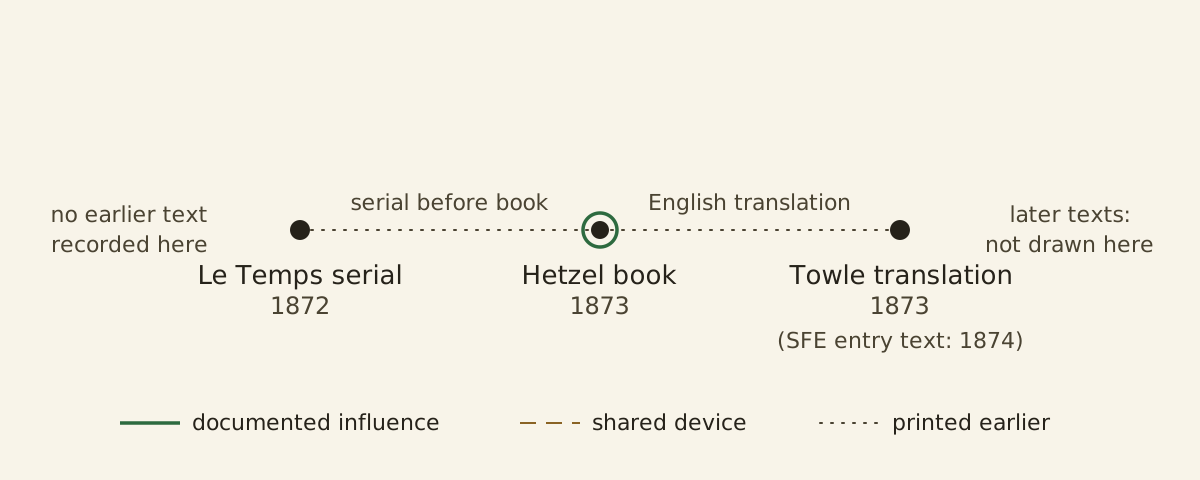
- Solid: documented influence (the later author's own statement, letter, review or note)
- Dashed: shared device (similar texts, no borrowing claimed)
- Dotted: dates only (publication order or other dates; no link claimed)
Lineage strip — three printings of the one novel, joined by dotted lines for publication order only.
Lineage strip: Le Temps serial to Towle translation, 1872–1873 · Genre Fiction Lineage · CC BY 4.0
Reuse credit (CC BY)
"Lineage strip: Le Temps serial to Towle translation, 1872–1873" by Genre Fiction Lineage, https://genrefictionlineage.com/scene-maps/around-world-80-days/, licensed under CC BY 4.0 (https://creativecommons.org/licenses/by/4.0/)
Dates, places and quotations from Jules Verne, Le Tour du monde en quatre-vingts jours, Project Gutenberg eBook #46541 (Hetzel illustrated edition), and the other sources listed on the entry page
Project Gutenberg's English text, eBook #103, carries Towle's name but does not say which printing it follows, so the English quotations on this page are new translations. For a French detective series that was in print before this novel, see Émile Gaboriau's Lecoq (printed earlier).
Which text does this map follow?
A chapter and a date only mean something in a named text. This map follows Project Gutenberg's transcription of a Hetzel illustrated edition with drawings by Neuville and Benett, whose title page gives the publisher as “J. HETZEL ET Cie, 18, RUE JACOB” and no year. The printer's line at the end reads “Imp. Gauthier-Villars, quai des Grands-Augustins, 55.—1757-73.”
The transcribers list the misprints they corrected. One of them is a date. In chapter IX, the day after leaving Suez was printed as the 29th and is corrected to “le 10 octobre” (“10 October”), which is the date this map uses.
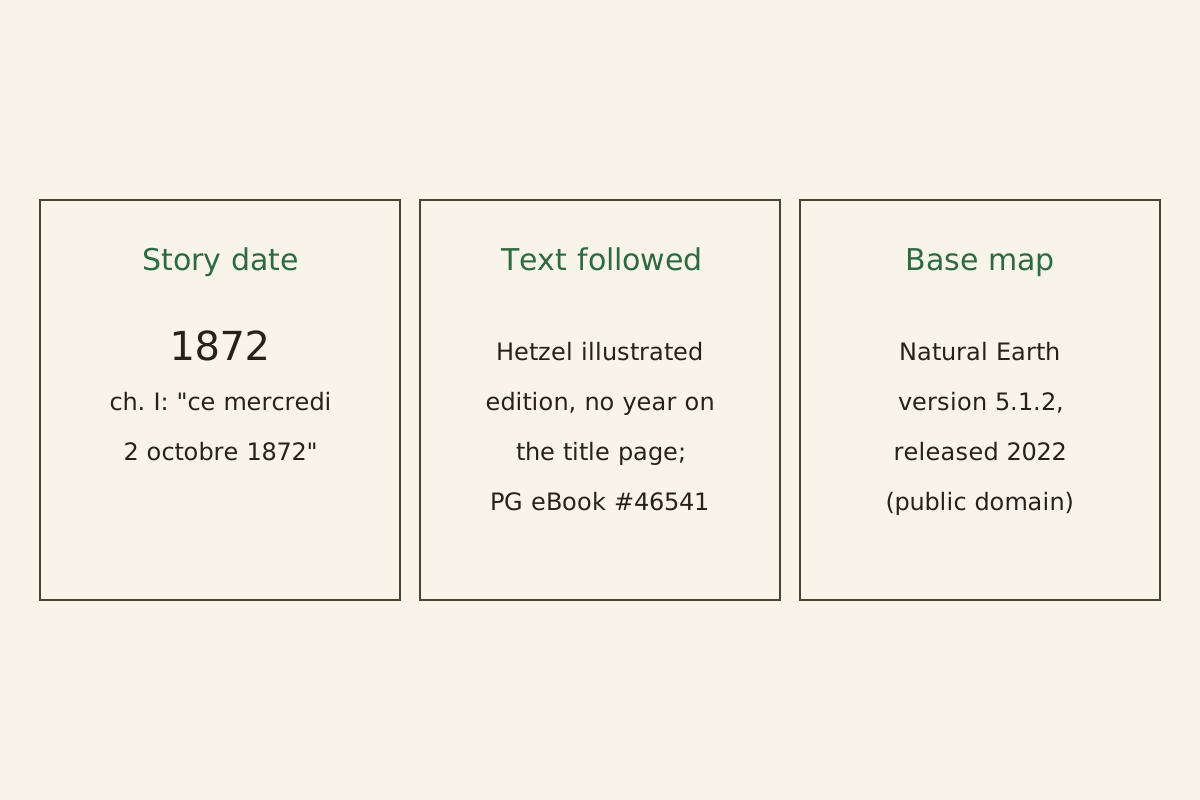
Three dates — the story year, the edition followed and the base map, kept apart as the cataloguing rules require.
Around the World in Eighty Days map: the three dates · Genre Fiction Lineage · CC BY 4.0
Reuse credit (CC BY)
"Around the World in Eighty Days map: the three dates" by Genre Fiction Lineage, https://genrefictionlineage.com/scene-maps/around-world-80-days/, licensed under CC BY 4.0 (https://creativecommons.org/licenses/by/4.0/)
Dates, places and quotations from Jules Verne, Le Tour du monde en quatre-vingts jours, Project Gutenberg eBook #46541 (Hetzel illustrated edition), and the other sources listed on the entry page
The two engravings come from a different copy, catalogued by the National Library of Poland as Hetzel, 1874, and were not compared page by page with the transcription. Present-day place names come from Natural Earth or from the Wikidata item for each place.
Places on the map
The English below is Genre Fiction Lineage translation; the French sentence for each place is in the places CSV.
- London: chapter VII, “Left London, Wednesday 2 October, 8.45 p.m.” (exact)
- Paris: chapter VII, “Arrived at Paris, Thursday 3 October, 7.20 a.m.” (exact)
- Turin: chapter VII, “Arrived at Turin by the Mont Cenis, Friday 4 October” (exact)
- Brindisi: chapter VII, “Arrived at Brindisi, Saturday 5 October, 4 p.m.” (exact)
- Suez: chapter VII, “Arrived at Suez, Wednesday 9 October, 11 a.m.” (exact)
- Aden: chapter IX, “it called at Steamer Point, north-west of the Aden roads” (approximate)
- Bombay: chapter X, “the passengers of the Mongolia had landed at Bombay” (exact)
- Nassik: chapter XI, “the train crossed the Ghats and passed through Nassik” (exact)
- Burhampour: chapter XI, “the train stopped at Burhampour station” (exact)
- Kholby: chapter XI, “At the hamlet of Kholby” (not placed)
- Rothal: chapter XI, “fifteen miles short of Rothal station” (not placed)
- The pagoda of Pillaji: chapter XII, “To the pagoda of Pillaji, two miles from here” (not placed)
- Allahabad: chapter XIV, “the guide announced Allahabad station” (exact)
- Benares: chapter XIV, “the train stopped at Benares station” (exact)
- Calcutta: chapter XIV, “At last, at seven in the morning, Calcutta was reached” (exact)
- Singapore: chapter XVII, “put in at Singapore to take on coal” (exact)
- Hong Kong: chapter XVIII, “that crowded the channels of Hong Kong” (exact)
- Off Shanghai: chapter XXI, “no more than forty-five miles from Shanghai” (approximate)
- Yokohama: chapter XXII, “the Carnatic entered the port of Yokohama” (exact)
- The 180th meridian: chapter XXIV, “on 23 November, passed the hundred-and-eightieth meridian” (not placed)
- San Francisco: chapter XXIV, “entered the bay of the Golden Gate and reached San Francisco” (exact)
- Ogden: chapter XXVII, “the travellers got off at Ogden station” (exact)
- Medicine Bow: chapter XXVIII, “The Medicine Bow bridge is shaken” (approximate)
- Kearney: chapter XXIX, “less than a hundred paces from Kearney station” (approximate)
- Omaha: chapter XXXI, “they all rushed to Omaha station” (exact)
- Chicago: chapter XXXI, “at four in the afternoon, it reached Chicago” (exact)
- New York: chapter XXXI, “the station on the right bank of the river” (approximate)
- Queenstown: chapter XXXIII, “the Henrietta entered Queenstown harbour” (exact)
- Dublin: chapter XXXIII, “reached Dublin at daybreak” (exact)
- Liverpool: chapter XXXIII, “Phileas Fogg at last landed on the quay at Liverpool” (exact)
Sources
- 1Jules Verne, Le Tour du monde en quatre-vingts jours, illustrated by Alphonse de Neuville and Léon Benett, Project Gutenberg eBook #46541, https://www.gutenberg.org/ebooks/46541 (base text: a Hetzel illustrated edition, Paris: J. Hetzel et Cie, 18 rue Jacob, with no year on the title page; printer's line "Imp. Gauthier-Villars ... 1757-73"; transcribed from an Internet Archive scan from Canadian libraries) https://www.gutenberg.org/ebooks/46541Read: full text, all 37 chapters, the table of contents and the transcribers' list of corrections
- 2"Verne, Jules," in John Clute, David Langford and Graham Sleight (eds), The Encyclopedia of Science Fiction, https://sf-encyclopedia.com/entry/verne_jules, accessed 2 November 2026 https://sf-encyclopedia.com/entry/verne_julesRead: full entry (updated 27 July 2026), text and bibliography lines for Le Tour du monde
- 3Jules Verne, Around the World in Eighty Days, translated by George M. Towle, Project Gutenberg eBook #103, https://www.gutenberg.org/ebooks/103 (base printing not stated) https://www.gutenberg.org/ebooks/103Read: header and contents only
- 4Project Gutenberg catalogue records for eBooks #46541, #103 and #20975 (read in the catalogue feed pg_catalog.csv), https://www.gutenberg.org/ebooks/46541 https://www.gutenberg.org/ebooks/46541Read: the rows for Verne's novel and for Nellie Bly
- 5Natural Earth, version 5.1.2 (released 13 May 2022), 1:110m and 1:50m land, 1:50m populated places and 1:10m populated places (simple), from the publisher's GitHub repository nvkelso/natural-earth-vector, https://github.com/nvkelso/natural-earth-vector https://github.com/nvkelso/natural-earth-vectorRead: the four GeoJSON layers named, the repository licence and the latest-release recordText licence: Public domain
- 6Wikidata items Q733093 (Cóbh, alias Queenstown), Q1028483 (Medicine Bow) and Q162442 (Prayagraj, alias Allahabad), https://www.wikidata.org/wiki/Q733093, https://www.wikidata.org/wiki/Q1028483 and https://www.wikidata.org/wiki/Q162442 https://www.wikidata.org/wiki/Q733093Read: the three items' EntityData JSONText licence: CC0
- 7Jennifer Jenkins and James Boyle, "Public Domain Day 2026," Center for the Study of the Public Domain, Duke Law School https://web.law.duke.edu/cspd/publicdomainday/2026/Read: full pageText licence: CC BY 4.0
- 8Urheberrechtsgesetz § 64 (Allgemeines), gesetze-im-internet.de https://www.gesetze-im-internet.de/urhg/__64.htmlRead: full text of the section
Cite this page
Genre Fiction Lineage. “Around the World in 80 Days: Fogg's Route, Dated by the Text.” Genre Fiction Lineage, published 3 November 2026. https://genrefictionlineage.com/scene-maps/around-world-80-days/. Accessed [the date you read it].
Next shelf over:
- Dracula Map: another novel whose places can be pinned chapter by chapter to its own sentences (for comparison).
- 221B Baker Street: Fogg's London starts at a club; Holmes's starts at a numbered door (for comparison).
- Read the text: Le Tour du monde en quatre-vingts jours (1873), Project Gutenberg
Related entries
More from Scene Maps.
Scene map
Dracula Map: Counted Here, Most Chapters Stay in England
By this page's count, 19 of Dracula's 27 chapters are set mainly in England. Every place tied to a chapter and a sentence, with Castle Dracula left unplaced.
Picture credit
"Houses by a beck (Whitby II)" by Frank Meadow Sutcliffe, undated — https://commons.wikimedia.org/wiki/File:Sutcliffe,_Frank_Meadow_(5226243318).jpg — Public domain (US: Sutcliffe (1853-1941) worked as a commercial photographer; the print is presumed published in his working life, before 1931 (presumption, not checked); Germany: 70 years after his death in 1941, expired 2011 (UrhG §64); France: 70 years after death, CPI L123-1 general rule, not checked against Légifrance; he was English, so the died-for-France extension does not apply (not checked))
Catalogue entry
221B Baker Street: Holmes's Rooms in the Stories, 1887–1903
Holmes's address as Doyle's text gives it: No. 221B, Baker Street in 1887, then the steps, windows and the house opposite, story by story, with a CSV.
Picture credit
"Breakfast in the rooms (The Five Orange Pips)" by Sidney Paget, 1892 — https://commons.wikimedia.org/wiki/File:Sidney_Paget_-_The_Five_Orange_Pips_01.jpg — Public domain (US: published 1891 in The Strand Magazine and 1892 in the Harper book edition (published before 1931); Germany and France: Paget died 1908 (GND 114595541X), so 70 years after death have run out (UrhG §64; CPI L123-1, general rule, not checked against Légifrance); he was British and died before 1914, so the French 'mort pour la France' extension does not apply; the halftone block maker's mark (W&S Ld) is a firm active by 1892 (presumed out of copyright))