Scene Maps · Catalogue entry
221B Baker Street: Holmes's Rooms in the Stories, 1887–1903
Genre Fiction Lineage Published
A Study in Scarlet gave the earliest known printing of Holmes's address, “No. 221B, Baker Street,” in 1887. Later stories fill in the rooms, from the seventeen steps in “A Scandal in Bohemia” (1891) to the empty house across the street in “The Adventure of the Empty House” (1903).
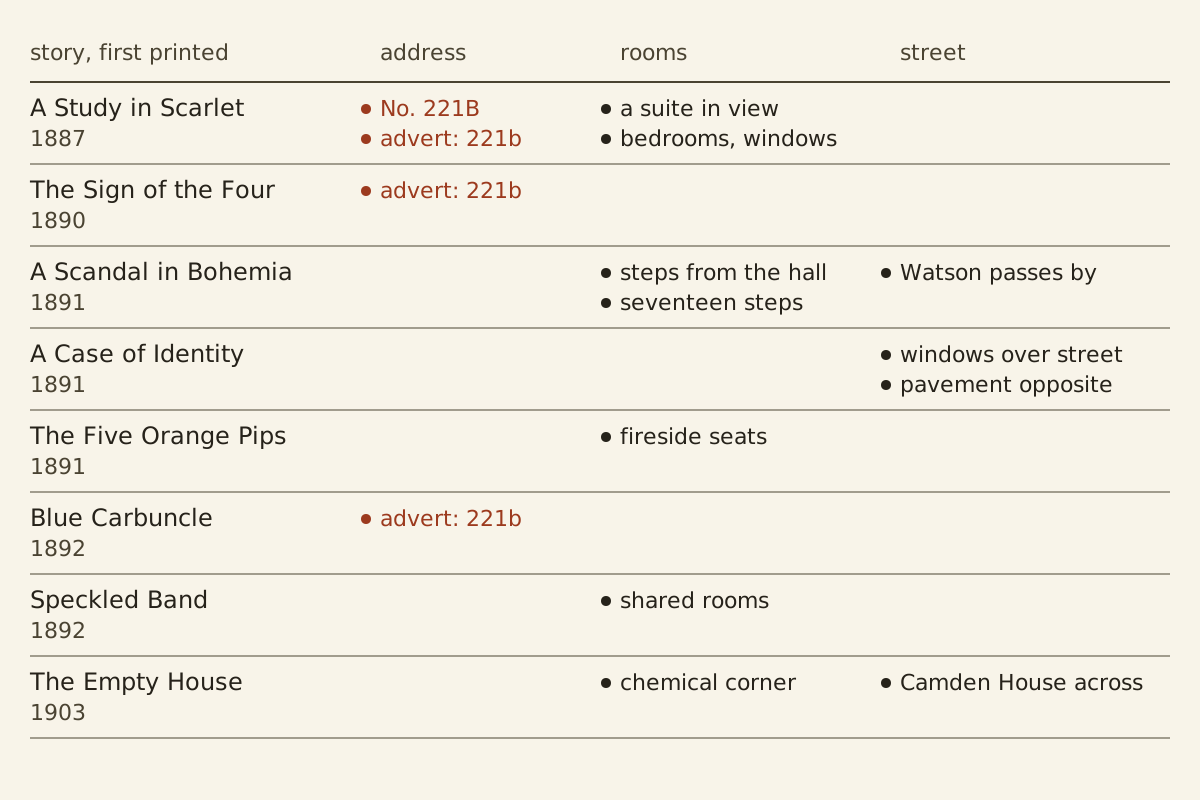
Fifteen clues in eight stories — what each text says about the address, the rooms and the street, in print order.
Baker Street clues, story by story · Genre Fiction Lineage · CC BY 4.0
Reuse credit (CC BY)
"Baker Street clues, story by story" by Genre Fiction Lineage, https://genrefictionlineage.com/scene-maps/221b-baker-street/, licensed under CC BY 4.0 (https://creativecommons.org/licenses/by/4.0/)
Clues and dates checked against transcriptions of the scanned printings listed on the entry page
This entry keeps to what the printed stories say, story by story, and quotes each clue from the magazine and annual printings of 1887 to 1903, as transcribed from scans at Wikisource. It does not place the house on a map or match it to a building. The clues, with chapter and source, are in a CSV of 15 Baker Street clues CSV · provenance note Clues and dates checked against transcriptions of the scanned printings listed on the entry page, and the eight printings, with their story dates, in a CSV of printings and story dates CSV · provenance note Clues and dates checked against transcriptions of the scanned printings listed on the entry page.
By this page's count, a clue is a passage that gives the number, describes the rooms, or says what can be seen from them or done in the street outside. Passages that only name Baker Street as a place someone goes, such as a cab ride home, are left out. So are stories not read for this page.
Where does 221B first appear in print?
The number first appears at the start of Part I, chapter II of A Study in Scarlet. Watson and Holmes “inspected the rooms at No. 221B, Baker Street,” a day after Holmes said, at the end of chapter I, “I have my eye on a suite in Baker Street.” The title page of Beeton's Christmas Annual prints the year 1887, the author as A. Conan Doyle, and the publisher, Ward, Lock and Co. of London. The Arthur Conan Doyle Encyclopedia gives the publication date as 21 November 1887 and counts it as Holmes's debut.
The address comes back in chapter V, where a notice in the “Found” column of a newspaper ends “Apply Dr. Watson, 221b, Baker Street, between eight and nine this evening.” The Wikisource transcription marks the letter after 221 as a reduced capital B in chapter II and as a small capital in chapter V. Those 1887 pages are marked proofread but not yet validated, so the setting rests on one proofreading of the scan.
Two later notices print the number again. Lippincott's Monthly Magazine for February 1890 printed The Sign of the Four, where Holmes's advertisement for a missing launch asks for news “at 221b Baker Street,” with the b marked as italic in the transcription. The Strand Magazine for January 1892 printed Holmes's notice in “The Adventure of the Blue Carbuncle” with the words “at 221b, Baker-street,” the b again marked as a small capital.
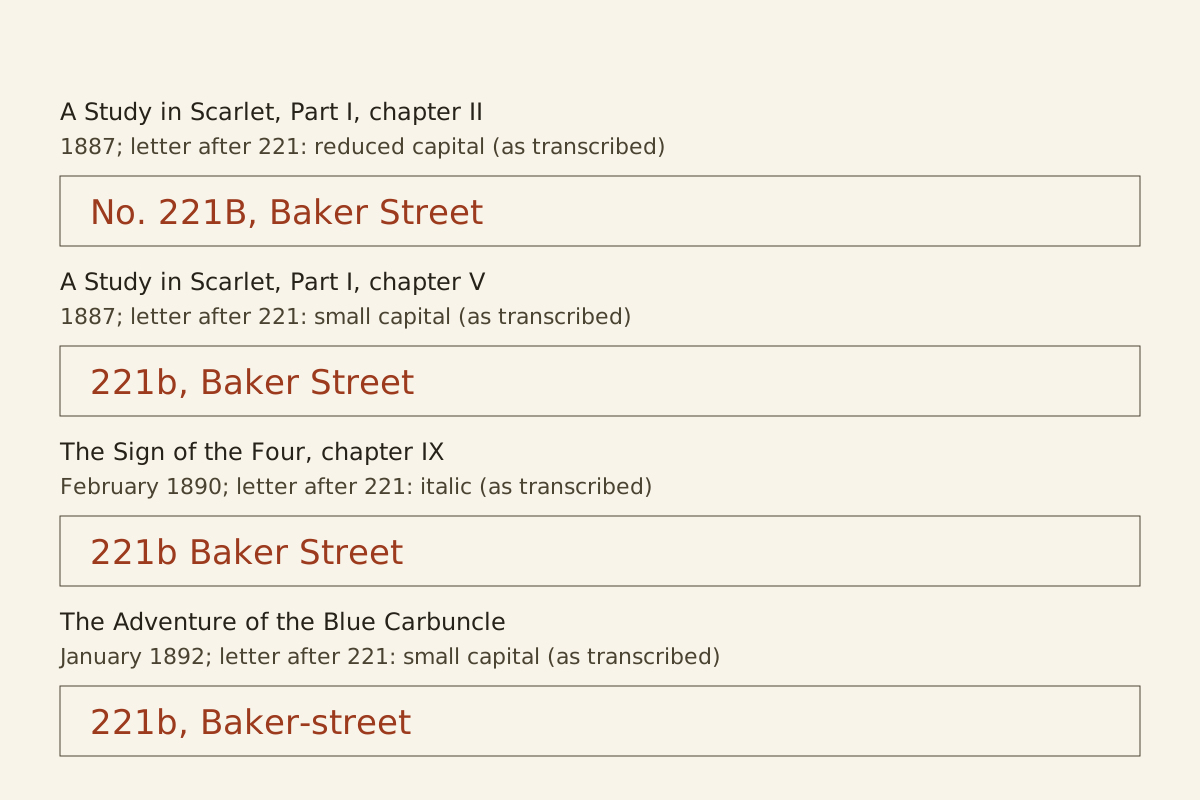
The address as printed — four forms in three magazines, with the letter after 221 set as the transcriptions of the scans mark it.
The address as printed · Genre Fiction Lineage · CC BY 4.0
Reuse credit (CC BY)
"The address as printed" by Genre Fiction Lineage, https://genrefictionlineage.com/scene-maps/221b-baker-street/, licensed under CC BY 4.0 (https://creativecommons.org/licenses/by/4.0/)
Clues and dates checked against transcriptions of the scanned printings listed on the entry page
Every Strand story of 1891 and 1892 quoted on this page that names the street prints it as “Baker-street,” with a hyphen and a small s. The 1903 story prints “Baker Street.”
What do the stories say about the rooms?
A Study in Scarlet gives the whole plan in one sentence: “a couple of comfortable bedrooms and a single large airy sitting-room, cheerfully furnished, and illuminated by two broad windows.” Later stories add parts without redrawing it. In “A Scandal in Bohemia” (The Strand Magazine, July 1891), Holmes asks Watson about “the steps which lead up from the hall to this room,” then gives the count himself: “I know that there are seventeen steps.”
“The Five Orange Pips” (November 1891) opens on a stormy September evening with the two men on either side of the fire, where “Sherlock Holmes sat moodily at one side of the fireplace cross-indexing his records of crime.” “The Adventure of the Speckled Band” (February 1892) looks back to the time when they were “sharing rooms as bachelors, in Baker-street.”
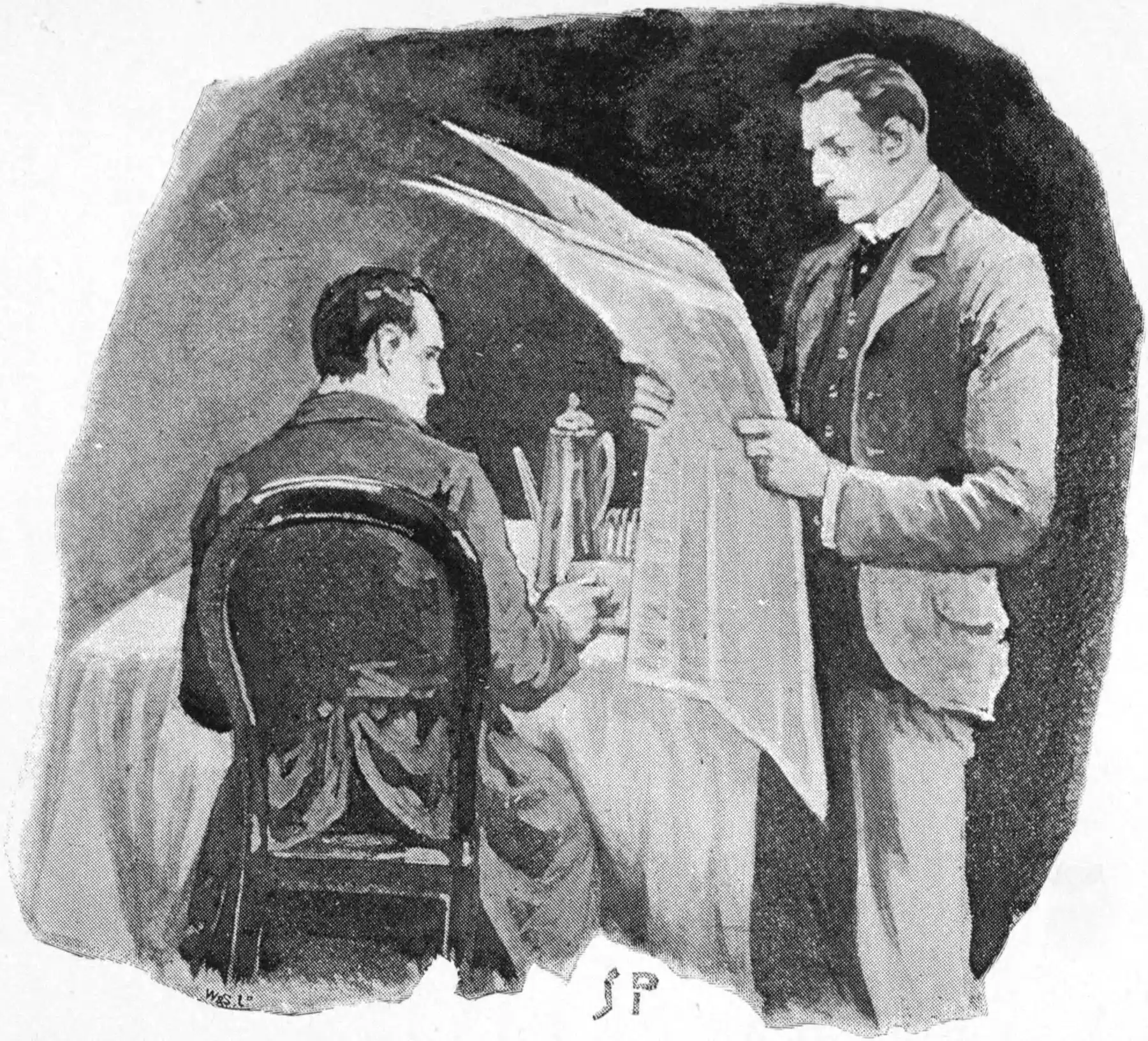
Breakfast in the rooms — Sidney Paget's drawing for “The Five Orange Pips” (Strand, 1891), the morning Watson finds the news in the paper, here from Harper's 1892 book edition.
Breakfast in the rooms (The Five Orange Pips) · Sidney Paget · public domain
Full credit
"Breakfast in the rooms (The Five Orange Pips)" by Sidney Paget, 1892 — https://commons.wikimedia.org/wiki/File:Sidney_Paget_-_The_Five_Orange_Pips_01.jpg — Public domain (US: published 1891 in The Strand Magazine and 1892 in the Harper book edition (published before 1931); Germany and France: Paget died 1908 (GND 114595541X), so 70 years after death have run out (UrhG §64; CPI L123-1, general rule, not checked against Légifrance); he was British and died before 1914, so the French 'mort pour la France' extension does not apply; the halftone block maker's mark (W&S Ld) is a firm active by 1892 (presumed out of copyright))
“The Adventure of the Empty House” was printed in 1903, 16 years after A Study in Scarlet. It brings Watson back to rooms kept as they had been. He lists what he finds in place: “There were the chemical corner and the acid-stained, deal-topped table.”
What do the stories say about the street?
The street is seen through the windows. In “A Case of Identity” (The Strand Magazine, September 1891), Holmes stands “gazing down into the dull, neutral-tinted London street,” and a client waits “on the pavement opposite” until she “hurried across the road” and rang. In “A Scandal in Bohemia,” Watson says “my way led me through Baker-street” on a night the story dates to 20 March 1888, and looks up to see Holmes's “tall spare figure pass twice in a dark silhouette against the blind.”
Both stories put the sitting-room above the street. The client in “A Case of Identity” “peeped up in a nervous, hesitating fashion at our windows,” and Watson, standing outside in “A Scandal in Bohemia,” sees Holmes “even as I looked up.” Neither text gives the floor by number.
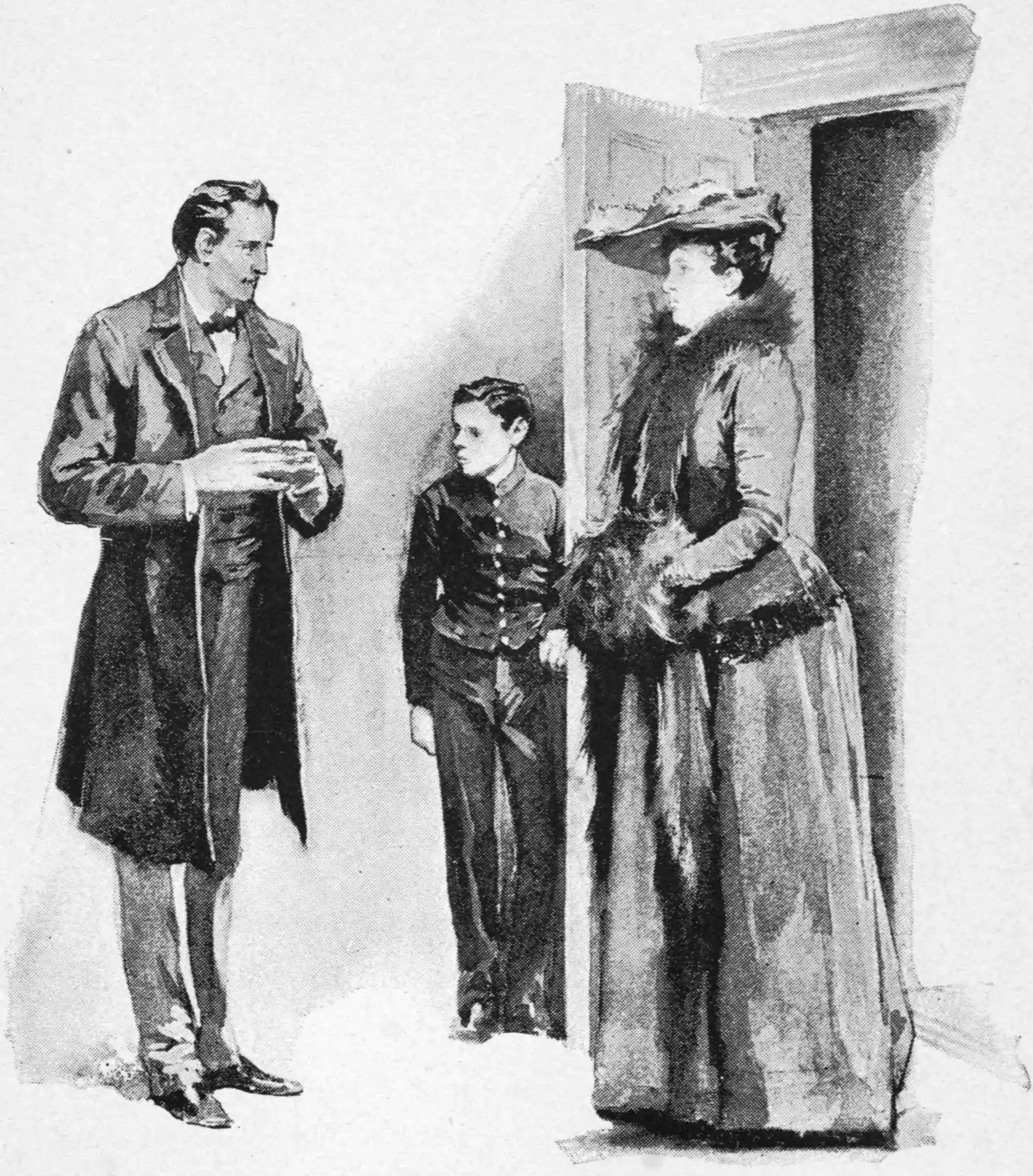
Sherlock Holmes welcomed her — Sidney Paget's drawing for “A Case of Identity,” Strand 1891, here from Harper's 1892 book edition: the client who had waited on the pavement opposite comes up to the sitting-room.
Sherlock Holmes welcomed her (A Case of Identity) · Sidney Paget · public domain
Full credit
"Sherlock Holmes welcomed her (A Case of Identity)" by Sidney Paget, 1892 — https://commons.wikimedia.org/wiki/File:Sidney_Paget_-_A_Case_of_Identity_01.jpg — Public domain (US: published 1891 in The Strand Magazine and 1892 in the Harper book edition (published before 1931); Germany and France: Paget died 1908 (GND 114595541X), so 70 years after death have run out (UrhG §64; CPI L123-1, general rule, not checked against Légifrance); he was British and died before 1914, so the French 'mort pour la France' extension does not apply)
“The Adventure of the Empty House” uses the far side of the road. Holmes leads Watson into a dark, empty building and tells him, “We are in Camden House, which stands opposite to our own old quarters.” From its window they look up at their old rooms, where a wax bust of Holmes throws its shadow on the lit blind. The two stories, twelve years apart in print, both show a Holmes-shaped shadow on the lit blind, seen from outside.
None of these passages gives a position that can be pinned on a map, and this entry does not try. Whether a house numbered 221 stood in Baker Street in the 1880s is a question for a street directory of the period. No directory was read for this page, so it makes no claim either way.
When do the stories take place?
By this page's reading, print dates and story dates part company in four of the eight stories. “A Scandal in Bohemia” was printed in 1891 but dates its opening to 1888, three years earlier. “The Five Orange Pips” (1891) sets its case in “The year '87,” four years before print. “The Adventure of the Speckled Band” (1892) begins “early in April in the year '83,” and “The Adventure of the Empty House” (1903) opens “in the spring of the year 1894,” each nine years before print.
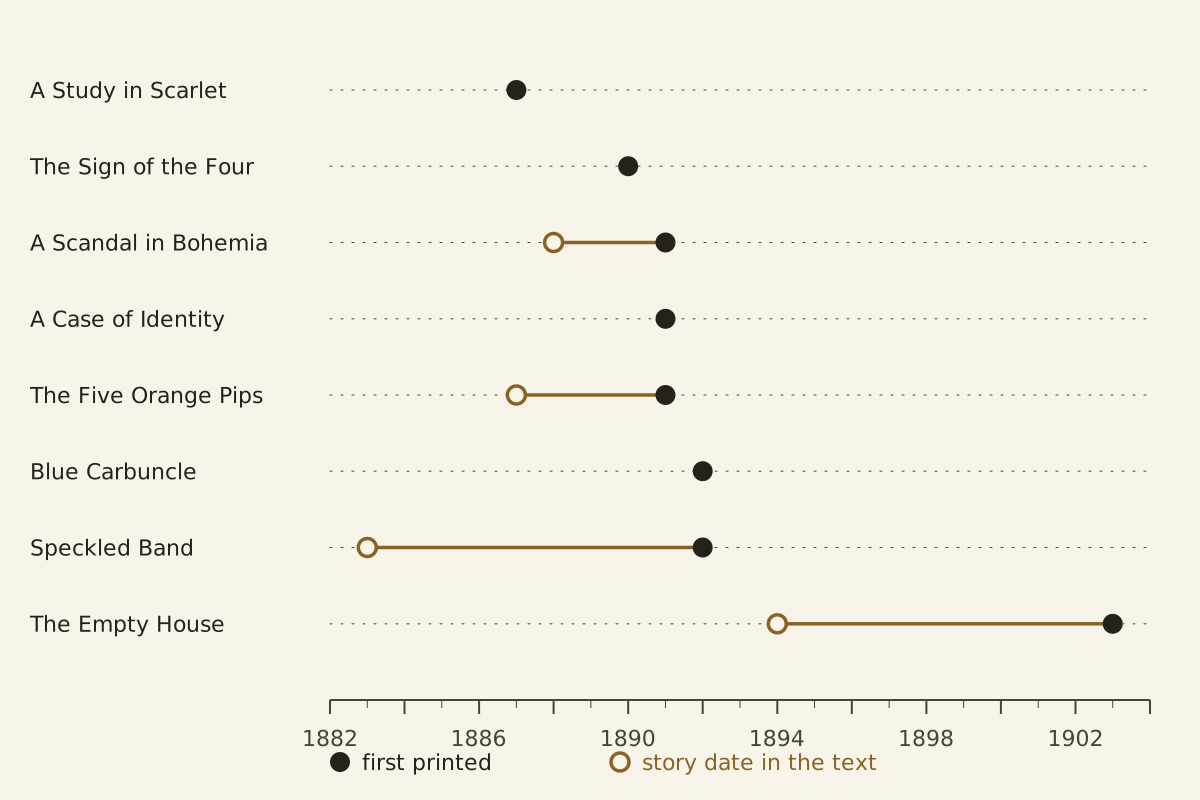
Story dates and print dates — the year each story was first printed and, for the four whose case year is recorded on this page, the year the text gives.
Story dates and print dates · Genre Fiction Lineage · CC BY 4.0
Reuse credit (CC BY)
"Story dates and print dates" by Genre Fiction Lineage, https://genrefictionlineage.com/scene-maps/221b-baker-street/, licensed under CC BY 4.0 (https://creativecommons.org/licenses/by/4.0/)
Clues and dates checked against transcriptions of the scanned printings listed on the entry page
A Study in Scarlet names no year for the move into the rooms, though Watson says he took his medical degree “In the year 1878.” The dates also show who lived in the rooms. In “A Scandal in Bohemia,” Watson, now married, writes that “My marriage had drifted us away from each other,” while Holmes “remained in our lodgings in Baker-street.” By that story's own date of 1888, the rooms first shared in A Study in Scarlet had one tenant left.
The gaps were counted from the CSV by year. The clue table on this page follows print order: the order in which magazine readers met each detail, not the order of events in Watson's account.
What came before and after 221B?
Inside Doyle's own texts, the line is publication order. The four stories on the strip were printed in 1887, 1890, 1891 and 1903, and each later one adds to the address the first one gave. All four have the same author, so the strip draws dates, not influence.
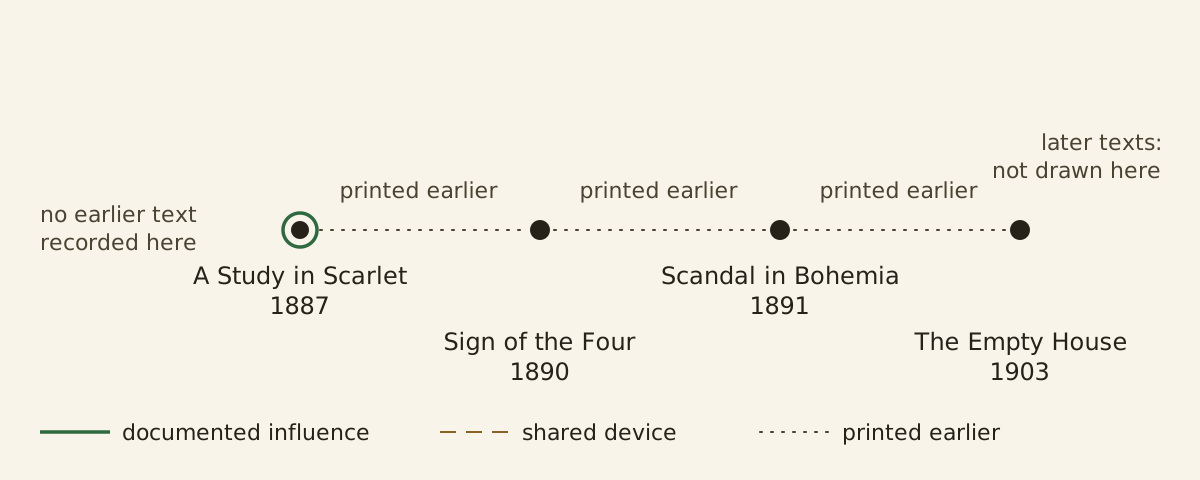
- Solid: documented influence (the later author's own statement, letter, review or note)
- Dashed: shared device (similar texts, no borrowing claimed)
- Dotted: dates only (publication order or other dates; no link claimed)
Lineage strip — four Holmes texts in print order; the dotted lines rest on dates alone, no earlier text is recorded here, and later stories are not drawn.
Lineage strip: A Study in Scarlet to The Empty House, 1887 to 1903 · Genre Fiction Lineage · CC BY 4.0
Reuse credit (CC BY)
"Lineage strip: A Study in Scarlet to The Empty House, 1887 to 1903" by Genre Fiction Lineage, https://genrefictionlineage.com/scene-maps/221b-baker-street/, licensed under CC BY 4.0 (https://creativecommons.org/licenses/by/4.0/)
Clues and dates checked against transcriptions of the scanned printings listed on the entry page
No earlier fictional detective's address was traced for this entry, so the left end of the strip stays empty. The rooms also open “The Speckled Band” of 1892, a sealed-room case; its place in a line of such stories that starts with Le Fanu's tale of about 1838, half a century before A Study in Scarlet, is traced in the locked-room lineage from Le Fanu to Leroux (printed earlier).
Sources
- 1Arthur Conan Doyle, "A Study in Scarlet" (Beeton's Christmas Annual, twenty-eighth season, London, Ward, Lock and Co., 1887), transcribed at Wikisource, https://en.wikisource.org/wiki/Beeton's_Christmas_Annual/A_Study_in_Scarlet https://en.wikisource.org/wiki/Beeton's_Christmas_Annual/A_Study_in_ScarletRead: the title page and printed pages 6, 7 and 31 (transcription of the scanned annual), with the index of the scan
- 2"A Study in Scarlet," The Arthur Conan Doyle Encyclopedia, https://www.arthur-conan-doyle.com/index.php?title=A_Study_in_Scarlet, accessed 2 November 2026 https://www.arthur-conan-doyle.com/index.php?title=A_Study_in_ScarletRead: the entry page (editions list)
- 3Arthur Conan Doyle, "The Sign of the Four; or, The Problem of the Sholtos," Lippincott's Monthly Magazine, vol. 45 (February 1890), transcribed at Wikisource, https://en.wikisource.org/wiki/Lippincott's_Monthly_Magazine/Volume_45/February_1890/The_Sign_of_the_Four https://en.wikisource.org/wiki/Lippincott's_Monthly_Magazine/Volume_45/February_1890/The_Sign_of_the_FourRead: opening page and chapter IX (transcription of the scanned volume)
- 4Arthur Conan Doyle, "The Adventure of the Blue Carbuncle," The Strand Magazine, vol. 3, no. 13 (January 1892), transcribed at Wikisource, https://en.wikisource.org/wiki/The_Strand_Magazine/Volume_3/Issue_13/The_Adventure_of_the_Blue_Carbuncle https://en.wikisource.org/wiki/The_Strand_Magazine/Volume_3/Issue_13/The_Adventure_of_the_Blue_CarbuncleRead: full story and the issue page (Vol. 3. No. 13. January 1892.)
- 5Arthur Conan Doyle, "A Scandal in Bohemia," The Strand Magazine, vol. 2, no. 7 (July 1891), transcribed at Wikisource, https://en.wikisource.org/wiki/The_Strand_Magazine/Volume_2/Issue_7/A_Scandal_in_Bohemia https://en.wikisource.org/wiki/The_Strand_Magazine/Volume_2/Issue_7/A_Scandal_in_BohemiaRead: full story and the issue page (Vol. 2. No. 7. July 1891.)
- 6Arthur Conan Doyle, "The Five Orange Pips," The Strand Magazine, vol. 2, no. 11 (November 1891), transcribed at Wikisource, https://en.wikisource.org/wiki/The_Strand_Magazine/Volume_2/Issue_11/The_Five_Orange_Pips https://en.wikisource.org/wiki/The_Strand_Magazine/Volume_2/Issue_11/The_Five_Orange_PipsRead: full story and the issue page (Vol. 2. No. 11. November 1891.)
- 7Arthur Conan Doyle, "The Adventure of the Speckled Band," The Strand Magazine, vol. 3, no. 14 (February 1892), transcribed at Wikisource https://en.wikisource.org/wiki/The_Strand_Magazine/Volume_3/Issue_14/The_Adventure_of_the_Speckled_BandRead: full text and the issue page
- 8Arthur Conan Doyle, "The Adventure of the Empty House," The Strand Magazine, vol. 26 (1903), transcribed at Wikisource, https://en.wikisource.org/wiki/The_Strand_Magazine/Volume_26/The_Adventure_of_the_Empty_House https://en.wikisource.org/wiki/The_Strand_Magazine/Volume_26/The_Adventure_of_the_Empty_HouseRead: full story and the volume index (year 1903; issue month not read)
- 9Arthur Conan Doyle, "A Case of Identity," The Strand Magazine, vol. 2, no. 9 (September 1891), transcribed at Wikisource, https://en.wikisource.org/wiki/The_Strand_Magazine/Volume_2/Issue_9/A_Case_of_Identity https://en.wikisource.org/wiki/The_Strand_Magazine/Volume_2/Issue_9/A_Case_of_IdentityRead: full story and the issue page (Vol. 2. No. 9. September 1891.)
- 10Arthur Conan Doyle, Adventures of Sherlock Holmes, illustrated by Sidney Paget (New York, Harper & Brothers, 1892), Internet Archive record adventuresofsher00doylrich (University of California Libraries copy) https://archive.org/details/adventuresofsher00doylrichRead: bibliographic record only (metadata)
- 11Arthur Conan Doyle, A Study in Scarlet, Project Gutenberg eBook https://www.gutenberg.org/ebooks/244Read: full text
- 12Gemeinsame Normdatei records for Arthur Conan Doyle (11852710X), Alfred Perceval Graves (1048161684) and Sidney Paget (114595541X), via lobid GND https://lobid.org/gnd/11852710XRead: authority records (life dates)
- 13Jennifer Jenkins and James Boyle, "Public Domain Day 2026," Center for the Study of the Public Domain, Duke Law School https://web.law.duke.edu/cspd/publicdomainday/2026/Read: full pageText licence: CC BY 4.0
- 14Urheberrechtsgesetz § 64 (Allgemeines), gesetze-im-internet.de https://www.gesetze-im-internet.de/urhg/__64.htmlRead: full text of the section
Cite this page
Genre Fiction Lineage. “221B Baker Street: Holmes's Rooms in the Stories, 1887–1903.” Genre Fiction Lineage, published 3 November 2026. https://genrefictionlineage.com/scene-maps/221b-baker-street/. Accessed [the date you read it].
Next shelf over:
- Dracula Map: Stoker also gives a character a numbered house in a real London street, No. 347, Piccadilly, in 1897 (shared device).
- Around the World in 80 Days: Fogg's London also starts at a numbered door, No. 7 Saville Row, but that page dates a route, not a set of rooms (for comparison).
- Read the text: A Study in Scarlet (1887), Project Gutenberg
Related entries
More from Scene Maps.
Scene map
Dracula Map: Counted Here, Most Chapters Stay in England
By this page's count, 19 of Dracula's 27 chapters are set mainly in England. Every place tied to a chapter and a sentence, with Castle Dracula left unplaced.
Picture credit
"Houses by a beck (Whitby II)" by Frank Meadow Sutcliffe, undated — https://commons.wikimedia.org/wiki/File:Sutcliffe,_Frank_Meadow_(5226243318).jpg — Public domain (US: Sutcliffe (1853-1941) worked as a commercial photographer; the print is presumed published in his working life, before 1931 (presumption, not checked); Germany: 70 years after his death in 1941, expired 2011 (UrhG §64); France: 70 years after death, CPI L123-1 general rule, not checked against Légifrance; he was English, so the died-for-France extension does not apply (not checked))
Scene map
Around the World in 80 Days: Fogg's Route, Dated by the Text
Verne's text dates Fogg's departure to 2 October 1872 and his deadline to 21 December. A map of the 21 legs, with counted dates and unplaced stops marked.
Picture credit
"The return to the Reform Club" by Alphonse de Neuville or Léon Benett, 1874 — https://commons.wikimedia.org/wiki/File:%27Around_the_World_in_Eighty_Days%27_by_Neuville_and_Benett_(139390668).jpg — Public domain (US: published in Paris by Hetzel by 1874 (National Library of Poland record "Paris: Hetzel, [1874]"), before 1931; Germany: Alphonse de Neuville died 1885 and Léon Benett 1917, so 70 years after death have run out (UrhG §64); France: the same, 70 years after death, CPI L123-1 general rule, not checked against Légifrance; Benett was French and died in 1917, the died-for-France extension was not checked, and 100 years after 1917 have also passed; the wood engraver is not identified and is presumed out of copyright from working years in the 1870s (presumption)); modified: cropped from the book page, desaturated and contrast adjusted on Wikimedia Commons before download