Fairy Tale Editions · Lineage essay
Little Red Riding Hood: Perrault's 1697 Text Has No Hunter
Genre Fiction Lineage Published
In Charles Perrault's 1697 text, the wolf eats Little Red Riding Hood and no hunter appears. The rescue, a huntsman cutting the wolf open, is in the Grimms' 1812 text, whose note says that apart from their oral source they had found the tale only in Perrault, the basis of Tieck's adaptation.
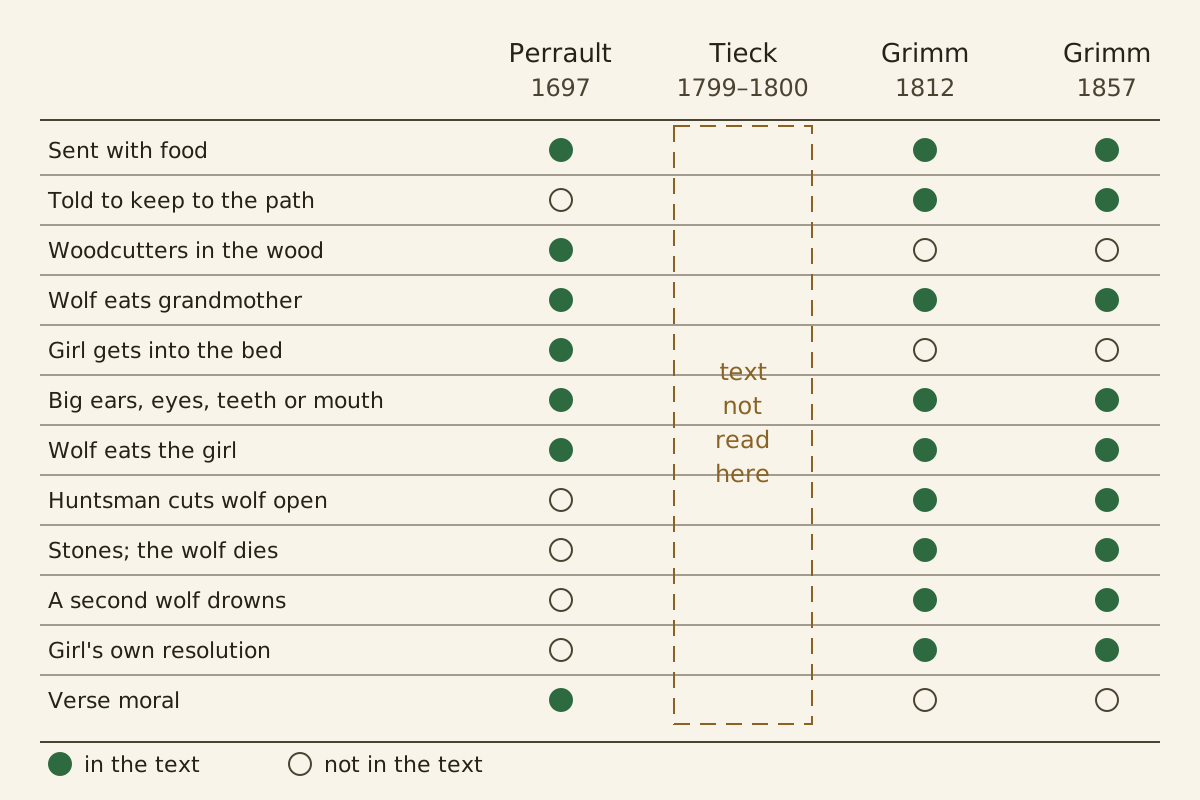
Four texts, twelve plot stages — which events Perrault's 1697 text and the Grimms' 1812 and 1857 texts print, with Tieck's 1799–1800 version listed but not read here.
Little Red Riding Hood: plot stages in four texts, 1697–1857 · Genre Fiction Lineage · CC BY 4.0
Reuse credit (CC BY)
"Little Red Riding Hood: plot stages in four texts, 1697–1857" by Genre Fiction Lineage, https://genrefictionlineage.com/fairy-tales/little-red-riding-hood/, licensed under CC BY 4.0 (https://creativecommons.org/licenses/by/4.0/)
Texts: Charles Perrault, Histoires ou contes du temps passé (Paris: Barbin, 1697), transcribed at French Wikisource; Jacob and Wilhelm Grimm, Kinder- und Haus-Märchen, vol. 1 (1812) and 7th edition (1857), transcribed at German Wikisource
Perrault's tale stops at the eating. A verse moral follows. The Grimms' text keeps going for about two-fifths of its length: a huntsman, a pair of scissors, stones in the wolf's belly, then a second wolf. Every stage in the chart, with the original sentence, a translation and the page, is in the CSV of plot stages in four texts CSV · provenance note Texts: Charles Perrault, Histoires ou contes du temps passé (Paris: Barbin, 1697), transcribed at French Wikisource; Jacob and Wilhelm Grimm, Kinder- und Haus-Märchen, vol. 1 (1812) and 7th edition (1857), transcribed at German Wikisource.
How does Perrault's 1697 text end?
The book is Histoires ou contes du temps passé, published in Paris by Claude Barbin with the year 1697 on its title page. No author's name appears there, and the royal privilege printed at the back, dated 28 October 1696, is granted to a “Sieur P. Darmancour,” who assigned it to Barbin; the privilege was entered in the register of the Paris printers and booksellers on 11 January 1697. The Grimms in 1812 call the tale Perrault's. Le petit chaperon rouge runs from page 47 to page 56, the second of eight tales in the table of contents.
The tale's last sentence is the eating: “Et, en disant ces mots, ce méchant loup se jetta sur le petit chaperon rouge, & la mangea.” In English, “And, saying these words, this wicked wolf threw himself on Little Red Riding Hood and ate her up” (Genre Fiction Lineage translation). Page 56 opens with the heading “MORALITÉ.”, and the verse moral fills that page.
Nobody comes back for her, and the tale ends where the wolf's meal ends. A full-text search of the 1697 tale for chasseur (hunter), veneur (huntsman), fusil (gun), ciseaux (scissors) and ventre (belly) finds nothing. The grandmother is gone as well: on page 52 the wolf “se jetta sur la bonne femme, & la devora en moins de rien,” he threw himself on the good woman and devoured her in no time (Genre Fiction Lineage translation).
One detail runs the other way. Perrault's girl “se deshabille, & va se mettre dans le lit” (undresses and goes to get into the bed; Genre Fiction Lineage translation) beside the wolf on page 54, while in both Grimm texts she draws back the bed curtains and stays standing beside the bed. The table below gives the chart in text form, with the page where each stage appears.
| Plot stage | Perrault 1697 | Grimm 1812 | Grimm 1857 |
|---|---|---|---|
| Sent with food | yes, p. 48 | yes, p. 113 | yes, p. 140 |
| Told to keep to the path | no | yes, p. 113 | yes, p. 140 |
| Woodcutters in the wood | yes, p. 49 | no | no |
| Wolf eats grandmother | yes, p. 52 | yes, p. 115 | yes, p. 141 |
| Girl gets into the bed | yes, p. 54 | no | no |
| Big ears, eyes, teeth or mouth | yes, p. 55 | yes, p. 116 | yes, p. 142 |
| Wolf eats the girl | yes, p. 55 | yes, p. 116 | yes, p. 142 |
| Huntsman cuts wolf open | no | yes, p. 116 | yes, p. 142 |
| Stones; the wolf dies | no | yes, p. 116 | yes, p. 143 |
| A second wolf drowns | no | yes, p. 118 | yes, p. 144 |
| Girl's own resolution | no | yes, p. 117 | yes, p. 143 |
| Verse moral | yes, p. 56 | no | no |
Tieck's 1799–1800 version is not in the table because its text is not read for this page.
Is there an earlier printed text?
This page has found no printed text of the tale earlier than the 1697 edition. The Grimms' 1812 note, quoted below, says that apart from their oral source they had found the tale only in Perrault, on whom Tieck's adaptation was based. That is one collection's search in 1812, not a census. Spoken tellings before 1697 are outside what a printing record can date, and this page cites none.
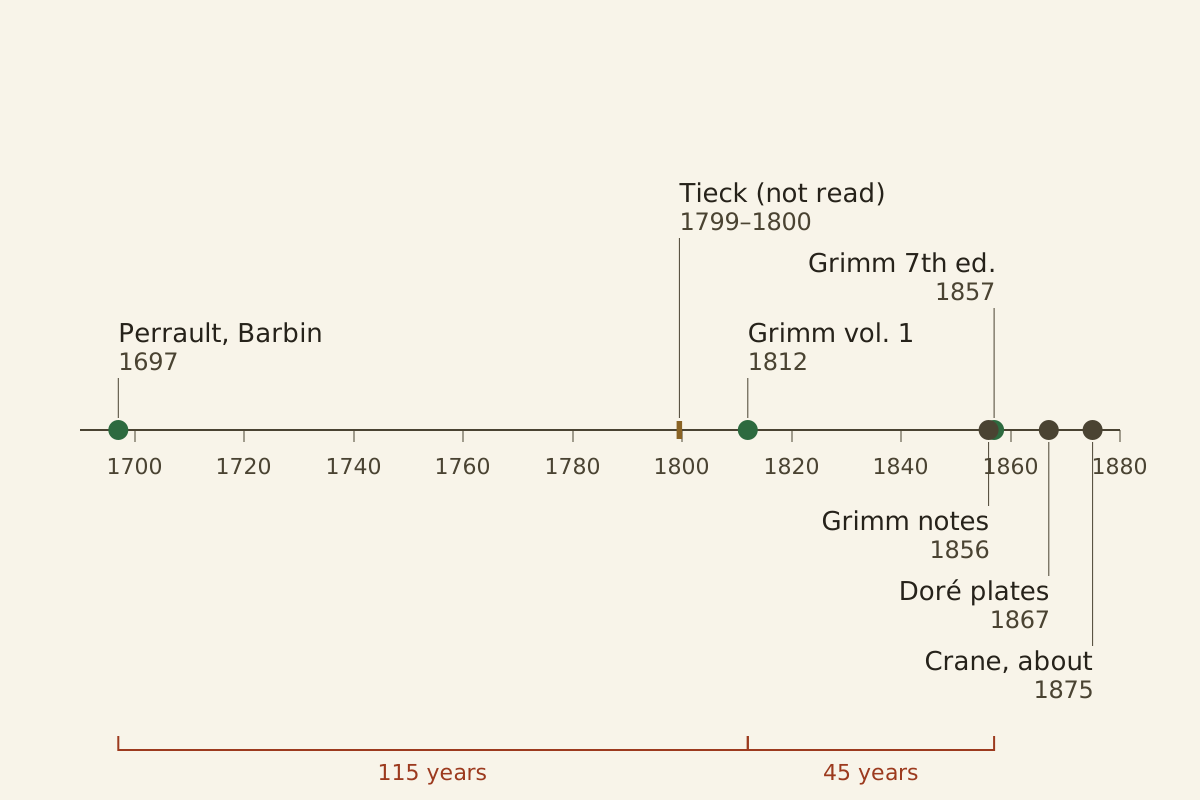
Little Red Riding Hood in print — the dated printings this page reads or cites, from the Barbin edition to Crane's toy book, with the gaps between the Perrault and Grimm texts.
Little Red Riding Hood in print, 1697–1875 · Genre Fiction Lineage · CC BY 4.0
Reuse credit (CC BY)
"Little Red Riding Hood in print, 1697–1875" by Genre Fiction Lineage, https://genrefictionlineage.com/fairy-tales/little-red-riding-hood/, licensed under CC BY 4.0 (https://creativecommons.org/licenses/by/4.0/)
Texts: Charles Perrault, Histoires ou contes du temps passé (Paris: Barbin, 1697), transcribed at French Wikisource; Jacob and Wilhelm Grimm, Kinder- und Haus-Märchen, vol. 1 (1812) and 7th edition (1857), transcribed at German Wikisource
Every date on the timeline, including the privilege of 28 October 1696 and its registration on 11 January 1697, is in the CSV of dated events, 1696 to about 1875 CSV · provenance note Texts: Charles Perrault, Histoires ou contes du temps passé (Paris: Barbin, 1697), transcribed at French Wikisource; Jacob and Wilhelm Grimm, Kinder- und Haus-Märchen, vol. 1 (1812) and 7th edition (1857), transcribed at German Wikisource with its page and source.
Who is in Perrault's wood?
Perrault's wood has people in it, although the reader never meets them. On page 49 the wolf meets the girl and wants to eat her, “mais il n’osa, à cause de quelques bucherons qui estoient dans la Forest,” but he did not dare, because of some woodcutters who were in the forest (Genre Fiction Lineage translation). The text never mentions them again.
Because he cannot attack her in the forest, the wolf needs a plan. He asks where the grandmother lives, hears that it is “par de-là le Moulin,” beyond the mill (Genre Fiction Lineage translation), at the first house of the village, and races the girl there by the shorter road while she gathers nuts and chases butterflies on the longer one. The woodcutters are the reason the danger moves indoors, to the grandmother's house.
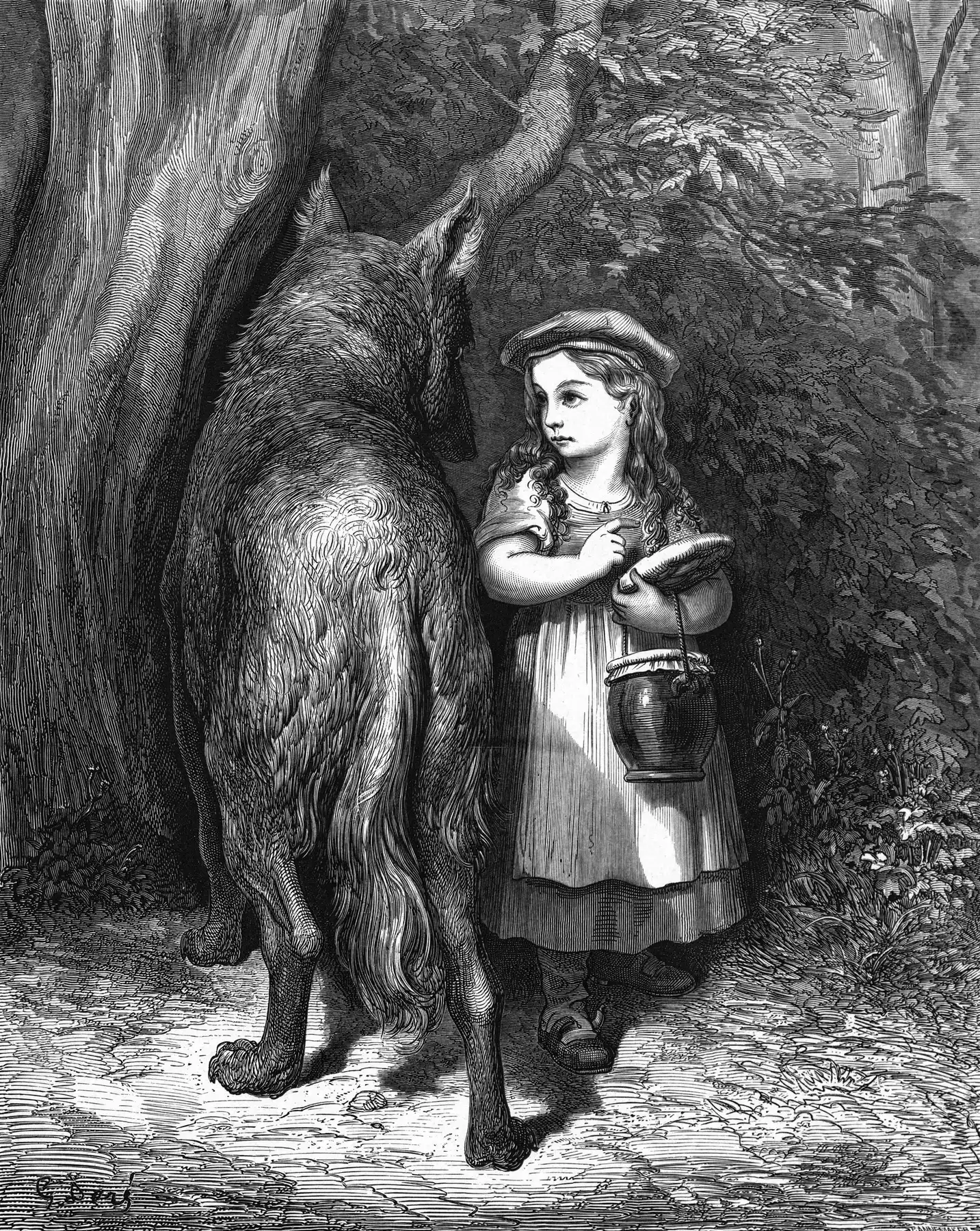
Meeting in the wood — Gustave Doré's plate as printed in the 1867 Hetzel edition of Perrault's tales shows the girl and the wolf alone on the path; the wood engraving is signed Pannemaker.
Little Red Riding Hood meets the wolf · Gustave Doré · public domain
Full credit
"Little Red Riding Hood meets the wolf" by Gustave Doré, 1867 — https://commons.wikimedia.org/wiki/File:Little_Red_Riding_Hood_(136547615).jpg — Public domain (US: published in Paris in 1867; Germany and France: Doré died 1883 (GND), and the engraver signing Pannemaker was at work by 1867 (presumed out of copyright from his working years; first name and dates not checked), so 70 years after death have run out); modified: cropped from the full book page, desaturated and contrast adjusted on Wikimedia Commons before download
Doré illustrated Perrault's text, not the Grimms'. The copy scanned here is from Hetzel's Paris edition of 1867, 170 years after the Barbin printing. The plate shows no woodcutters, although the text places them somewhere in the same forest, close enough to keep the wolf from attacking.
The Grimms' wood has no woodcutters. Nothing in it holds the wolf back. A full-text search of the 1812 and 1857 texts for Holzhauer, Holzhacker and Holzfäller (all words for woodcutter) finds nothing. Their grandmother lives “draußen im Wald, eine halbe Stunde vom Dorf,” out in the wood, half an hour from the village (Genre Fiction Lineage translation), and the wolf talks the girl off the path to pick flowers instead of racing her.
What did the Grimms print in 1812?
The Grimms' version is No. 26 in the first volume of Kinder- und Haus-Märchen, published in Berlin by the Realschulbuchhandlung in 1812, on pages 113 to 118. Their heroine is Rothkäppchen, Little Red-Cap, named for a cap of red velvet from her grandmother. Before she sets out, her mother tells her “lauf nicht vom Weg ab,” don't run off the path (Genre Fiction Lineage translation). The mother in Perrault's text gives no such warning.
Off the path — an illustration of the wood in the Grimms' 1812 text, where the wolf talks the girl into picking flowers, not a book illustration.
Illustration: Genre Fiction Lineage. Generated scene illustration — not a book illustration, photograph or historical record. No copyright is claimed in the generated imagery; if you reuse it, please credit "Genre Fiction Lineage".
The eating happens as in Perrault, and then the text keeps going. The wolf falls asleep and snores, and a huntsman passing the house goes in, decides not to shoot in case the grandmother can still be saved, and “Da nahm er die Scheere und schnitt ihm den Bauch auf,” then he took the scissors and cut its belly open (Genre Fiction Lineage translation). The girl jumps out crying “ach wie war ich erschrocken, was wars so dunkel in dem Wolf seinem Leib” (“oh, how frightened I was, how dark it was in the wolf's body”; Genre Fiction Lineage translation). The grandmother comes out alive, and the heavy stones Little Red-Cap fetches make the wolf fall down dead when he wakes.
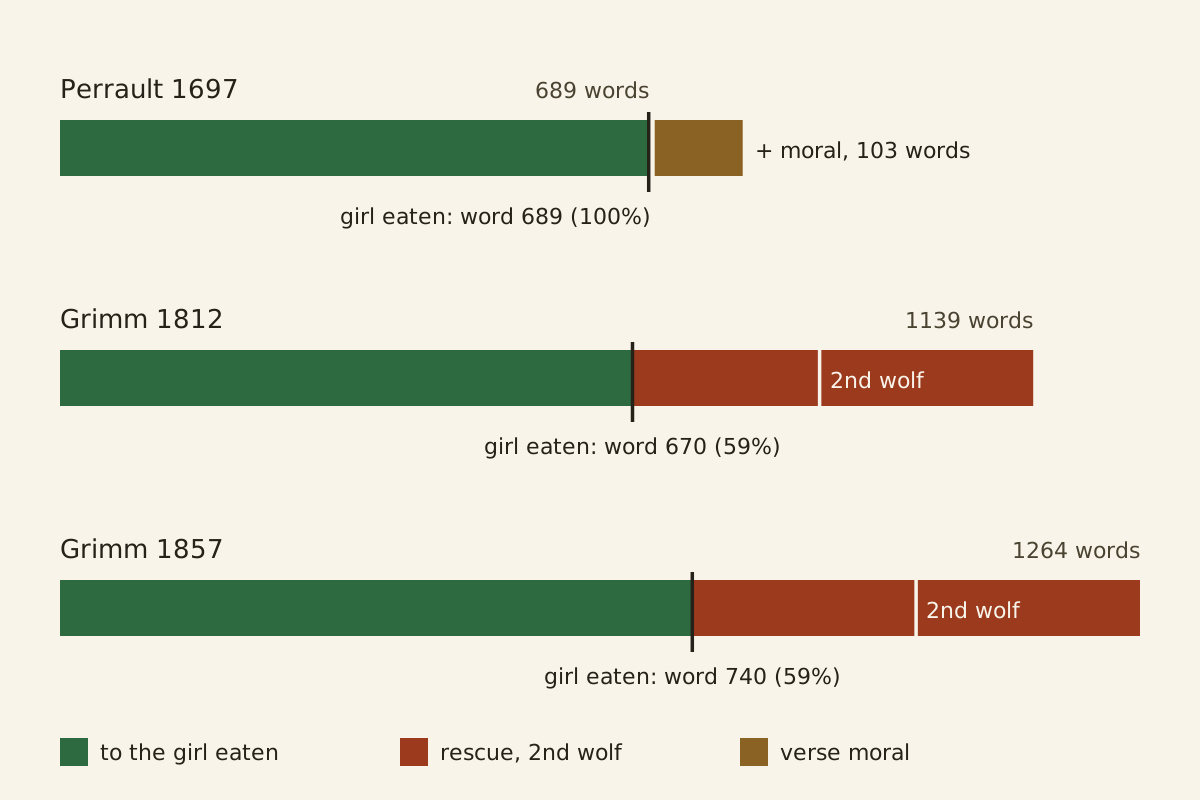
Where the tale stops — the length of each text in words, with the point where the girl is eaten; in both Grimm texts about two-fifths of the tale comes after it.
Little Red Riding Hood: where the girl is eaten in three texts · Genre Fiction Lineage · CC BY 4.0
Reuse credit (CC BY)
"Little Red Riding Hood: where the girl is eaten in three texts" by Genre Fiction Lineage, https://genrefictionlineage.com/fairy-tales/little-red-riding-hood/, licensed under CC BY 4.0 (https://creativecommons.org/licenses/by/4.0/)
Texts: Charles Perrault, Histoires ou contes du temps passé (Paris: Barbin, 1697), transcribed at French Wikisource; Jacob and Wilhelm Grimm, Kinder- und Haus-Märchen, vol. 1 (1812) and 7th edition (1857), transcribed at German Wikisource
Counted by words, the 1697 tale is 689 words long, and the eating is its last sentence. The 1812 text runs to 1,139 words, and the eating ends at word 670, 59 percent of the way through; the 1857 text keeps the same share, 740 of 1,264. The counts leave out headings, the verse moral and the notes, and the CSV gives the word position of each tale passage it quotes.
What is the second ending?
After the rescue the Grimms add a second episode, introduced with “Es wird auch erzählt,” it is also told (Genre Fiction Lineage translation). On another visit Little Red-Cap meets another wolf, stays on the road, and warns her grandmother, who keeps the door shut. The wolf climbs onto the roof to wait for her, so the grandmother has her fill a stone trough with the water sausages were boiled in. The wolf leans after the smell, slides off the roof into the trough and “ertrank,” drowned (Genre Fiction Lineage translation).
What does the Grimms' note say about Perrault and Tieck?
At the back of the 1812 volume the Grimms printed notes to the tales. The note to No. 26, on page XXII, reads in full: “Dieses Märchen haben wir außer unserer mündlichen Sage, was zu wundern ist, nirgends angetroffen, als bei Perrault (chaperon rouge) wonach Tiecks Bearbeitung.” In English: “Apart from our oral source, we have, surprisingly, found this tale nowhere except in Perrault (chaperon rouge), on which Tieck's adaptation is based” (Genre Fiction Lineage translation).
That note is written contact between the later editors and the earlier book, so this site's cataloguing rules count the Perrault-to-Grimm link as documented influence. It does not say the Grimms copied Perrault; it says their own text came from a spoken source and that Perrault's was the only other version they had found. Between the two printings lie 115 years, 1697 to 1812.
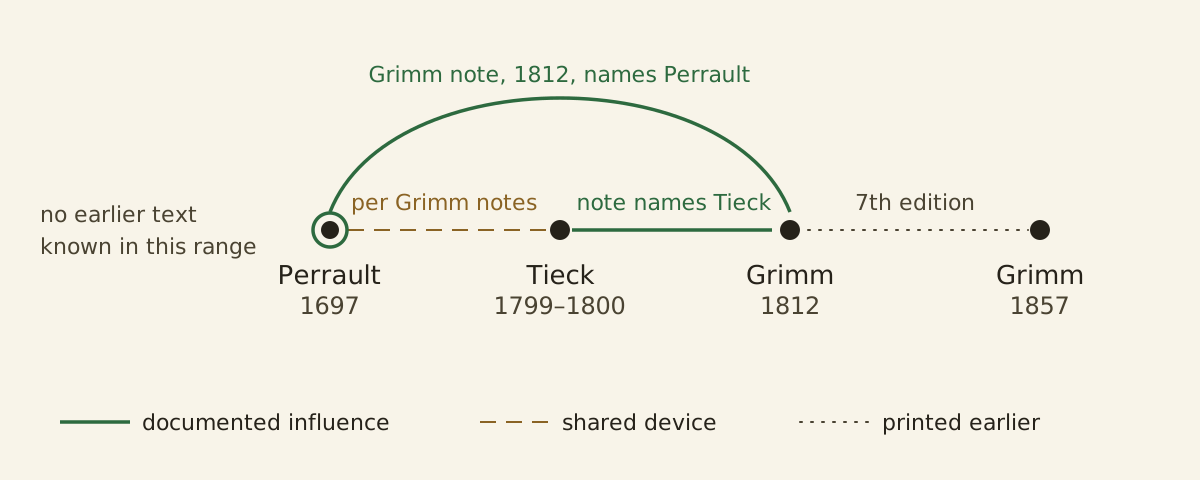
- Solid: documented influence (the later author's own statement, letter, review or note)
- Dashed: shared device (similar texts, no borrowing claimed)
- Dotted: dates only (publication order or other dates; no link claimed)
Lineage strip — four texts in print order; the two solid lines rest on the Grimms' 1812 note, the dashed line on the Grimms' word about Tieck, the dotted line on dates alone.
Lineage strip: Perrault 1697 to Grimm 1857 · Genre Fiction Lineage · CC BY 4.0
Reuse credit (CC BY)
"Lineage strip: Perrault 1697 to Grimm 1857" by Genre Fiction Lineage, https://genrefictionlineage.com/fairy-tales/little-red-riding-hood/, licensed under CC BY 4.0 (https://creativecommons.org/licenses/by/4.0/)
Texts: Charles Perrault, Histoires ou contes du temps passé (Paris: Barbin, 1697), transcribed at French Wikisource; Jacob and Wilhelm Grimm, Kinder- und Haus-Märchen, vol. 1 (1812) and 7th edition (1857), transcribed at German Wikisource
The four links and their evidence, with the Grimms' words for three, are in the CSV of the lineage links and their evidence CSV · provenance note Texts: Charles Perrault, Histoires ou contes du temps passé (Paris: Barbin, 1697), transcribed at French Wikisource; Jacob and Wilhelm Grimm, Kinder- und Haus-Märchen, vol. 1 (1812) and 7th edition (1857), transcribed at German Wikisource.
Did Tieck follow Perrault?
The Grimms say so, and without Tieck's own text this page can go no further than their statement. According to the 1911 Encyclopaedia Britannica, Ludwig Tieck's dramatic poem Leben und Tod des kleinen Rotkäppchens appeared in his Romantische Dichtungen, two volumes dated 1799–1800. Tieck's text is not read here, so its plot, including whether anyone rescues the girl, is not compared on this page. The strip draws Perrault to Tieck as a shared device on the Grimms' word, and Tieck to the Grimms as documented, because their note names his adaptation.
The Grimms repeated the point 44 years later, in the separate volume of notes they published in 1856. There, on page 47, the note to No. 26 begins “Aus den Maingegenden. Bei Perrault chaperon rouge, wonach Tieks anmuthige Bearbeitung in den romantischen Dichtungen.” In English: “From the Main region. In Perrault, chaperon rouge, on which Tieck's charming adaptation in the Romantische Dichtungen is based” (Genre Fiction Lineage translation). By then the oral source has a region, and Tieck's adaptation has a book. The 1812 preface, on page VII, had already said that almost everything in the volume was collected “in Hessen und den Main- und Kinziggegenden in der Grafschaft Hanau” (in Hesse and the Main and Kinzig regions in the county of Hanau; Genre Fiction Lineage translation) from oral tradition.
What changed between 1812 and 1857?
The Grimms kept revising the collection, and the 1857 title page calls its first volume the seventh edition of the large collection, published in Göttingen by Dieterich, 45 years after the first. Rothkäppchen is still No. 26, now on pages 140 to 144, and it is 125 words longer, 1,264 words against 1,139. The order of events does not change, and the added words go into manners, motive and speech, as the table shows; the translations are the site's own.
| Passage | 1812 text | 1857 text |
|---|---|---|
| Mother's instructions | “be good and give her my love, walk properly and don’t run off the path” (p. 113) | adds “don’t forget to say good morning, and don’t go peering into every corner first” (p. 140) |
| The girl's promise | she promised to be very obedient (p. 113) | “I’ll do everything right,” and she gave her hand on it (p. 140) |
| The wolf's plan | “that is a good fat mouthful for me” (p. 114) | the girl “will taste even better than the old woman” and he must catch both (p. 141) |
| The greeting | absent | “She called ‘good morning’ but got no answer” (p. 142) |
| The huntsman | “I won’t shoot, thought the huntsman” (p. 116) | “So I find you here, you old sinner,” and he means to raise his gun (p. 142) |
| After the rescue | the huntsman took the wolf’s pelt (p. 116) | the huntsman skinned the wolf and went home with the pelt (p. 143) |
| The last line | she went home “happy and safe” (p. 118) | she went home happy, “and no one did her any harm” (p. 144) |
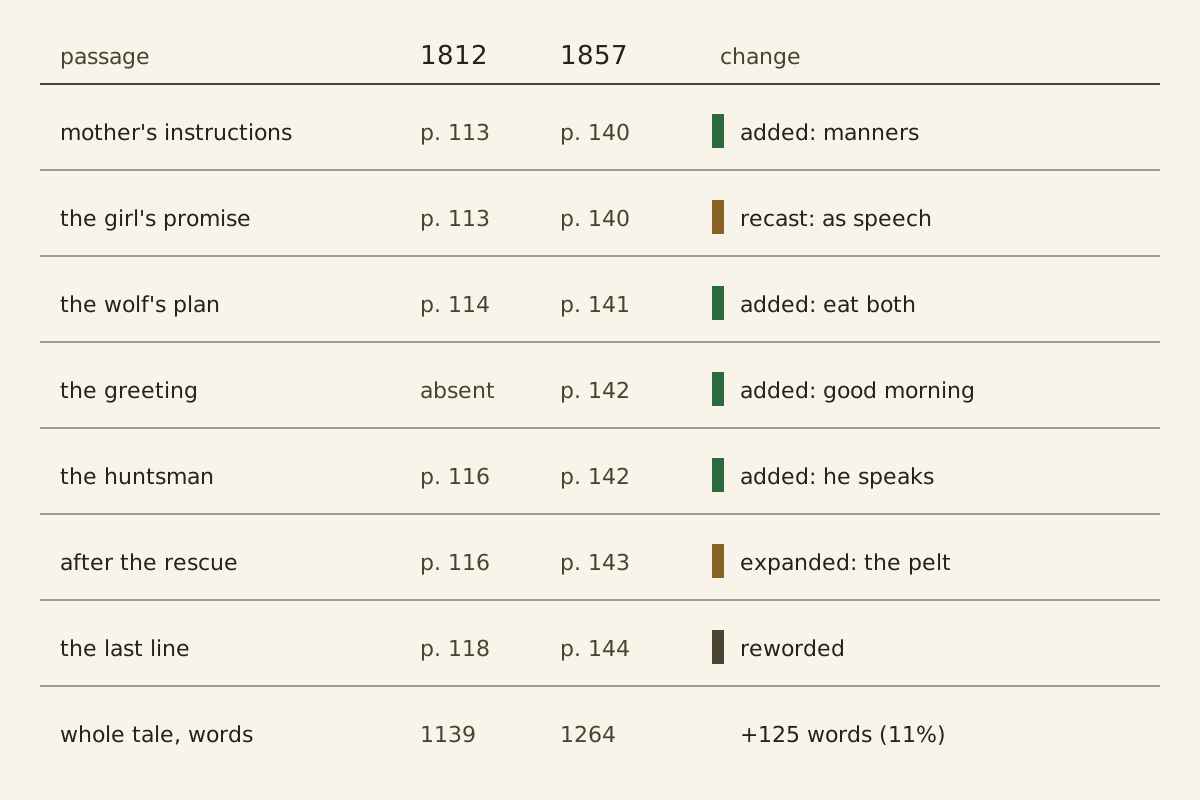
Seven changed passages — the Grimms' Rothkäppchen in 1812 and 1857, with the page of each passage, the kind of change and the length of each text.
The Grimms' Rothkäppchen: 1812 and 1857 compared · Genre Fiction Lineage · CC BY 4.0
Reuse credit (CC BY)
"The Grimms' Rothkäppchen: 1812 and 1857 compared" by Genre Fiction Lineage, https://genrefictionlineage.com/fairy-tales/little-red-riding-hood/, licensed under CC BY 4.0 (https://creativecommons.org/licenses/by/4.0/)
Texts: Charles Perrault, Histoires ou contes du temps passé (Paris: Barbin, 1697), transcribed at French Wikisource; Jacob and Wilhelm Grimm, Kinder- und Haus-Märchen, vol. 1 (1812) and 7th edition (1857), transcribed at German Wikisource
The wolf of 1857 is more deliberate about his meal. In 1857 he thinks “das junge zarte Ding, das ist ein fetter Bissen, der wird noch besser schmecken als die Alte,” that young tender thing is a fat mouthful and will taste even better than the old woman (Genre Fiction Lineage translation). The German of all seven passages is in the CSV of the 1812 and 1857 passages CSV · provenance note Texts: Charles Perrault, Histoires ou contes du temps passé (Paris: Barbin, 1697), transcribed at French Wikisource; Jacob and Wilhelm Grimm, Kinder- und Haus-Märchen, vol. 1 (1812) and 7th edition (1857), transcribed at German Wikisource. A text revised across editions by the people who first published it is also the subject of Frankenstein, 1818 and 1831 (for comparison).
Is the 1812 text darker?
The claim that the 1812 text is darker can be tested on this pair, and on violence it does not hold. In both editions the wolf swallows two people, the huntsman cuts him open with scissors, the stones kill him, and the second wolf drowns in the trough. The 1857 text names the huntsman's gun and adds the wolf's plan to eat both, and a passage-by-passage comparison finds no violent passage of 1812 cut or softened. The result covers Rothkäppchen in these two editions only, and each of the Grimms' other tales needs its own pair of named editions before the claim can be judged.
What does Perrault's moral say?
The moral on page 56 is fifteen lines of verse, printed here as one passage with the line breaks marked. The 1697 printing sets “I” where modern French has “J,” so “Ie dis” is je dis and “Iusque” is jusque.
On voit icy que de jeunes enfans, / Sur tout de jeunes filles, / Belles, bien faites & gentilles, / Font tres-mal d’écouter toute sorte de gens, / Et que ce n’est pas chose estrange, / S’il en est tant que le loup mange. / Ie dis le loup, car tous les loups ; / Ne sont pas de la mesme sorte ; / Il en est d’une humeur accorte, / Sans bruit, sans fiel & sans courroux, / Qui privez, complaisans & doux / Suivent les jeunes Demoiselles / Iusque dans les maisons, jusque dans les ruelles ; / Mais, hélas ! qui ne sçait que ces loups doucereux, / De tous les loups sont les plus dangereux.
The first six lines say (Genre Fiction Lineage translation): “Here one sees that young children, above all young girls, pretty, well made and kind, do very wrong to listen to all sorts of people, and that it is no wonder the wolf eats so many of them.” The next seven narrow the word: “I say the wolf, for not all wolves are of the same sort; there are some of an agreeable temper, without noise, without gall and without anger,” who, “tame, obliging and gentle, follow young ladies right into their houses, right into the ruelles,” the space beside the bed. The last two lines end: “but alas, who does not know that these smooth-talking wolves are of all wolves the most dangerous?”
The Grimm texts end differently, with no verse and no address to the reader. Their lesson is the girl's own thought on page 117 of the 1812 text: “du willst dein Lebtag nicht wieder allein vom Weg ab in den Wald laufen, wenn dirs die Mutter verboten hat,” never again in your life will you run off the path into the wood alone when your mother has forbidden it (Genre Fiction Lineage translation). The 1697 moral warns young girls in general about a kind of wolf that follows them indoors, while the 1812 resolution is one girl's promise about one path.
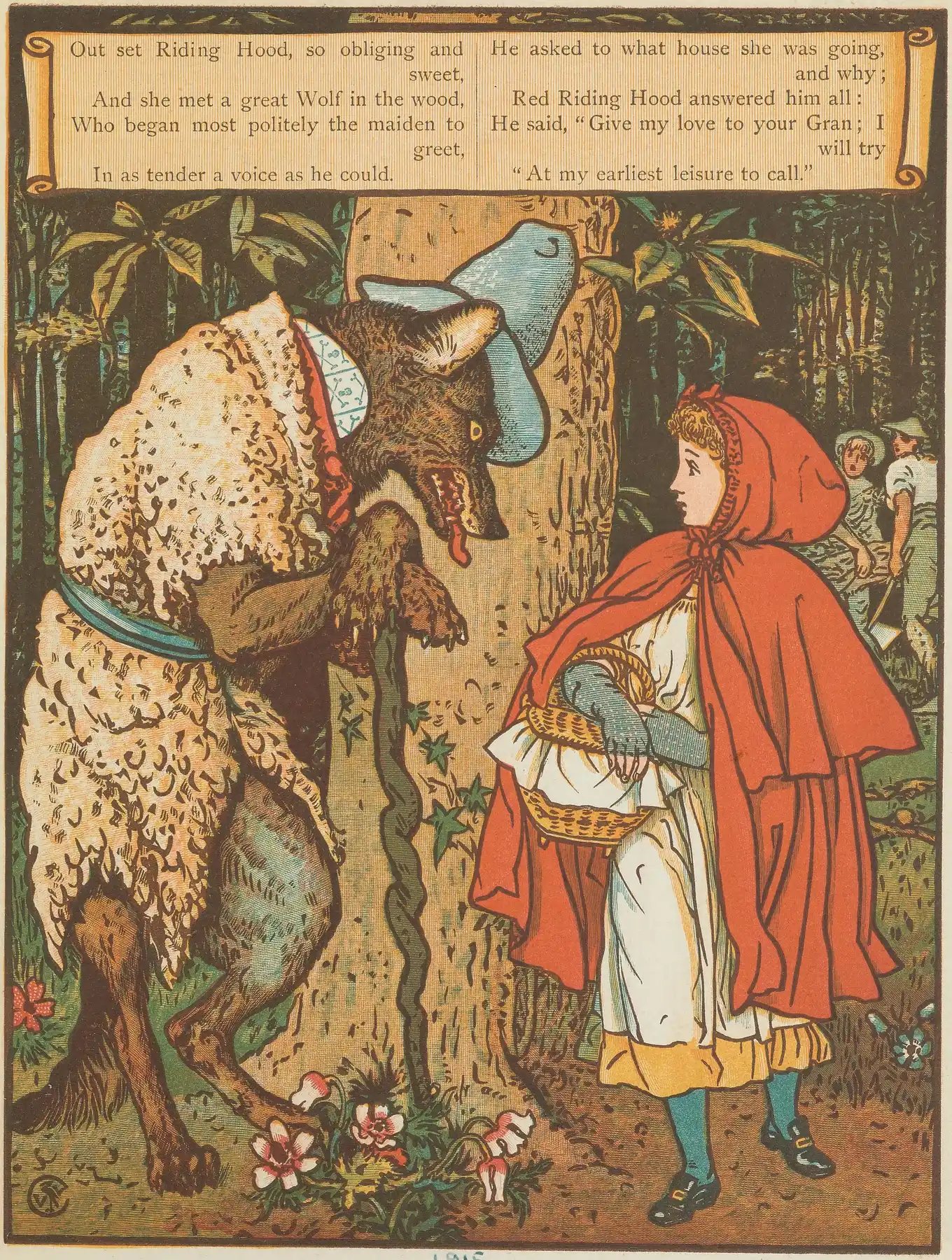
A wolf in a fleece — Walter Crane's English toy book, dated about 1875, gives the wolf a sheepskin and a bonnet and has him greet the girl “In as tender a voice as he could.”
Little Red Riding Hood meets the wolf, from Walter Crane's toy book · Walter Crane · public domain
Full credit
"Little Red Riding Hood meets the wolf, from Walter Crane's toy book" by Walter Crane, 1875 — https://commons.wikimedia.org/wiki/File:RRH_Walter_Crane_1875.jpg — Public domain (US: published in London about 1875 (Smithsonian Libraries record: 1875 after Spencer, 1873 after Massé); Germany and France: Crane died 1915 (GND), and the engraver-printer Edmund Evans was at work by the 1870s (presumed out of copyright from his working years; dates not checked), so 70 years after death have run out)
Crane's picture book has its own verse, and this page does not compare its text with Perrault's or the Grimms'. The Smithsonian Libraries record for its copy gives 1875 from one bibliography and 1873 from another, so the date stays approximate.
Sources
- 1Charles Perrault, Histoires ou contes du temps passé. Avec des Moralitez (Paris: Claude Barbin, 1697), title page and table of contents, transcribed at Wikisource https://fr.wikisource.org/wiki/Histoires_ou_Contes_du_temps_pass%C3%A9_(1697)/OriginalRead: title page and table of contents (validated transcription of the 1697 edition)
- 2Charles Perrault, Histoires ou contes du temps passé (Paris: Claude Barbin, 1697), “Extrait du Privilége du Roy,” pp. 231–232, transcribed at Wikisource https://fr.wikisource.org/wiki/Histoires_ou_Contes_du_temps_pass%C3%A9_(1697)/Original/Extrait_du_Privil%C3%A8ge_du_RoyRead: full text of the privilege (validated transcription)
- 3Charles Perrault, “Le petit chaperon rouge,” in Histoires ou contes du temps passé (Paris: Claude Barbin, 1697), pp. 47–56, transcribed at Wikisource https://fr.wikisource.org/wiki/Histoires_ou_Contes_du_temps_pass%C3%A9_(1697)/Original/Le_petit_chaperon_rougeRead: full text of the tale and its verse moral (validated transcription)
- 4Jacob and Wilhelm Grimm, Kinder- und Haus-Märchen, vol. 1 (Berlin: Realschulbuchhandlung, 1812), title page, transcribed at Wikisource https://de.wikisource.org/wiki/Kinder-_und_Haus-M%C3%A4rchen_Band_1_(1812)Read: title page and the preface sentence on p. VII (transcription checked twice against the scan)
- 5Jacob and Wilhelm Grimm, “Rothkäppchen,” No. 26, and the note “Zum Rothkäppchen,” in Kinder- und Haus-Märchen, vol. 1 (Berlin, 1812), pp. 113–118 and notes p. XXII, transcribed at Wikisource https://de.wikisource.org/wiki/Rothk%C3%A4ppchen_(1812)Read: full text of the tale and its note (transcription checked twice against the scan)
- 6Jacob and Wilhelm Grimm, Kinder- und Hausmärchen, vol. 1, 7th edition (Göttingen: Dieterich, 1857), title page, transcribed at Wikisource https://de.wikisource.org/wiki/Kinder-_und_Haus-M%C3%A4rchen_Band_1_(1857)Read: title page (transcription checked twice against the scan)
- 7Jacob and Wilhelm Grimm, “Rothkäppchen,” No. 26, in Kinder- und Hausmärchen, vol. 1, 7th edition (Göttingen, 1857), pp. 140–144, transcribed at Wikisource https://de.wikisource.org/wiki/Rothk%C3%A4ppchen_(1857)Read: full text of the tale (transcription checked twice against the scan)
- 8Jacob and Wilhelm Grimm, Kinder- und Haus-Märchen, vol. 3, notes (1856), note to No. 26, p. 47, transcribed at Wikisource https://de.wikisource.org/wiki/Kinder-_und_Haus-M%C3%A4rchen_Band_3_(1856)/AnmerkungenRead: the note to No. 26 (single entry)
- 9“Tieck, Johann Ludwig,” Encyclopædia Britannica, 11th edition (1911), vol. 26, transcribed at Wikisource https://en.wikisource.org/wiki/1911_Encyclop%C3%A6dia_Britannica/Tieck,_Johann_LudwigRead: full entry
- 10Gemeinsame Normdatei (GND), Deutsche Nationalbibliothek, records for Charles Perrault (118740008), Jacob Grimm (118542257), Wilhelm Grimm (118542265), Ludwig Tieck (12989432X), Gustave Doré (118526839) and Walter Crane (118522639), via lobid.org https://lobid.org/gnd/118740008Read: authority records (life dates)
- 11Walter Crane, Little Red Riding Hood (London: George Routledge & Sons, [1875?]), Smithsonian Libraries copy, catalogue record at the Internet Archive https://archive.org/details/LittleRedRiding00CranRead: catalogue record only
- 12Jennifer Jenkins and James Boyle, "Public Domain Day 2026," Center for the Study of the Public Domain, Duke Law School https://web.law.duke.edu/cspd/publicdomainday/2026/Read: full pageText licence: CC BY 4.0
- 13Urheberrechtsgesetz § 64 (Allgemeines), gesetze-im-internet.de https://www.gesetze-im-internet.de/urhg/__64.htmlRead: full text of the section
- 14Urheberrechtsgesetz § 69 (Berechnung der Fristen), gesetze-im-internet.de https://www.gesetze-im-internet.de/urhg/__69.htmlRead: full text of the section
Cite this page
Genre Fiction Lineage. “Little Red Riding Hood: Perrault's 1697 Text Has No Hunter.” Genre Fiction Lineage, published 3 November 2026. https://genrefictionlineage.com/fairy-tales/little-red-riding-hood/. Accessed [the date you read it].
Next shelf over:
- Snow White: the same 1812 volume, and a queen the Grimms changed in a later edition (printed later).
- Fairy Tales by Perrault and the Grimms: all eight of Perrault's 1697 prose tales set against the Grimms' editions, with the notes that name him (documented influence).
- Read the text: Histoires ou contes du temps passé (1697), Wikisource
Related entries
More from Fairy Tale Editions.
Edition comparison
Snow White: In the 1812 Grimm Text, the Queen Is Her Mother
In the Grimms' 1812 Snow White the jealous queen is her own mother; the 1819 edition makes her a stepmother. Thirteen passages compared in three editions.
Picture credit
"Blanca Nieve y los siete enanos" by José Guadalupe Posada, 1900 — https://commons.wikimedia.org/wiki/File:Snow_White_and_the_Seven_Dwarfs_MET_DP869499.jpg — CC0 1.0 (https://creativecommons.org/publicdomain/zero/1.0/)
Edition comparison
Fairy Tales by Perrault: Matched Against Grimm, 1812 to 1857
Perrault's 1697 book has eight prose tales; the Grimms' notes pair seven with tales in their 1812 edition, and two of those are absent from 1819 to 1857.
Picture credit
"Puss in Boots by the river" by Gustave Doré, 1867 — https://commons.wikimedia.org/wiki/File:Puss_in_Boots_(136548352).jpg — Public domain (US: published in Paris in 1867; Germany and France: Doré died 1883 (GND), and the engraver signing Pannemaker was at work by 1867 (presumed out of copyright from his working years; first name and dates not checked), so 70 years after death have run out); modified: cropped from the full book page, desaturated and contrast adjusted on Wikimedia Commons before download
Lineage essay
Rapunzel: The Grimms' 1812 Note Names Schulz, Not La Force
The Grimms' 1812 note says Schulz told Rapunzel in 1790 from an oral source; a 1913 reference dates La Force's Persinette, with 14 of 17 stages alike, earlier.
Picture credit
"Rapunzel (eene soort salade), No. 69: the climb" by anonymous printmaker (published by C. Burckardt's successors), 1889 — https://commons.wikimedia.org/wiki/File:Rapunzel_(eene_soort_salade)_(titel_op_object),_RP-P-OB-200.889.jpg — CC0 1.0 (https://creativecommons.org/publicdomain/zero/1.0/); modified: one of the sixteen pictures cropped from the full sheet with its printed frame line, without its caption; no other change