Fairy Tale Editions · Edition comparison
Fairy Tales by Perrault: Matched Against Grimm, 1812 to 1857
Genre Fiction Lineage Published
Of the eight prose tales in Perrault's 1697 book, the Grimms' notes pair seven with tales in their 1812 edition. Two of them, Der gestiefelte Kater (Puss in Boots) and Blaubart (Bluebeard), are missing from every later edition of the full collection up to 1857, and no Grimm text read for this page gives a reason that names either tale.
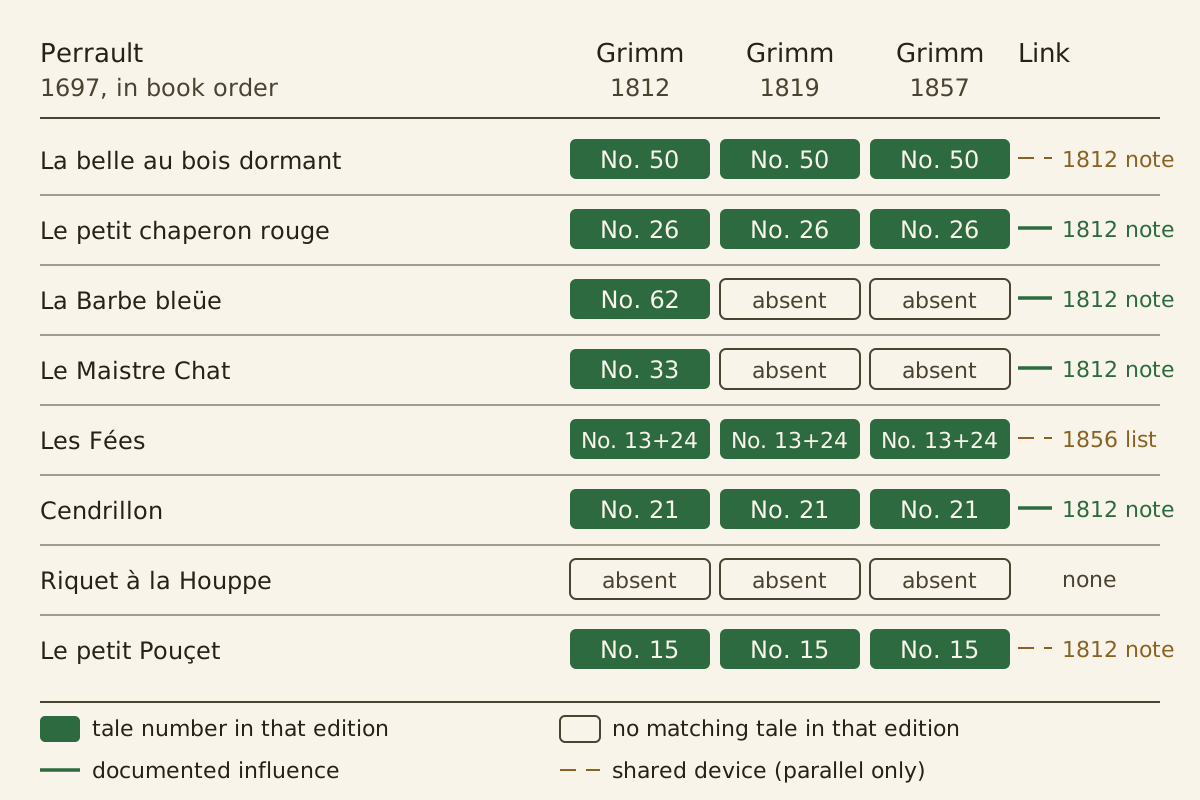
Eight tales, three editions — the Grimm tale number paired with each of Perrault's 1697 tales, and the kind of evidence behind each pairing.
Perrault's tales in the Grimms' editions, 1812–1857 · Genre Fiction Lineage · CC BY 4.0
Reuse credit (CC BY)
"Perrault's tales in the Grimms' editions, 1812–1857" by Genre Fiction Lineage, https://genrefictionlineage.com/fairy-tales/perrault-grimm-shared-tales/, licensed under CC BY 4.0 (https://creativecommons.org/licenses/by/4.0/)
Texts: Charles Perrault, Histoires ou contes du temps passé (Paris: Barbin, 1697), transcribed at French Wikisource; Jacob and Wilhelm Grimm, Kinder- und Haus-Märchen, 1812 to 1857 editions and the 1856 notes volume, transcribed at German Wikisource
The 1819 preface says only that whatever seemed suspect, including anything that might be of foreign origin, was examined again and removed. The 1812 notes had already named Perrault for both tales. Connecting those two facts is this page's inference, not a statement by the Grimms. Every pairing, with the Grimms' words, the page and an English translation, is in the CSV of the Perrault–Grimm index CSV · provenance note Texts: Charles Perrault, Histoires ou contes du temps passé (Paris: Barbin, 1697), transcribed at French Wikisource; Jacob and Wilhelm Grimm, Kinder- und Haus-Märchen, 1812 to 1857 editions and the 1856 notes volume, transcribed at German Wikisource.
Which of Perrault's tales did the Grimms print?
The book is Histoires ou contes du temps passé, published in Paris by Claude Barbin with M. DC. XCVII on its title page. Its table of contents lists eight prose tales, from La belle au bois dormant on page 1 to Le petit Pouçet on page 183. The Grimms' first volume of Kinder- und Haus-Märchen came out in Berlin in 1812, 115 years later.
Every pairing in this index depends on the Grimms' own published words. For six tales, the note printed at the back of the 1812 volume under the matching German tale names Perrault or the French title. For Les Fées, the pairing appears only in a list of Perrault's tales in the Grimms' 1856 notes volume, and of Riquet à la Houppe that list says “Im italienischen und deutschen nichts ähnliches” (“nothing similar in the Italian and the German”; Genre Fiction Lineage translation).
| Perrault 1697 (page) | Grimm tale | 1812 | 1819 | 1857 | Evidence |
|---|---|---|---|---|---|
| La belle au bois dormant (p. 1) | Dornröschen | No. 50 | No. 50 | No. 50 | 1812 note, parallel only |
| Le petit chaperon rouge (p. 47) | Rothkäppchen | No. 26 | No. 26 | No. 26 | 1812 note |
| La Barbe bleüe (p. 57) | Blaubart | No. 62 | absent | absent | 1812 note |
| Le Maistre Chat, ou le Chat Botté (p. 83) | Der gestiefelte Kater | No. 33 | absent | absent | 1812 note |
| Les Fées (p. 105) | Die drei Männlein im Walde; Frau Holle | Nos. 13, 24 | Nos. 13, 24 | Nos. 13, 24 | 1856 list, parallel only |
| Cendrillon (p. 117) | Aschenputtel | No. 21 | No. 21 | No. 21 | 1812 note |
| Riquet à la Houppe (p. 149) | none | absent | absent | absent | 1856 list: none |
| Le petit Pouçet (p. 183) | Hänsel und Gretel | No. 15 | No. 15 | No. 15 | 1812 note, parallel only |
By this page's count, seven of the eight tales have a Grimm match in 1812, and five have one in 1819 and in 1857. The editions of 1837, 1840, 1843 and 1850 keep the same five matches under the same tale numbers, and none of their contents pages, in either volume, lists Der gestiefelte Kater or Blaubart.
The Grimms' own count of Perrault's tales was different in their first edition. Their preface, on page XVI, says Perrault “giebt nur neun, freilich die bekanntesten” (“gives only nine, the best known, to be sure”; Genre Fiction Lineage translation). The 1856 notes volume, on page 301, speaks of “Diese acht Stücke” (“these eight pieces”; Genre Fiction Lineage translation) for the 1697 book, which matches the eight titles in the Barbin table of contents. It adds “In den folgenden Ausgaben kamen noch drei hinzu” (“in the following editions three more were added”; Genre Fiction Lineage translation) and lists them on page 302, among them Peau d’âne and Les souhaits ridicules, the second marked “in Versen” (in verse; Genre Fiction Lineage translation), so this index covers only the eight prose tales of 1697.
How does the 1812 Puss in Boots differ from Perrault's?
Both texts begin with a miller who leaves a mill, a donkey and a cat to three sons, and in both the youngest son gets the cat. In both, the cat asks for boots: Perrault's cat says “vous n’avez qu’à me donner un Sac, & me faire faire une paire de Bottes” (“you have only to give me a sack and have a pair of boots made for me”), and the Grimms' cat says “laß mir nur ein paar Stiefel machen” (“just have a pair of boots made for me”; both Genre Fiction Lineage translations). After that the two texts part company at several points; the tables give the site's own translations, and the French and German are in the CSV.
| Passage | Perrault 1697 | Grimm 1812 |
|---|---|---|
| First gift to the king | a warren rabbit (p. 88) | partridges, which the king loved to eat (p. 149) |
| The master's new title | “the Marquis of Carabas” (p. 88) | “the count,” with a long noble name the text never gives (p. 149) |
| Owner of the castle | an ogre (p. 97) | “the great sorcerer” (p. 152) |
| The cat's reward | “became a great lord” (p. 103) | “first minister” (p. 155) |
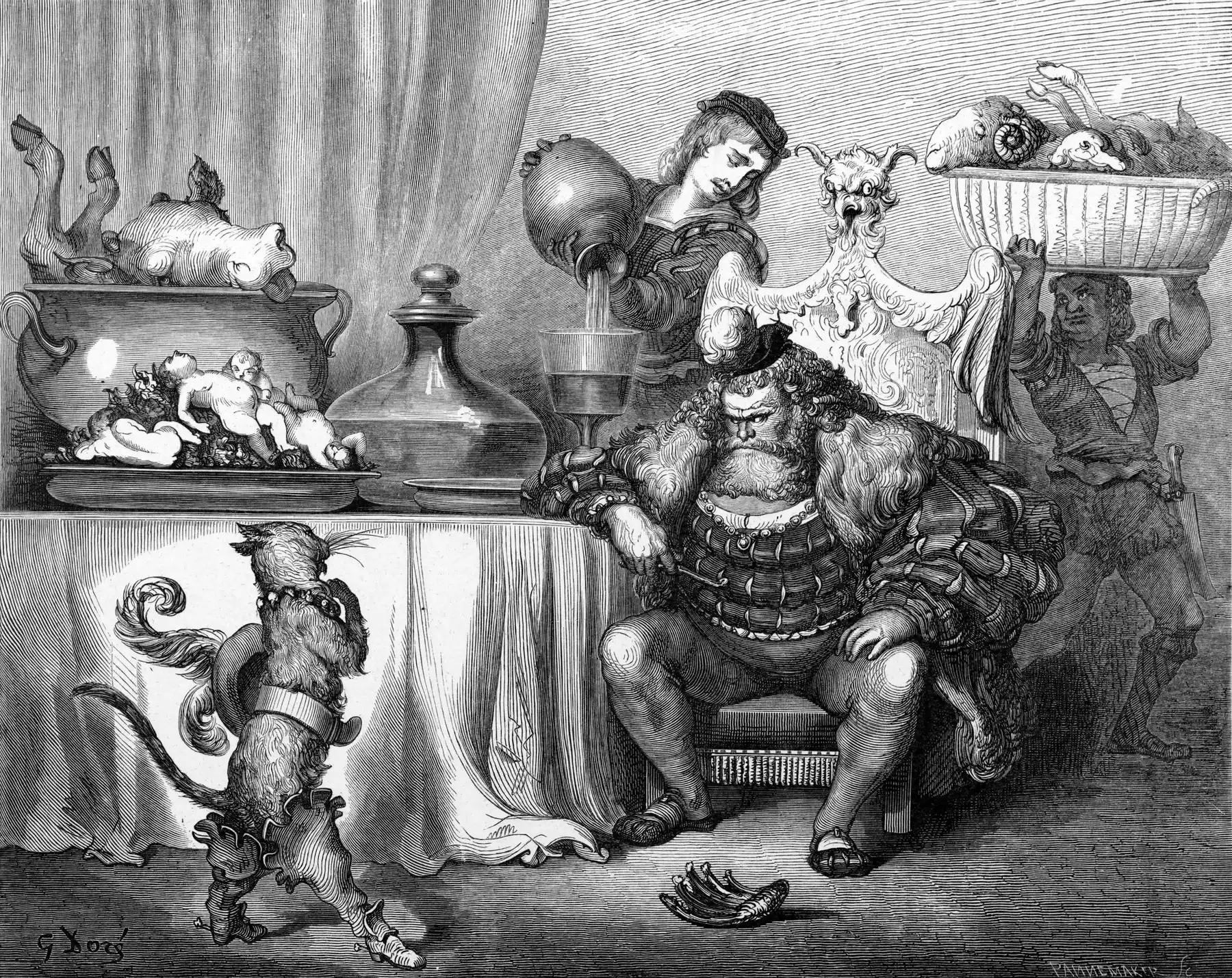
The cat at the ogre's table — Gustave Doré's plate for Perrault's tale, as printed in the 1867 Hetzel edition; the Grimms' 1812 text has a sorcerer in this place.
Puss in Boots at the ogre's table · Gustave Doré · public domain
Full credit
"Puss in Boots at the ogre's table" by Gustave Doré, 1867 — https://commons.wikimedia.org/wiki/File:Puss_in_Boots_(136548447).jpg — Public domain (US: published in Paris in 1867; Germany and France: Doré died 1883 (GND), and the engraver signing Pannemaker was at work by 1867 (presumed out of copyright from his working years; first name and dates not checked), so 70 years after death have run out); modified: cropped from the full book page, desaturated and contrast adjusted on Wikimedia Commons before download
Doré illustrated the French text, so his ogre belongs to Perrault. Perrault's castle owner turns into a lion and then a mouse, whereas the Grimms' sorcerer becomes an elephant, a lion and finally a mouse. The French and German of every passage, with translations, are in the CSV of Puss in Boots and Bluebeard passages, 1697 and 1812 CSV · provenance note Texts: Charles Perrault, Histoires ou contes du temps passé (Paris: Barbin, 1697), transcribed at French Wikisource; Jacob and Wilhelm Grimm, Kinder- und Haus-Märchen, 1812 to 1857 editions and the 1856 notes volume, transcribed at German Wikisource.
What did the 1812 notes say about Perrault?
At the back of the 1812 volume the Grimms printed notes on the tales, with roman page numbers of their own. Seven of those notes name a tale of Perrault's, and three of the seven belong to tales that are not in the 1819 edition. The note to Der gestiefelte Kater, on pages XXIII and XXIV, says “Perrault hat es in s. chat botté gut erzählt” (“Perrault told it well in his chat botté”; Genre Fiction Lineage translation).
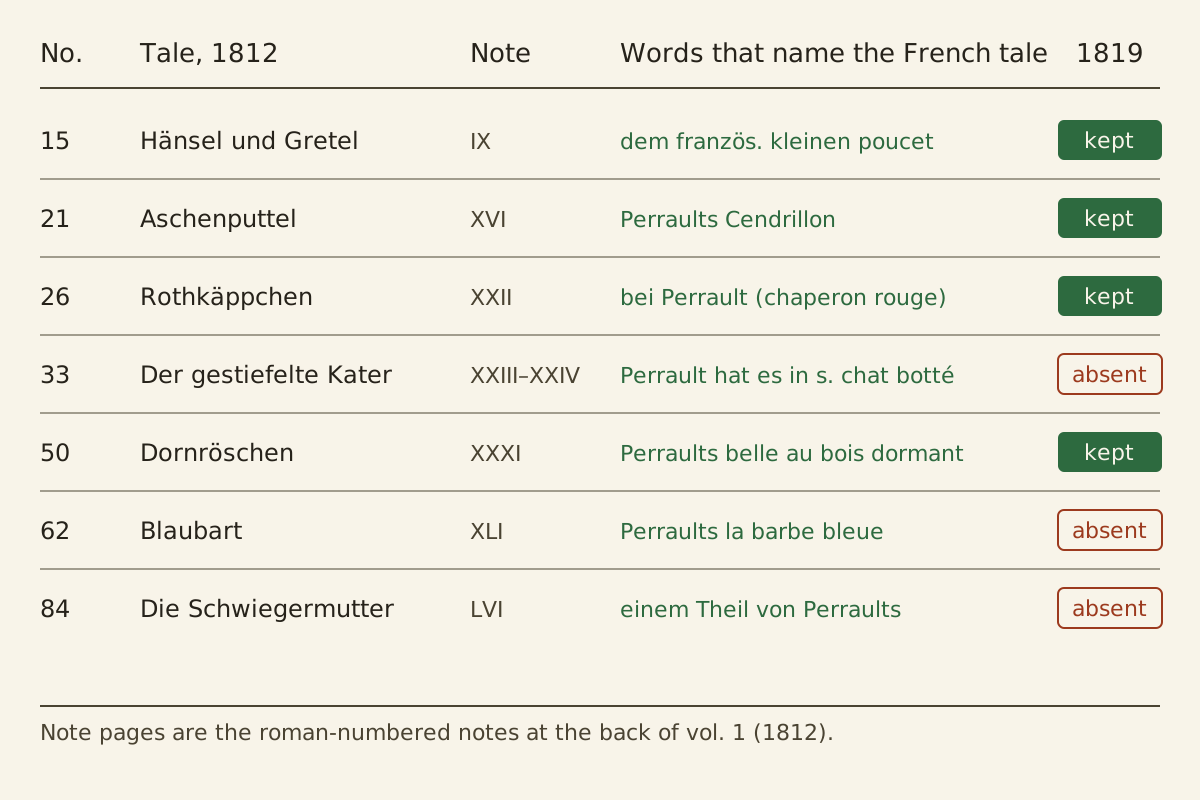
Seven notes, 1812 — the Grimm tales whose notes name a French tale of Perrault's, the words used, and which of those tales the 1819 edition keeps.
The Grimms' 1812 notes that name Perrault · Genre Fiction Lineage · CC BY 4.0
Reuse credit (CC BY)
"The Grimms' 1812 notes that name Perrault" by Genre Fiction Lineage, https://genrefictionlineage.com/fairy-tales/perrault-grimm-shared-tales/, licensed under CC BY 4.0 (https://creativecommons.org/licenses/by/4.0/)
Texts: Charles Perrault, Histoires ou contes du temps passé (Paris: Barbin, 1697), transcribed at French Wikisource; Jacob and Wilhelm Grimm, Kinder- und Haus-Märchen, 1812 to 1857 editions and the 1856 notes volume, transcribed at German Wikisource
| No. (1812) | Tale | Note page | Words that name the French tale | In English (Genre Fiction Lineage translation) | In 1819 |
|---|---|---|---|---|---|
| 15 | Hänsel und Gretel | p. IX | “dem französ. kleinen poucet” | “the French little poucet” | kept |
| 21 | Aschenputtel | p. XVI | “Perraults Cendrillon” | “Perrault's Cendrillon” | kept |
| 26 | Rothkäppchen | p. XXII | “bei Perrault (chaperon rouge)” | “in Perrault (chaperon rouge)” | kept |
| 33 | Der gestiefelte Kater | pp. XXIII–XXIV | “Perrault hat es in s. chat botté gut erzählt” | “Perrault told it well in his chat botté” | absent |
| 50 | Dornröschen | p. XXXI | “Perraults belle au bois dormant” | “Perrault's belle au bois dormant” | kept |
| 62 | Blaubart | p. XLI | “Perraults la barbe bleue” | “Perrault's la barbe bleue” | absent |
| 84 | Die Schwiegermutter | p. LVI | “einem Theil von Perraults” | “part of Perrault's” | absent |
The note to No. 26 reads in full: “Dieses Märchen haben wir außer unserer mündlichen Sage, was zu wundern ist, nirgends angetroffen, als bei Perrault (chaperon rouge) wonach Tiecks Bearbeitung.” In English: “Apart from our oral source, we have, surprisingly, found this tale nowhere except in Perrault (chaperon rouge), on which Tieck's adaptation is based” (Genre Fiction Lineage translation). Its clause about Tieck is the Grimms' word about a third writer, so this site records it as a shared device only.
What does the Bluebeard note compare?
The note to Blaubart, on page XLI, begins “Perraults la barbe bleue gehört zu seinem am besten erzählten Märchen” (“Perrault's la barbe bleue is among his best-told tales”; Genre Fiction Lineage translation). It then sets the French sister Anne against the German telling: “In der deutschen Erzählung, wenigstens wie wir sie gehört haben, fehlt dies gänzlich” (“In the German telling, at least as we have heard it, this is missing entirely”; Genre Fiction Lineage translation), and the two printed texts, compared passage by passage below, bear the observation out.
| Passage | Perrault 1697 | Grimm 1812 |
|---|---|---|
| Who Bluebeard is | a rich man with houses in town and country (pp. 57–58) | a king (p. 285) |
| The stained key | it cannot be cleaned, “for the key was enchanted” (p. 69) | she lays it in the hay to draw out the blood (p. 287) |
| The call for help | “Anne, sister Anne, do you see anything coming?” (p. 74) | “Brothers, my dear brothers, come, help me!” (p. 288) |
| The rescuers | two brothers, a dragoon and a musketeer (p. 79) | three brothers (p. 289) |
Why are Puss in Boots and Bluebeard missing after 1812?
The second edition, published in Berlin by G. Reimer in 1819, gives No. 33 to Die drei Sprachen and No. 62 to Die Bienenkönigin. Its preface explains the cuts only in general terms, on page XIV: “Es ist noch einmal geprüft, was verdächtig schien, d. h. was etwa hätte fremden Ursprungs oder durch Zusätze verfälscht seyn können, und dann alles ausgeschieden.” In English: “What seemed suspect, that is, whatever might have been of foreign origin or corrupted by additions, has been examined once more, and all of it then removed” (Genre Fiction Lineage translation), a sentence that names no individual tale and does not mention Perrault.
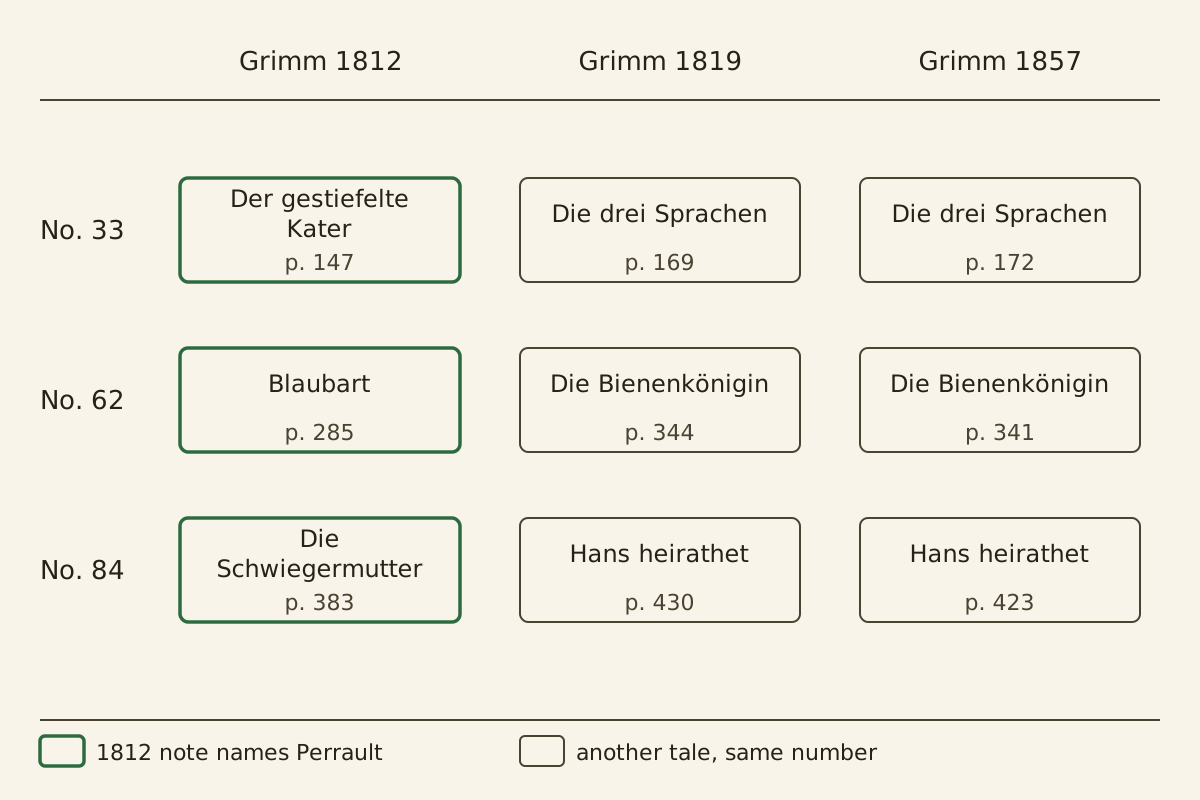
Three numbers, three editions — the tales printed as Nos. 33, 62 and 84 in 1812, 1819 and 1857, with the page each starts on.
Grimm tale numbers 33, 62 and 84, 1812–1857 · Genre Fiction Lineage · CC BY 4.0
Reuse credit (CC BY)
"Grimm tale numbers 33, 62 and 84, 1812–1857" by Genre Fiction Lineage, https://genrefictionlineage.com/fairy-tales/perrault-grimm-shared-tales/, licensed under CC BY 4.0 (https://creativecommons.org/licenses/by/4.0/)
Texts: Charles Perrault, Histoires ou contes du temps passé (Paris: Barbin, 1697), transcribed at French Wikisource; Jacob and Wilhelm Grimm, Kinder- und Haus-Märchen, 1812 to 1857 editions and the 1856 notes volume, transcribed at German Wikisource
| No. | 1812 | 1819 | 1857 |
|---|---|---|---|
| 33 | Der gestiefelte Kater | Die drei Sprachen | Die drei Sprachen |
| 62 | Blaubart | Die Bienenkönigin | Die Bienenkönigin |
| 84 | Die Schwiegermutter | Hans heirathet | Hans heirathet |
Read beside the 1812 notes, the general rule fits these two tales. The Kater note adds that there were “deutsche gedruckte Uebersetzungen nach Perrault” (German translations in print, after Perrault; Genre Fiction Lineage translation), and the Blaubart note says a Swedish broadside of 1810 “ist bloß eine Uebersetzung davon” (is merely a translation of it; Genre Fiction Lineage translation), meaning of Perrault's tale. Applying the 1819 rule to these two tales is this page's inference, and no Grimm text read here says it.
The notes by themselves do not predict which tales were removed. Rothkäppchen, Dornröschen and Aschenputtel also had 1812 notes naming Perrault, and all three are in the 1819 edition. One fragment disappeared at the same time: No. 84, Die Schwiegermutter, in which an old queen orders her cook to serve up her grandchildren, carries a note on page LVI saying it “Stimmt überein mit einem Theil von Perraults” la belle au bois dormant (agrees with part of Perrault's tale; Genre Fiction Lineage translation).
That fragment is in none of the later editions of the tales (the 1856 notes volume retells it as fragment No. 5, on page 269). The row for La belle au bois dormant still keeps its match, Dornröschen, so this page counts two tales that lose their match after 1812, not three. Which tales took the freed numbers, edition by edition, is in the CSV of contents entries in seven editions CSV · provenance note Texts: Charles Perrault, Histoires ou contes du temps passé (Paris: Barbin, 1697), transcribed at French Wikisource; Jacob and Wilhelm Grimm, Kinder- und Haus-Märchen, 1812 to 1857 editions and the 1856 notes volume, transcribed at German Wikisource.
The empty boots — an illustration of the boots both texts give the cat, not a book illustration.
Illustration: Genre Fiction Lineage. Generated scene illustration — not a book illustration, photograph or historical record. No copyright is claimed in the generated imagery; if you reuse it, please credit "Genre Fiction Lineage".
What did the Grimms say about Perrault in 1856?
By 1856 the notes occupied a separate volume, whose scanned title page reads third volume, third edition, Göttingen, Dieterich, 1856, and a section on the literature of the tales discusses Perrault. On page 300 it argues that the French tales are related to the Italian and German ones yet plainly independent of them, which proves “daß ihr Inhalt aus mündlicher Überlieferung ist genommen worden” (“that their content was taken from oral tradition”; Genre Fiction Lineage translation).
On pages 300 and 301 the volume lists Perrault's tales one by one against German numbers. Blaubart no longer has its own number there: Perrault's Bluebeard is set against No. 46, Fitchers Vogel, “doch ziemlich abweichend” (though rather different; Genre Fiction Lineage translation). Le chat botté is set against “Bruchstück Nr. 4,” entry 4 in the volume's section of fragments, which gives notes on the tale rather than a text of it.
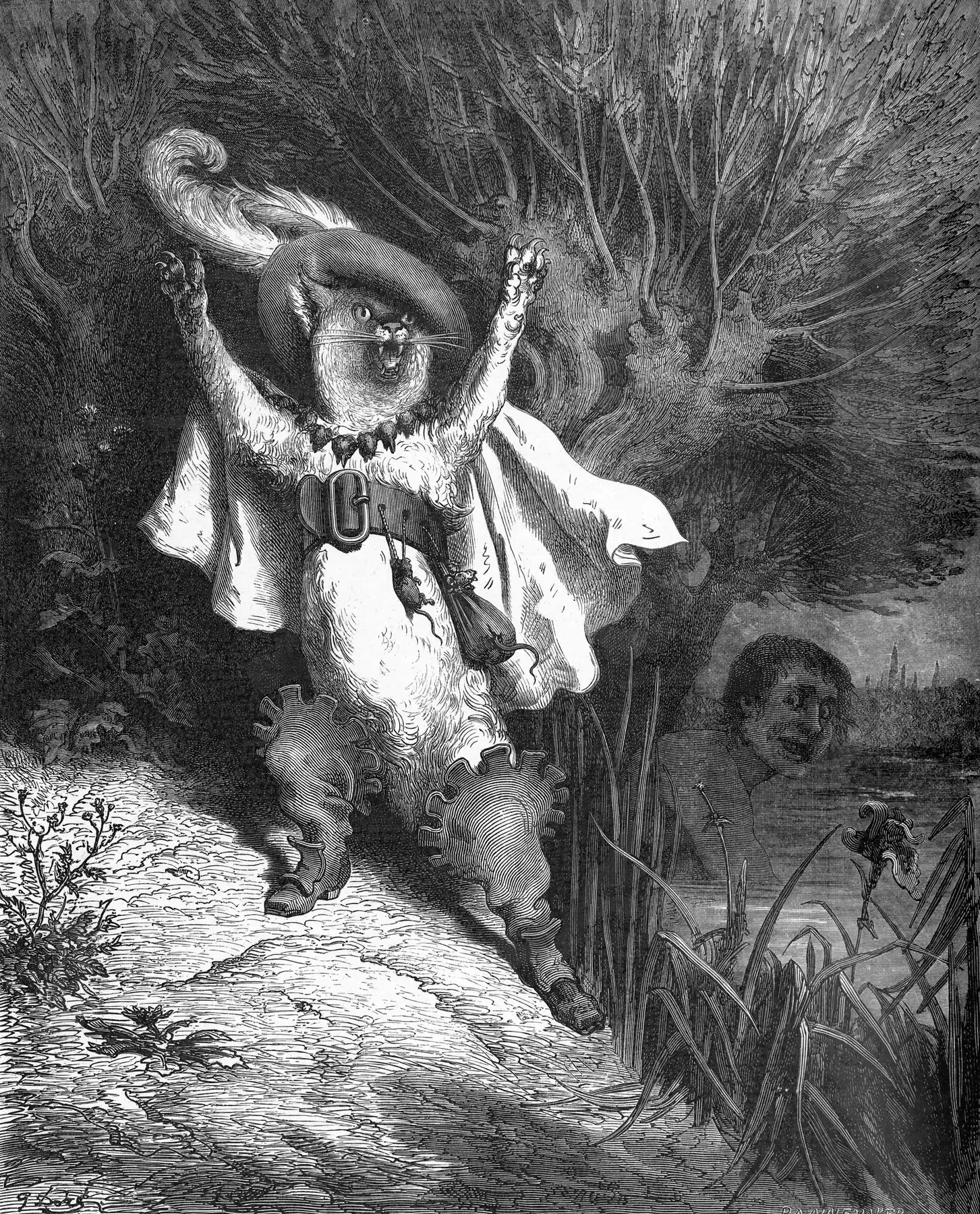
Puss in Boots by the river — Doré's plate for Perrault's tale in the 1867 Hetzel edition, the cat crying out while his master bathes; the wood engraving is signed Pannemaker.
Puss in Boots by the river · Gustave Doré · public domain
Full credit
"Puss in Boots by the river" by Gustave Doré, 1867 — https://commons.wikimedia.org/wiki/File:Puss_in_Boots_(136548352).jpg — Public domain (US: published in Paris in 1867; Germany and France: Doré died 1883 (GND), and the engraver signing Pannemaker was at work by 1867 (presumed out of copyright from his working years; first name and dates not checked), so 70 years after death have run out); modified: cropped from the full book page, desaturated and contrast adjusted on Wikimedia Commons before download
That entry, on page 268, begins “Das Märchen wird gewöhnlich nach Perraults französischer Darstellung erzählt” (“The tale is usually told after Perrault's French version”; Genre Fiction Lineage translation). On page 399 the volume adds “es ist wohl nur Zufall daß sich der gestiefelte Kater noch nicht vollständig in Deutschland gefunden hat” (“it is probably only chance that Puss in Boots has not yet been found complete in Germany”; Genre Fiction Lineage translation). These lines fit the inference above. They were printed 37 years after the 1819 cut, though, and show the Grimms' view by 1856, not a reason given in 1819.
How does the index link the editions?
This site counts a link as documented when the later writers' own words show that they knew or used the earlier text. Four 1812 notes do that: the notes to Nos. 21, 33 and 62 judge how well Perrault told the tale, and the note to No. 26 says the Grimms had found Rothkäppchen nowhere but in Perrault, so the strip draws one solid line from Perrault's 1697 book to the Grimms' 1812 volume. The note is evidence of contact, not of copying: the note to No. 26 says the Grimms' own text came from an oral source.
The notes to Hänsel und Gretel and Dornröschen set the French tale beside the German one as a parallel, without saying that the Grimms read or drew on it, so the index records those two rows as a shared device. Les Fées is paired only in the 1856 list, 44 years after Nos. 13 and 24 were first printed, and their 1812 notes do not name Perrault, so the index records that pair as a shared device too. The dotted lines join printings of the Grimms' own collection and carry dates only.
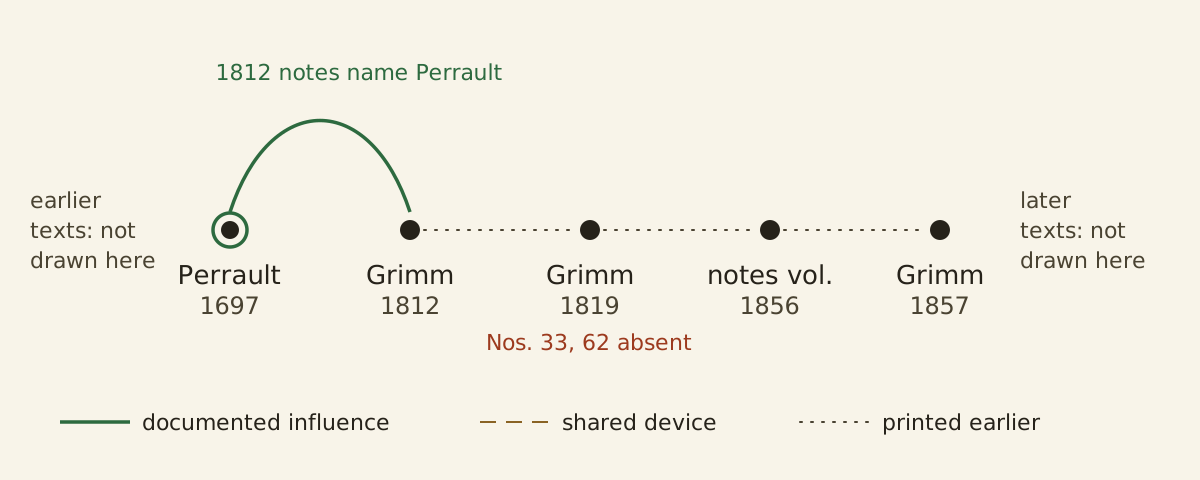
- Solid: documented influence (the later author's own statement, letter, review or note)
- Dashed: shared device (similar texts, no borrowing claimed)
- Dotted: dates only (publication order or other dates; no link claimed)
Lineage strip — five printings in date order; the solid line rests on the four 1812 notes that show the Grimms knew Perrault's text, and the dotted lines on dates alone.
Lineage strip: Perrault 1697 to Grimm 1857 · Genre Fiction Lineage · CC BY 4.0
Reuse credit (CC BY)
"Lineage strip: Perrault 1697 to Grimm 1857" by Genre Fiction Lineage, https://genrefictionlineage.com/fairy-tales/perrault-grimm-shared-tales/, licensed under CC BY 4.0 (https://creativecommons.org/licenses/by/4.0/)
Texts: Charles Perrault, Histoires ou contes du temps passé (Paris: Barbin, 1697), transcribed at French Wikisource; Jacob and Wilhelm Grimm, Kinder- und Haus-Märchen, 1812 to 1857 editions and the 1856 notes volume, transcribed at German Wikisource
The Rothkäppchen row is set out text by text in Little Red Riding Hood, from Perrault's 1697 text to the Grimms' 1857 text (documented influence). Another tale from the same 1812 volume, changed by 1819, is Snow White (printed later). A text whose own author revised it between editions is Frankenstein, 1818 and 1831 (for comparison). The links and their evidence are in the CSV of the lineage links CSV · provenance note Texts: Charles Perrault, Histoires ou contes du temps passé (Paris: Barbin, 1697), transcribed at French Wikisource; Jacob and Wilhelm Grimm, Kinder- und Haus-Märchen, 1812 to 1857 editions and the 1856 notes volume, transcribed at German Wikisource, and every quoted note and preface is in the CSV of the Grimms' statements about Perrault CSV · provenance note Texts: Charles Perrault, Histoires ou contes du temps passé (Paris: Barbin, 1697), transcribed at French Wikisource; Jacob and Wilhelm Grimm, Kinder- und Haus-Märchen, 1812 to 1857 editions and the 1856 notes volume, transcribed at German Wikisource.
Sources
- 1Charles Perrault, Histoires ou contes du temps passé. Avec des Moralitez (Paris: Claude Barbin, 1697), title page and table of contents, transcribed at Wikisource https://fr.wikisource.org/wiki/Histoires_ou_Contes_du_temps_pass%C3%A9_(1697)/OriginalRead: title page and table of contents (validated transcription of the 1697 edition)
- 2Charles Perrault, “Le Maistre Chat, ou le Chat Botté,” in Histoires ou contes du temps passé (Paris: Claude Barbin, 1697), pp. 83–104, transcribed at Wikisource https://fr.wikisource.org/wiki/Histoires_ou_Contes_du_temps_pass%C3%A9_(1697)/Original/Le_Maistre_ChatRead: full text of the tale and its two morals (validated transcription)
- 3Charles Perrault, “La Barbe bleüe,” in Histoires ou contes du temps passé (Paris: Claude Barbin, 1697), pp. 57–82, transcribed at Wikisource https://fr.wikisource.org/wiki/Histoires_ou_Contes_du_temps_pass%C3%A9_(1697)/Original/La_Barbe_bleueRead: full text of the tale and its morals (validated transcription)
- 4Jacob and Wilhelm Grimm, Kinder- und Haus-Märchen, vol. 1 (Berlin: Realschulbuchhandlung, 1812), title page, preface and table of contents, transcribed at Wikisource https://de.wikisource.org/wiki/Kinder-_und_Haus-M%C3%A4rchen_Band_1_(1812)Read: title page, preface pp. V–XXI and table of contents (transcription checked twice against the scan)
- 5Jacob and Wilhelm Grimm, “Der gestiefelte Kater,” No. 33, and the note “Zum gestiefelten Kater,” in Kinder- und Haus-Märchen, vol. 1 (Berlin, 1812), pp. 147–155 and notes pp. XXIII–XXIV, transcribed at Wikisource https://de.wikisource.org/wiki/Der_gestiefelte_Kater_(1812)Read: full text of the tale and its note (transcription checked twice against the scan)
- 6Jacob and Wilhelm Grimm, “Blaubart,” No. 62, and the note “Zu dem Blaubart,” in Kinder- und Haus-Märchen, vol. 1 (Berlin, 1812), pp. 285–289 and notes p. XLI, transcribed at Wikisource https://de.wikisource.org/wiki/Blaubart_(1812)Read: full text of the tale and its notes (transcription checked twice against the scan)
- 7Jacob and Wilhelm Grimm, note “Zum Rothkäppchen,” No. 26, in Kinder- und Haus-Märchen, vol. 1 (Berlin, 1812), notes p. XXII, transcribed at Wikisource https://de.wikisource.org/wiki/Rothk%C3%A4ppchen_(1812)Read: the note (single entry); same words as the lineage CSV of 16-0005
- 8Jacob and Wilhelm Grimm, note “Zu Dornröschen,” No. 50, in Kinder- und Haus-Märchen, vol. 1 (Berlin, 1812), notes p. XXXI, transcribed at Wikisource https://de.wikisource.org/wiki/Dornr%C3%B6schen_(1812)Read: the note (single entry)
- 9Jacob and Wilhelm Grimm, note to “Aschenputtel,” No. 21, in Kinder- und Haus-Märchen, vol. 1 (Berlin, 1812), notes p. XVI, transcribed at Wikisource https://de.wikisource.org/wiki/Aschenputtel_(1812)Read: the note only (one index row; the tale is not compared on this page)
- 10Jacob and Wilhelm Grimm, note “Zu Hänsel und Gretel,” No. 15, in Kinder- und Haus-Märchen, vol. 1 (Berlin, 1812), notes p. IX, transcribed at Wikisource https://de.wikisource.org/wiki/H%C3%A4nsel_und_Gretel_(1812)Read: the note (single entry)
- 11Jacob and Wilhelm Grimm, “Die Schwiegermutter,” No. 84, and its note, in Kinder- und Haus-Märchen, vol. 1 (Berlin, 1812), pp. 383–385 and notes p. LVI, transcribed at Wikisource https://de.wikisource.org/wiki/Die_Schwiegermutter_(1812)Read: full text of the fragment and its note
- 12Jacob and Wilhelm Grimm, “Die drei Männlein im Walde,” No. 13, in Kinder- und Haus-Märchen, vol. 1 (Berlin, 1812), pp. 43–47, with notes, transcribed at Wikisource https://de.wikisource.org/wiki/Die_drei_M%C3%A4nnlein_im_Walde_(1812)Read: notes searched for Perrault (no mention)
- 13Jacob and Wilhelm Grimm, “Frau Holle,” No. 24, in Kinder- und Haus-Märchen, vol. 1 (Berlin, 1812), pp. 106–110, with notes, transcribed at Wikisource https://de.wikisource.org/wiki/Frau_Holle_(1812)Read: notes searched for Perrault (no mention)
- 14Jacob and Wilhelm Grimm, Kinder- und Haus-Märchen, vols. 1–2, 2nd edition (Berlin: G. Reimer, 1819), title page, preface and tables of contents, transcribed at Wikisource https://de.wikisource.org/wiki/Kinder-_und_Haus-M%C3%A4rchen_Band_1_(1819)Read: title page, preface p. XIV and the tables of contents of both volumes
- 15Jacob and Wilhelm Grimm, Kinder- und Haus-Märchen, vols. 1–2, 3rd edition (1837), tables of contents, transcribed at Wikisource https://de.wikisource.org/wiki/Kinder-_und_Haus-M%C3%A4rchen_Band_1_(1837)Read: tables of contents of both volumes
- 16Jacob and Wilhelm Grimm, Kinder- und Haus-Märchen, vols. 1–2, 4th edition (1840), tables of contents, transcribed at Wikisource https://de.wikisource.org/wiki/Kinder-_und_Haus-M%C3%A4rchen_Band_1_(1840)Read: tables of contents of both volumes
- 17Jacob and Wilhelm Grimm, Kinder- und Haus-Märchen, vols. 1–2, 5th edition (1843), tables of contents, transcribed at Wikisource https://de.wikisource.org/wiki/Kinder-_und_Haus-M%C3%A4rchen_Band_1_(1843)Read: tables of contents of both volumes
- 18Jacob and Wilhelm Grimm, Kinder- und Haus-Märchen, vols. 1–2, 6th edition (1850), tables of contents, transcribed at Wikisource https://de.wikisource.org/wiki/Kinder-_und_Haus-M%C3%A4rchen_Band_1_(1850)Read: tables of contents of both volumes
- 19Jacob and Wilhelm Grimm, Kinder- und Hausmärchen, vols. 1–2, 7th edition (Göttingen: Dieterich, 1857), title page and tables of contents, transcribed at Wikisource https://de.wikisource.org/wiki/Kinder-_und_Haus-M%C3%A4rchen_Band_1_(1857)Read: title page and tables of contents of both volumes
- 20Jacob and Wilhelm Grimm, Kinder- und Hausmärchen, vol. 3, 3rd edition (Göttingen: Dieterich, 1856), title page and preface, transcribed at Wikisource https://de.wikisource.org/wiki/Kinder-_und_Haus-M%C3%A4rchen_Band_3_(1856)Read: title page and preface
- 21Scan of the title page of Kinder und Hausmärchen, vol. 3, 3rd edition (Göttingen, 1856), Heinrich Heine University Düsseldorf scan on Wikimedia Commons https://commons.wikimedia.org/wiki/File:Kinder_und_Hausm%C3%A4rchen_(Grimm)_1856_III_p_003.jpgRead: the scanned title page, viewed in full
- 22Jacob and Wilhelm Grimm, “Literatur,” in Kinder- und Hausmärchen, vol. 3, 3rd edition (Göttingen, 1856), pp. 299–302 and 399, transcribed at Wikisource https://de.wikisource.org/wiki/Kinder-_und_Haus-M%C3%A4rchen_Band_3_(1856)/LiteraturRead: the section on Perrault (pp. 299–302) and p. 399
- 23Jacob and Wilhelm Grimm, “Bruchstücke,” No. 4, “Der gestiefelte Kater,” in Kinder- und Hausmärchen, vol. 3, 3rd edition (Göttingen, 1856), pp. 268–269, transcribed at Wikisource https://de.wikisource.org/wiki/Kinder-_und_Haus-M%C3%A4rchen_Band_3_(1856)/Bruchst%C3%BCckeRead: fragments Nos. 4 and 5
- 24Gemeinsame Normdatei (GND), Deutsche Nationalbibliothek, records for Charles Perrault (118740008), Jacob Grimm (118542257), Wilhelm Grimm (118542265), Ludwig Tieck (12989432X), Gustave Doré (118526839) and Walter Crane (118522639), via lobid.org https://lobid.org/gnd/118740008Read: authority records (life dates)
- 25Jennifer Jenkins and James Boyle, "Public Domain Day 2026," Center for the Study of the Public Domain, Duke Law School https://web.law.duke.edu/cspd/publicdomainday/2026/Read: full pageText licence: CC BY 4.0
- 26Urheberrechtsgesetz § 64 (Allgemeines), gesetze-im-internet.de https://www.gesetze-im-internet.de/urhg/__64.htmlRead: full text of the section

Cite this page
Genre Fiction Lineage. “Fairy Tales by Perrault: Matched Against Grimm, 1812 to 1857.” Genre Fiction Lineage, published 3 November 2026. https://genrefictionlineage.com/fairy-tales/perrault-grimm-shared-tales/. Accessed [the date you read it].
Next shelf over:
- Little Red Riding Hood: one row of this index opened up, from Perrault's 1697 tale to the Grimms' 1857 text, with the note that names him (documented influence).
- Rapunzel and Persinette: another tale a French writer printed before the Grimms printed theirs (for comparison).
- Read the text: Histoires ou contes du temps passé (1697), Wikisource
Related entries
More from Fairy Tale Editions.
Lineage essay
Little Red Riding Hood: Perrault's 1697 Text Has No Hunter
Perrault's 1697 Little Red Riding Hood ends with the wolf eating her; the huntsman's rescue is in the Grimms' 1812 text. Three texts compared stage by stage.
Picture credit
"Little Red Riding Hood meets the wolf" by Gustave Doré, 1867 — https://commons.wikimedia.org/wiki/File:Little_Red_Riding_Hood_(136547615).jpg — Public domain (US: published in Paris in 1867; Germany and France: Doré died 1883 (GND), and the engraver signing Pannemaker was at work by 1867 (presumed out of copyright from his working years; first name and dates not checked), so 70 years after death have run out); modified: cropped from the full book page, desaturated and contrast adjusted on Wikimedia Commons before download
Edition comparison
Snow White: In the 1812 Grimm Text, the Queen Is Her Mother
In the Grimms' 1812 Snow White the jealous queen is her own mother; the 1819 edition makes her a stepmother. Thirteen passages compared in three editions.
Picture credit
"Blanca Nieve y los siete enanos" by José Guadalupe Posada, 1900 — https://commons.wikimedia.org/wiki/File:Snow_White_and_the_Seven_Dwarfs_MET_DP869499.jpg — CC0 1.0 (https://creativecommons.org/publicdomain/zero/1.0/)
Lineage essay
Rapunzel: The Grimms' 1812 Note Names Schulz, Not La Force
The Grimms' 1812 note says Schulz told Rapunzel in 1790 from an oral source; a 1913 reference dates La Force's Persinette, with 14 of 17 stages alike, earlier.
Picture credit
"Rapunzel (eene soort salade), No. 69: the climb" by anonymous printmaker (published by C. Burckardt's successors), 1889 — https://commons.wikimedia.org/wiki/File:Rapunzel_(eene_soort_salade)_(titel_op_object),_RP-P-OB-200.889.jpg — CC0 1.0 (https://creativecommons.org/publicdomain/zero/1.0/); modified: one of the sixteen pictures cropped from the full sheet with its printed frame line, without its caption; no other change