Science Fiction · Edition comparison
Frankenstein: In the 1818 Text, Elizabeth Is Victor's Cousin
Genre Fiction Lineage Published
In the first edition of Frankenstein (1818), Elizabeth Lavenza is Victor's cousin, the only child of his father's sister. In Mary Shelley's revised text of 1831, she is the daughter of a Milanese nobleman, taken in by Victor's parents, and the two only call each other cousin.
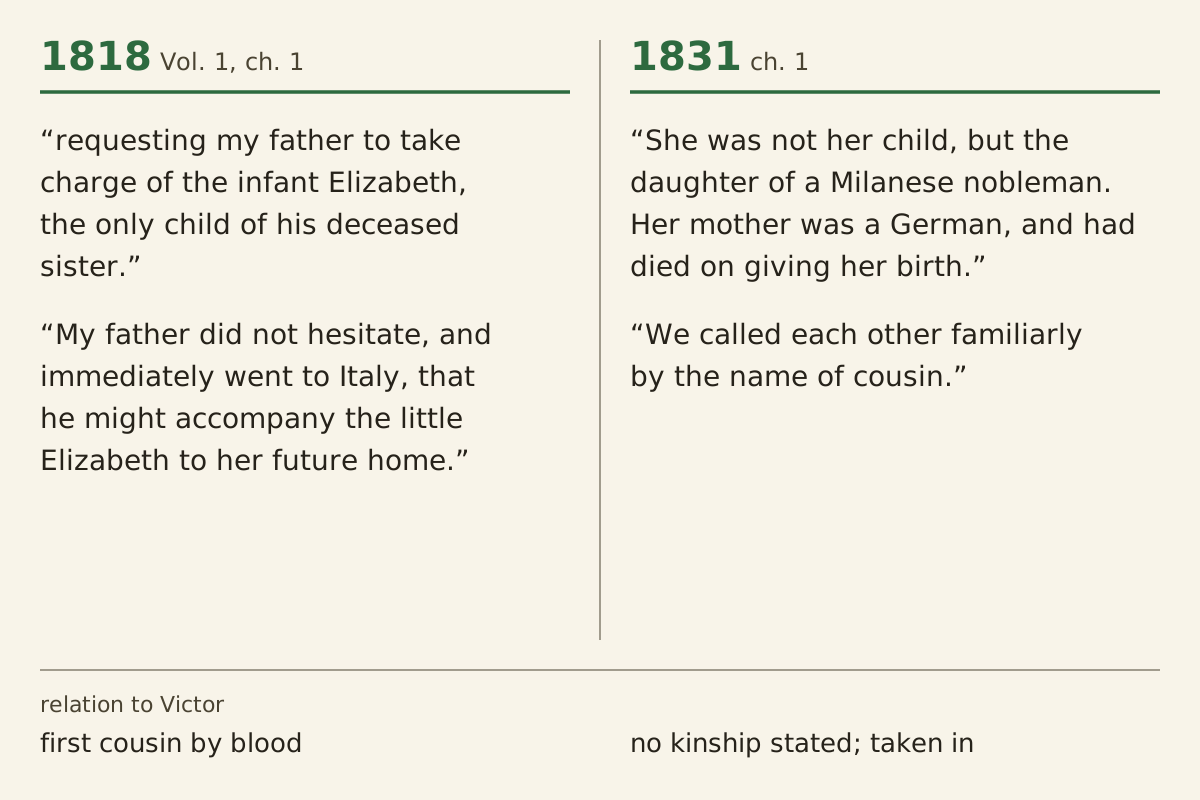
Elizabeth in chapter one — the 1818 text makes her the daughter of Victor's aunt, while the 1831 text makes her the daughter of a Milanese nobleman whom Victor's parents take in.
Frankenstein: Elizabeth's origin in the 1818 and 1831 texts · Genre Fiction Lineage · CC BY 4.0
Reuse credit (CC BY)
"Frankenstein: Elizabeth's origin in the 1818 and 1831 texts" by Genre Fiction Lineage, https://genrefictionlineage.com/science-fiction/frankenstein-editions/, licensed under CC BY 4.0 (https://creativecommons.org/licenses/by/4.0/)
Texts: Mary Shelley, Frankenstein, 1818 and 1831 editions, Project Gutenberg eBooks #41445 and #42324 (photo-reprints)
Which Elizabeth a reader meets depends on which text an edition prints, because the two versions disagree about her parentage from the first chapter onward. In bibliographic usage, an edition is all the copies printed from substantially the same setting of type; the texts compared on this page are Project Gutenberg transcriptions of photo-reprints, that is, photographic facsimiles, of the 1818 and 1831 editions. The thirteen passages compared below, with their chapters and the wording of both texts, are in a CSV of the 1818 and 1831 passages CSV · provenance note Texts: Mary Shelley, Frankenstein, 1818 and 1831 editions, Project Gutenberg eBooks #41445 and #42324 (photo-reprints).
Who is Elizabeth in 1818, and who is she in 1831?
Victor Frankenstein tells the story of Elizabeth's arrival in the first chapter of both texts. In 1818 his father's sister has married an Italian gentleman and died, and the widower writes to the family in Geneva, “requesting my father to take charge of the infant Elizabeth, the only child of his deceased sister.”
His letter calls her “your niece,” and it adds, “Her mother’s fortune is secured to her.” That makes Elizabeth the daughter of Victor's aunt, his first cousin. The same chapter says that Victor's mother resolved “to consider Elizabeth as my future wife,” and in the third volume the two marry.
The 1831 text, published thirteen years later, opens Elizabeth's story somewhere else. Victor's parents are travelling in Italy, and at a poor cottage on the shores of the Lake of Como his mother finds a fair-haired girl among five children. The peasant woman tells the girl's history: “She was not her child, but the daughter of a Milanese nobleman. Her mother was a German, and had died on giving her birth.”
Her father had worked for his country's liberty, and nobody knew whether he had died or was held in an Austrian prison. “His property was confiscated, his child became an orphan and a beggar.” Victor's mother persuades the foster parents to give the girl up, and Elizabeth joins the household. The family tie survives only as a name: “We called each other familiarly by the name of cousin.”
One phrase connects the two texts. Both use “an orphan and a beggar” a few paragraphs earlier to describe Victor's mother, Caroline Beaufort, after her own father dies in poverty at Lucerne, and the 1831 text repeats the same words a second time for Elizabeth.
What else changed in the opening chapters?
The Elizabeth passage is the largest change in the opening chapters. It is not the only one. This page compares thirteen passages: four concern Elizabeth's kinship, five change other details of the family story, and four concern how the book is framed and divided.
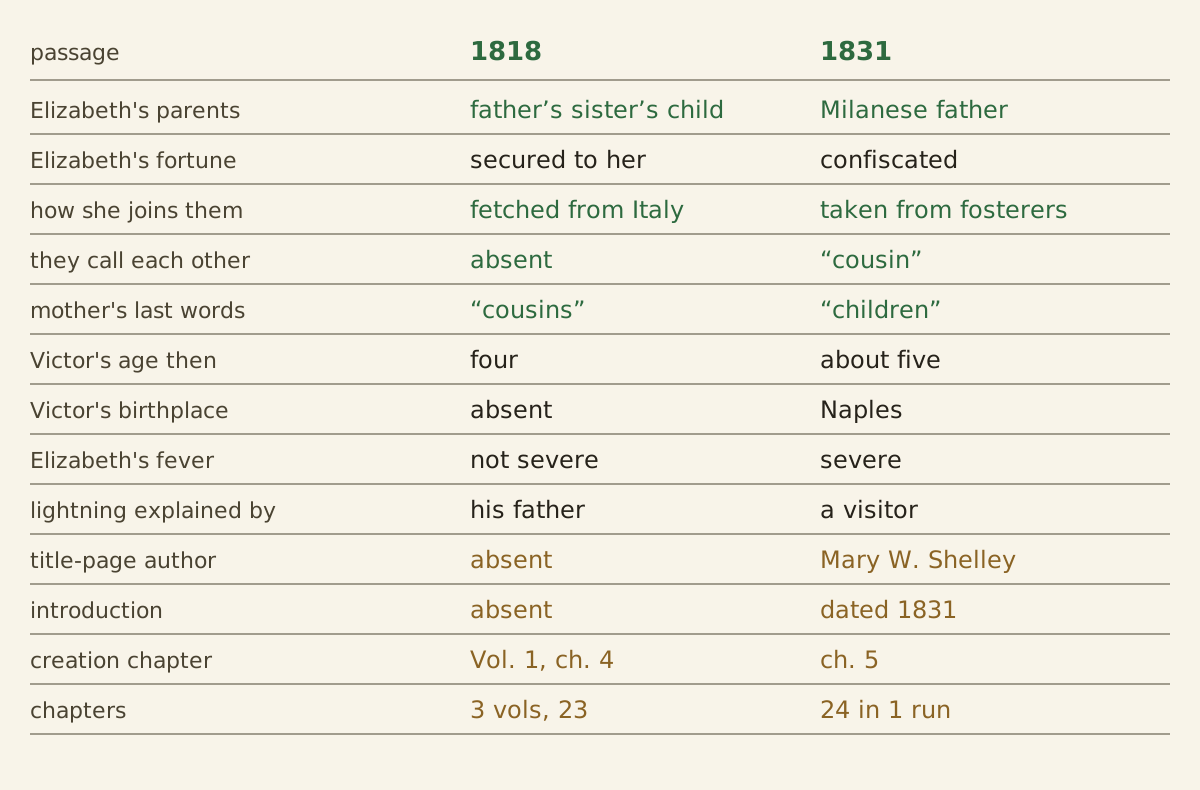
Thirteen passages compared — green rows concern Elizabeth's kinship, brass rows the framing of the book, and black rows other details.
Frankenstein, 1818 and 1831: thirteen passages compared · Genre Fiction Lineage · CC BY 4.0
Reuse credit (CC BY)
"Frankenstein, 1818 and 1831: thirteen passages compared" by Genre Fiction Lineage, https://genrefictionlineage.com/science-fiction/frankenstein-editions/, licensed under CC BY 4.0 (https://creativecommons.org/licenses/by/4.0/)
Texts: Mary Shelley, Frankenstein, 1818 and 1831 editions, Project Gutenberg eBooks #41445 and #42324 (photo-reprints)
The mother's last words carry the kinship change forward. Elizabeth catches scarlet fever, Victor's mother goes to her sickroom before the danger of infection has passed, and in both texts the mother catches the fever and dies. In 1818 she tells Elizabeth, “you must supply my place to your younger cousins.” In 1831 the words are “you must supply my place to my younger children.”
Other details move too. In 1818 Victor is four when Elizabeth arrives, and in 1831 he is “about five years old.” Only the 1831 text says he was “born at Naples,” during his parents' travels in Italy. In 1818 Elizabeth's fever “was not severe, and she quickly recovered,” while in 1831 “her illness was severe, and she was in the greatest danger.”
The lightning that destroys an oak near the family house has a new explainer as well. In 1818 the young Victor asks his father about it, and his father answers “Electricity,” describes its effects and shows a few experiments; in 1831 the explanation comes from “a man of great research in natural philosophy” who was with the family at the time.
| Passage | 1818 text | 1831 text |
|---|---|---|
| Elizabeth's parents | his father's sister's only child | daughter of a Milanese nobleman and a German mother |
| Elizabeth's fortune | her mother's fortune is secured to her | her father's property was confiscated |
| How Elizabeth joins the family | Victor's father fetches her from Italy | Victor's mother takes her from foster parents by Lake Como |
| What Victor and Elizabeth call each other | absent | “by the name of cousin” |
| The mother's last words | “your younger cousins” | “my younger children” |
| Victor's age when Elizabeth arrives | four | about five |
| Victor's birthplace | absent | Naples |
| Elizabeth's scarlet fever | not severe | severe, in the greatest danger |
| Who explains the lightning | his father | a visiting natural philosopher |
| Name on the title page | absent | Mary W. Shelley |
| Author's introduction | absent (preface only) | signed M. W. S., 15 October 1831 |
| Chapter in which the creature opens its eye | Vol. 1, ch. 4 | ch. 5 |
| Volumes and chapter numbers | 3 volumes, 23 chapters | 1 run of 24 chapters |
What did the 1831 edition add?
The 1831 text came out as one title in a series. Its title page names the author as “Mary W. Shelley” and the publishers as Henry Colburn and Richard Bentley of London, and it describes the book as “Revised, Corrected, and Illustrated with a New Introduction, by the Author.”
The introduction opens by saying that the publishers of the Standard Novels, in choosing Frankenstein for their series, had asked her how the story began. SFE's checklist describes the 1831 printing as a two-volume set in Bentley's Standard Novels that also held Schiller's The Ghost Seer and Charles Brockden Brown's Edgar Huntley.
Most of the introduction tells how the story began. Shelley recalls the ghost-story contest, long conversations between Byron and Percy Shelley about galvanism and “the nature of the principle of life,” and a waking vision in which she saw “the pale student of unhallowed arts kneeling beside the thing he had put together.” The 1818 edition has only a short preface, which mentions the summer of 1816 near Geneva, German ghost stories read there, and an agreement among friends that each would write a story founded on a supernatural event.
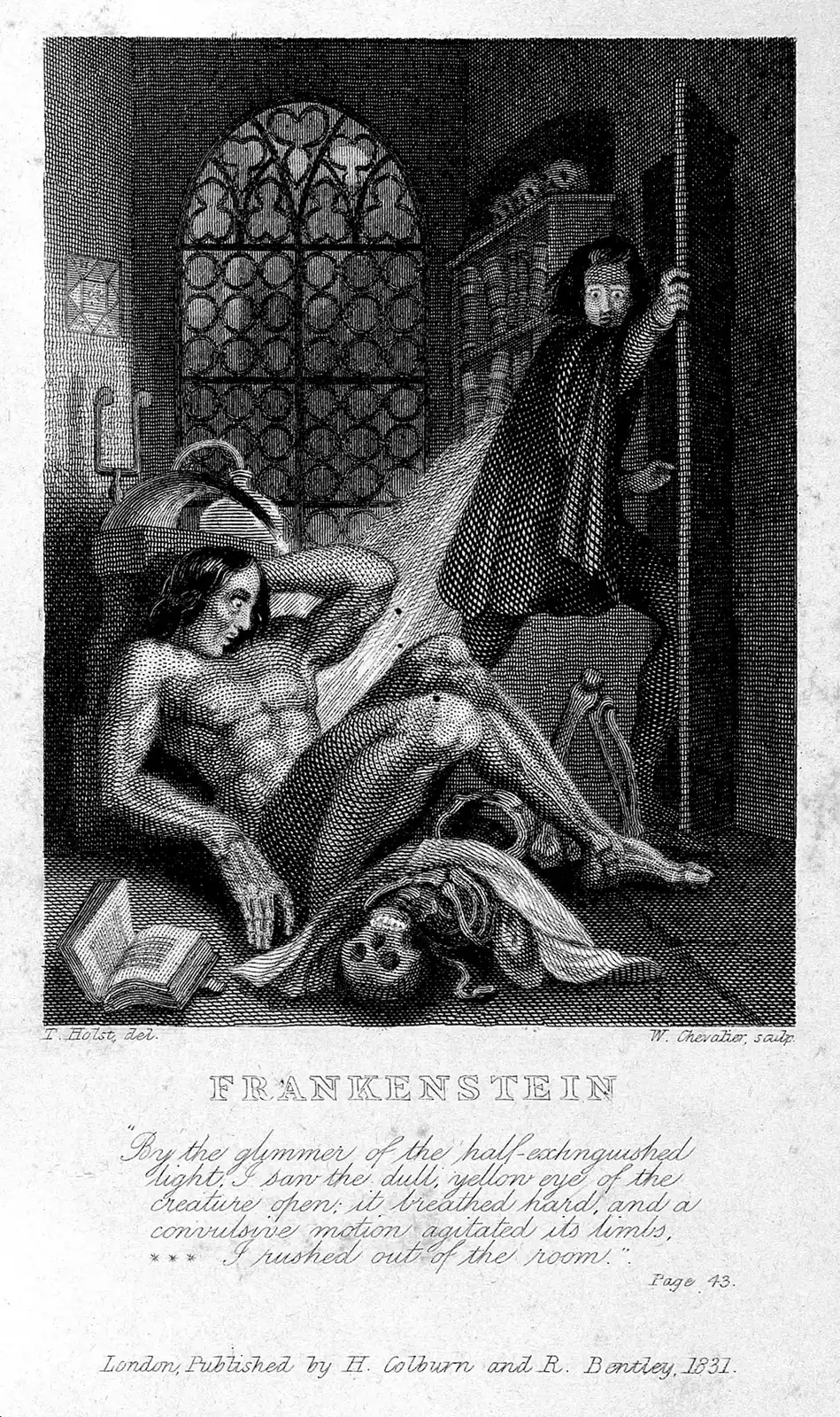
Frontispiece to the 1831 Frankenstein — engraved by W. Chevalier after Theodor von Holst, with a line from the creation scene, the page number 43 and the imprint of Colburn and Bentley, 1831.
"Frankenstein observing the first stirrings of his creature" by Wellcome Collection, 1831 — https://commons.wikimedia.org/wiki/File:Frankenstein_observing_the_first_stirrings_of_his_creature._Wellcome_L0027125.jpg — CC BY 4.0 (https://creativecommons.org/licenses/by/4.0/)
The book also gained a frontispiece, the illustration that faces the title page. It is signed “T. Holst, del.” and “W. Chevalier, sculp.,” meaning that Theodor von Holst drew it and W. Chevalier engraved it. Below the picture runs a line from the creation scene: “By the glimmer of the half-extinguished light, I saw the dull, yellow eye of the creature open.”
The 1818 edition named no author at all. Its title page gives the title, the three volumes and the London booksellers Lackington, Hughes, Harding, Mavor, & Jones, and its dedication to William Godwin is signed only by “the author.”
According to SFE, an edition in between came from G. and W. B. Whittaker of London in 1823, in two volumes, and SFE says no English edition before it carried Shelley's name. SFE also records that a French translation by Jules Saladin, published in 1821, had already named her, spelled “Shelly.” This page has not read the 1823 text and does not compare it.
What did Mary Shelley say about the revision?
Shelley's introduction ends with a paragraph about the changes. “I will add but one word as to the alterations I have made,” she writes. “They are principally those of style. I have changed no portion of the story, nor introduced any new ideas or circumstances.”
She then says where the changes are: “these changes occur almost exclusively in the beginning of the first volume.” The passages on this page fit that statement. All nine changed passages in the story itself fall in the first two chapters of the 1818 first volume, which the 1831 text spreads over its first three chapters.
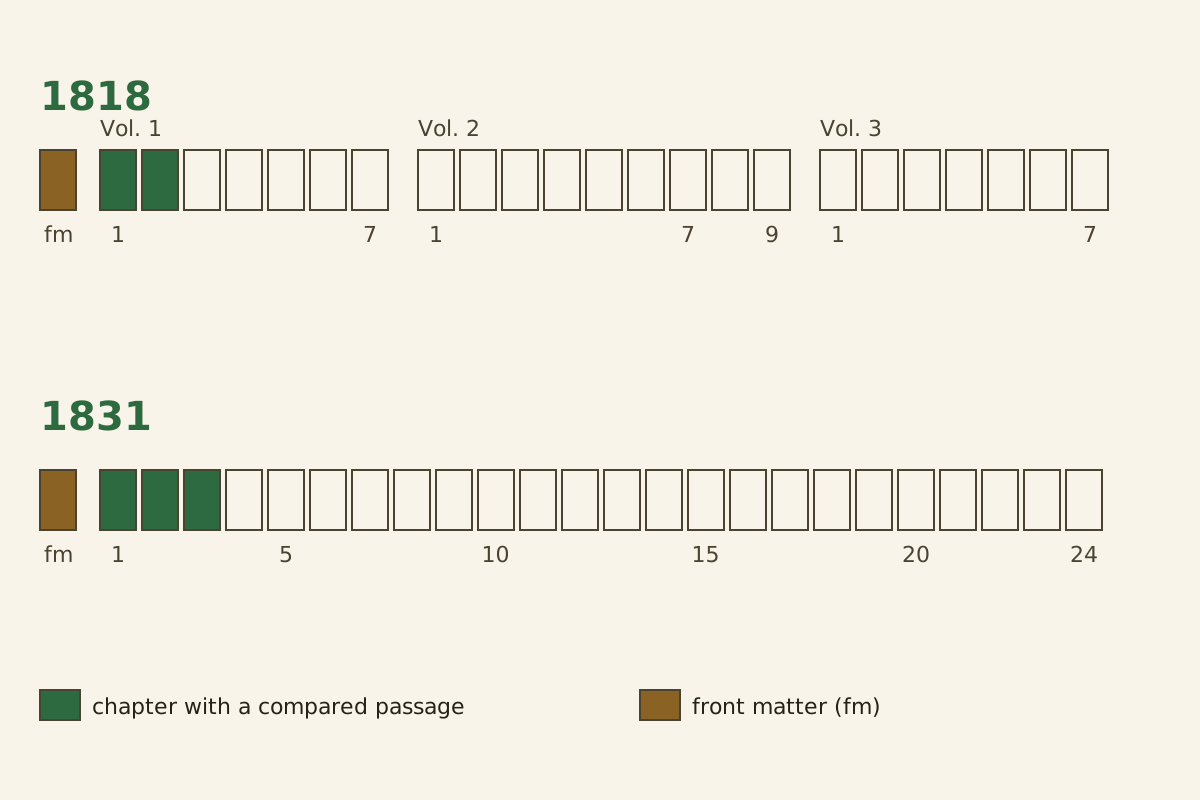
Where the compared passages fall — the first two chapters of 1818 and the first three of 1831 hold every story passage on this page, and the front matter holds the title-page and introduction changes.
Frankenstein, 1818 and 1831: where the compared passages fall · Genre Fiction Lineage · CC BY 4.0
Reuse credit (CC BY)
"Frankenstein, 1818 and 1831: where the compared passages fall" by Genre Fiction Lineage, https://genrefictionlineage.com/science-fiction/frankenstein-editions/, licensed under CC BY 4.0 (https://creativecommons.org/licenses/by/4.0/)
Texts: Mary Shelley, Frankenstein, 1818 and 1831 editions, Project Gutenberg eBooks #41445 and #42324 (photo-reprints)
The 1831 text gets its extra chapter this way. It divides the 1818 first chapter in two, so the lightning scene from 1818's chapter 1 lands in 1831's chapter 2. From there on, the 1831 numbers run one ahead of a straight count of the 1818 chapters, and the creation night in Volume 1, chapter 4 of 1818 is chapter 5 in 1831.
The first statement reads differently beside the Elizabeth passages. The Lake Como cottage, the Milanese nobleman and his German wife do not appear anywhere in the 1818 text. The introduction gives no reason for the new account of Elizabeth's birth. No other source read for this page gives one either.
Her introduction also says something about the 1818 preface, which both editions print. “As far as I can recollect, it was entirely written by him,” she writes of her husband, Percy Bysshe Shelley. SFE's entry on Shelley calls the 1831 version “more far-reaching in its changes” than the 1823 one and reports a growing view among critics that the 1818 text matters more than either later version.
A desk for a revision — an illustration of an author's working table, not a book illustration or a historical image.
Illustration: Genre Fiction Lineage. Generated scene illustration — not a book illustration, photograph or historical record. No copyright is claimed in the generated imagery; if you reuse it, please credit "Genre Fiction Lineage".
Where does Frankenstein sit on the dated tree?
Where Frankenstein belongs in the history of science fiction depends on whose account is used. SFE's entry calls it “the most famous English Horror novel” and says it was first read as a Gothic tale. It reports that Brian W. Aldiss argued in Billion Year Spree (1973) that the book is the first science fiction novel. SFE calls that argument deliberately provocative and, judged by subject matter alone, wrong, while granting that Aldiss rightly stressed how new the book was.
The lineage strip below follows the novel's own printings. The 1831 text was revised by Shelley, as her 1831 introduction says, but editions of one work are not separate works, so the arc from 1818 to 1831 is dotted, for publication order. The 1823 edition sits between them on dates alone, because this page has read only its bibliographic record. The printings on the strip, each with its source, are in a CSV of the printings on the strip CSV · provenance note Texts: Mary Shelley, Frankenstein, 1818 and 1831 editions, Project Gutenberg eBooks #41445 and #42324 (photo-reprints).
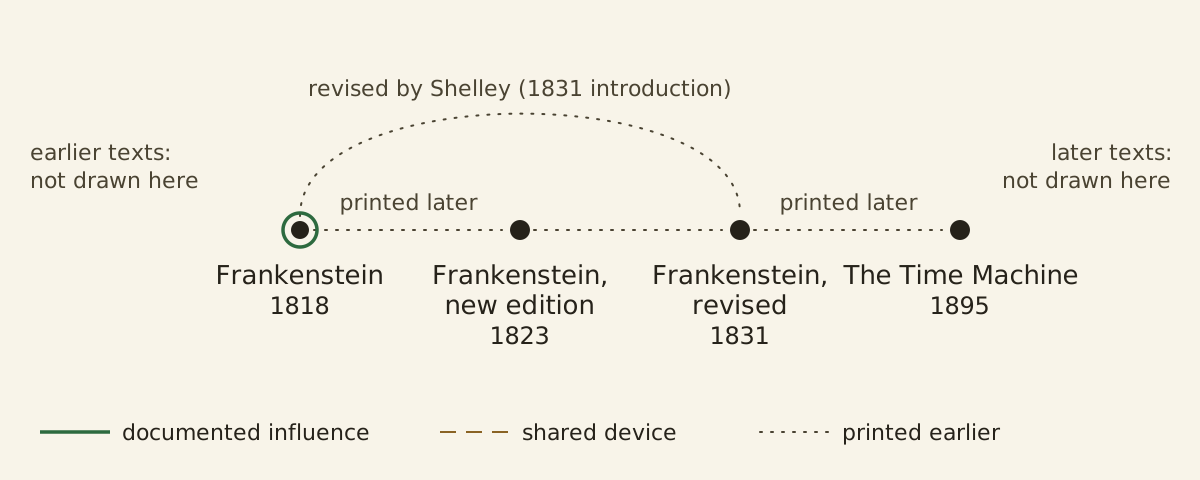
- Solid: documented influence (the later author's own statement, letter, review or note)
- Dashed: shared device (similar texts, no borrowing claimed)
- Dotted: dates only (publication order or other dates; no link claimed)
Lineage strip — four printings in date order, every line dotted for publication order; the arc from 1818 to 1831 marks the text Shelley revised.
Lineage strip: Frankenstein 1818 to The Time Machine 1895 · Genre Fiction Lineage · CC BY 4.0
Reuse credit (CC BY)
"Lineage strip: Frankenstein 1818 to The Time Machine 1895" by Genre Fiction Lineage, https://genrefictionlineage.com/science-fiction/frankenstein-editions/, licensed under CC BY 4.0 (https://creativecommons.org/licenses/by/4.0/)
Texts: Mary Shelley, Frankenstein, 1818 and 1831 editions, Project Gutenberg eBooks #41445 and #42324 (photo-reprints)
The Time Machine (1895) appeared 77 years after the 1818 edition and 64 years after the revised text. No source read for this page links the two books, so the line to Wells is dotted.
To the left, the strip leaves out the earlier texts that Shelley herself names. Her introduction recalls that in the wet summer of 1816 “Some volumes of ghost stories, translated from the German into French, fell into our hands,” and that Lord Byron then said, “We will each write a ghost story.” SFE identifies those volumes as Fantasmagoriana (1812), a French translation of a German collection.
How can you tell which text you are reading?
Before quoting Frankenstein, check which of the two texts a copy follows, since a modern reprint may follow either one. Five checks drawn from the table above tell the two texts apart. The three in the story itself are the surest, since a reprint can add front matter or renumber chapters.
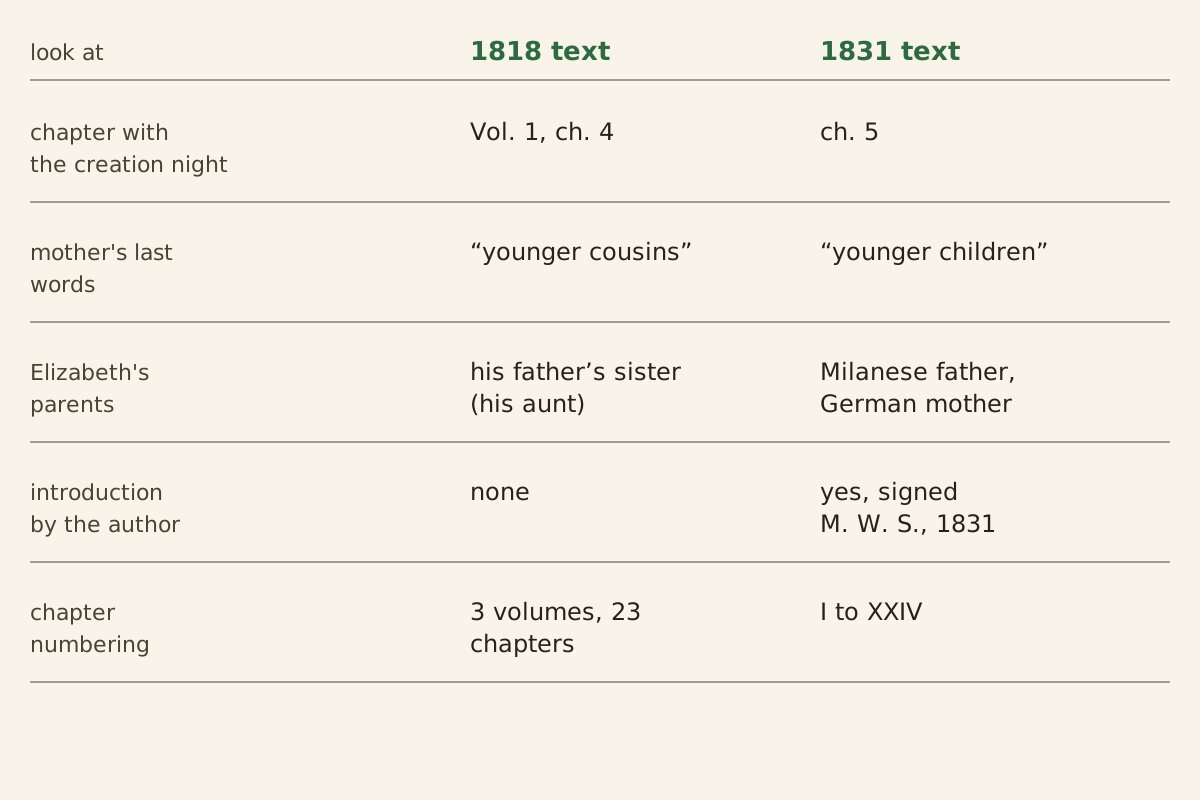
Five checks — each line names what to look at and what the 1818 and 1831 texts print there.
Frankenstein: five checks for the 1818 and 1831 texts · Genre Fiction Lineage · CC BY 4.0
Reuse credit (CC BY)
"Frankenstein: five checks for the 1818 and 1831 texts" by Genre Fiction Lineage, https://genrefictionlineage.com/science-fiction/frankenstein-editions/, licensed under CC BY 4.0 (https://creativecommons.org/licenses/by/4.0/)
Texts: Mary Shelley, Frankenstein, 1818 and 1831 editions, Project Gutenberg eBooks #41445 and #42324 (photo-reprints)
- Find the creation night, which begins “It was on a dreary night of November.” It opens Volume 1, chapter 4 in the 1818 text and chapter 5 in the 1831 text.
- Read the mother's last words before Victor leaves for university. “Your younger cousins” is the 1818 text, and “my younger children” is the 1831 text.
- Read chapter 1 for Elizabeth's parents: Victor's aunt in 1818, a Milanese nobleman and a German mother in 1831.
- Look for an introduction signed “M. W. S.” and dated 15 October 1831. Only the 1831 text has one.
- Look at the chapter numbers. The 1818 text starts again at chapter I in each of its three volumes, and the 1831 text numbers them straight through to XXIV.
Both texts used here can be read free: Project Gutenberg eBook #41445 follows a photo-reprint of the 1818 edition, and #42324 a photo-reprint of the 1831 edition. Here both texts are the author's own, while the English text of Thomas More's Utopia (for comparison) is a translator's.
Sources
- 1Mary Shelley, Frankenstein; or, The Modern Prometheus, Project Gutenberg eBook #41445 (base text: photo-reprint of the first edition, London: Lackington, Hughes, Harding, Mavor, & Jones, 1818, three volumes) https://www.gutenberg.org/ebooks/41445Read: full text
- 2Mary Shelley, Frankenstein: or, The Modern Prometheus, revised edition with a new introduction, Project Gutenberg eBook #42324 (base text: photo-reprint of the edition of London: Henry Colburn and Richard Bentley, 1831) https://www.gutenberg.org/ebooks/42324Read: full text, including the author's introduction
- 3John Clute, "Shelley, Mary Wollstonecraft," in John Clute, David Langford and Graham Sleight (eds), The Encyclopedia of Science Fiction, https://sf-encyclopedia.com/entry/shelley_mary_wollstonecraft, accessed 2 November 2026 https://sf-encyclopedia.com/entry/shelley_mary_wollstonecraftRead: full entry (entry updated 24 August 2026), including the checklist
- 4John Clute and Brian Stableford, "Wells, H G," in John Clute, David Langford and Graham Sleight (eds), The Encyclopedia of Science Fiction https://sf-encyclopedia.com/entry/wells_h_gRead: full entry
- 5Gemeinsame Normdatei (GND), Deutsche Nationalbibliothek, records for Mary Shelley (11879695X) and Theodor von Holst (119324180), via lobid.org https://lobid.org/gnd/11879695XRead: authority records (life dates)
- 6Jennifer Jenkins and James Boyle, "Public Domain Day 2026," Center for the Study of the Public Domain, Duke Law School https://web.law.duke.edu/cspd/publicdomainday/2026/Read: full pageText licence: CC BY 4.0
- 7Urheberrechtsgesetz § 64 (Allgemeines), gesetze-im-internet.de https://www.gesetze-im-internet.de/urhg/__64.htmlRead: full text of the section
Cite this page
Genre Fiction Lineage. “Frankenstein: In the 1818 Text, Elizabeth Is Victor's Cousin.” Genre Fiction Lineage, published 3 November 2026. https://genrefictionlineage.com/science-fiction/frankenstein-editions/. Accessed [the date you read it].
Next shelf over:
- The Time Machine: seventy-seven years on, a science fiction novel whose printings can also be dated one by one (printed later).
- Science Fiction Subgenres: the named branches of science fiction, each name dated by its earliest record in HDSF against the work it describes (for comparison).
- Read the text: Frankenstein (1818), Project Gutenberg
Related entries
More from Science Fiction.
Lineage essay
The Time Machine: Gaspar's Time Ship Was in Print by 1887
Enrique Gaspar's El anacronópete put a time machine in print in Barcelona in 1887, eight years before Wells. Ten time-travel stories to 1895, dated, with a CSV.
Picture credit
Illustration: Genre Fiction Lineage. Generated scene illustration — not a book illustration, photograph or historical record. No copyright is claimed in the generated imagery; if you reuse it, please credit "Genre Fiction Lineage".
Data page
Science Fiction Subgenres: Most of 12 Names Came After Books
Twelve science fiction names, from utopia to steampunk, each dated against an early work of its kind. Most of the names reached print years later.
Picture credit
"The War of the Worlds, page 279" by Warwick Goble, 1898 — https://commons.wikimedia.org/wiki/File:War_of_the_Worlds_pg_279.png — Public domain (US: published 1898 (Harper); Germany and France: Goble died 1943 (dates on the Commons file page of the whole 1898 book), so 70 years after death ran out at the end of 2013 (Germany: UrhG §64; France: CPI L123-1, general rule, not checked against Légifrance); a British illustrator, so the French 'mort pour la France' extension is not considered (general knowledge, not checked); Wells (died 1946) is the author of the text, not the image)

Catalogue entry
Space Opera: Earliest Known Printed English Use, 1941
The earliest known use of “space opera” is in a January 1941 fan magazine, per the Historical Dictionary of Science Fiction. The stories it names came first.
Picture credit
Illustration: Genre Fiction Lineage. Generated scene illustration — not a book illustration, photograph or historical record. No copyright is claimed in the generated imagery; if you reuse it, please credit "Genre Fiction Lineage".