Science Fiction · Lineage essay
The Time Machine: Gaspar's Time Ship Was in Print by 1887
Genre Fiction Lineage Published
A Spanish novel put a time machine in print in 1887: Enrique Gaspar's El anacronópete, published in Barcelona. That is eight years before H. G. Wells's The Time Machine (1895), and no source read for this page shows that Wells knew Gaspar's book, so the two share a device and an order of publication, not a documented link.
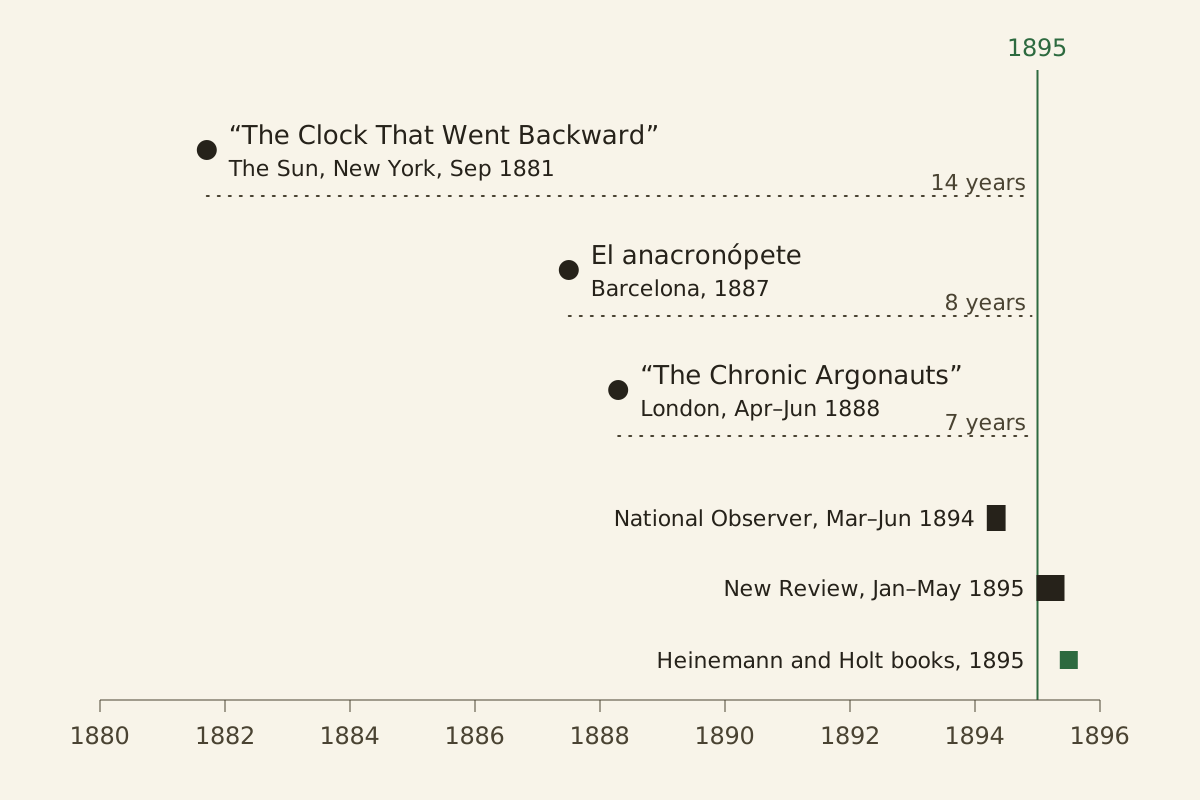
Time machines in print, 1881 to 1895 — Mitchell's clock story, Gaspar's novel and Wells's 1888 serial, each measured in whole years to 1895, with the 1894 papers, the 1895 serial and the two 1895 books.
Time machines in print, 1881 to 1895 · Genre Fiction Lineage · CC BY 4.0
Reuse credit (CC BY)
"Time machines in print, 1881 to 1895" by Genre Fiction Lineage, https://genrefictionlineage.com/science-fiction/time-machine/, licensed under CC BY 4.0 (https://creativecommons.org/licenses/by/4.0/)
Bibliographic facts checked against the public-domain texts and the entries of The Encyclopedia of Science Fiction, eds. John Clute, David Langford and Graham Sleight (sf-encyclopedia.com), listed on the entry page
Wells's own record points to an earlier version of the same story: his 1888 serial “The Chronic Argonauts,” which he called his first draft of The Time Machine in his 1934 autobiography. The ten time-travel stories on this page, with dates, devices, relations and sources, are in a CSV of time-travel fiction to 1895 CSV · provenance note Bibliographic facts checked against the public-domain texts and the entries of The Encyclopedia of Science Fiction, eds. John Clute, David Langford and Graham Sleight (sf-encyclopedia.com), listed on the entry page.
When was a time machine first in print?
The answer depends on what counts as a machine. This site uses the patient-zero text for the earliest known print record inside a stated range. The range here is printed fiction in English and Spanish that this page has read, in which someone builds a vehicle to carry people through time.
Inside that range, the patient-zero text is El anacronópete. Its title page names the place, the publisher and the year: “BARCELONA … DANIEL CORTEZO y C.ª … 1887.” SFE's entry on Gaspar takes a similar view in guarded terms: the book “seems to be the first to describe a Time Machine.” That is eight years before the first instalment of The Time Machine appeared in The New Review in January 1895.
Widen “machine” to any mechanism and the date moves back six years. In September 1881 the New York Sun printed an unsigned story, “The Clock That Went Backward,” which SFE attributes to Edward Page Mitchell. SFE's Mitchell entry describes the clock as “a mechanical device or Time Machine” and suggests the story may be the earliest known tale to use one.
The two findings do not collide, because nothing in Mitchell's story says the clock was built for the trip, as the section on his story shows. Both are statements about the record so far. An earlier printing in either range would move the slot, and this page would record the change.
Ask instead for the earliest known time-travel story of any kind, and the trail leaves machines behind. SFE's “Time Travel” entry calls Johan Herman Wessel's play Anno 7603 (1785), which uses fairy magic to reach the year 7603, one of the earliest time-travel fictions. This page has read only the play's 1785 title page, which names no author, and records the rest as SFE's report. SFE spells the name Hermann; the Project Gutenberg record of the play has Herman.
What was Gaspar's anacronópete?
SFE describes Gaspar (1842–1902) as a Spanish diplomat and playwright, and says he first wrote the story as a zarzuela, a Spanish comic operetta, that was never staged. El anacronópete came out in a Barcelona volume with two shorter works, “Viaje a China” and “Metempsícosis,” illustrated by Francesc Gómez Soler. Its inventor, Don Sindulfo García, launches his machine from the Champ de Mars in Paris in July 1878. That was the summer of the Universal Exposition.
In chapter III he explains the name: “El Anacronópete, que es una especie de arca de Noé, debe su nombre a tres voces griegas” (“The Anacronópete, which is a kind of Noah's ark, owes its name to three Greek words”; Genre Fiction Lineage translation). The three words mean backward, time and one who flies. The power source gets one plain sentence: “Su motor es la electricidad” (“Its motor is electricity”; Genre Fiction Lineage translation).
Chapter VII describes a sealed, rectangular vehicle with a great glass disc in each wall. Through those discs the travellers watch the landscape with telescopes. Gómez Soler drew them doing it. The same chapter fits the cabin with two clocks, one for the real time on board and one for the historical moment outside, by century, year, month and day.
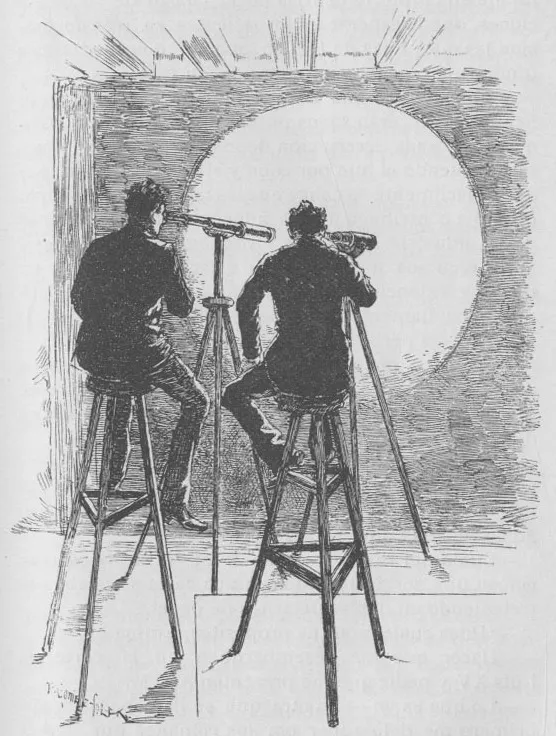
Two travellers at the glass disc — Francesc Gómez Soler's illustration on page 75 of the 1887 Barcelona edition, printed beside the passage on what time travellers may not change.
Illustration for El anacronópete, page 75 · Francesc Gómez Soler · public domain
Full credit
"Illustration for El anacronópete, page 75" by Francesc Gómez Soler, 1887 — https://commons.wikimedia.org/wiki/File:El_anacron%C3%B3pete_-_Enrique_Gaspar_i_Rimbau.pdf — Public domain (US: published 1887; Germany and France: Gómez Soler died 1899 (date in the Commons creator data), so 70 years after death have run out; a Spanish illustrator who died before 1914, so no French wartime extension applies (general knowledge, not checked)); modified: page 75 taken from the 391-page scan PDF and cropped to the illustration; running head and text lines removed
The route runs backward through history. The travellers watch the battle of Tetuán in 1860, stop in China in the year 220 and later reach Pompeii. SFE describes the tone as satire driven by romantic intrigue and farce.
In chapter VIII, Gaspar gives the journey a rule. Don Sindulfo tells his friend: “Nosotros podemos asistir como testigos presenciales a los hechos consumados en los siglos precedentes; pero nunca destruir su existencia” (“We can be present as eyewitnesses at the deeds of past centuries, but never destroy their existence”; Genre Fiction Lineage translation). The ending then reframes the whole trip.
Chapter XX sends the machine into the chaos before creation, where its window bursts, and the next paragraph finds the family at a Jules Verne play in Paris, where “el tutor se había dormido y había soñado” (“the guardian had fallen asleep and dreamed”; Genre Fiction Lineage translation).
Did Wells know Gaspar's novel?
No source read for this page says that he did. Evidence of contact would be a letter, a review, a note or a mention of the book in Wells's own writing, and none has turned up. If one does, the dashed line on the strip becomes a solid one, and the change goes into the corrections at the foot of the page. SFE's Gaspar entry lists English translations only from 2012, and this page has found no English text of the novel before then.
That leaves two things that the record does show. El anacronópete appeared before The Time Machine, and both books describe a machine built for time travel. In this site's terms, the pair shares a device and an order of publication. The lineage strip below draws a dashed line from Gaspar's book to Wells's 1888 draft, whose Argo is also built for time travel, and no solid line from Gaspar to Wells.
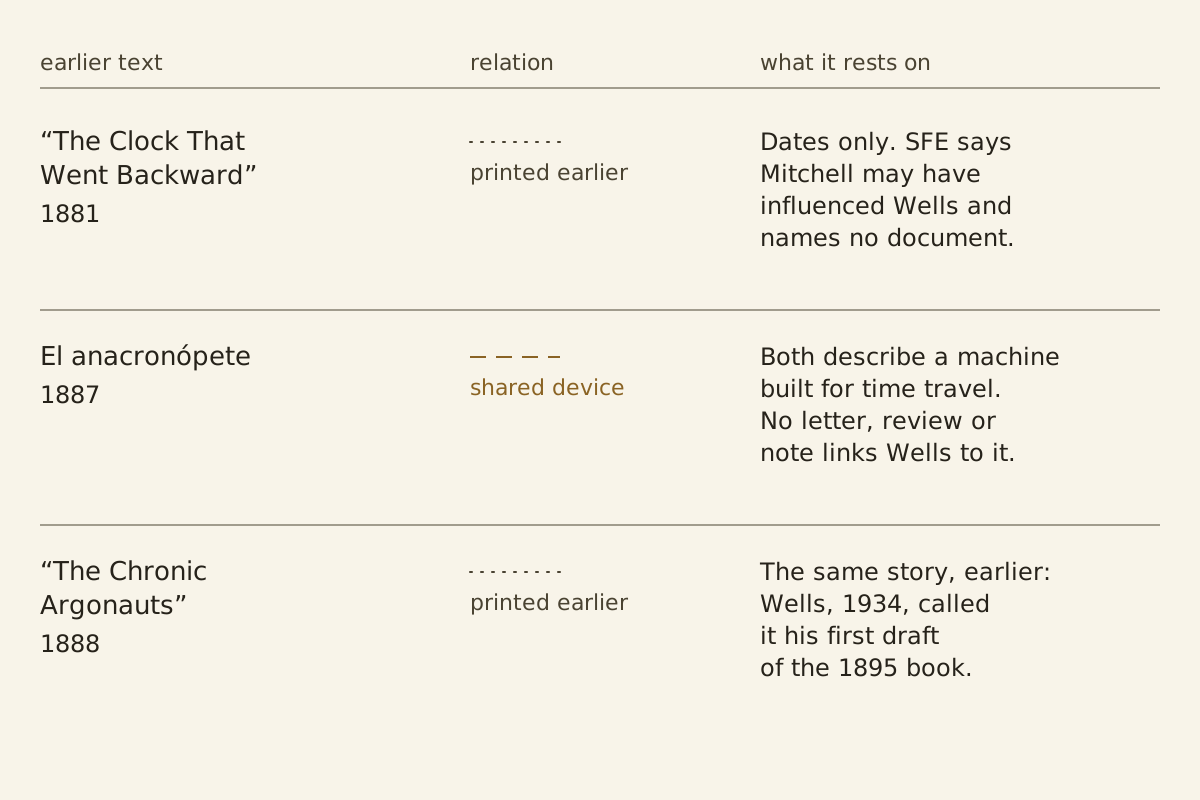
What each link rests on — Mitchell's story by date order only, Gaspar's novel by a shared device, and Wells's 1888 serial by date order, as an earlier version of the same story in his own later words.
What each link to The Time Machine rests on · Genre Fiction Lineage · CC BY 4.0
Reuse credit (CC BY)
"What each link to The Time Machine rests on" by Genre Fiction Lineage, https://genrefictionlineage.com/science-fiction/time-machine/, licensed under CC BY 4.0 (https://creativecommons.org/licenses/by/4.0/)
Bibliographic facts checked against the public-domain texts and the entries of The Encyclopedia of Science Fiction, eds. John Clute, David Langford and Graham Sleight (sf-encyclopedia.com), listed on the entry page
Gaspar's own text names a different writer. The opening chapter mentions Jules Verne and the Nautilus, Don Sindulfo's lecture speaks of an audience that knows Verne's works by heart, and the dream ends at a Verne play.
Mitchell's case is similar to Gaspar's. SFE's entry suggests that Mitchell's stories “may have influenced H G Wells and others,” but it names no document, so this page records date order only. Among the earlier texts on this page, the only one that Wells himself tied to The Time Machine is his own.
What was “The Chronic Argonauts”?
“The Chronic Argonauts” ran in The Science Schools Journal in London in 1888, seven years before The Time Machine. SFE's Wells entry dates the run from April to June 1888. The transcription's note gives the journal as that of the Royal College of Science. In his autobiography Wells says he broke the serial off after three instalments and describes it as a romance written under the influence of Nathaniel Hawthorne, in prose he judged over-elaborate.
The story opens in a Welsh village, where a strange newcomer, Dr. Nebogipfel, works on an invention in an empty house. Its third part is told from the depositions of a local clergyman, the Reverend Elijah Ulysses Cook, who goes with him.
The invention is a vehicle. Nebogipfel calls himself “an Anachronic Man,” born before his proper age, and he calls his machine “the Chronic Argo, the ship that sails through time.” He has spent thirty years building it, and he means to ride it forward to the age where he belongs. The surviving text ends as the machine departs with Cook aboard and leaves the rest of the voyage untold.
Wells named the connection himself in 1934. In Experiment in Autobiography (chapter 6, section 5) he calls the serial “my first draft of the Time Machine, the ‘Chronic Argonauts.’” By his own account, then, the serial is an earlier version of the same story, not a separate work that shaped it. This site records versions of one work by print order and keeps documented influence for links between different works.
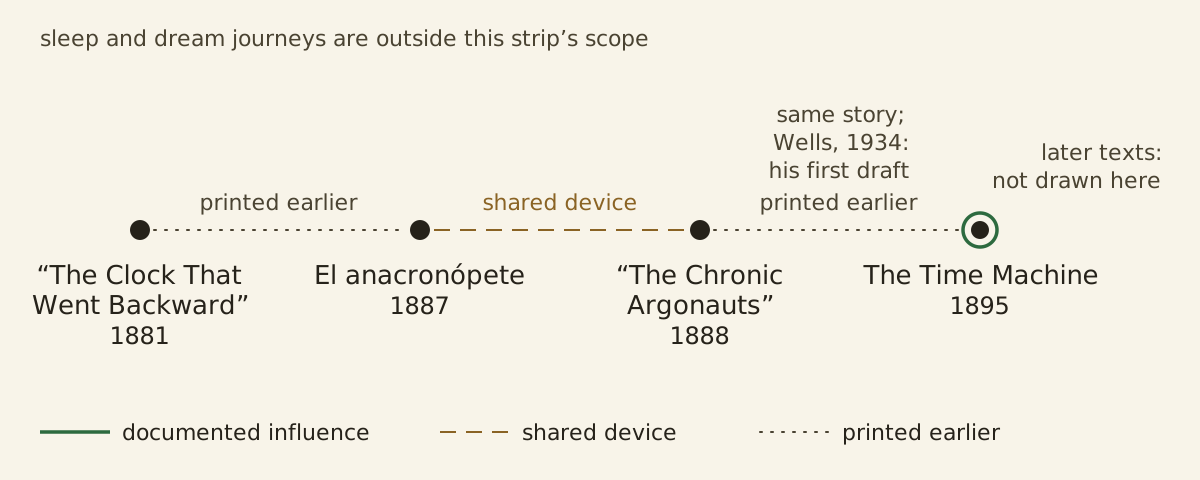
- Solid: documented influence (the later author's own statement, letter, review or note)
- Dashed: shared device (similar texts, no borrowing claimed)
- Dotted: dates only (publication order or other dates; no link claimed)
Lineage strip — four time-machine texts in print order; the dotted lines rest on dates alone, the second joining two versions of Wells's story, and the dashed line on a shared device.
Lineage strip: "The Clock That Went Backward" to The Time Machine, 1881–1895 · Genre Fiction Lineage · CC BY 4.0
Reuse credit (CC BY)
"Lineage strip: "The Clock That Went Backward" to The Time Machine, 1881–1895" by Genre Fiction Lineage, https://genrefictionlineage.com/science-fiction/time-machine/, licensed under CC BY 4.0 (https://creativecommons.org/licenses/by/4.0/)
Bibliographic facts checked against the public-domain texts and the entries of The Encyclopedia of Science Fiction, eds. John Clute, David Langford and Graham Sleight (sf-encyclopedia.com), listed on the entry page
A workshop time machine — an illustration of an inventor's machine of the kind Wells describes in 1895, not a book illustration.
Illustration: Genre Fiction Lineage. Generated scene illustration — not a book illustration, photograph or historical record. No copyright is claimed in the generated imagery; if you reuse it, please credit "Genre Fiction Lineage".
How did the 1888 story become the 1895 book?
The story ran in periodicals three times before the two books appeared. A serial is a story printed in parts across several issues of a periodical, and each of those runs was one. In his autobiography Wells recalls that William Ernest Henley asked him for a contribution to The National Observer, and that he dug up his old time-travelling idea and turned it into seven papers between March and June. Wikisource transcribes seven issues dated 17 March to 23 June 1894, and SFE gives the first paper's title as “Time Travelling: Possibility or Paradox?”
The New Review then ran The Time Machine in five monthly issues, January to May 1895, numbers 68 to 72 of its twelfth volume. The serial began about seven months after the last of the 1894 papers. Both 1895 books open with a short note on these earlier printings. The London edition says that “The substance of the first chapter of this story and of several paragraphs from the context appeared in the ‘National Observer’ in 1894.”
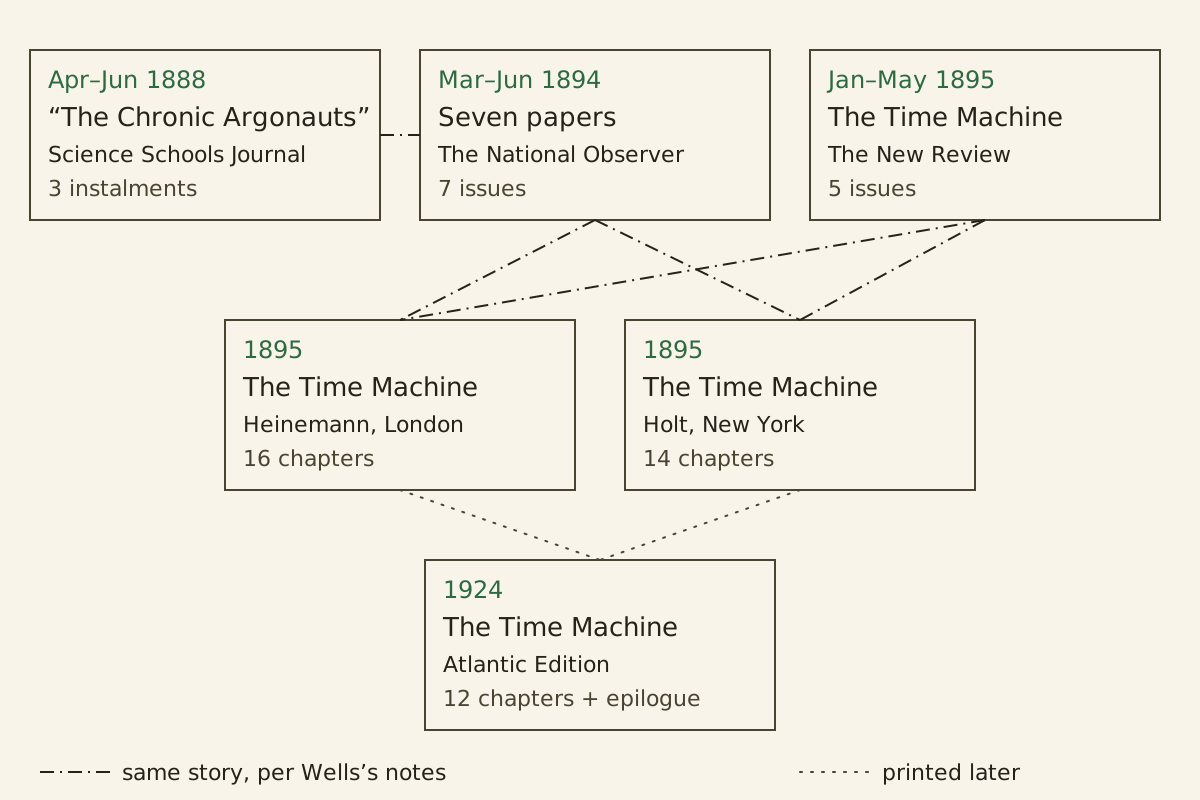
Printed stages, 1888 to 1924 — the 1888 serial, the 1894 papers and the 1895 serial, with dash-dot lines where Wells's own notes carry text from one stage of the story into a later one.
The Time Machine: printed stages, 1888–1924 · Genre Fiction Lineage · CC BY 4.0
Reuse credit (CC BY)
"The Time Machine: printed stages, 1888–1924" by Genre Fiction Lineage, https://genrefictionlineage.com/science-fiction/time-machine/, licensed under CC BY 4.0 (https://creativecommons.org/licenses/by/4.0/)
Bibliographic facts checked against the public-domain texts and the entries of The Encyclopedia of Science Fiction, eds. John Clute, David Langford and Graham Sleight (sf-encyclopedia.com), listed on the entry page
The New York edition carries an author's note of its own: “The Time Traveler's Story and a part of the introductory conversation appeared as a serial in the New Review.” It is signed “H. S. W.,” a set of initials that does not match the name on the title page. The same note adds that “the explanation of the ‘principles’ of Time Traveling given in this book is inserted from the latter paper,” meaning the National Observer. From the 1888 serial to the 1895 books is seven years, and the full sequence is in a CSV of the printed texts of The Time Machine CSV · provenance note Bibliographic facts checked against the public-domain texts and the entries of The Encyclopedia of Science Fiction, eds. John Clute, David Langford and Graham Sleight (sf-encyclopedia.com), listed on the entry page.
Which text of The Time Machine is which?
An edition here means one setting of the text, issued by one publisher. In 1895 two editions appeared, one from William Heinemann in London and one from Henry Holt and Company in New York, and they differ on the page. The same sentence shows it.
The Heinemann text, chapter II: “The thing the Time Traveller held in his hand was a glittering metallic framework, scarcely larger than a small clock, and very delicately made.” The Holt text gives the same sentence in its chapter I as “The thing the Time Traveler held in his hand,” with one “l” and a different chapter number. Heinemann lists 16 chapters, from “Introduction” to “After the Story”; Holt lists 14, from “The Inventor” to “After the Time Traveler's Story.” The front pages differ too. The Heinemann text is dedicated to William Ernest Henley, who had asked for the 1894 papers, while the Holt text opens with two lines of Robert Browning: “Fool! All that is at all / Lasts ever past recall.”
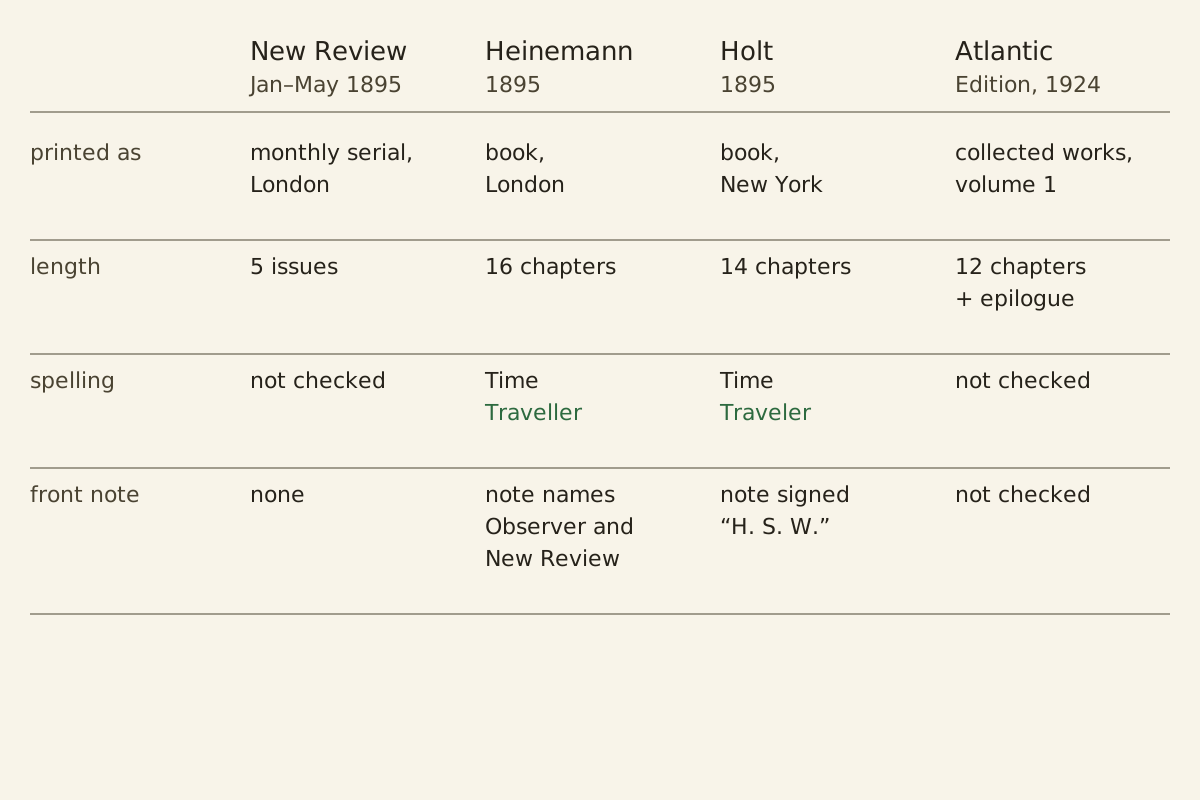
Four texts compared — the 1895 serial, the London and New York books of 1895 and the 1924 Atlantic Edition, with chapter counts as the tables of contents give them.
Four texts of The Time Machine compared · Genre Fiction Lineage · CC BY 4.0
Reuse credit (CC BY)
"Four texts of The Time Machine compared" by Genre Fiction Lineage, https://genrefictionlineage.com/science-fiction/time-machine/, licensed under CC BY 4.0 (https://creativecommons.org/licenses/by/4.0/)
Bibliographic facts checked against the public-domain texts and the entries of The Encyclopedia of Science Fiction, eds. John Clute, David Langford and Graham Sleight (sf-encyclopedia.com), listed on the entry page
| Text | Printed as | Length | Spelling | Front note |
|---|---|---|---|---|
| The New Review serial | monthly serial, London, January to May 1895 | 5 issues | not checked | not checked |
| Heinemann text | book, London, 1895 | 16 chapters | Time Traveller | names the National Observer (1894) and the New Review |
| Holt text | book, New York, 1895 | 14 chapters | Time Traveler | names the New Review and the National Observer; signed “H. S. W.” |
| Atlantic Edition | collected works, volume 1, 1924 | 12 chapters and an epilogue | not checked | not checked |
The Atlantic Edition of 1924 came 29 years after the first books. It divides the story differently again. Before quoting The Time Machine, check which of these texts the quotation comes from.
What was “The Clock That Went Backward”?
SFE describes Mitchell (1852–1927) as a New York Sun journalist, later its editor-in-chief, whose science fiction came from the first decade of his career and mostly appeared first in his own paper. The story is set around a tall Dutch clock with a maker's name, Jan Lipperdam, and the date 1572 on its dial. The narrator and his cousin Harry see their great-aunt wind it one night and watch its hands run backward. Years later, in Leyden, their professor winds it again, and the two young men find themselves in the city under siege three centuries earlier.
The moment itself takes one sentence: “The hands were whirling around the dial from right to left with inconceivable rapidity.” In the besieged city the cousins find their professor's face on the clockmaker, Jan Lipperdam, and Harry defending a breach in the wall. Harry stays behind in the past, and the narrator returns alone to his rooms, where his only companion is the silent clock. The Wikisource transcription labels the story with the date 18 September 1881, and SFE gives September 1881 and lists the story as anonymous.
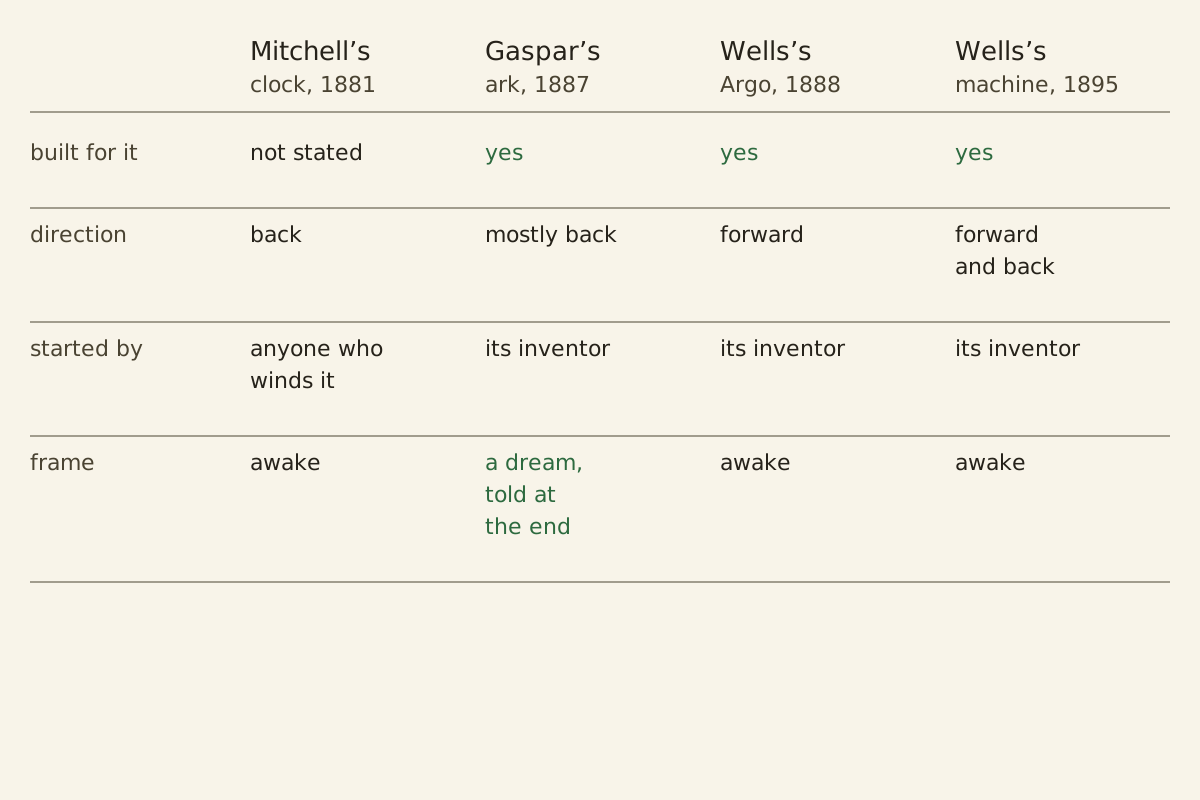
Four devices compared — only the clock is not described as built for time travel, and only Gaspar's journey turns out to be a dream.
Four time-travel devices compared, 1881–1895 · Genre Fiction Lineage · CC BY 4.0
Reuse credit (CC BY)
"Four time-travel devices compared, 1881–1895" by Genre Fiction Lineage, https://genrefictionlineage.com/science-fiction/time-machine/, licensed under CC BY 4.0 (https://creativecommons.org/licenses/by/4.0/)
Bibliographic facts checked against the public-domain texts and the entries of The Encyclopedia of Science Fiction, eds. John Clute, David Langford and Graham Sleight (sf-encyclopedia.com), listed on the entry page
| Device | Built for time travel | Direction | Started by | Frame |
|---|---|---|---|---|
| Mitchell's clock, 1881 | not stated | back | anyone who winds it | waking |
| Gaspar's ark, 1887 | yes | mostly back | its inventor | a dream, revealed at the end |
| Wells's Argo, 1888 | yes | forward | its inventor | waking |
| Wells's machine, 1895 | yes | forward and back | its inventor | waking |
The comparison across the four devices is in a CSV of four time-travel devices CSV · provenance note Bibliographic facts checked against the public-domain texts and the entries of The Encyclopedia of Science Fiction, eds. John Clute, David Langford and Graham Sleight (sf-encyclopedia.com), listed on the entry page. Mitchell's clock moves people through time, but the story never shows anyone building it for that purpose.
Machine, sleep or dream?
Before the machine, fiction reached other times by other means. SFE's “Time Travel” entry says that until the end of the nineteenth century “dreams were the favoured method,” and it names fairy magic, timeslips and long sleep as well. This page sorts ten stories to 1895 by the device each uses, taking the six it has not read from that entry.
Two of the other means are close to Wells in date. Grant Allen's “Pausodyne” (December 1881) uses suspended animation, and Mark Twain's A Connecticut Yankee in King Arthur's Court (1889) uses a timeslip, a sudden unexplained move to another time, by SFE's account of both.
By this page's count, four of the ten use a machine, two a dream, one a sleep and three some other means. None of the four stories dated before 1881 uses a machine. All four machines appear in the 14 years from Mitchell's 1881 clock to Wells's 1895 book.
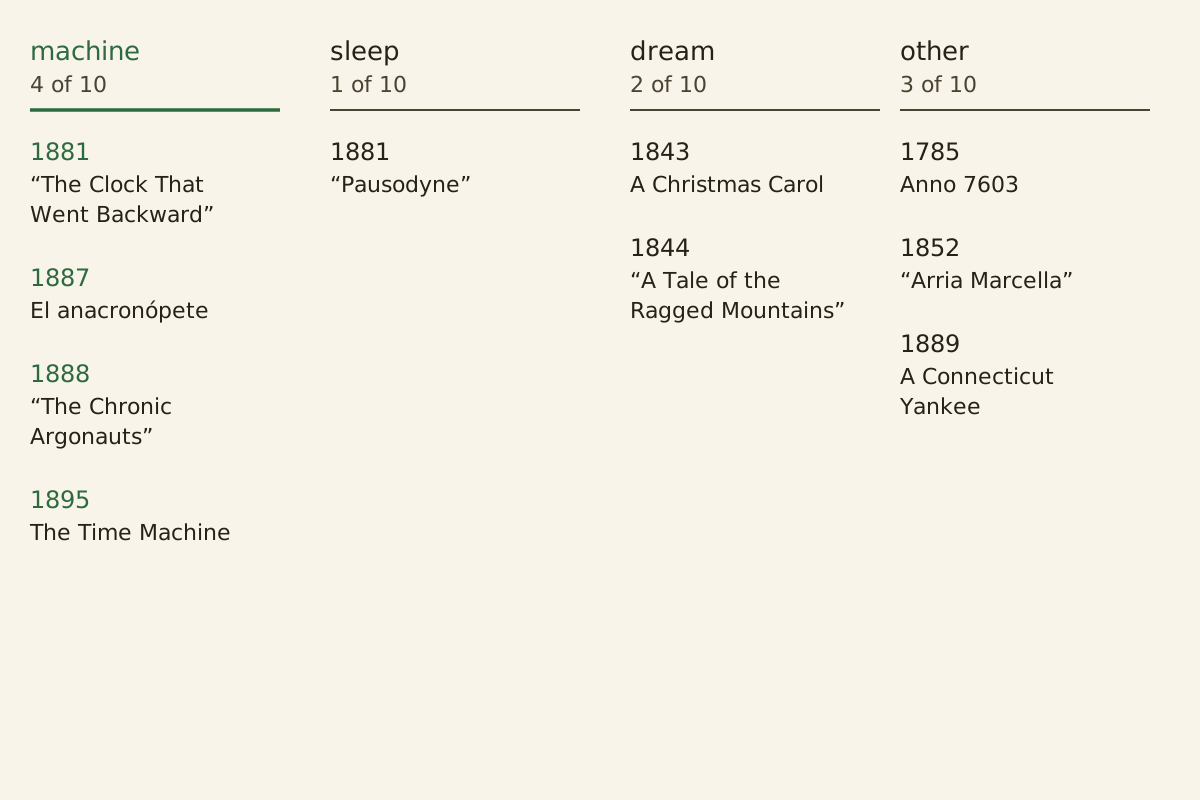
Machine, sleep, dream or other — ten time-travel stories from 1785 to 1895, grouped by device and dated by first print as SFE or the text gives it.
Time-travel fiction to 1895 by device · Genre Fiction Lineage · CC BY 4.0
Reuse credit (CC BY)
"Time-travel fiction to 1895 by device" by Genre Fiction Lineage, https://genrefictionlineage.com/science-fiction/time-machine/, licensed under CC BY 4.0 (https://creativecommons.org/licenses/by/4.0/)
Bibliographic facts checked against the public-domain texts and the entries of The Encyclopedia of Science Fiction, eds. John Clute, David Langford and Graham Sleight (sf-encyclopedia.com), listed on the entry page
| Year | Story | Device | According to |
|---|---|---|---|
| 1785 | Anno 7603, Johan Herman Wessel | other: fairy magic | SFE |
| 1843 | A Christmas Carol, Charles Dickens | dream | SFE |
| 1844 | “A Tale of the Ragged Mountains,” Edgar Allan Poe | dream | SFE |
| 1852 | “Arria Marcella,” Théophile Gautier | other: timeslip, explained as a vision | SFE |
| 1881 | “The Clock That Went Backward,” unsigned; Edward Page Mitchell per SFE | machine: an old clock | text read here |
| 1881 | “Pausodyne,” Grant Allen | sleep: suspended animation | SFE |
| 1887 | El anacronópete, Enrique Gaspar | machine: an ark, inside a dream | text read here |
| 1888 | “The Chronic Argonauts,” H. G. Wells | machine: the Chronic Argo | text read here |
| 1889 | A Connecticut Yankee in King Arthur's Court, Mark Twain | other: timeslip | SFE |
| 1895 | The Time Machine, H. G. Wells | machine | text read here |
Gaspar's novel could sit in two columns. The chart files it under machine, but its machine runs inside a dream. Wells himself turned to sleep four years after The Time Machine, when When the Sleeper Wakes began in The Graphic in January 1899 and carried its hero two centuries ahead. That serial is row 3 of the dystopian novels table (shared device).
Sources
- 1Enrique Gaspar, El anacronópete; Viaje a China; Metempsícosis, illustrated by F. Gómez Soler, Project Gutenberg eBook #62359 (base text: Barcelona, Daniel Cortezo y C.ª, Biblioteca Arte y Letras, 1887) https://www.gutenberg.org/ebooks/62359Read: full text of El anacronópete
- 2John Clute, "Gaspar, Enrique," in John Clute, David Langford and Graham Sleight (eds), The Encyclopedia of Science Fiction https://sf-encyclopedia.com/entry/gaspar_enriqueRead: full entry (updated 18 November 2024)
- 3John Clute and David Langford, "Mitchell, Edward Page," in John Clute, David Langford and Graham Sleight (eds), The Encyclopedia of Science Fiction https://sf-encyclopedia.com/entry/mitchell_edward_pageRead: full entry (updated 25 November 2024)
- 4Edward Page Mitchell, "The Clock That Went Backward" (The Sun, New York, 1881), transcribed at Wikisource https://en.wikisource.org/wiki/The_New_York_Sun/The_Clock_That_Went_BackwardRead: full text (five chapter pages)
- 5Brian Stableford, Malcolm J Edwards and David Langford, "Time Travel," in John Clute, David Langford and Graham Sleight (eds), The Encyclopedia of Science Fiction https://sf-encyclopedia.com/entry/time_travelRead: full entry (updated 31 August 2026)
- 6Anno 7603: Skuespil i 6 Acter, Project Gutenberg eBook #48962 (base text: Kiøbenhavn, P. Horrebow, 1785; record author Johan Herman Wessel) https://www.gutenberg.org/ebooks/48962Read: title page and cast list only; bibliographic record only for the author's name
- 7H. G. Wells, "The Chronic Argonauts" (The Science Schools Journal, 1888), Project Gutenberg Australia eBook 0602911h (transcribed by Project Gutenberg Australia, not collated with the 1888 journal) https://gutenberg.net.au/ebooks06/0602911h.htmlRead: full text
- 8H. G. Wells, Experiment in Autobiography (London: Victor Gollancz and the Cresset Press, 1934), chapters 6 (sections 2 and 5) and 8 (section 1), Project Gutenberg Australia eBook 1303511h https://gutenberg.net.au/ebooks13/1303511h.htmlRead: full text searched; the passages on The Chronic Argonauts and the National Observer read in full
- 9John Clute and Brian Stableford, "Wells, H G," in John Clute, David Langford and Graham Sleight (eds), The Encyclopedia of Science Fiction https://sf-encyclopedia.com/entry/wells_h_gRead: full entry
- 10H. G. Wells, The Time Machine, versions page and National Observer issue list, transcribed at Wikisource https://en.wikisource.org/wiki/The_Time_MachineRead: single page (list of versions and transcribed issues)
- 11H. G. Wells, "The Time Machine," The New Review, vol. 12, nos. 68–72 (January–May 1895), transcribed at Wikisource https://en.wikisource.org/wiki/The_Time_Machine_(The_New_Review)Read: single page (list of the five instalments)
- 12H. G. Wells, The Time Machine: An Invention (London: William Heinemann, 1895), the "Heinemann text", transcribed at Wikisource https://en.wikisource.org/wiki/The_Time_Machine_(Heinemann_text)Read: front matter, contents and chapters 1–2
- 13H. G. Wells, The Time Machine: An Invention (New York: Henry Holt and Company, 1895), the "Holt text", transcribed at Wikisource https://en.wikisource.org/wiki/The_Time_Machine_(Holt_text)Read: front matter, contents and chapter I
- 14H. G. Wells, "The Time Machine," in The Works of H. G. Wells (Atlantic Edition), volume 1 (1924), transcribed at Wikisource https://en.wikisource.org/wiki/The_Works_of_H._G._Wells_(Atlantic_Edition)/Volume_1/The_Time_MachineRead: single page (list of chapters)
- 15Jennifer Jenkins and James Boyle, "Public Domain Day 2026," Center for the Study of the Public Domain, Duke Law School https://web.law.duke.edu/cspd/publicdomainday/2026/Read: full pageText licence: CC BY 4.0
- 16Urheberrechtsgesetz § 64 (Allgemeines), gesetze-im-internet.de https://www.gesetze-im-internet.de/urhg/__64.htmlRead: full text of the section
Cite this page
Genre Fiction Lineage. “The Time Machine: Gaspar's Time Ship Was in Print by 1887.” Genre Fiction Lineage, published 3 November 2026. https://genrefictionlineage.com/science-fiction/time-machine/. Accessed [the date you read it].
Next shelf over:
- Frankenstein, 1818 and 1831: seventy-seven years before Wells, a science fiction novel that its author printed in two different texts (printed earlier).
- Science Fiction Subgenres: the time-travel branch, dated alongside the other named branches of the genre (for comparison).
- Read the text: The Time Machine (1895), Wikisource
Related entries
More from Science Fiction.
Edition comparison
Frankenstein: In the 1818 Text, Elizabeth Is Victor's Cousin
In the 1818 Frankenstein, Elizabeth is Victor's first cousin; in the 1831 text she is a Milanese nobleman's daughter. Thirteen passages compared side by side.
Picture credit
"Frankenstein observing the first stirrings of his creature" by Wellcome Collection, 1831 — https://commons.wikimedia.org/wiki/File:Frankenstein_observing_the_first_stirrings_of_his_creature._Wellcome_L0027125.jpg — CC BY 4.0 (https://creativecommons.org/licenses/by/4.0/)
Data page
Science Fiction Subgenres: Most of 12 Names Came After Books
Twelve science fiction names, from utopia to steampunk, each dated against an early work of its kind. Most of the names reached print years later.
Picture credit
"The War of the Worlds, page 279" by Warwick Goble, 1898 — https://commons.wikimedia.org/wiki/File:War_of_the_Worlds_pg_279.png — Public domain (US: published 1898 (Harper); Germany and France: Goble died 1943 (dates on the Commons file page of the whole 1898 book), so 70 years after death ran out at the end of 2013 (Germany: UrhG §64; France: CPI L123-1, general rule, not checked against Légifrance); a British illustrator, so the French 'mort pour la France' extension is not considered (general knowledge, not checked); Wells (died 1946) is the author of the text, not the image)

Catalogue entry
Space Opera: Earliest Known Printed English Use, 1941
The earliest known use of “space opera” is in a January 1941 fan magazine, per the Historical Dictionary of Science Fiction. The stories it names came first.
Picture credit
Illustration: Genre Fiction Lineage. Generated scene illustration — not a book illustration, photograph or historical record. No copyright is claimed in the generated imagery; if you reuse it, please credit "Genre Fiction Lineage".