Utopias & Dystopias · Lineage essay
Dystopian Novels: Orwell Read Zamyatin's We in French
Genre Fiction Lineage Published
This page lists 20 dystopian novels in the order they first appeared in print, from 1879 to 1985. Each row gives the title the work first carried, where it ran and what changed later, and 13 of the 20 first appeared in another form or had their text changed afterward.
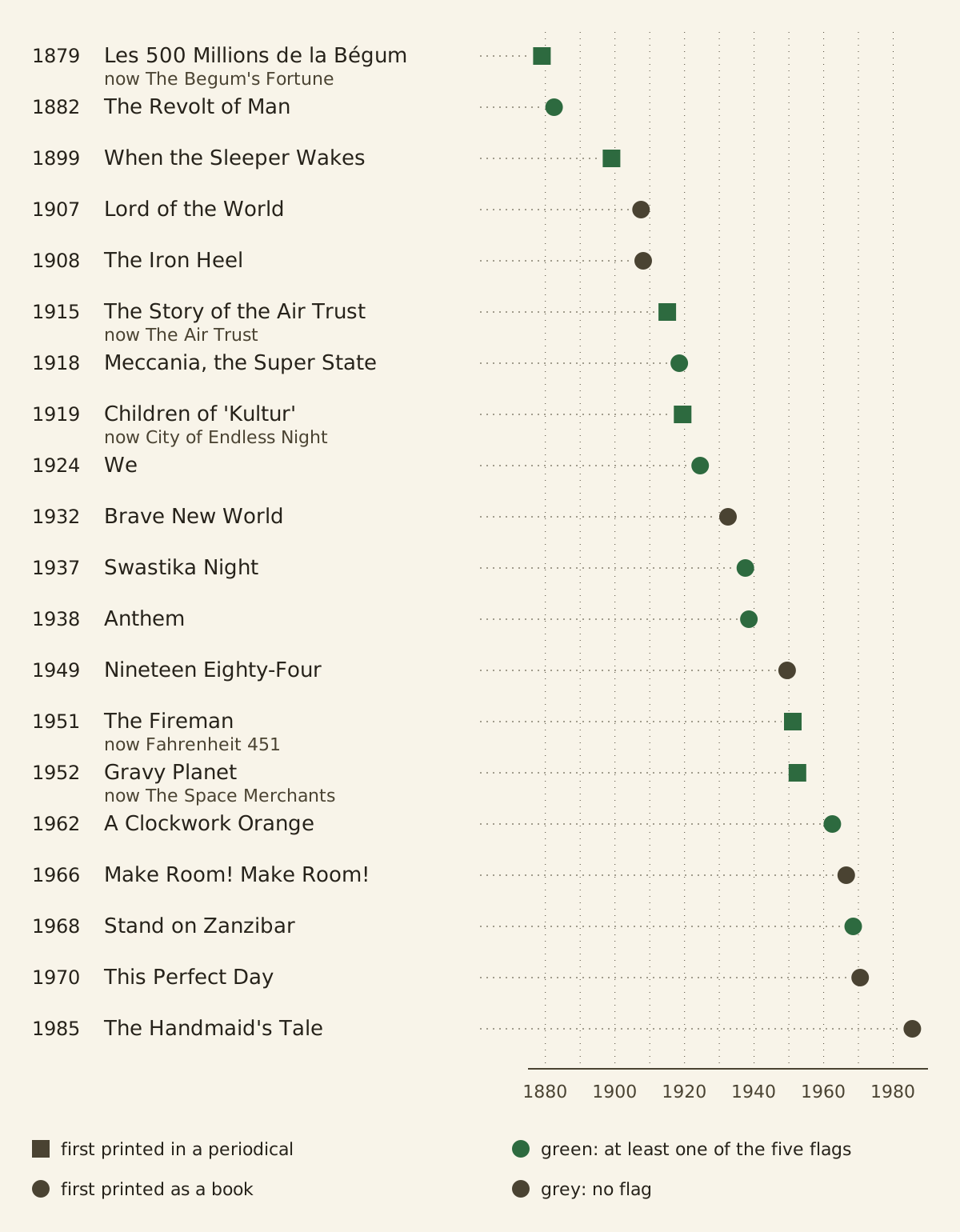
Print-order ladder — 20 dystopian novels by first appearance in print, with the 13 flagged rows (periodical first, other title, other country, hidden author or later text change) marked in green.
Dystopian novels by first appearance in print, 1879–1985 · Genre Fiction Lineage · CC BY 4.0
Reuse credit (CC BY)
"Dystopian novels by first appearance in print, 1879–1985" by Genre Fiction Lineage, https://genrefictionlineage.com/utopia-dystopia/dystopian-novels-print-order/, licensed under CC BY 4.0 (https://creativecommons.org/licenses/by/4.0/)
Bibliographic facts checked against The Encyclopedia of Science Fiction, eds. John Clute, David Langford and Graham Sleight (sf-encyclopedia.com), and the other sources listed on the entry page
In January 1946, George Orwell reviewed Yevgeny Zamyatin's We from a borrowed French copy. The English translation had been published in New York in 1924, but Orwell wrote that he had “never been able to procure a copy.” For We, where the novel first reached print decided who could read it, and in which words.
Every date traces to a source listed below, and all 20 rows are in a CSV file of the print-order table CSV · provenance note Bibliographic facts checked against The Encyclopedia of Science Fiction, eds. John Clute, David Langford and Graham Sleight (sf-encyclopedia.com), and the other sources listed on the entry page.
Dystopian novels in print order, 1879–1985
Inclusion here is not a matter of taste. Every title is discussed in SFE's “Dystopias” entry, as a dystopia or as a novel built on dystopian images; that entry names many more books, and this first version of the table takes 20 that span the period. Dates mean first appearance in print anywhere, in any form, taken from SFE's author entries; where the printed book disagrees with a reference entry, the book's own pages decide.
| # | First in print | As first printed | Where | What changed later |
|---|---|---|---|---|
| 1 | 1 Jan 1879, serial | “Les 500 Millions de la Bégum,” Jules Verne | Magasin d'Éducation et de Récréation | Book from Hetzel, Paris, 1879; English translation, New York, 1879 |
| 2 | 1882 | The Revolt of Man, anonymous | William Blackwood, Edinburgh | SFE attributes it to Walter Besant |
| 3 | 7 Jan 1899, serial | When the Sleeper Wakes, H. G. Wells | The Graphic | Book 1899; revised as The Sleeper Awakes, 1910 |
| 4 | 1907 | Lord of the World, Robert Hugh Benson | Pitman, London | none recorded |
| 5 | Feb 1908 | The Iron Heel, Jack London | Macmillan, New York | Copyright page says 1907 (see below) |
| 6 | Jan 1915, serial | “The Story of the Air Trust,” George Allan England | The National Rip-Saw | Book as The Air Trust, St Louis, 1915 |
| 7 | 1918 | Meccania, the Super State, “Owen Gregory” | Methuen, London | Author still unidentified |
| 8 | Jun 1919, serial | “Children of 'Kultur',” Milo Hastings | True Story | Revised as City of Endless Night, New York, 1920 |
| 9 | 1924 | We, Yevgeny Zamyatin, translated by Gregory Zilboorg | E. P. Dutton, New York | First Russian-language book, 1952 |
| 10 | 1932 | Brave New World, Aldous Huxley | Chatto and Windus, London | none recorded |
| 11 | 1937 | Swastika Night, “Murray Constantine” | Victor Gollancz, London | Author confirmed as Katharine Burdekin, 1985 |
| 12 | 1938 | Anthem, Ayn Rand | Cassell, London | Cut version, Los Angeles, 1946 |
| 13 | 1949 | Nineteen Eighty-Four, George Orwell | Secker and Warburg, London | none recorded |
| 14 | Feb 1951, magazine | “The Fireman,” Ray Bradbury | Galaxy Science Fiction | Expanded as Fahrenheit 451, 1953 |
| 15 | Jun 1952, serial | “Gravy Planet,” Frederik Pohl and C. M. Kornbluth | Galaxy | Revised and cut as The Space Merchants, 1953 |
| 16 | 1962 | A Clockwork Orange, Anthony Burgess | Heinemann, London | Final chapter cut in the 1963 New York edition |
| 17 | 1966 | Make Room! Make Room!, Harry Harrison | Doubleday, Garden City, N.Y. | Reissued as Soylent Green, 1973 |
| 18 | 1968 | Stand on Zanzibar, John Brunner | Doubleday, Garden City, N.Y. | none recorded |
| 19 | 1970 | This Perfect Day, Ira Levin | Random House, New York | none recorded |
| 20 | 1985 | The Handmaid's Tale, Margaret Atwood | McClelland and Stewart, Toronto | UK release, 1986 |
How many first appeared in another form?
Thirteen of the 20 either first appeared in another form or had their text changed later, and each carries at least one of five flags: first printed in a periodical (6), under a different English title (4), outside the author's home country (3), with the writer's identity hidden (3), or in a text later revised, cut or expanded (6). Several rows carry more than one flag, and the CSV marks each one. The seven unflagged rows include Brave New World and Nineteen Eighty-Four, which appeared as London hardbacks under the titles they still carry.
The order is the point. This table does not rank the books, because a dystopia is a political argument with a plot attached, and a score strips out the date that shows what each argument was answering. For the real communities that tried to build the opposite, see Utopian Communities That Actually Existed (for comparison).
What was the first dystopian novel?
It depends on the scope you set. This site uses the patient-zero text for the earliest known print record within a stated language, place and medium, and that range has to be named before “first” means anything.
Widen the range and the record leaves the novel behind. SFE notes that the first item in I. F. Clarke's bibliography The Tale of the Future (third edition, 1978) is a 1644 tract warning of disaster if the monarchy were restored. Hansard records the word on 12 March 1868, when John Stuart Mill said of the Government, in a debate on the state of Ireland, that “they ought rather to be called dys-topians, or cacotopians.” SFE calls Mill “an early user” of the term and does not claim he was the first.
Inside this table, the patient-zero text is Verne's serial, which began in the Magasin d'Éducation et de Récréation on 1 January 1879, nearly eleven years after Mill's speech. SFE places the spread of dystopian images in the last decades of the nineteenth century, and the table's first three rows (1879, 1882, 1899) fall in that stretch. The claim covers these 20 rows only. A longer table could move the slot.
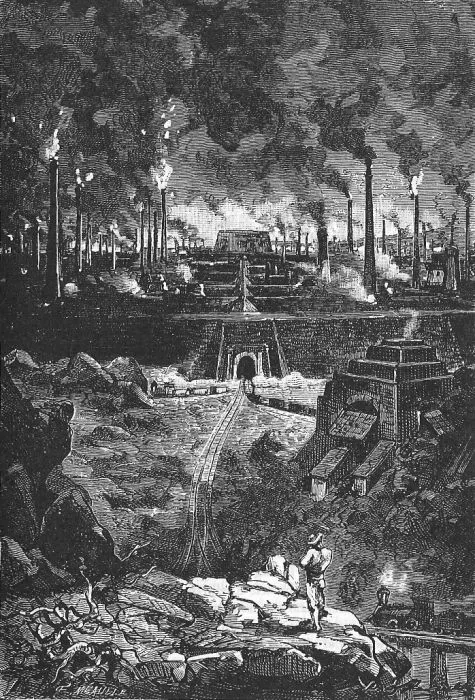
A city of furnaces — Léon Benett's plate for Verne's novel, from the illustrated Hetzel edition that SFE dates to 1879; the Wikisource transcription of an undated printing prints it in chapter 5 under the legend naming Stahlstadt, and the wood engraving is signed F. Méaulle.
Illustration for Les Cinq Cents Millions de la Bégum · Léon Benett · public domain
Full credit
"Illustration for Les Cinq Cents Millions de la Bégum" by Léon Benett, 1879 — https://commons.wikimedia.org/wiki/File:%27The_Begum%27s_Fortune%27_by_L%C3%A9on_Benett_12.jpg — Public domain (US: published 1879; Germany and France: Benett died 1917 and the engraver was active by 1879 (engraver presumed out of copyright from his working years), so 70 years after death and even the longest French extension have run out)
Where are the dystopian images in Verne's 1879 novel?
SFE's “Dystopias” entry brings Verne's novel in for its setting. It says the book contrasts utopian and dystopian images in two rival cities, which SFE calls Frankville and Stahlstadt, so the earliest row in this table is a novel that sets the two images side by side. Hetzel's illustrated edition gives each city its own chapter, and both halves of that claim can be checked in the French.
The page numbers below are those of the copy transcribed on Wikisource, an undated printing of that edition, not checked word for word against an 1879 copy. Chapter 5, “La Cité de l'Acier,” makes Stahlstadt the private property of Herr Schultze, a former chemistry professor from Jena who now casts cannon. Thirty thousand workers, most of them German by origin, live in its suburbs (p. 43), and a guard warns a new hand that he will be expelled if he enters any sector but his own (p. 44). Inside the walls, the narrator says, “on chercherait vainement aucun vestige de cette liberté qui a fondé la puissance de la république des États-Unis” (“you would look in vain for any trace of the liberty that built the power of the United States republic,” Genre Fiction Lineage translation; pp. 43–44).
The answer comes in chapter 10. France-Ville, a model city on the Oregon coast, is described through an article in an invented German review that grudgingly credits the plan to the French doctor Sarrasin (p. 95). Its ten fixed rules for houses deal with air, light, drainage and washable walls (pp. 100–101), and a footnote says the rules “sont empruntées au savant docteur Benjamin Ward Richardson” (“are borrowed from the learned Dr. Benjamin Ward Richardson,” Genre Fiction Lineage translation; p. 100). By the review's count the city holds nearly 100,000 people, with a five-year average death rate of 1.5 percent, while in the most favoured cities of Europe and America the rate had never fallen noticeably below 3 percent (pp. 105–106).
English readers had the novel the same year, according to SFE's Verne entry. It lists an anonymous New York translation, The 500 Millions of the Begum, from George Munro, and a London one, The Begum's Fortune, from Sampson Low, translated by Agnes Kinloch Kingston but published under the name of W. H. G. Kingston. The “Dystopias” entry gives the translation as 1880, so two entries in one reference disagree by a year. The table follows the author entry, which names a publisher and a city for each 1879 edition, and both dates are in a CSV of the novel's 1879–1880 printings CSV · provenance note Bibliographic facts checked against The Encyclopedia of Science Fiction, eds. John Clute, David Langford and Graham Sleight (sf-encyclopedia.com), and the other sources listed on the entry page.
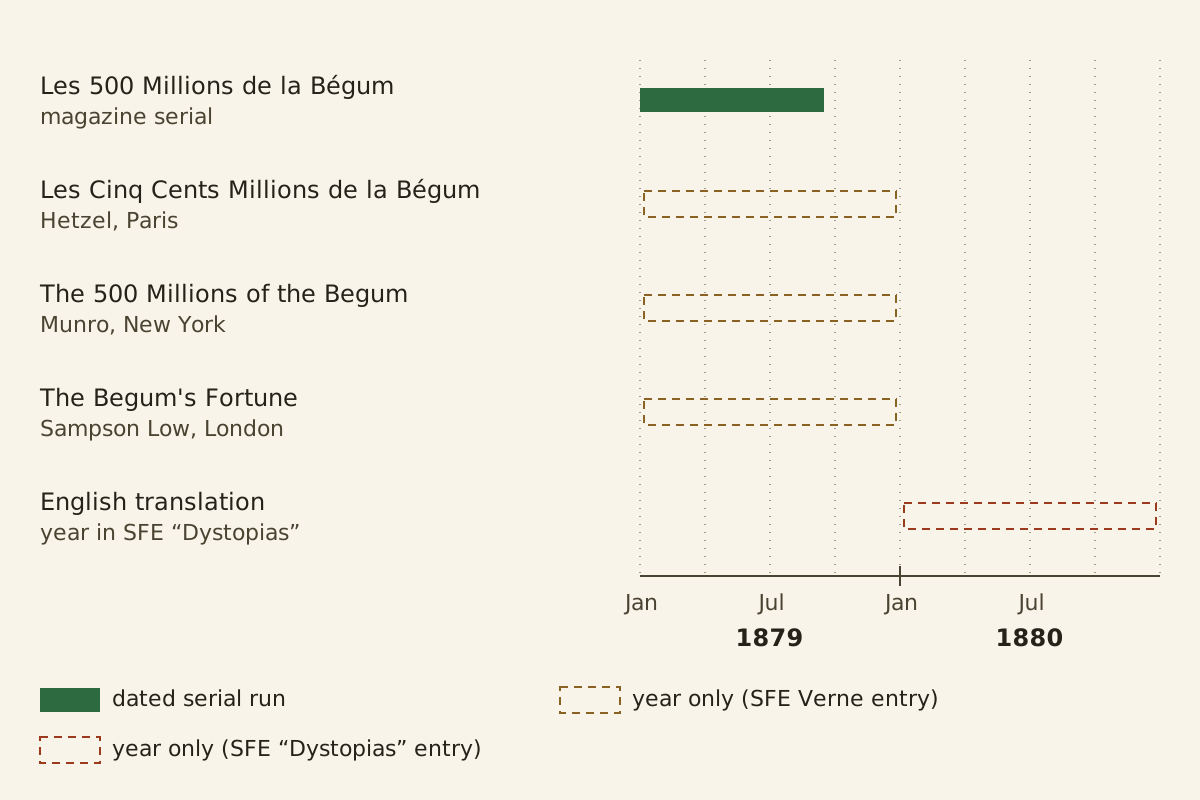
Verne in print, 1879–1880 — the dated serial run, the Paris book and the two English translations that SFE's Verne entry dates to 1879, with the 1880 year in its “Dystopias” entry.
Les Cinq Cents Millions de la Bégum in print, 1879–1880 · Genre Fiction Lineage · CC BY 4.0
Reuse credit (CC BY)
"Les Cinq Cents Millions de la Bégum in print, 1879–1880" by Genre Fiction Lineage, https://genrefictionlineage.com/utopia-dystopia/dystopian-novels-print-order/, licensed under CC BY 4.0 (https://creativecommons.org/licenses/by/4.0/)
Bibliographic facts checked against The Encyclopedia of Science Fiction, eds. John Clute, David Langford and Graham Sleight (sf-encyclopedia.com), and the other sources listed on the entry page
| Printing | Publisher | Date | According to |
|---|---|---|---|
| “Les 500 Millions de la Bégum,” serial | Magasin d'Éducation et de Récréation | 1 Jan to 15 Sep 1879 | SFE, Verne entry |
| Les Cinq Cents Millions de la Bégum | J. Hetzel et Cie, Paris | 1879 | SFE, Verne entry |
| The 500 Millions of the Begum, translator not named | George Munro, New York | 1879 | SFE, Verne entry |
| The Begum's Fortune, published as by W. H. G. Kingston | Sampson Low, London | 1879 | SFE, Verne entry |
| English translation | not named | 1880 | SFE, “Dystopias” entry |
Why did We appear in English before Russian?
The short answer is a refusal at home. SFE dates the writing to 1920 and says the novel circulated in manuscript. Orwell's review, drawing on Gleb Struve's history of Soviet literature, gives a later date of about 1923 and says the book was refused publication as ideologically undesirable, after which a copy of the manuscript left the country.
The first printed book was Gregory Zilboorg's English translation, published by E. P. Dutton in New York in 1924. SFE records the Russian text in an émigré journal in Prague in 1927 and gives 1952 for the first Russian-language book, 28 years after the translation. Orwell, writing in 1946, knew of English, French and Czech translations and of no Russian edition. SFE dates Zamyatin's rehabilitation in the USSR to the glasnost year of 1988.
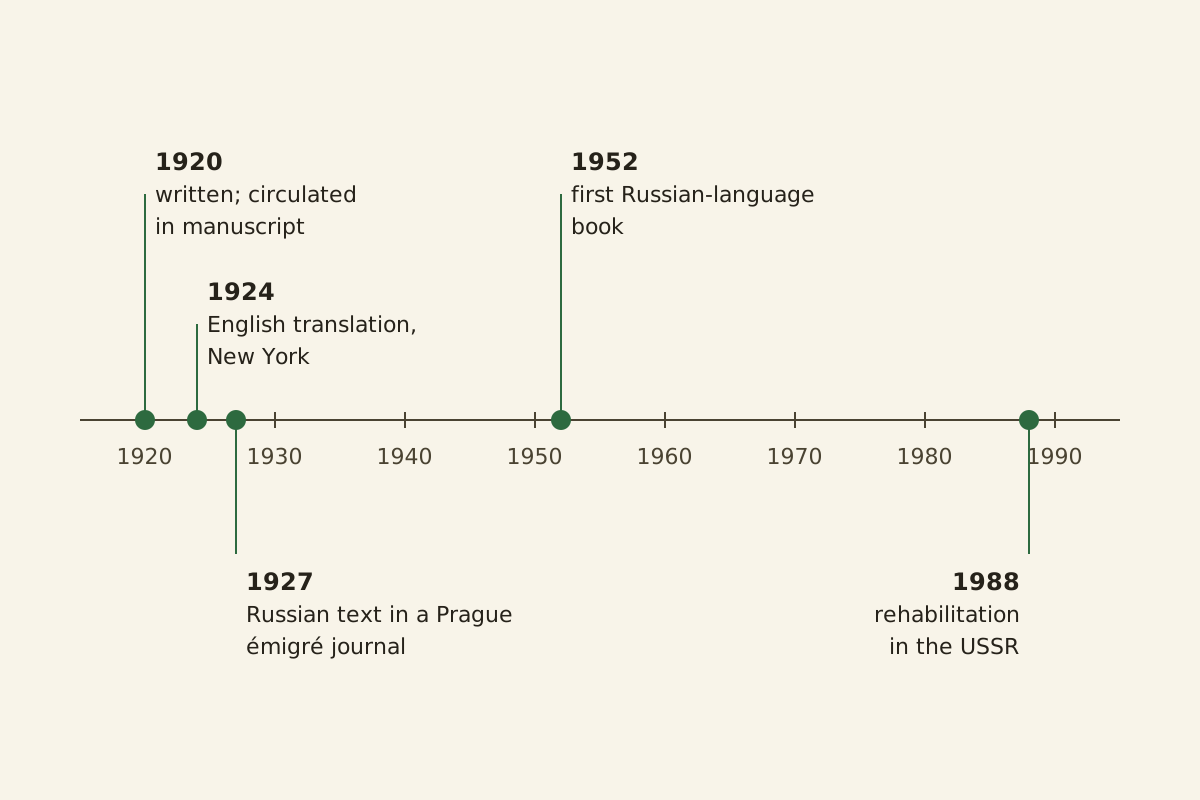
We in print — the dates SFE gives for the writing, the 1924 English translation, the 1927 Prague journal text, the 1952 Russian book and the 1988 rehabilitation.
We: writing and printing dates, 1920–1988 · Genre Fiction Lineage · CC BY 4.0
Reuse credit (CC BY)
"We: writing and printing dates, 1920–1988" by Genre Fiction Lineage, https://genrefictionlineage.com/utopia-dystopia/dystopian-novels-print-order/, licensed under CC BY 4.0 (https://creativecommons.org/licenses/by/4.0/)
Bibliographic facts checked against The Encyclopedia of Science Fiction, eds. John Clute, David Langford and Graham Sleight (sf-encyclopedia.com), and the other sources listed on the entry page
That geography explains Orwell's borrowed copy. His review ran in Tribune on 4 January 1946, 22 years after the New York edition, and his line about having “never been able to procure a copy” refers to that American translation. He closed by telling readers to look for the book once an English edition appeared.
A borrowed copy — an illustration of a lamp-lit reading desk, not a book illustration or a historical record.
Illustration: Genre Fiction Lineage. Generated scene illustration — not a book illustration, photograph or historical record. No copyright is claimed in the generated imagery; if you reuse it, please credit "Genre Fiction Lineage".
Is We even a dystopia?
The label itself is disputed inside one reference work. SFE's “Dystopias” entry calls We perhaps the most ruthless of all dystopias. SFE's Zamiatin entry argues that the novel judges a utopia turned absolutist without rejecting utopia itself, and concludes that “the book is thus not a Dystopia.” The table follows the “Dystopias” entry and records the disagreement in the CSV.
The Space Merchants draws a smaller caveat from the “Dystopias” entry itself. The entry calls it the archetype of novels in which one interest group takes over society, says such novels are “gaudy fakes that use dystopian images for melodramatic convenience,” and says genre sf of the period produced “only one genuine dystopian novel,” Fahrenheit 451. SFE's Kornbluth entry takes the other side and calls the book “the archetype of a whole generation of Dystopian sf.” The row stays in the table, and the CSV records both readings.
Did We influence Nineteen Eighty-Four and Brave New World?
The documented part is narrow. Orwell's review shows he had read We by January 1946, and Nineteen Eighty-Four was published in 1949; the review's first line says he had heard of the book “several years” earlier. That is written contact between the later author and the earlier book. It is not a list of borrowings.
Brave New World is a different case. Orwell wrote that Huxley's 1932 novel “must be partly derived from” We, pointing to a shared premise: a revolt of the human spirit against a rationalised, painless world set about six hundred years ahead. That is a third party describing textual similarity, so the strip records the pair as a shared device only.
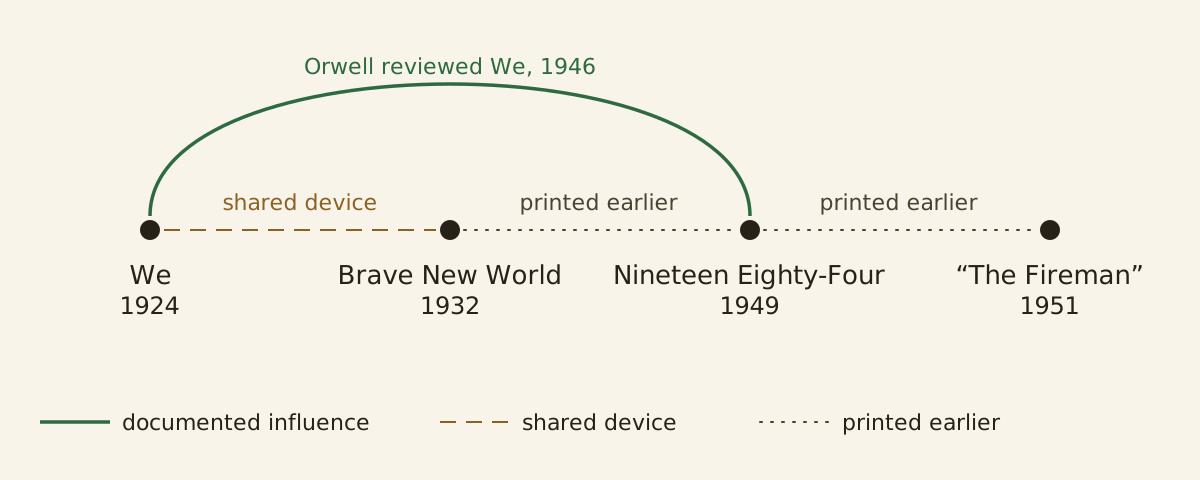
- Solid: documented influence (the later author's own statement, letter, review or note)
- Dashed: shared device (similar texts, no borrowing claimed)
- Dotted: dates only (publication order or other dates; no link claimed)
Lineage strip — four dystopian texts in print order; the solid arc rests on Orwell's own 1946 review, the dashed line on a shared premise, the dotted lines on dates alone.
Lineage strip: We to "The Fireman", 1924–1951 · Genre Fiction Lineage · CC BY 4.0
Reuse credit (CC BY)
"Lineage strip: We to "The Fireman", 1924–1951" by Genre Fiction Lineage, https://genrefictionlineage.com/utopia-dystopia/dystopian-novels-print-order/, licensed under CC BY 4.0 (https://creativecommons.org/licenses/by/4.0/)
Bibliographic facts checked against The Encyclopedia of Science Fiction, eds. John Clute, David Langford and Graham Sleight (sf-encyclopedia.com), and the other sources listed on the entry page
Which dystopian novels first appeared in magazines?
Six of the 20 reached readers first in a periodical. Wells's When the Sleeper Wakes ran in The Graphic from 7 January to 6 May 1899, and its book edition followed the same year. George Allan England's novel about a monopoly on oxygen ran in The National Rip-Saw from January to October 1915 as “The Story of the Air Trust.” Milo Hastings's “Children of 'Kultur'” began in True Story in June 1919, a year before the revised book, City of Endless Night.
Two postwar titles came out of the same magazine. Galaxy Science Fiction printed Bradbury's novella “The Fireman” in February 1951, and the June 1952 Galaxy opened Pohl and Kornbluth's “Gravy Planet” as instalment 1 of a three-part serial. SFE's entries give the run as July and August 1952, but the June issue lists the first instalment, so the table follows the issue.
Ballantine published both as books in 1953, Fahrenheit 451 expanded and The Space Merchants revised and cut. So a quotation from the magazine text may not match the book. For when “dystopia” and the other branch names of science fiction were first recorded as genre labels, see Science Fiction Subgenres (for comparison).
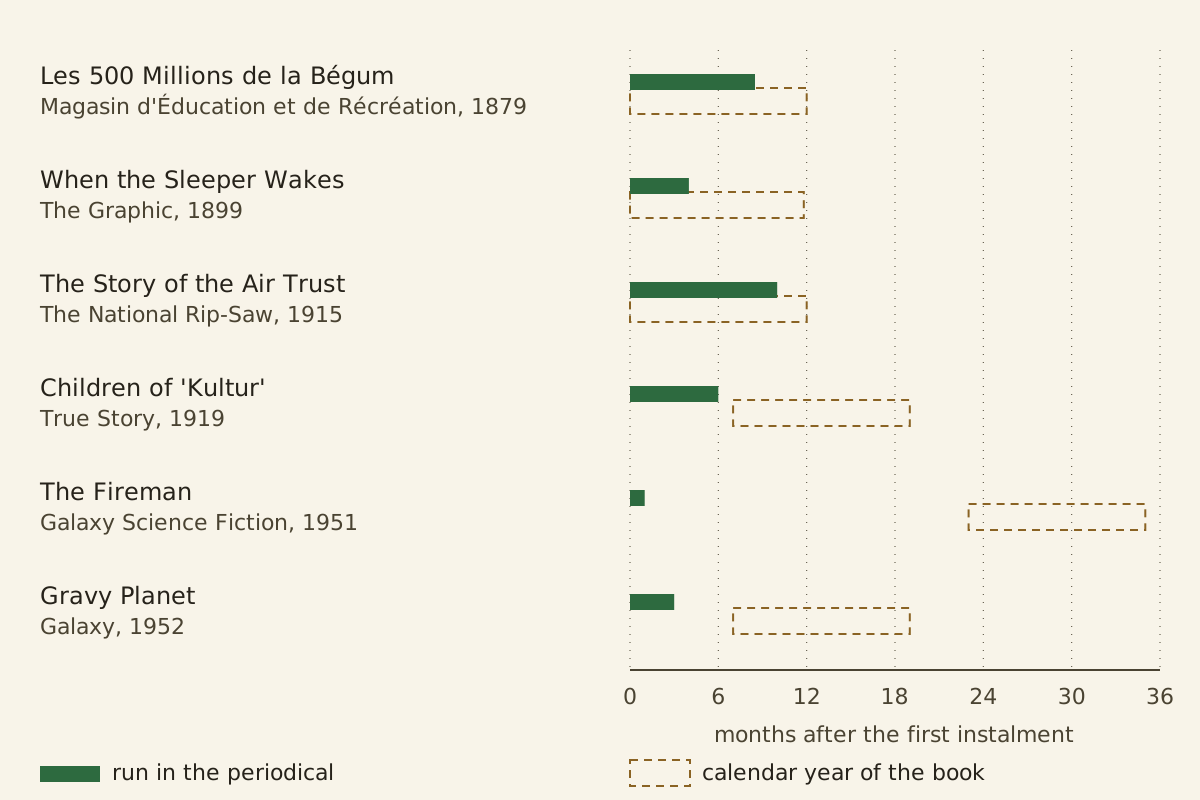
Serials first — six periodical first printings, with each run measured in months from the first instalment and the calendar year of the book.
Dystopian novels first printed in periodicals: runs and book years · Genre Fiction Lineage · CC BY 4.0
Reuse credit (CC BY)
"Dystopian novels first printed in periodicals: runs and book years" by Genre Fiction Lineage, https://genrefictionlineage.com/utopia-dystopia/dystopian-novels-print-order/, licensed under CC BY 4.0 (https://creativecommons.org/licenses/by/4.0/)
Bibliographic facts checked against The Encyclopedia of Science Fiction, eds. John Clute, David Langford and Graham Sleight (sf-encyclopedia.com), and the other sources listed on the entry page
| As first printed | Periodical | Run | Book |
|---|---|---|---|
| “Les 500 Millions de la Bégum” | Magasin d'Éducation et de Récréation | 1 Jan to 15 Sep 1879 | 1879 |
| When the Sleeper Wakes | The Graphic | 7 Jan to 6 May 1899 | 1899 |
| “The Story of the Air Trust” | The National Rip-Saw | Jan to Oct 1915 | 1915 |
| “Children of 'Kultur'” | True Story | Jun to Nov 1919 | 1920 |
| “The Fireman” | Galaxy Science Fiction | Feb 1951 | 1953 |
| “Gravy Planet” | Galaxy | Jun to Aug 1952 | 1953 |
A seventh case is unsettled. SFE lists a serial of Make Room! Make Room! in SF Impulse from August to October 1966, the same year as the Doubleday book, and marks it as possibly simultaneous. The table dates that row by the book and leaves the flag off.
Which dystopian novels were cut or revised?
Six rows carry a later text change, and each one sets two named editions apart. Fahrenheit 451 began as “The Fireman” in Galaxy in February 1951, and SFE's “Dystopias” entry gives the 1953 book as the expanded text. The Space Merchants went the other way: SFE lists the 1953 Ballantine book as revised and cut from the 1952 Galaxy serial “Gravy Planet.”
A Clockwork Orange lost its ending in America. Heinemann published the novel in London in 1962, and SFE lists the 1963 W. W. Norton edition in New York with the final chapter cut and a glossary of the narrator's invented slang added. This site keeps the term the tame edit for a later edition that softens specific content, and its definition page sets out the test.
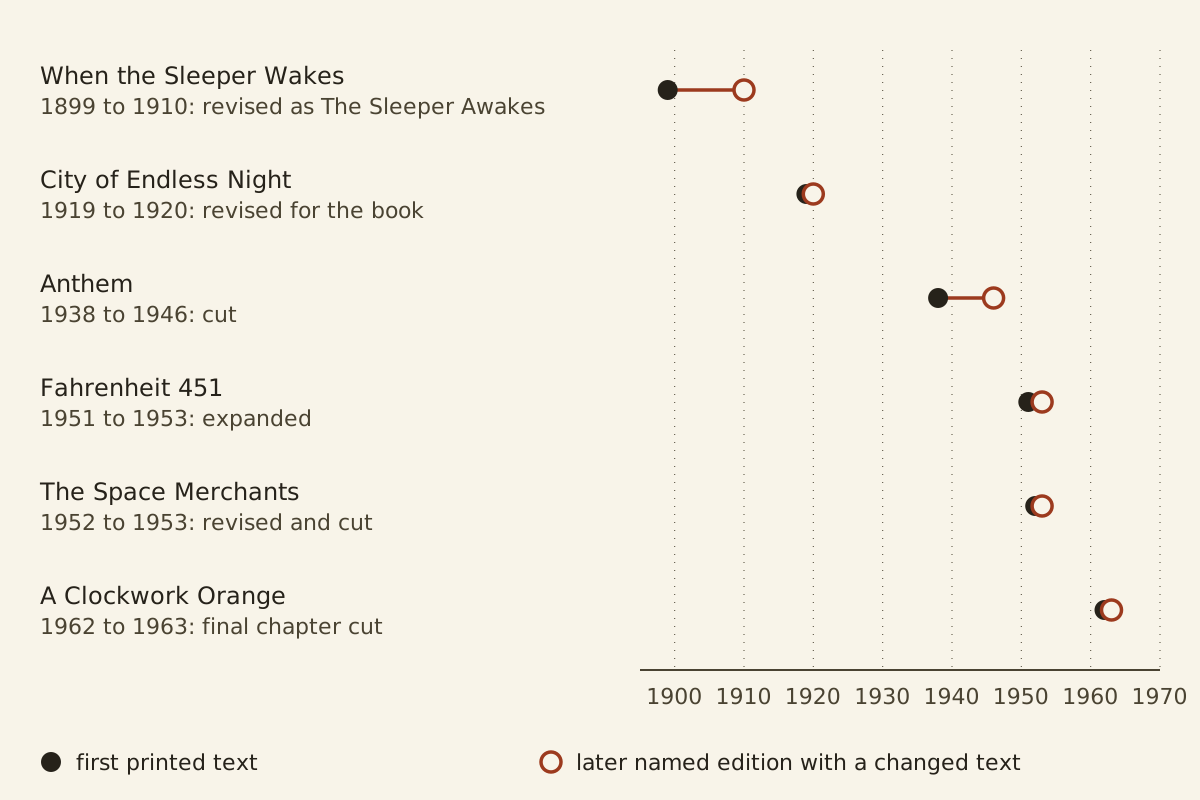
Later texts — six novels with the year of first print, the year of the changed edition and the kind of change.
Dystopian novels with a changed text in a later named edition · Genre Fiction Lineage · CC BY 4.0
Reuse credit (CC BY)
"Dystopian novels with a changed text in a later named edition" by Genre Fiction Lineage, https://genrefictionlineage.com/utopia-dystopia/dystopian-novels-print-order/, licensed under CC BY 4.0 (https://creativecommons.org/licenses/by/4.0/)
Bibliographic facts checked against The Encyclopedia of Science Fiction, eds. John Clute, David Langford and Graham Sleight (sf-encyclopedia.com), and the other sources listed on the entry page
| Novel | First text | Later named edition | Change |
|---|---|---|---|
| When the Sleeper Wakes | 1899 | The Sleeper Awakes, 1910 | revised |
| City of Endless Night | “Children of 'Kultur',” 1919 | Dodd, Mead, 1920 | revised |
| Anthem | Cassell, 1938 | Pamphleteers, 1946 | cut |
| Fahrenheit 451 | “The Fireman,” 1951 | Ballantine, 1953 | expanded |
| The Space Merchants | “Gravy Planet,” 1952 | Ballantine, 1953 | revised and cut |
| A Clockwork Orange | Heinemann, 1962 | Norton, 1963 | final chapter cut |
Revision split three more texts. Cassell published Anthem in London in 1938, and SFE lists the 1946 Pamphleteers edition from Los Angeles as a cut version. The 1899 Wells novel returned in revised form as The Sleeper Awakes in 1910, and Hastings revised his 1919 serial for the 1920 book. Before quoting any of these books, name the edition.
Which dystopian novels hid their authors?
Three rows went to press with the writer's identity hidden. The Revolt of Man appeared anonymously from Blackwood in Edinburgh in 1882, and SFE attributes it to Walter Besant. Meccania, the Super State came out from Methuen in London in 1918 as by “Owen Gregory,” and SFE says the writer's identity has still not been confirmed. Its entry reports George Locke's speculation, based on an inscribed copy, that the author was E. S. P. Haynes, and it remains speculation.
Swastika Night was published by Victor Gollancz in 1937 as by “Murray Constantine.” SFE states that the pen name was confirmed as Katharine Burdekin's only in 1985, when the Feminist Press reissued the novel with an introduction by Daphne Patai. That is 48 years between first print and a confirmed byline. A pen name alone does not set the flag: SFE gives both George Orwell and Ayn Rand as pseudonyms, and neither row is flagged.
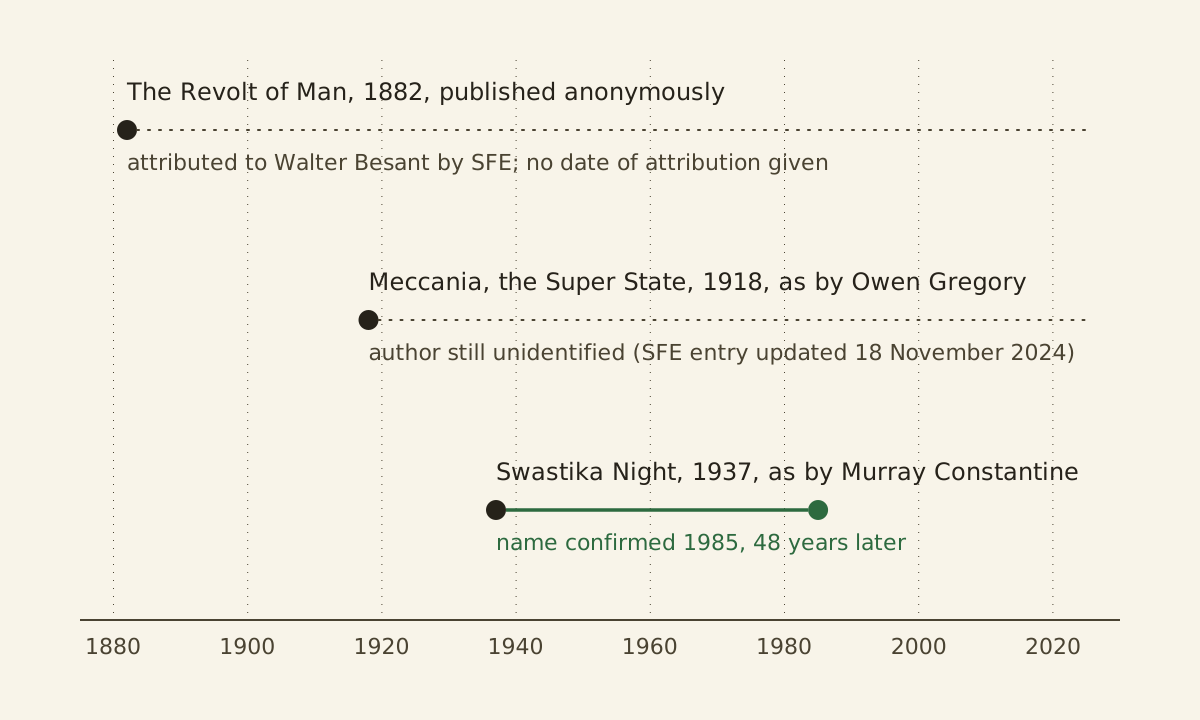
Hidden bylines — three novels printed anonymously or under a pen name, and the one confirmation date on record, 48 years after first print.
Dystopian novels printed with the author hidden · Genre Fiction Lineage · CC BY 4.0
Reuse credit (CC BY)
"Dystopian novels printed with the author hidden" by Genre Fiction Lineage, https://genrefictionlineage.com/utopia-dystopia/dystopian-novels-print-order/, licensed under CC BY 4.0 (https://creativecommons.org/licenses/by/4.0/)
Bibliographic facts checked against The Encyclopedia of Science Fiction, eds. John Clute, David Langford and Graham Sleight (sf-encyclopedia.com), and the other sources listed on the entry page
Why does this table date The Iron Heel to 1908?
The book's own copyright page separates two dates. SFE lists The Iron Heel as 1907. The copyright page of a later printing, transcribed on Wikisource, reads “Copyright, 1907” and then “Set up and electrotyped. Published February, 1908.” The copyright year and the publication date are different events, so this table records publication and keeps both dates in the CSV.
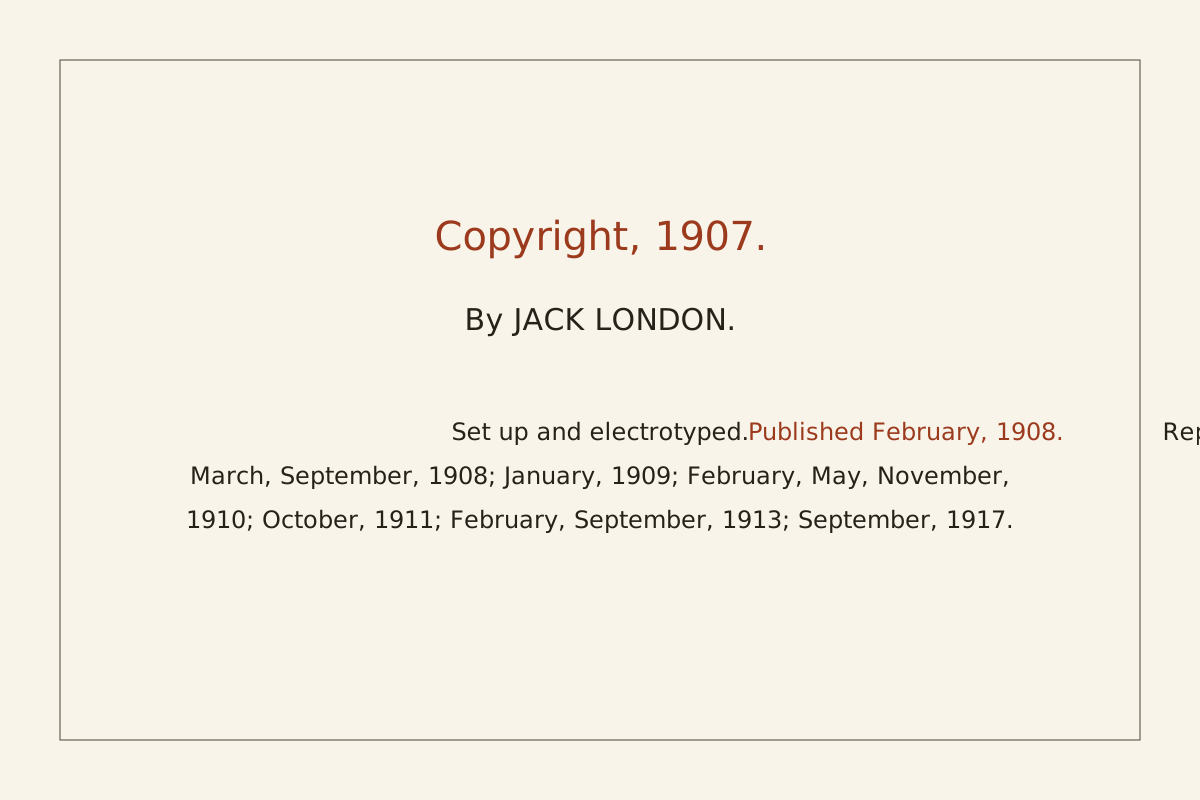
The Iron Heel, copyright page — the printed dates reset in type from the Wikisource transcription of a printing whose reprint list ends in September 1917.
The Iron Heel: copyright page dates, reset in type · Genre Fiction Lineage · CC BY 4.0
Reuse credit (CC BY)
"The Iron Heel: copyright page dates, reset in type" by Genre Fiction Lineage, https://genrefictionlineage.com/utopia-dystopia/dystopian-novels-print-order/, licensed under CC BY 4.0 (https://creativecommons.org/licenses/by/4.0/)
Bibliographic facts checked against The Encyclopedia of Science Fiction, eds. John Clute, David Langford and Graham Sleight (sf-encyclopedia.com), and the other sources listed on the entry page
When a reference entry and the printed book disagree, the book wins. The same first-print rule fixes Nineteen Eighty-Four to London, where Secker and Warburg published it in 1949.
Sources
- 1Brian Stableford, "Dystopias," in John Clute, David Langford and Graham Sleight (eds), The Encyclopedia of Science Fiction https://sf-encyclopedia.com/entry/dystopiasRead: full entry (updated 27 July 2026)
- 2The Encyclopedia of Science Fiction, author entries for the 21 writers in the table (bibliographies and birth and death dates); each row of the CSV links its entry https://sf-encyclopedia.com/Read: full entries for all 21 writers
- 3UK Parliament, Hansard, "State of Ireland. Adjourned Debate," HC Deb 12 March 1868, vol 190, cc1459–549 (speech of John Stuart Mill) https://api.parliament.uk/historic-hansard/commons/1868/mar/12/adjourned-debateRead: full debate page
- 4Jules Verne, Les Cinq Cents Millions de la Bégum, illustrated Hetzel edition (Paris, Collection Hetzel, undated printing; the edition is dated 1879 by SFE), chapters 5 ("La Cité de l'Acier," pp. 40–52) and 10 (pp. 95–106), transcribed at Wikisource https://fr.wikisource.org/wiki/Les_Cinq_Cents_Millions_de_la_B%C3%A9gumRead: title page data, table of contents and chapters 5 and 10 in full (validated transcription)
- 5Galaxy Science Fiction, vol. 4, no. 3 (June 1952), Internet Archive record galaxymagazine-1952-06 https://archive.org/details/galaxymagazine-1952-06Read: bibliographic record, contents page and editor's page of the scanned issue
- 6George Orwell, "Review of 'WE' by E. I. Zamyatin," Tribune, 4 January 1946; text at orwell.ru https://orwell.ru/library/reviews/zamyatin/english/e_zamyRead: full text of the review
- 7Jack London, The Iron Heel, copyright page of a printing whose reprint list ends September 1917, transcribed at Wikisource https://en.wikisource.org/wiki/Page:The_iron_heel.djvu/10Read: single page (validated transcription)
- 8Jennifer Jenkins and James Boyle, "Public Domain Day 2026," Center for the Study of the Public Domain, Duke Law School https://web.law.duke.edu/cspd/publicdomainday/2026/Read: full pageText licence: CC BY 4.0
- 9Urheberrechtsgesetz § 64 (Allgemeines), gesetze-im-internet.de https://www.gesetze-im-internet.de/urhg/__64.htmlRead: full text of the section
- 10Urheberrechtsgesetz § 69 (Berechnung der Fristen), gesetze-im-internet.de https://www.gesetze-im-internet.de/urhg/__69.htmlRead: full text of the section
Cite this page
Genre Fiction Lineage. “Dystopian Novels: Orwell Read Zamyatin's We in French.” Genre Fiction Lineage, published 3 November 2026. https://genrefictionlineage.com/utopia-dystopia/dystopian-novels-print-order/. Accessed [the date you read it].
Next shelf over:
- Thomas More's Utopia: the other side of this table, a society drawn as a good place instead of a bad one (printed earlier).
- News from Nowhere: William Morris's utopia, from the same late-Victorian decades as this table's first three rows (for comparison).
- Read the text: Les Cinq Cents Millions de la Bégum (1879), Wikisource
Related entries
More from Utopias & Dystopias.
Lineage essay
Utopian Communities: Owen Bought New Harmony, Ready-Built
Robert Owen bought New Harmony ready-built. A dated table of 16 American communities, founded 1825–1846 and later dissolved, each date from an 1870s survey.
Picture credit
"New Harmony on the Wabash" by Karl Bodmer, 1839 — https://commons.wikimedia.org/wiki/File:Karl_Bodmer,_%22New_Harmony_on_the_Wabash%22_2009_26_2v1.jpg — CC0 1.0 (https://creativecommons.org/publicdomain/zero/1.0/)
Edition comparison
Thomas More's Utopia: In English 16 Years After His Death
Thomas More's Utopia was printed in Latin in 1516; the earliest known English edition in USTC is Robinson's of 1551. A dated table of 13 printings to 1715.
Picture credit
"Frontispiece to L'Utopie de Thomas Morus, 1715" by François van Bleyswyck, 1715 — https://commons.wikimedia.org/wiki/File:1715_-_Thomas_More_L'Utopie_-_Nicolas_Gueudeville_-_Frontispice_(e-rara).jpg — Public domain (US: published 1715; Germany and France: the engraver François van Bleyswyck died 1746 and the translator Nicolas Gueudeville 1721 (GND), so 70 years after death have run out; both died before 1914, so no French wartime or died-for-France extension applies); modified: cropped at the bottom edge of the engraved plate to remove a library stamp in the margin below
Lineage essay
News from Nowhere: Morris Reviewed Bellamy 203 Days Earlier
William Morris reviewed Bellamy's Looking Backward on 22 June 1889; News from Nowhere began in the same weekly in 1890. Dated editions, two texts compared.
Picture credit
Illustration: Genre Fiction Lineage. Generated scene illustration — not a book illustration, photograph or historical record. No copyright is claimed in the generated imagery; if you reuse it, please credit "Genre Fiction Lineage".