Utopias & Dystopias · Lineage essay
Utopian Communities: Owen Bought New Harmony, Ready-Built
Genre Fiction Lineage Published
Robert Owen's 1825 community at New Harmony, Indiana, moved into a town he had bought ready-built from the Harmony Society. Charles Nordhoff's 1875 survey puts the price at $150,000, and the table below dates 16 communities in the United States, founded 1825–1846 and later dissolved, each from a nineteenth-century source.
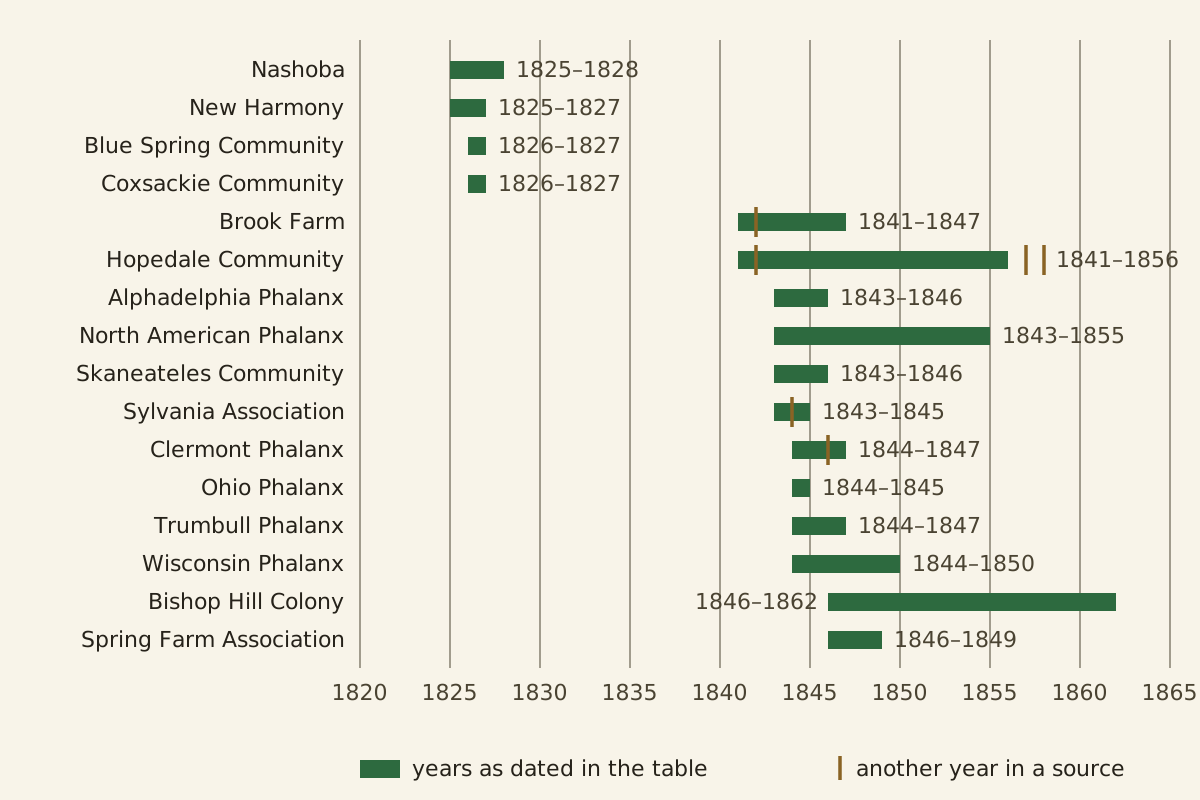
Sixteen communities, founded to dissolved — each bar runs from the founding year to the closing year printed in Noyes (1870) or Nordhoff (1875), for Hopedale the lower of the two years Noyes gives, and brass ticks mark years that another account gives instead.
16 dissolved utopian communities, founded 1825–1846 · Genre Fiction Lineage · CC BY 4.0
Reuse credit (CC BY)
"16 dissolved utopian communities, founded 1825–1846" by Genre Fiction Lineage, https://genrefictionlineage.com/utopia-dystopia/utopian-communities/, licensed under CC BY 4.0 (https://creativecommons.org/licenses/by/4.0/)
Dates and reasons from John Humphrey Noyes, History of American Socialisms (1870), and Charles Nordhoff, The Communistic Societies of the United States (1875), both public domain
John Humphrey Noyes's History of American Socialisms (1870) dates Owen's community at New Harmony to 1825–27. All 16 rows, with members, reasons for closing and alternative years, are in a CSV file of the community table CSV · provenance note Dates and reasons from John Humphrey Noyes, History of American Socialisms (1870), and Charles Nordhoff, The Communistic Societies of the United States (1875), both public domain.
Which utopian communities actually existed, 1800–1900?
“Utopian communities” is a modern shelf label. Noyes called these experiments “Associations” and “Socialisms,” and Nordhoff's 1875 book called them communistic societies. This page uses the modern label for the same groups and dates them from those two books.
A row needs three things printed in one survey: the state, a founding year and a closing year. Most of Noyes's list came from the papers of A. J. Macdonald, a Scottish printer who collected memoirs of short-lived communities, and Noyes warned that the figures had been picked out “one by one, like scattered bones, from Macdonald's heap.” Fifteen rows rest on Noyes and one, Bishop Hill, on Nordhoff. William Alfred Hinds's American Communities (1878) serves only as a cross-check.
| Community | State | Founded | Ended | Dated by |
|---|---|---|---|---|
| Nashoba | Tennessee | 1825 | 1828 | Noyes, from Macdonald |
| New Harmony | Indiana | 1825 | 1827 | Noyes, from Macdonald |
| Blue Spring Community | Indiana | 1826 | 1827 | Noyes, from Macdonald |
| Coxsackie Community | New York | 1826 | 1827 | Noyes, from Macdonald |
| Brook Farm | Massachusetts | 1841 | 1847 | Noyes (index gives 1842 for the start) |
| Hopedale Community | Massachusetts | 1841 | 1856 or later | Noyes |
| Alphadelphia Phalanx | Michigan | 1843 | 1846 | Noyes |
| North American Phalanx | New Jersey | 1843 | 1855 | Noyes |
| Skaneateles Community | New York | 1843 | 1846 | Noyes, from Macdonald |
| Sylvania Association | Pennsylvania | 1843 | 1845 | Noyes's index |
| Clermont Phalanx | Ohio | 1844 | 1847 | Noyes's index |
| Ohio Phalanx | Ohio | 1844 | 1845 | Noyes |
| Trumbull Phalanx | Ohio | 1844 | 1847 | Noyes |
| Wisconsin Phalanx | Wisconsin | 1844 | 1850 | Noyes |
| Bishop Hill Colony | Illinois | 1846 | 1862 | Nordhoff |
| Spring Farm Association | Wisconsin | 1846 | 1849 | Noyes, from Macdonald |
The table splits into two waves that Noyes himself named. Four rows belong to what he called the Owen movement of the mid-1820s. Eleven belong to the Fourier movement of the 1840s, named for the French theorist Charles Fourier, and several of those called themselves a phalanx. Bishop Hill, a Swedish religious colony in Illinois, sits outside both.
How did Owen get New Harmony?
The town was already standing when Owen arrived. Noyes tells the story of the Harmonists, followers of George Rapp from Württemberg, who organized their society in Pennsylvania in 1805. In 1814 they sold up and moved to Indiana. In Noyes's words, “On the banks of the Wabash they built a new village and again called it Harmony.”
Noyes then puts the point directly: “Owen did not build the village of New Harmony.” He adds that Owen “bought them outright from a previous religious Community.” Hinds, writing in 1878, gives the same order: the Harmonists “built New Harmony,” and ten years after the move they sold out to Robert Owen.
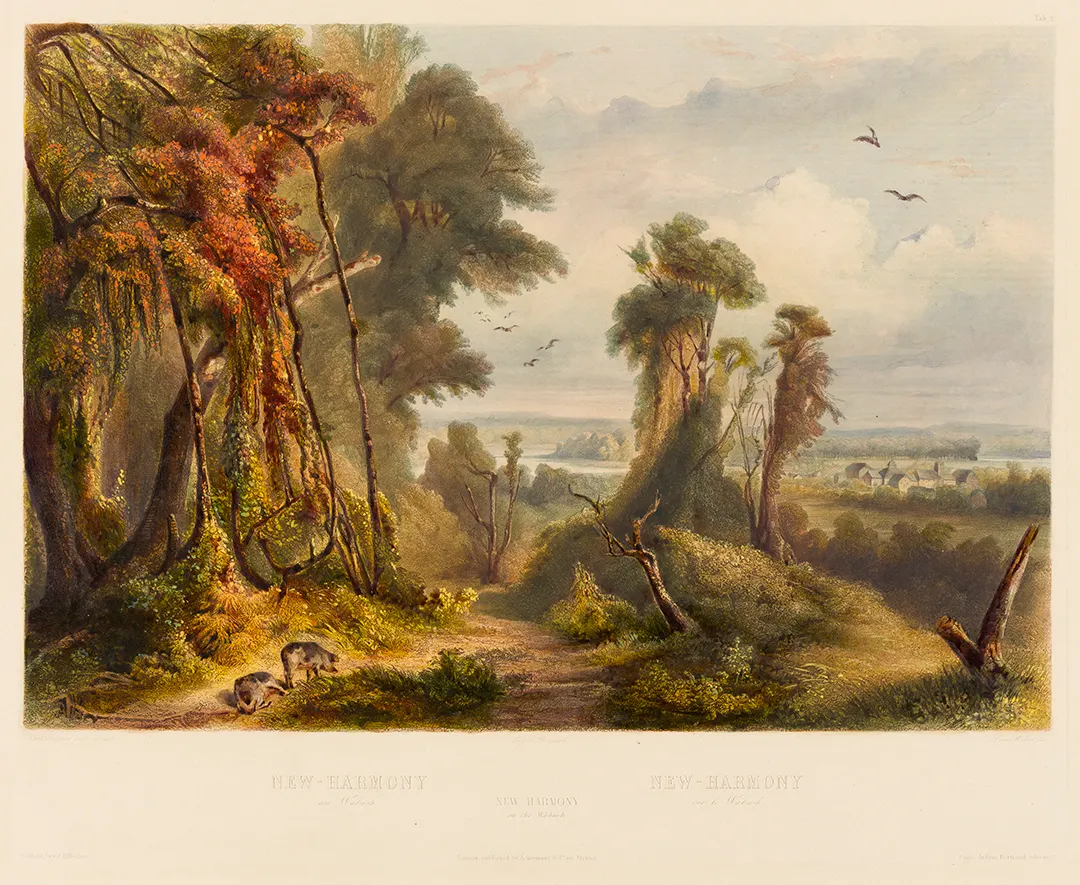
New Harmony on the Wabash — Karl Bodmer's view of the town from a wooded rise, published in the atlas of Prince Maximilian of Wied's North American journey (Paris and Coblenz, 1839–1843).
"New Harmony on the Wabash" by Karl Bodmer, 1839 — https://commons.wikimedia.org/wiki/File:Karl_Bodmer,_%22New_Harmony_on_the_Wabash%22_2009_26_2v1.jpg — CC0 1.0 (https://creativecommons.org/publicdomain/zero/1.0/)
Bodmer's view, dated 1832–1834 in the museum's record, shows the place a few years after Owen's community closed. The roofs on the right are the Harmonist town that changed hands in the 1820s, seen from a rise above the river.
Inside that ready-made town, the community kept changing its rules. Working from Macdonald's extracts of the New Harmony Gazette, Noyes counts seven constitutions in about seventeen months, from 27 April 1825 to 17 September 1826. By January 1827, Macdonald reported, “the greater part of the town was now resolved into individual lots.” On 18 June 1827 the Gazette announced Owen's farewell meeting, and the table closes the row in that year.
What did $150,000 buy?
Four accounts describe the sale. The two that name a price agree on it, but the date and the acreage differ. Nordhoff writes that in 1824 the Harmonists sold the town with “twenty thousand acres of land,” and that “Owen paid one hundred and fifty thousand dollars.” The Harmonist historian Aaron Williams, quoted by Noyes, gives the same sum for “all its houses, mills, factories and thirty thousand acres of land.”
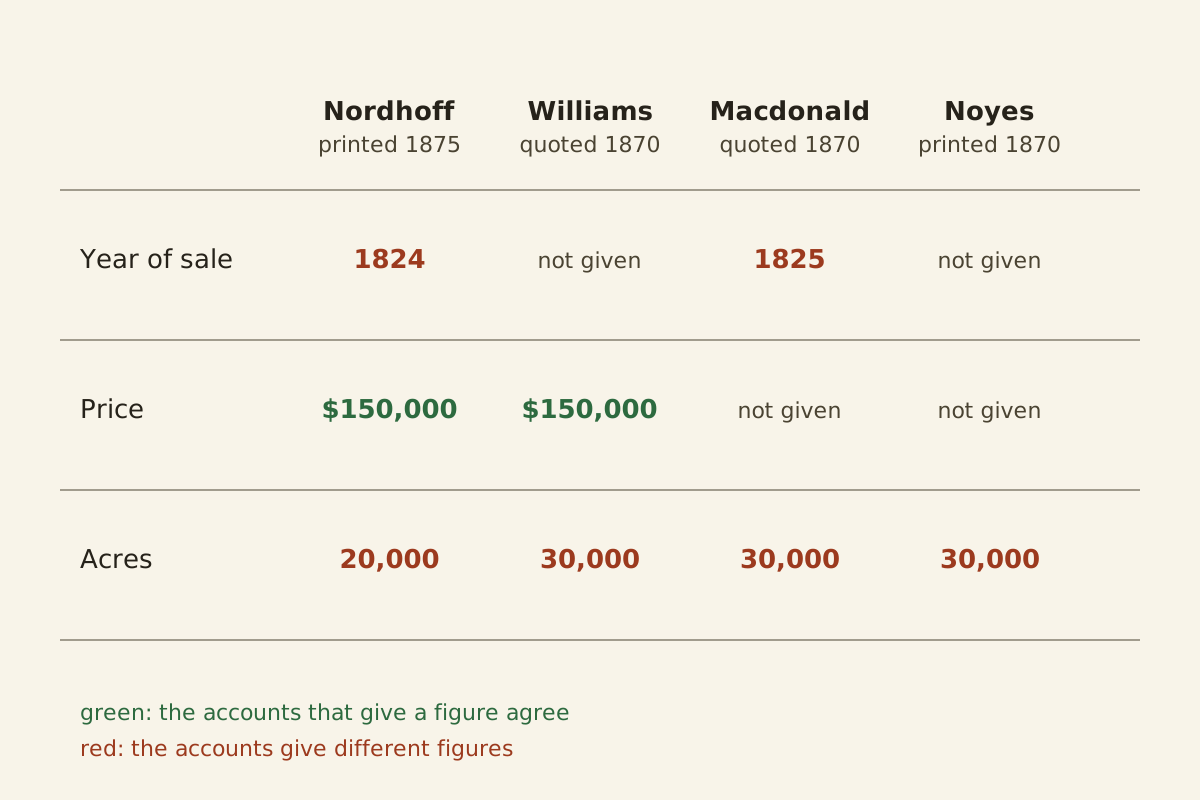
The sale in four accounts — Nordhoff, Williams, Macdonald and Noyes side by side; green marks the figure the accounts agree on, red the year and acreage where they split.
The sale of Harmony to Robert Owen in four accounts · Genre Fiction Lineage · CC BY 4.0
Reuse credit (CC BY)
"The sale of Harmony to Robert Owen in four accounts" by Genre Fiction Lineage, https://genrefictionlineage.com/utopia-dystopia/utopian-communities/, licensed under CC BY 4.0 (https://creativecommons.org/licenses/by/4.0/)
Dates and reasons from John Humphrey Noyes, History of American Socialisms (1870), and Charles Nordhoff, The Communistic Societies of the United States (1875), both public domain
Macdonald, also quoted by Noyes, dates the deal later: “In the spring of 1825 Mr. Owen closed the bargain.” His inventory lists 18 acres of vines and “a regularly laid out town,” with brick buildings put up by the Rappites for churches and schools. Noyes read the deal as a head start. Owen, he wrote, had “substantially the ready-made material conditions” that Fourier's followers thought necessary.
The years line up with the building time. The Harmonists moved to Indiana in 1814 and sold in 1824 by Nordhoff's date, ten years later. Noyes says the same: “Ten of their best years they spent in building a village on the Wabash.” The CSV of the four sale accounts CSV · provenance note Dates and reasons from John Humphrey Noyes, History of American Socialisms (1870), and Charles Nordhoff, The Communistic Societies of the United States (1875), both public domain keeps each version in its own row.
How long did they last?
Most rows are short. Measured as closing year minus founding year, the median community in the table lasted 3 calendar years. Three lasted a single year: Blue Spring, Coxsackie and the Ohio Phalanx. Noyes reached the same verdict for his whole list: “All died young, and most of them before they were two years old.”
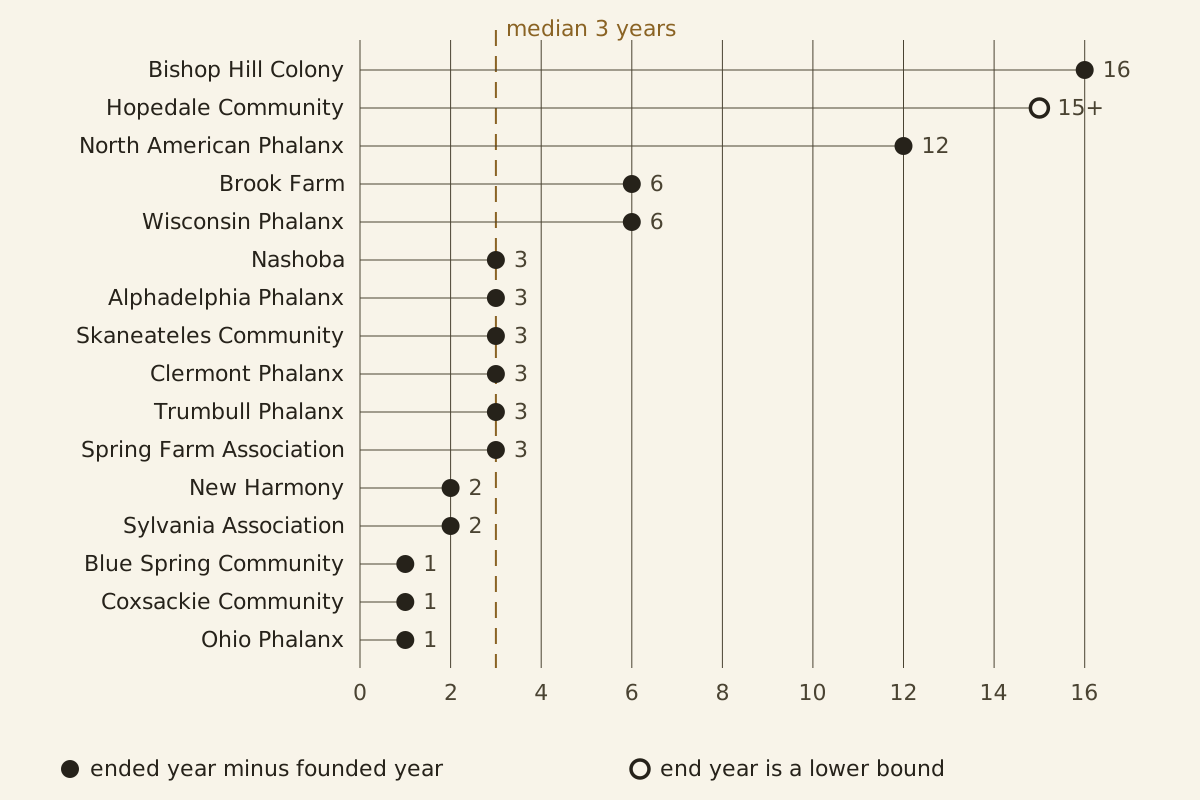
Years in operation — calendar years from founding to closing for each row, with a hollow dot where the closing year is only a lower bound.
Years each community lasted, in calendar years · Genre Fiction Lineage · CC BY 4.0
Reuse credit (CC BY)
"Years each community lasted, in calendar years" by Genre Fiction Lineage, https://genrefictionlineage.com/utopia-dystopia/utopian-communities/, licensed under CC BY 4.0 (https://creativecommons.org/licenses/by/4.0/)
Dates and reasons from John Humphrey Noyes, History of American Socialisms (1870), and Charles Nordhoff, The Communistic Societies of the United States (1875), both public domain
Three rows stand apart. Bishop Hill ran from 1846 to 1862, 16 years by Nordhoff's dates, and the North American Phalanx ran from 1843 to 1855, 12 years. Noyes noted that the North American was “reputed to have outlived all the other Associations of the Fourier epoch.” Then he corrected the record: Hopedale “not only was born before it, but lived after it,” lasting “certainly till 1856 or 1857.”
Bishop Hill's long run began in hardship. Nordhoff reports that the first Swedish settlers reached Illinois in October 1846. For eighteen months they lived “in holes in the ground, and under sheds built against hillsides.” By 1859 the colony owned ten thousand acres, but in the spring of 1860 the members chose to divide the property, and in 1862 “the commune ceased to exist.”
Calendar years are a rough measure, so the CSV keeps the duration each source reports beside them. Brook Farm spans 1841 to 1847, six calendar years, while Noyes's summary gives “5 years.” New Harmony covers two calendar years, 1825 to 1827, and the same summary says “nearly 3 years.”
Why did they end, by each source?
Each reason below is the one a nineteenth-century account gave, not a verdict from this page. Money comes up most often. A correspondent of the Fourierist paper The Harbinger said the Ohio Phalanx dissolved on 24 June 1845 for “the want of funds.” Macdonald reported that the Clermont Phalanx collected scarcely $6,000 of $17,000 in subscribed stock.
Fire ended two others. Noyes wrote that a fire on 3 March 1846 was “a disaster from which Brook Farm never recovered.” At the North American Phalanx, a fire burned the mills in 1854. The former member Alcander Longley recalled that the stockholders would not pay to rebuild and “dissolved the concern.”
| Community | Reason as reported | Reported by |
|---|---|---|
| Nashoba | Frances Wright abandoned it | Macdonald, in Noyes |
| New Harmony | Owen sold the town in lots, then left | Macdonald, in Noyes |
| Blue Spring Community | none given; no trace after 1 January 1827 | Macdonald, in Noyes |
| Coxsackie Community | small capital, debt, too much law-making | Macdonald, in Noyes |
| Brook Farm | the fire of 3 March 1846 | Noyes |
| Hopedale Community | the majority stockholder ended it | Adin Ballou, in Noyes |
| Alphadelphia Phalanx | no money paid in, bad management | Macdonald, in Noyes |
| North American Phalanx | mill fire of 1854; stockholders voted to dissolve | Alcander Longley, in Noyes |
| Skaneateles Community | its founder gave up the idea | Macdonald, in Noyes |
| Sylvania Association | poor soil, harsh climate, no market | The Phalanx, in Noyes |
| Clermont Phalanx | unpaid stock, a lawsuit, flood losses | Macdonald, in Noyes |
| Ohio Phalanx | want of funds | The Harbinger, in Noyes |
| Trumbull Phalanx | “errors” not named | a member's letter, in Noyes |
| Wisconsin Phalanx | members working for private gain | a member's history, in Noyes |
| Bishop Hill Colony | debt, then lawsuits and disputes | Nordhoff |
| Spring Farm Association | poverty and a failed harvest | a member, in Noyes |
A few accounts deny the usual explanation. Macdonald insisted that Skaneateles “did not fail through pecuniary embarrassment,” because its founder, John A. Collins, simply concluded the plan could not work. Spring Farm's members, by one member's account, “dissolved by mutual agreement” after frost cut off their second harvest.
Noyes also offered a diagnosis of his own. It is his opinion, not a tally. He thought the Associations' “fondness for land” had much to do with their failures, because farming led them into the wilderness, far from markets. In his phrase, they were “wrecked by running aground,” and he would have advised a factory instead.
Where the dates disagree
Seven dates differ between accounts. The table keeps one year, and the CSV records the rest. Brook Farm and Hopedale each have a founding year of 1841 in Noyes's chapters and 1842 in his index. For Hopedale's end, Noyes gives “1856 or 1857” and adds that a reported seventeenth year “would carry it to 1858.”
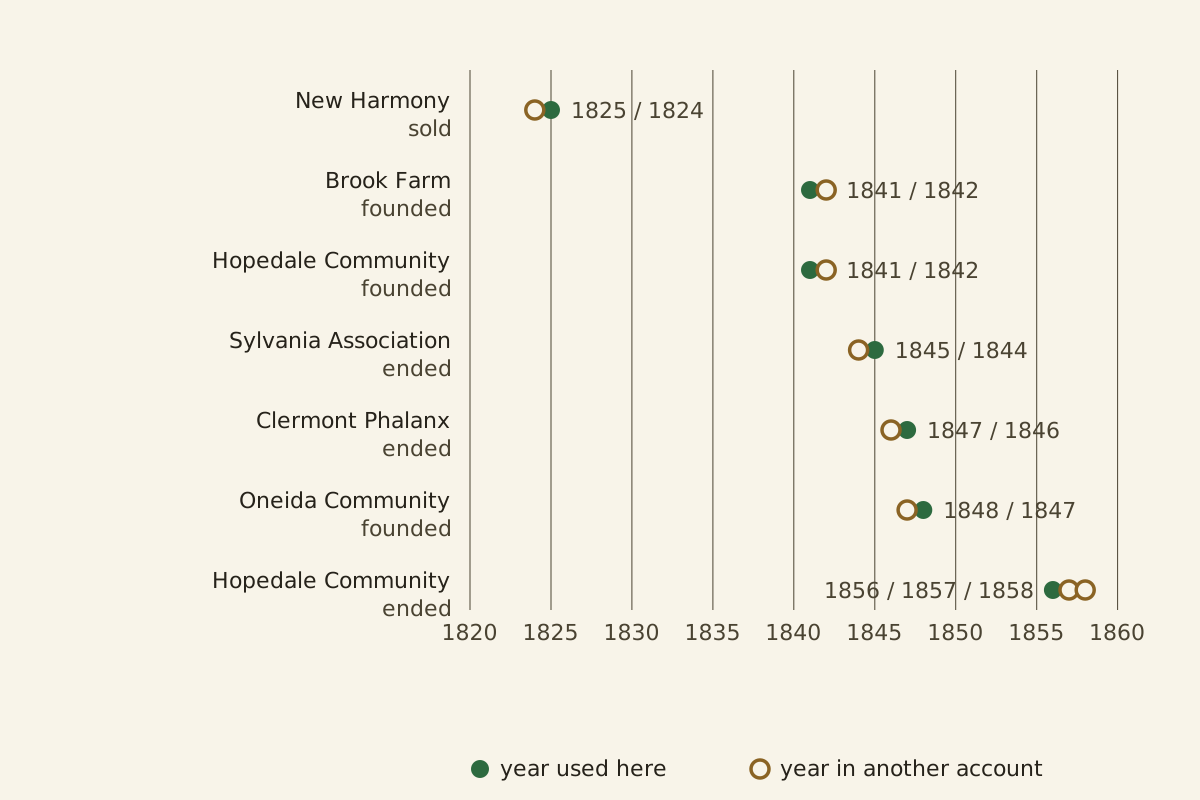
Dates in dispute — a green dot for the year used on this page and a brass ring for each year another account gives, from the sale of Harmony to the end of Hopedale.
Dates on which the nineteenth-century accounts disagree · Genre Fiction Lineage · CC BY 4.0
Reuse credit (CC BY)
"Dates on which the nineteenth-century accounts disagree" by Genre Fiction Lineage, https://genrefictionlineage.com/utopia-dystopia/utopian-communities/, licensed under CC BY 4.0 (https://creativecommons.org/licenses/by/4.0/)
Dates and reasons from John Humphrey Noyes, History of American Socialisms (1870), and Charles Nordhoff, The Communistic Societies of the United States (1875), both public domain
The rest are one year apart, including the 1824 or 1825 sale of Harmony. Sylvania's end is 1845 in the index, but The Phalanx of 10 August 1844 reported its decision to dissolve. Clermont's end is 1847 in the index and the fall of 1846 in Macdonald's chapter. The Oneida Community, outside the table, appears as 1847 in Noyes's index and 1848 in Nordhoff and Hinds.
Who wrote their histories?
The main source was written by a man who led a community himself. Noyes founded the Oneida Community in New York and wrote the chapter on Oneida as its founder. He signed his preface at Wallingford, Connecticut, in December 1869. Hinds's 1878 book was published at Oneida by the office of The American Socialist.
Behind Noyes stands Macdonald, whom Noyes pictured “wandering from grave to grave, patiently deciphering the epitaphs of defunct ‘Phalanxes.’” Macdonald, a disciple of Owen, died of cholera in New York before finishing his book, and Noyes's last record of his visits is dated February 1854. About ten years later Noyes's associates found the papers at the home of Macdonald's brother-in-law. They ran to 747 pages, indexed under the names of sixty-nine experiments.
That makes Noyes's book evidence of contact as well as a history. He wrote that the Oneida group, though it rejected Fourier's system, “received a great impulse from Brook Farm.” That sentence is the later founder's own written statement, so the strip below draws it as documented influence. Brook Farm began in 1841, seven years before Oneida in 1848.
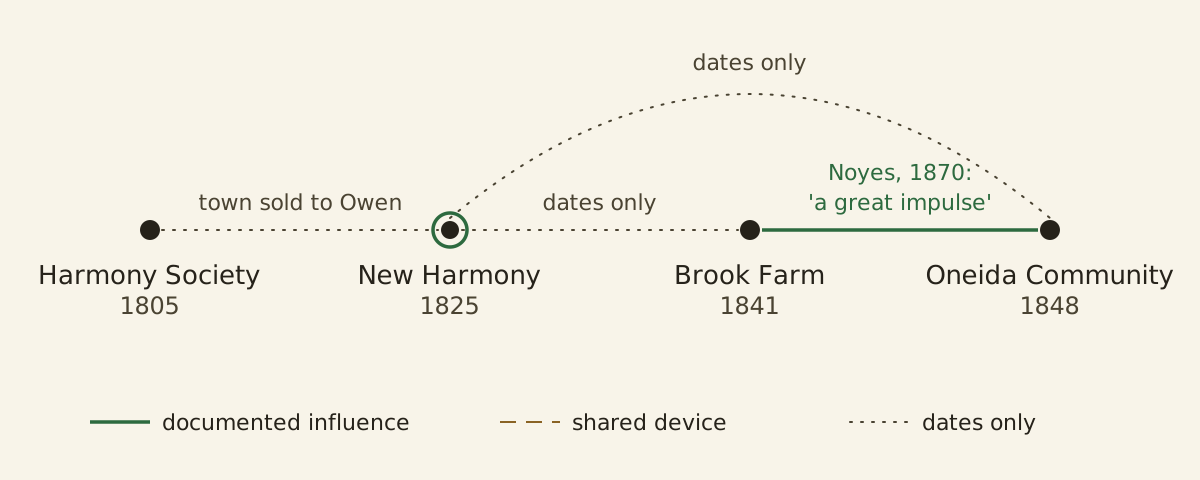
- Solid: documented influence (the later author's own statement, letter, review or note)
- Dashed: shared device (similar texts, no borrowing claimed)
- Dotted: dates only (publication order or other dates; no link claimed)
Lineage strip — four communities in date order; the solid line rests on Noyes's own 1870 statement, the dotted lines on dates and a land sale alone.
Lineage strip: Harmony Society to Oneida, 1805–1848 · Genre Fiction Lineage · CC BY 4.0
Reuse credit (CC BY)
"Lineage strip: Harmony Society to Oneida, 1805–1848" by Genre Fiction Lineage, https://genrefictionlineage.com/utopia-dystopia/utopian-communities/, licensed under CC BY 4.0 (https://creativecommons.org/licenses/by/4.0/)
Dates and reasons from John Humphrey Noyes, History of American Socialisms (1870), and Charles Nordhoff, The Communistic Societies of the United States (1875), both public domain
The line from the Harmony Society to New Harmony stays dotted. Noyes argued that Owen “leaned on them for practical ideas,” but that is Noyes's reading of Owen, not Owen's own statement. The strip therefore records only the sale of the town.
The arc from New Harmony to Oneida is dotted too. Noyes later wrote New Harmony's history and put the chapter before an evening gathering at Oneida, but his own account of how Oneida began names revivalism and Brook Farm, not Owen. A CSV of the strip's links CSV · provenance note Dates and reasons from John Humphrey Noyes, History of American Socialisms (1870), and Charles Nordhoff, The Communistic Societies of the United States (1875), both public domain gives the evidence for each line.
The same dating rule runs through the rest of this shelf. For dystopian novels dated by first appearance in print, see Dystopian Novels in Print Order (for comparison). For the literary utopia among the named branches of speculative fiction, see Science Fiction Subgenres (for comparison).
Which groups are left out?
Groups still running when these surveys went to press are named here but not tabled, because the three books cannot date their endings. Nordhoff's 1875 comparison lists eight: the Shakers, the Harmony Society at Economy, Zoar, Amana, Bethel, the Oneida Perfectionists, the Icarians and Aurora. Hinds's 1878 title adds Wallingford and the Brotherhood of the New Life. Nordhoff counted those eight as at least seventy-two separate communes, 58 of them Shaker communes, with about five thousand people in 1874.
A shared house at dusk — an illustration of a nineteenth-century communal farm, not a picture of any community in the table.
Illustration: Genre Fiction Lineage. Generated scene illustration — not a book illustration, photograph or historical record. No copyright is claimed in the generated imagery; if you reuse it, please credit "Genre Fiction Lineage".
Other omissions follow from the rules. Communities founded before 1800, such as the Shaker societies, are outside the date range. Entries in Noyes's index without a state or a closing year are left out rather than guessed. This page records history only; it does not describe or assess any group that exists today and gives no visiting information.
Sources
- 1John Humphrey Noyes, History of American Socialisms (Philadelphia: Lippincott, 1870), Project Gutenberg eBook #35687 (exact reprint of the 1870 edition) https://www.gutenberg.org/ebooks/35687Read: full text
- 2Charles Nordhoff, The Communistic Societies of the United States (New York: Harper, 1875), Project Gutenberg eBook #8116 https://www.gutenberg.org/ebooks/8116Read: full text
- 3William Alfred Hinds, American Communities (Oneida, N.Y.: Office of the American Socialist, 1878), Cornell University Library copy at the Internet Archive https://archive.org/details/cu31924084318025Read: full text (scanned copy, consulted as a cross-check)
- 4Karl Bodmer, New Harmony on the Wabash, hand-coloured aquatint, Crystal Bridges Museum of American Art 2009.26.2, file page at Wikimedia Commons https://commons.wikimedia.org/wiki/File:Karl_Bodmer,_%22New_Harmony_on_the_Wabash%22_2009_26_2v1.jpgRead: file page and image
- 5Gemeinsame Normdatei records for John Humphrey Noyes (118786547) and Charles Nordhoff (121866963), via lobid.org https://d-nb.info/gnd/118786547Read: authority records
- 6Jennifer Jenkins and James Boyle, "Public Domain Day 2026," Center for the Study of the Public Domain, Duke Law School https://web.law.duke.edu/cspd/publicdomainday/2026/Read: full pageText licence: CC BY 4.0
- 7Urheberrechtsgesetz § 64 (Allgemeines), gesetze-im-internet.de https://www.gesetze-im-internet.de/urhg/__64.htmlRead: full text of the section

Cite this page
Genre Fiction Lineage. “Utopian Communities: Owen Bought New Harmony, Ready-Built.” Genre Fiction Lineage, published 3 November 2026. https://genrefictionlineage.com/utopia-dystopia/utopian-communities/. Accessed [the date you read it].
Next shelf over:
- Thomas More's Utopia: the 1516 book that gave these experiments their later label, traced edition by edition (for comparison).
- News from Nowhere: a utopia that stayed on paper, printed in 1890, beside communities with real opening and closing dates (for comparison).
- Read the text: The Communistic Societies of the United States (1875), Project Gutenberg
Related entries
More from Utopias & Dystopias.
Lineage essay
Dystopian Novels: Orwell Read Zamyatin's We in French
20 dystopian novels dated by first appearance in print, 1879–1985: magazine serials, changed titles, hidden authors and later edits. Sourced, with a CSV.
Picture credit
Illustration: Genre Fiction Lineage. Generated scene illustration — not a book illustration, photograph or historical record. No copyright is claimed in the generated imagery; if you reuse it, please credit "Genre Fiction Lineage".
Edition comparison
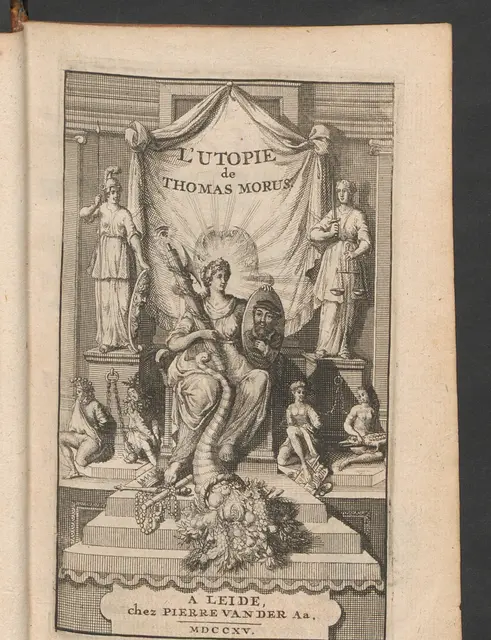
Thomas More's Utopia: In English 16 Years After His Death
Thomas More's Utopia was printed in Latin in 1516; the earliest known English edition in USTC is Robinson's of 1551. A dated table of 13 printings to 1715.
Picture credit
"Frontispiece to L'Utopie de Thomas Morus, 1715" by François van Bleyswyck, 1715 — https://commons.wikimedia.org/wiki/File:1715_-_Thomas_More_L'Utopie_-_Nicolas_Gueudeville_-_Frontispice_(e-rara).jpg — Public domain (US: published 1715; Germany and France: the engraver François van Bleyswyck died 1746 and the translator Nicolas Gueudeville 1721 (GND), so 70 years after death have run out; both died before 1914, so no French wartime or died-for-France extension applies); modified: cropped at the bottom edge of the engraved plate to remove a library stamp in the margin below
Lineage essay
News from Nowhere: Morris Reviewed Bellamy 203 Days Earlier
William Morris reviewed Bellamy's Looking Backward on 22 June 1889; News from Nowhere began in the same weekly in 1890. Dated editions, two texts compared.
Picture credit
Illustration: Genre Fiction Lineage. Generated scene illustration — not a book illustration, photograph or historical record. No copyright is claimed in the generated imagery; if you reuse it, please credit "Genre Fiction Lineage".