Utopias & Dystopias · Edition comparison
Thomas More's Utopia: In English 16 Years After His Death
Genre Fiction Lineage Published
Thomas More's Utopia came out in Latin at Louvain in 1516 and reached English print in London in 1551. Ralph Robinson's translation, sold as a “pleasaunt worke of the beste state of a publyque weale,” is the earliest known English edition in the Universal Short Title Catalogue, printed 16 years after More's death in 1535.
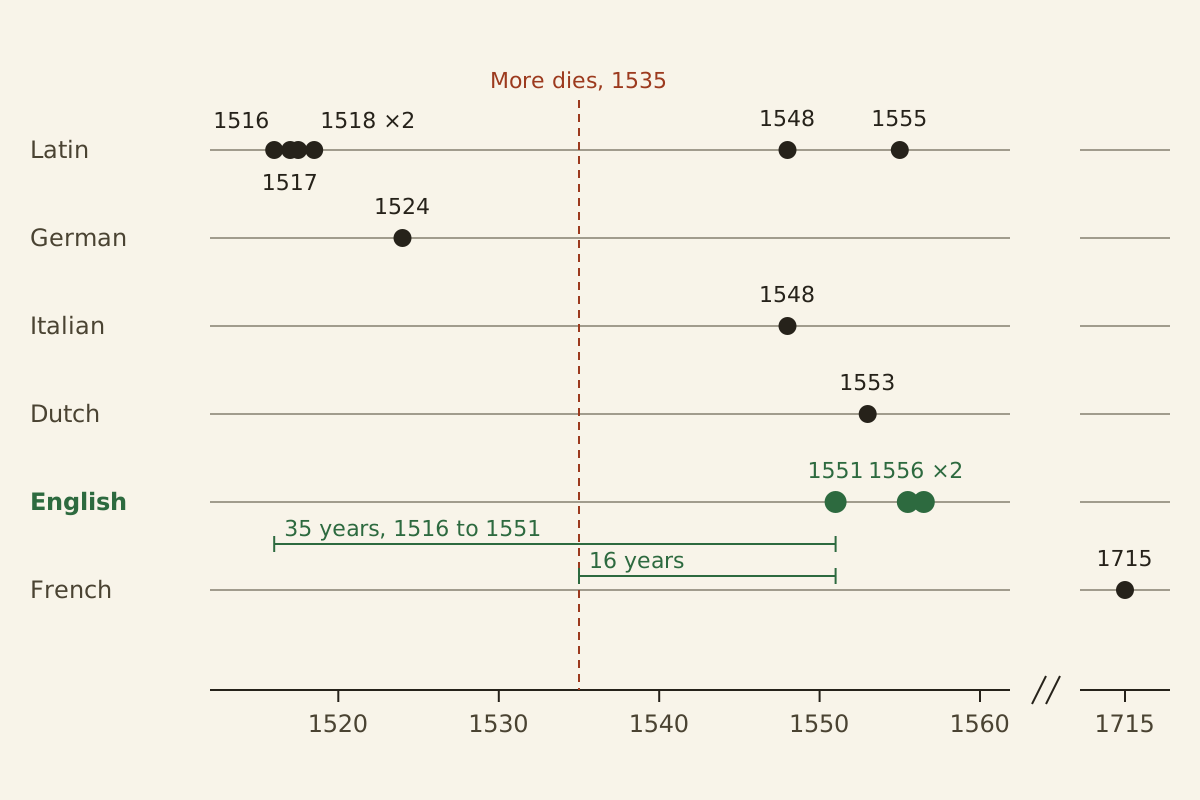
Printings of Utopia by language — each dot is one edition in the table, set in the row for its language, with More's death in 1535 marked in red and the 1715 French translation after the break.
Printings of Utopia by language, 1516–1556, and the 1715 French translation · Genre Fiction Lineage · CC BY 4.0
Reuse credit (CC BY)
"Printings of Utopia by language, 1516–1556, and the 1715 French translation" by Genre Fiction Lineage, https://genrefictionlineage.com/utopia-dystopia/thomas-more-utopia/, licensed under CC BY 4.0 (https://creativecommons.org/licenses/by/4.0/)
Edition data from the Universal Short Title Catalogue (single bibliographic facts) and the EEBO-TCP transcription A07706 of the 1551 English edition (CC0)
Robinson's 1551 text survives in a free transcription by the Text Creation Partnership (TCP). This page quotes it in its original spelling. Every printing in the timeline, with printer, catalogue number and source, is in a CSV of Utopia editions, 1516–1715 CSV · provenance note Edition data from the Universal Short Title Catalogue (single bibliographic facts) and the EEBO-TCP transcription A07706 of the 1551 English edition (CC0).
When was Utopia first printed?
The Universal Short Title Catalogue (USTC) is a union catalogue, a single list built from many libraries, of books printed in Europe up to 1700. It dates the earliest known printing of Utopia to Louvain in 1516, from the press of Thierry Martens. Its short title begins Libellus vere aureus nec minus salutaris quam festivus, “a truly golden little book, no less helpful than merry” (Genre Fiction Lineage translation).
The subject follows in the same title: de optimo reipublicae statu, deque nova insula Utopia, “on the best state of a commonwealth, and on the new island of Utopia” (Genre Fiction Lineage translation). Robinson's 1551 English renders the same two ideas as “publyque weale” and “yle.”
A Paris edition followed in 1517. Its title says the book is printed jam iterum, sed multo correctius quam prius, “now again, but much more correctly than before” (Genre Fiction Lineage translation). USTC lists four editors for that edition: Guillaume Budé, Erasmus, Thomas Lupset and More's friend Pieter Gillis.
In 1518 Johann Froben printed it at Basel. USTC lists two Froben editions from that year. All four of these printings are in Latin.
What did the 1518 Basel edition add?
Froben's volume packed more into the same binding. USTC's titles for both 1518 records go on to list epigrams by More, most of them è Graecis versa, “turned from the Greek” (Genre Fiction Lineage translation), and then more epigrams, which the title of USTC 630792 gives to Erasmus. The record for USTC 630792 names eight people connected with the volume, More included, among them William Lily, Philipp Melanchthon and Beatus Rhenanus. A Basel University Library copy, described on the scan's file page as the March 1518 edition and worded like USTC 630793 on its title page, also prints a full-page woodcut of the island.
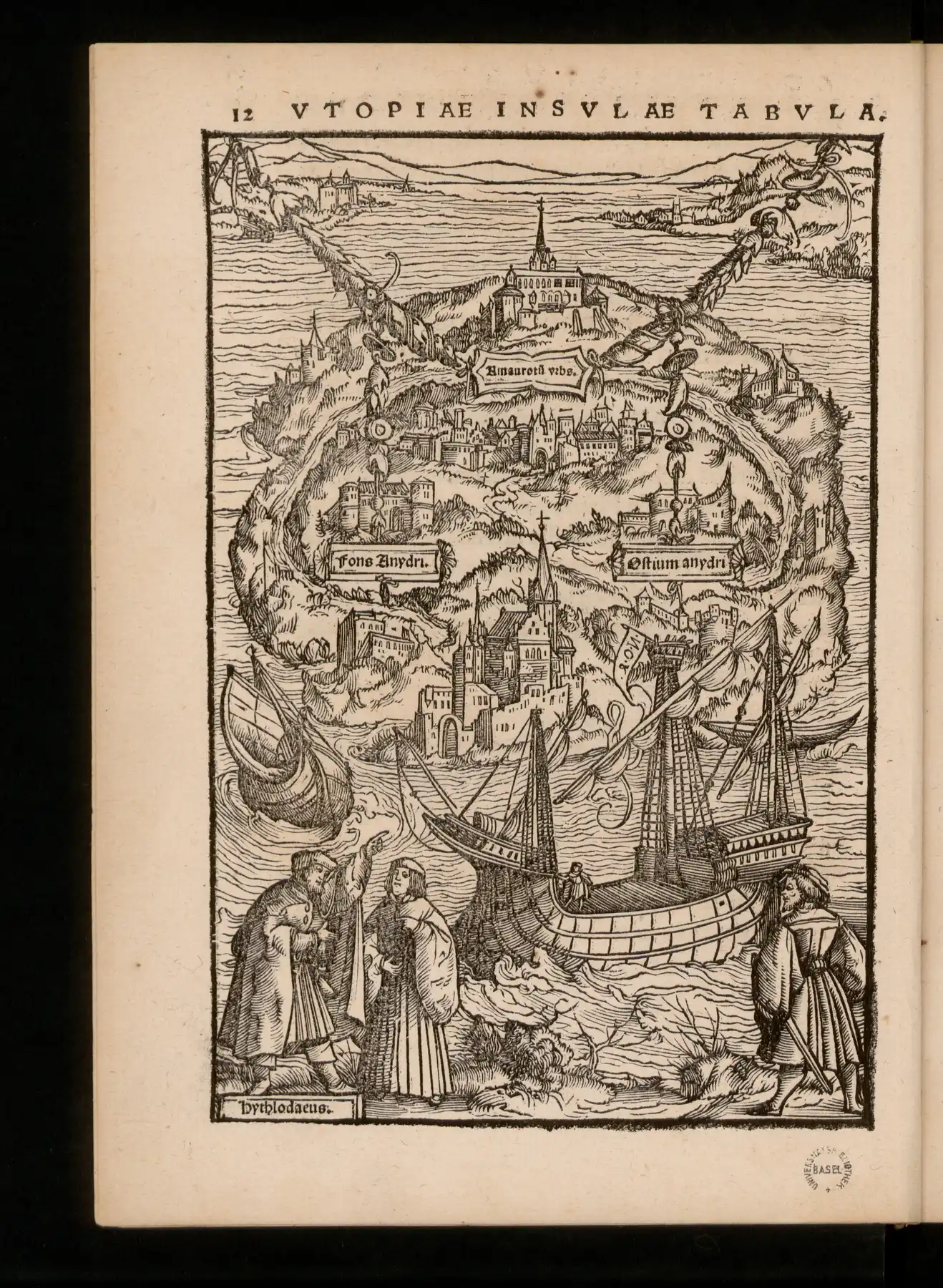
The island of Utopia, Basel, 1518 — a woodcut headed VTOPIAE INSVLAE TABVLA, “map of the island of Utopia” (Genre Fiction Lineage translation), from a copy of Froben's edition, with the traveller Hythlodaeus labelled in the lower left corner.
"Map of the island of Utopia (VTOPIAE INSVLAE TABVLA)" by Universitätsbibliothek Basel, 1518 — https://commons.wikimedia.org/wiki/File:Thomas_More_Utopia_1518_March_VTOPIAE_INSVLAE_TABULA_(Universit%C3%A4tsbibliothek_Basel).jpg — CC BY-SA 4.0 (https://creativecommons.org/licenses/by-sa/4.0/)
The woodcut's labels name the city of Amaurotum near the top and mark the source and the mouth of the river Anyder. A figure on the shore is labelled Hythlodaeus, the traveller whose report fills the book. Robinson's English gives the island's size in words instead: it “conteyneth in breadthe in the myddell part of it (for there it is brodest) CC. miles.” CC is the Roman numeral for two hundred.
When did Utopia appear in English?
Robinson's translation came out in London in 1551. TCP transcribed it from a copy at the Huntington Library, and its title page credits the English to “Raphe Robynson Citizein and Goldsmythe of London.” The imprint names the bookseller Abraham Vele, “dwelling in Pauls churcheyarde at the sygne of the Lambe.” USTC and the TCP header, which takes the name from the Short-Title Catalogue (STC 18094), give Steven Mierdman as the printer.
Two USTC searches look for an earlier English Utopia. The first, for English-language books matching “utopia” up to 1560, returns three records: this 1551 edition and two from 1556. The second, for English books by More from 1516 to 1551, finds other works such as The Supplycacyon of Soulys (1529) but no earlier Utopia. On USTC's record, Robinson's 1551 text is the earliest known English Utopia.
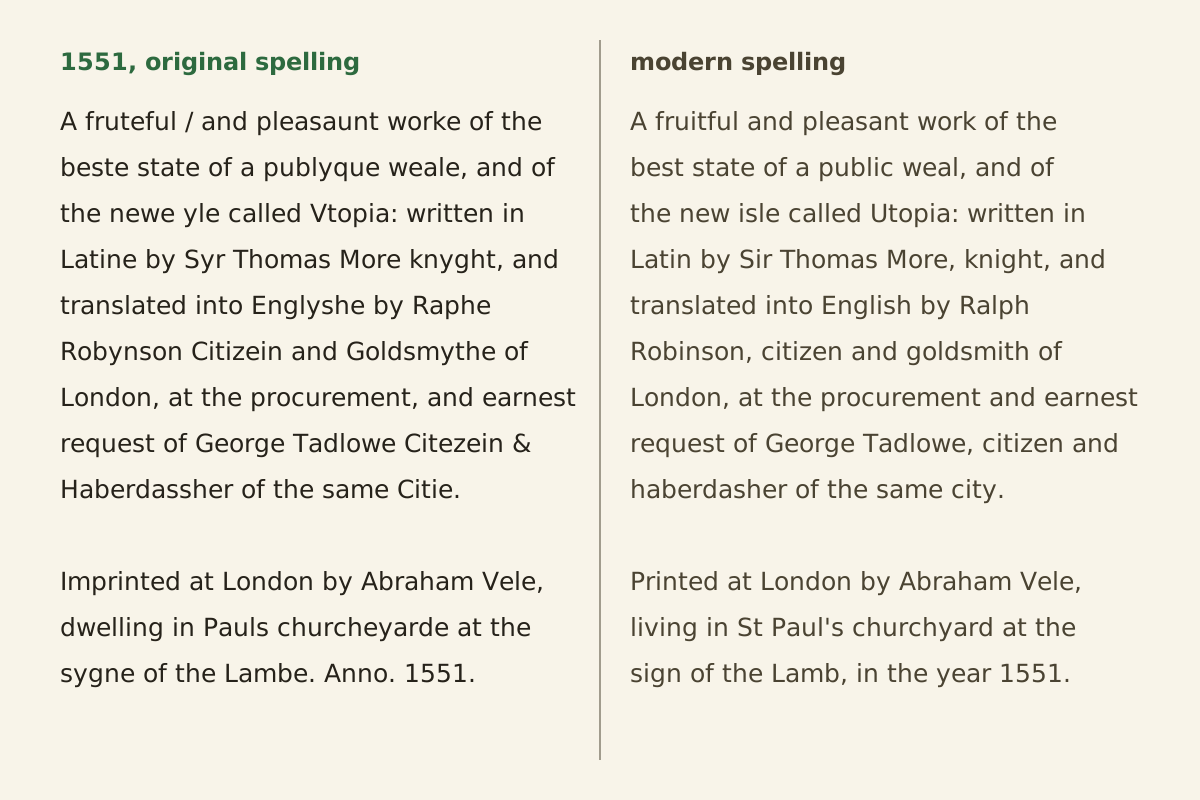
The 1551 title page in two spellings — the left column is the TCP transcription, broken into lines for the figure, and the right column is this site's modern spelling.
The 1551 English title page of Utopia in original and modern spelling · Genre Fiction Lineage · CC BY 4.0
Reuse credit (CC BY)
"The 1551 English title page of Utopia in original and modern spelling" by Genre Fiction Lineage, https://genrefictionlineage.com/utopia-dystopia/thomas-more-utopia/, licensed under CC BY 4.0 (https://creativecommons.org/licenses/by/4.0/)
Edition data from the Universal Short Title Catalogue (single bibliographic facts) and the EEBO-TCP transcription A07706 of the 1551 English edition (CC0)
English was not the first vernacular in USTC's records. A German Utopia came out at Basel in 1524 and an Italian one at Venice in 1548, 27 years and 3 years before Robinson's. Counting the table row by row, seven printings came before 1551: five in Latin, one in German and one in Italian.
Johann Bebel printed the German version, Von der wunderbarlichen innsel Utopia, at Basel. Its USTC record lists Claudius Cantiuncula as a contributor but names no translator. After Robinson, a Dutch De Utopie followed at Antwerp in 1553. The Latin text was printed again at Cologne in 1555.
Robinson's letter to William Cecil, printed before the text, explains the job in his own words: “I toke vpō me to tourne, and translate out of Latine into oure Englishe tonge” More's book. He dates the original as “writtē almost fourtie yeres ago by thesaid sir Thomas More.” Robinson counts from the writing. The printed record dates only the printings, and it gives 35 years from the 1516 Latin to the 1551 English.
The same letter names the man who asked for the work, the London haberdasher George Tadlowe, “at whoes request, & instaūce I first toke vpō my weake, & feble sholders” the task. The German national authority file (GND) gives Robinson's birth year as 1521, which made him about 30 in 1551, and records no death year. His volume also prints More's own opening letter in English, addressed to “Peter Giles,” in which More apologizes for sending the book “welnigh after a yeares space.”
Set beside USTC's 1516 short title, Robinson's English title keeps the Latin order, phrase by phrase. The short title stops before any name. The 1551 English, as transcribed, names both its author and its translator.
| Passage | Louvain 1516 (Latin, USTC short title) | London 1551 (English, TCP transcription) |
|---|---|---|
| What kind of book | libellus vere aureus nec minus salutaris quam festivus | “A fruteful / and pleasaunt worke” |
| Subject | de optimo reipublicae statu | “of the beste state of a publyque weale” |
| The island | deque nova insula Utopia | “and of the newe yle called Vtopia” |
| Author | not part of the short title | “written in Latine by Syr Thomas More knyght” |
| Translator | absent: this is the Latin original | “translated into Englyshe by Raphe Robynson” |
What changed in the 1556 English edition?
Five years later the same bookseller issued Robinson's translation again. USTC lists two London records for 1556, printed by Richard Tottell for Abraham Veale. USTC puts the year in brackets, the usual catalogue sign for a date supplied from outside the imprint. The 1556 title adds one word to the 1551 wording, which becomes “A frutefull, pleasaunt, & wittie worke.”
The entry on More in The Encyclopedia of Science Fiction (SFE) calls the 1556 text a revised translation. This page found no free transcription of the 1556 edition, so it does not compare the two texts sentence by sentence. For a book whose author revised her own text between two named editions, see Frankenstein, 1818 against 1831 (for comparison).
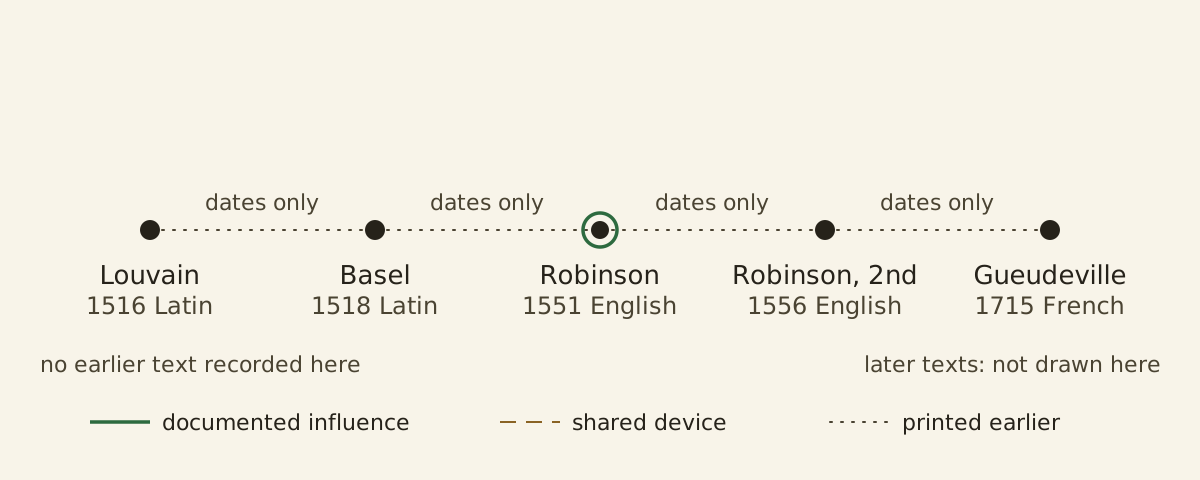
- Solid: documented influence (the later author's own statement, letter, review or note)
- Dashed: shared device (similar texts, no borrowing claimed)
- Dotted: dates only (publication order or other dates; no link claimed)
Lineage strip — the same work at five dates, joined by dotted lines that rest on dates alone.
Lineage strip: Utopia from Louvain 1516 to Leiden 1715 · Genre Fiction Lineage · CC BY 4.0
Reuse credit (CC BY)
"Lineage strip: Utopia from Louvain 1516 to Leiden 1715" by Genre Fiction Lineage, https://genrefictionlineage.com/utopia-dystopia/thomas-more-utopia/, licensed under CC BY 4.0 (https://creativecommons.org/licenses/by/4.0/)
Edition data from the Universal Short Title Catalogue (single bibliographic facts) and the EEBO-TCP transcription A07706 of the 1551 English edition (CC0)
Every line on the strip is dotted. The 1551 title page says in print that the book is translated from More's Latin, but a translation is the same work in another language, so this page records it as a later printing, not as influence between two works. Neither the title page nor the letter to Cecil says which Latin printing Robinson used, so the strip follows the dates. A CSV of the strip's links CSV · provenance note Edition data from the Universal Short Title Catalogue (single bibliographic facts) and the EEBO-TCP transcription A07706 of the 1551 English edition (CC0) gives the evidence for each line.
How did the 1715 French edition present the book?
Nicolas Gueudeville's French translation, L'Utopie de Thomas Morus, came out at Leiden in 1715, six years before his death in 1721 by GND's dates. Its engraved frontispiece, the picture facing the title page, prints the imprint “A LEIDE, chez PIERRE VANDER Aa,” “at Leiden, at Pierre vander Aa's” (Genre Fiction Lineage translation), and the date MDCCXV. The description on the scan's file page names the engraver as François van Bleyswik, spelled Bleyswyck in the German national authority file, which dates him 1671–1746. Gueudeville's version came 199 years after the Louvain Latin and 164 years after Robinson's English.
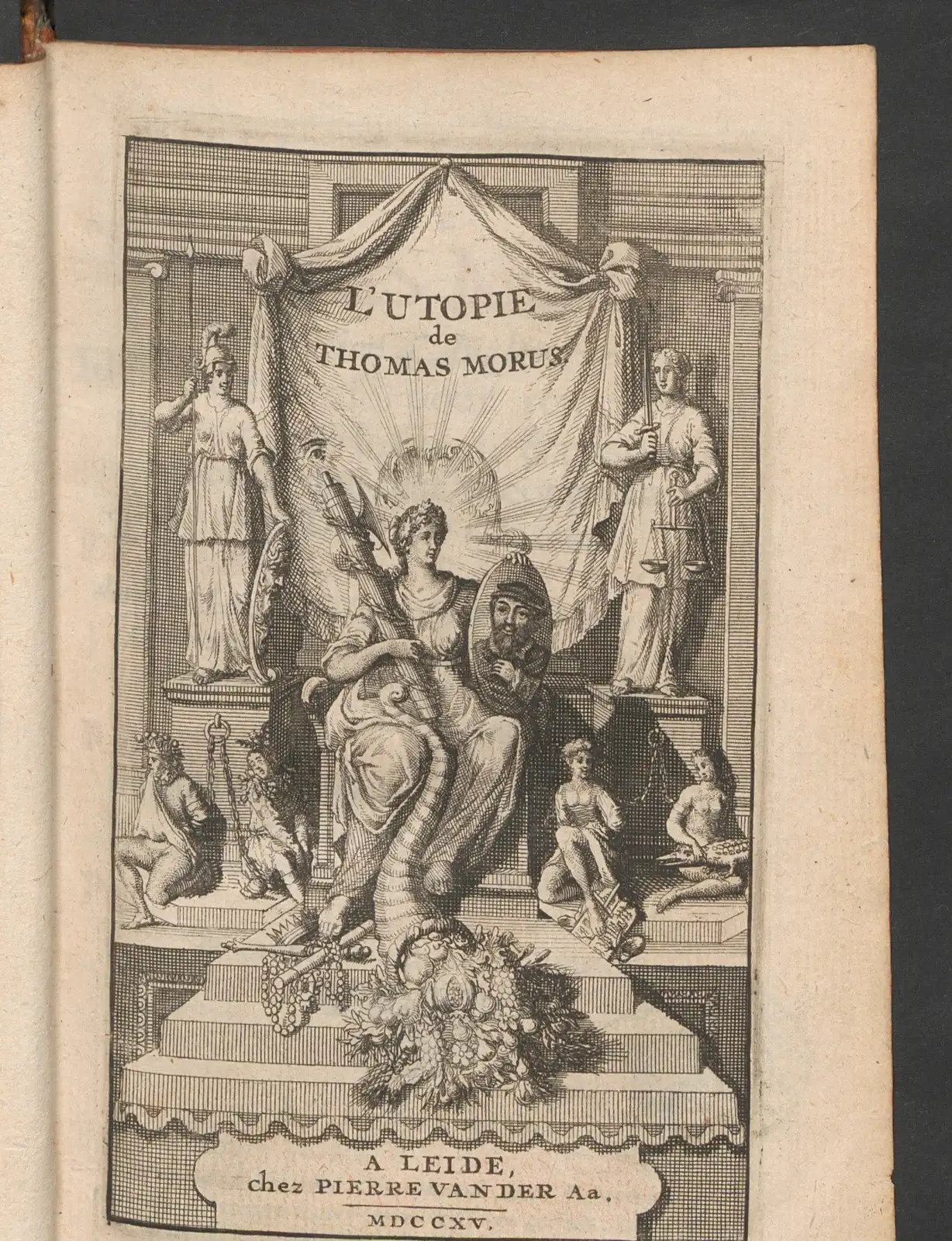
Frontispiece to the 1715 French translation — engraved for Gueudeville's L'Utopie, published at Leiden by Pierre vander Aa, and not part of More's 1516 Latin edition.
Frontispiece to L'Utopie de Thomas Morus, 1715 · François van Bleyswyck · public domain
Full credit
"Frontispiece to L'Utopie de Thomas Morus, 1715" by François van Bleyswyck, 1715 — https://commons.wikimedia.org/wiki/File:1715_-_Thomas_More_L'Utopie_-_Nicolas_Gueudeville_-_Frontispice_(e-rara).jpg — Public domain (US: published 1715; Germany and France: the engraver François van Bleyswyck died 1746 and the translator Nicolas Gueudeville 1721 (GND), so 70 years after death have run out; both died before 1914, so no French wartime or died-for-France extension applies); modified: cropped at the bottom edge of the engraved plate to remove a library stamp in the margin below
The picture is an allegory, not a map. A seated woman, with rays behind her head, holds a staff and a shield with a bearded man's portrait. A helmeted figure with a spear stands on one side and a figure holding scales on the other. The engraving does not name the man on the shield.
What does the word utopia mean?
Two SFE entries explain the name in slightly different ways. The Utopias entry says More derived the word from “outopia” (no place) rather than “eutopia” (good place). The entry on More reads it as a pun on both, made explicit only in verses by More's friend Pieter Gillis that were appended to the Latin text.
A search of the TCP transcription of Robinson's 1551 English finds neither those verses nor any form of “Eutopie.” Inside the story, Robinson's text explains the name another way. The island carries the name of its conqueror, “kyng Vtopus,” and had another name before he came.
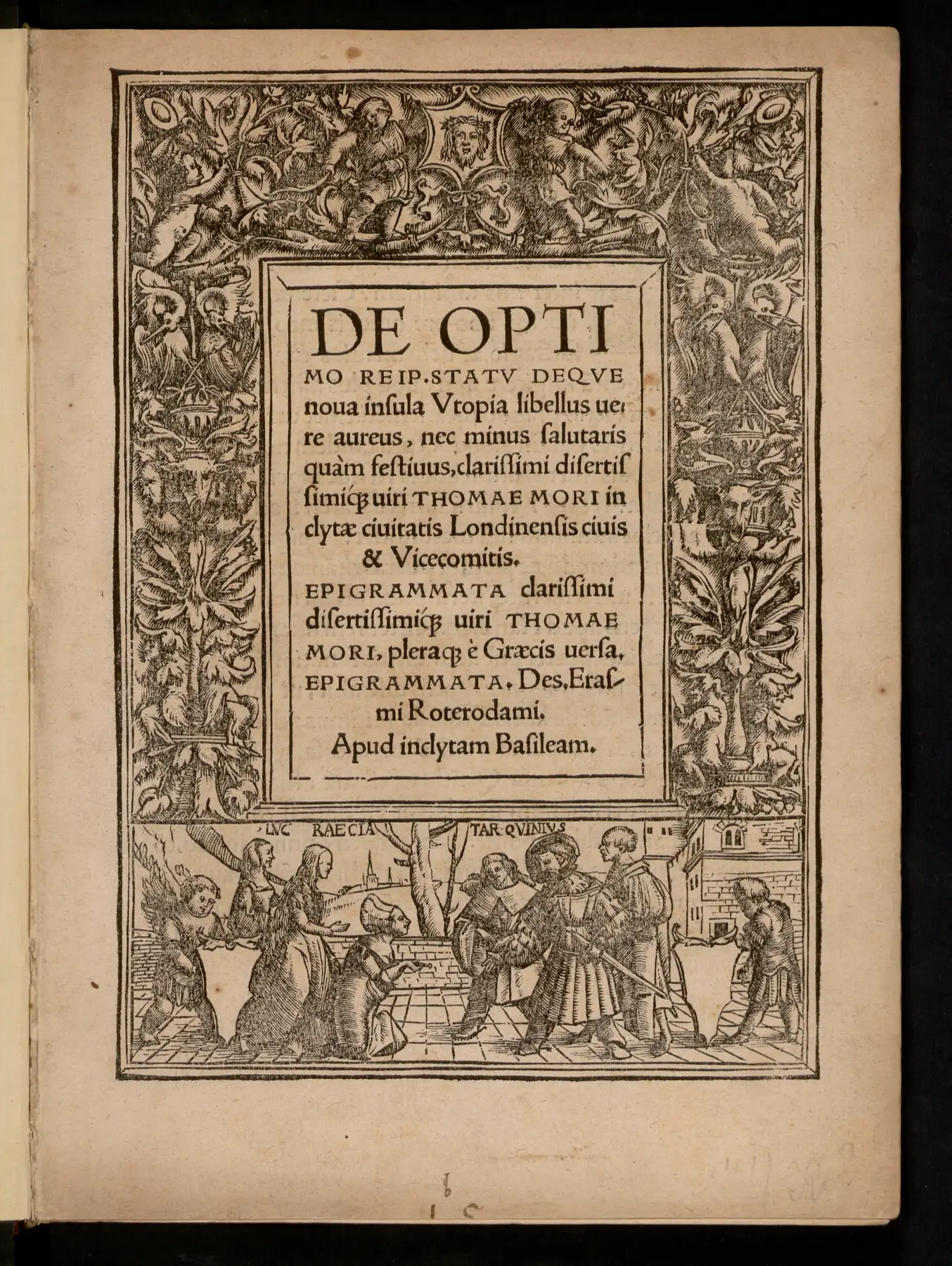
Title page of the Basel edition, 1518 — a woodcut border frames the title, which names the island as noua insula Vtopia, “the new island Utopia” (Genre Fiction Lineage translation).
"Title page, De optimo reip. statu deque noua insula Vtopia (Basel, 1518)" by Universitätsbibliothek Basel, 1518 — https://commons.wikimedia.org/wiki/File:Thomas_More_Utopia_1518_March_De_Optimo_reip._statu_deque_noua_insula_Vtopia_(Universit%C3%A4tsbibliothek_Basel).jpg — CC BY-SA 4.0 (https://creativecommons.org/licenses/by-sa/4.0/)
On the 1518 title page the name is printed as a plain place name, noua insula Vtopia. Whatever the word's Greek roots, the book's own pages present Utopia as an island named after a king.
Sources
- 1Thomas More, A fruteful, and pleasaunt worke of the beste state of a publyque weale, and of the newe yle called Vtopia, translated by Ralph Robinson (London: Abraham Vele, 1551; STC 18094, ESTC S110035), EEBO-TCP Phase I transcription A07706 from the Huntington Library copy https://github.com/textcreationpartnership/A07706Read: full textText licence: CC0 1.0
- 2Universal Short Title Catalogue, USTC 400360: Thomas More, Libellus vere aureus nec minus salutaris quam festivus de optimo reipublicae statu, deque nova insula Utopia (Louvain: Thierry Martens, 1516) https://www.ustc.ac.uk/editions/400360Read: bibliographic record only
- 3Universal Short Title Catalogue, USTC 144673: Thomas More, De optimo reipublicae statu, deque nova insula utopia, jam iterum, sed multo correctius quam prius (Paris: Jean du Pré (II) and Jacques Le Messier, 1517) https://www.ustc.ac.uk/editions/144673Read: bibliographic record only
- 4Universal Short Title Catalogue, USTC 630792 and 630793 (VD16 M 6299, M 6300): Thomas More, De optimo reip. statu deque nova insula utopia (Basel: Johann Froben, 1518) https://www.ustc.ac.uk/editions/630793Read: bibliographic records only
- 5Map of the island of Utopia (VTOPIAE INSVLAE TABVLA) from Thomas More, Utopia (Basel: Johann Froben, 1518), photograph by Universitätsbibliothek Basel, file page at Wikimedia Commons https://commons.wikimedia.org/wiki/File:Thomas_More_Utopia_1518_March_VTOPIAE_INSVLAE_TABULA_(Universit%C3%A4tsbibliothek_Basel).jpgRead: file page and imageText licence: CC BY-SA 4.0
- 6Universal Short Title Catalogue, USTC 504664 (STC 18094, ESTC S110035): Thomas More, A fruteful, and pleasaunt worke of the beste state of a publyque weale, and of the newe yle called Utopia, translated by Ralph Robinson (London: [Steven Mierdman] for Abraham Veale, 1551) https://www.ustc.ac.uk/editions/504664Read: bibliographic record only
- 7Universal Short Title Catalogue searches of 2 November 2026: utopia 1516–1560 (18 records); English-language utopia to 1560 (3 records); More, Thomas, English, 1516–1551 (18 records); Utopie and Eutopia to 1556; with the record for USTC 703719 (Basel: Johann Bebel, 1524) https://www.ustc.ac.uk/explore?q=utopia&fql=English&fqyt=1560Read: search result lists and one edition record
- 8Universal Short Title Catalogue, USTC 505325 (STC 18095) and 505351 (STC 18095.5): Thomas More, A frutefull, pleasaunt, & wittie worke, of the beste state of a publique weale, and of the newe yle, called Utopia, translated by Ralph Robinson (London: [Richard Tottell] for Abraham Veale, [1556]) https://www.ustc.ac.uk/editions/505325Read: bibliographic records only
- 9"More, Sir Thomas," in John Clute, David Langford and Graham Sleight (eds), The Encyclopedia of Science Fiction, https://sf-encyclopedia.com/entry/more_sir_thomas, accessed 2 November 2026 (entry updated 25 November 2024) https://sf-encyclopedia.com/entry/more_sir_thomasRead: full entry
- 10François van Bleyswyck, engraved frontispiece to L'Utopie de Thomas Morus, translated by Nicolas Gueudeville (Leiden: Pierre vander Aa, 1715), ETH-Bibliothek Zürich copy, file page at Wikimedia Commons https://commons.wikimedia.org/wiki/File:1715_-_Thomas_More_L'Utopie_-_Nicolas_Gueudeville_-_Frontispice_(e-rara).jpgRead: file page and image
- 11Gemeinsame Normdatei records for Thomas More (118641158), Ralph Robinson (1055272852), Nicolas Gueudeville (100348491) and François van Bleyswyck (132719908), via lobid.org https://d-nb.info/gnd/118641158Read: authority records
- 12"Utopias," in John Clute, David Langford and Graham Sleight (eds), The Encyclopedia of Science Fiction, https://sf-encyclopedia.com/entry/utopias, accessed 2 November 2026 (entry updated 16 March 2026) https://sf-encyclopedia.com/entry/utopiasRead: full entry
- 13Title page of Thomas More, De optimo reip. statu deque noua insula Vtopia (Basel: Johann Froben, 1518), photograph by Universitätsbibliothek Basel, file page at Wikimedia Commons https://commons.wikimedia.org/wiki/File:Thomas_More_Utopia_1518_March_De_Optimo_reip._statu_deque_noua_insula_Vtopia_(Universit%C3%A4tsbibliothek_Basel).jpgRead: file page and imageText licence: CC BY-SA 4.0
- 14Jennifer Jenkins and James Boyle, "Public Domain Day 2026," Center for the Study of the Public Domain, Duke Law School https://web.law.duke.edu/cspd/publicdomainday/2026/Read: full pageText licence: CC BY 4.0
- 15Urheberrechtsgesetz § 64 (Allgemeines), gesetze-im-internet.de https://www.gesetze-im-internet.de/urhg/__64.htmlRead: full text of the section


Cite this page
Genre Fiction Lineage. “Thomas More's Utopia: In English 16 Years After His Death.” Genre Fiction Lineage, published 3 November 2026. https://genrefictionlineage.com/utopia-dystopia/thomas-more-utopia/. Accessed [the date you read it].
Next shelf over:
- Dystopian Novels in Print Order: the other side of the word, with 20 dystopian novels dated by first appearance in print (printed later).
- Utopian Communities: real American settlements with founding and closing dates, set beside More's imagined island (for comparison).
- Read the text: A fruteful, and pleasaunt worke … Vtopia (1551), Text Creation Partnership on GitHub
Related entries
More from Utopias & Dystopias.
Lineage essay
Dystopian Novels: Orwell Read Zamyatin's We in French
20 dystopian novels dated by first appearance in print, 1879–1985: magazine serials, changed titles, hidden authors and later edits. Sourced, with a CSV.
Picture credit
Illustration: Genre Fiction Lineage. Generated scene illustration — not a book illustration, photograph or historical record. No copyright is claimed in the generated imagery; if you reuse it, please credit "Genre Fiction Lineage".
Lineage essay
Utopian Communities: Owen Bought New Harmony, Ready-Built
Robert Owen bought New Harmony ready-built. A dated table of 16 American communities, founded 1825–1846 and later dissolved, each date from an 1870s survey.
Picture credit
"New Harmony on the Wabash" by Karl Bodmer, 1839 — https://commons.wikimedia.org/wiki/File:Karl_Bodmer,_%22New_Harmony_on_the_Wabash%22_2009_26_2v1.jpg — CC0 1.0 (https://creativecommons.org/publicdomain/zero/1.0/)
Lineage essay
News from Nowhere: Morris Reviewed Bellamy 203 Days Earlier
William Morris reviewed Bellamy's Looking Backward on 22 June 1889; News from Nowhere began in the same weekly in 1890. Dated editions, two texts compared.
Picture credit
Illustration: Genre Fiction Lineage. Generated scene illustration — not a book illustration, photograph or historical record. No copyright is claimed in the generated imagery; if you reuse it, please credit "Genre Fiction Lineage".