Utopias & Dystopias · Lineage essay
News from Nowhere: Morris Reviewed Bellamy 203 Days Earlier
Genre Fiction Lineage Published
William Morris reviewed Edward Bellamy's Looking Backward in Commonweal on 22 June 1889. His own utopia, News from Nowhere, began in the same weekly on 11 January 1890, and its revised text never names Bellamy, so the review is the one written link between the two books found for this page.
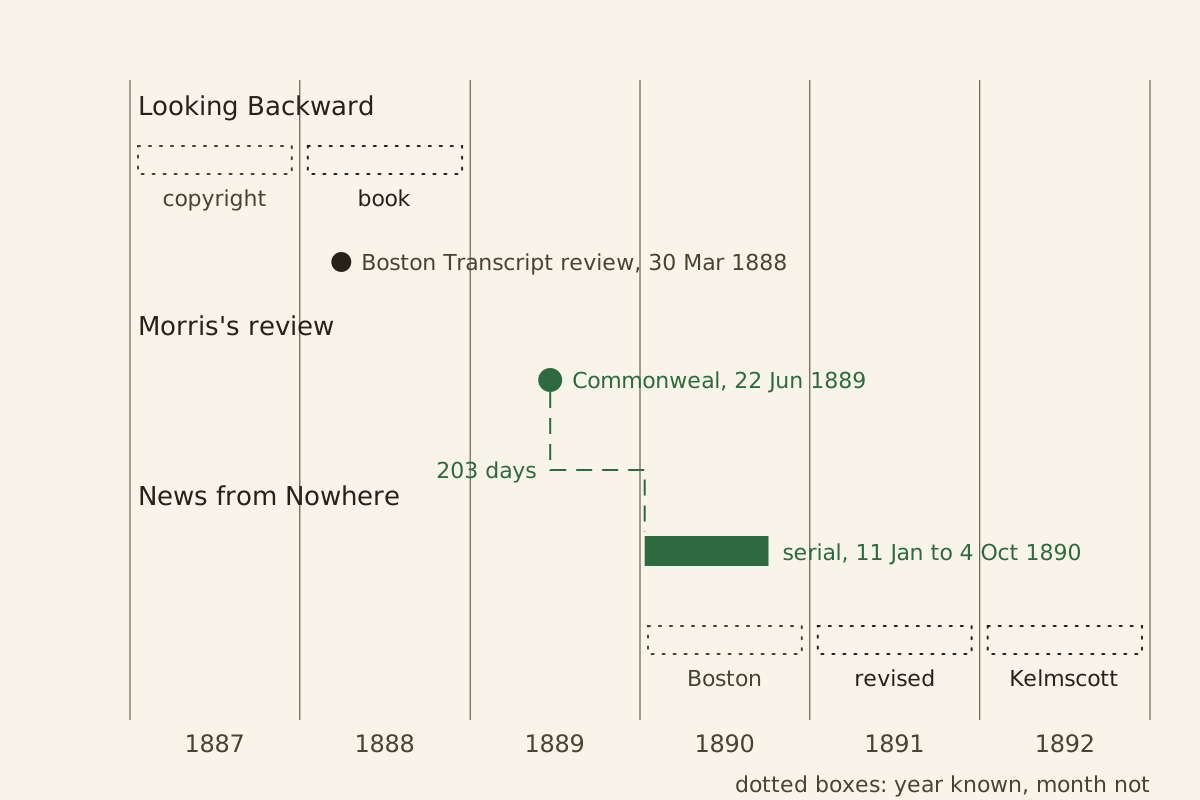
From review to Kelmscott — Bellamy's novel in 1888 by SFE's date, Morris's review in June 1889, the serial 203 days later and the book editions of 1890, 1891 and 1892.
Looking Backward and News from Nowhere in print, 1887-1892 · Genre Fiction Lineage · CC BY 4.0
Reuse credit (CC BY)
"Looking Backward and News from Nowhere in print, 1887-1892" by Genre Fiction Lineage, https://genrefictionlineage.com/utopia-dystopia/news-from-nowhere/, licensed under CC BY 4.0 (https://creativecommons.org/licenses/by/4.0/)
Text data from William Morris, News from Nowhere (Commonweal serial, 1890; revised text, 1908 Longmans printing) and Edward Bellamy, Looking Backward (Houghton Mifflin printing), both public domain; dates from the Marxists Internet Archive transcription of Commonweal and The Encyclopedia of Science Fiction (single facts)
Whether Morris wrote the novel as a reply is a separate question. The Encyclopedia of Science Fiction (SFE) says he did, in three of its entries, while the review is the one document read for this page in which Morris himself names Bellamy's book. Every date in the timeline is in a CSV of dated events, 1887–1908 CSV · provenance note Text data from William Morris, News from Nowhere (Commonweal serial, 1890; revised text, 1908 Longmans printing) and Edward Bellamy, Looking Backward (Houghton Mifflin printing), both public domain; dates from the Marxists Internet Archive transcription of Commonweal and The Encyclopedia of Science Fiction (single facts; place of Bellamy's death also from the 1911 Encyclopaedia Britannica).
What did Morris say about Looking Backward in 1889?
The review ran on pages 194–195 of Commonweal, Vol. 5, No. 180, under the heading “Looking Backward.” This page reads it in the transcription at the Marxists Internet Archive, which gives that citation; it has not been checked against a scan of the paper. Morris names the book and its author early on and notes that “several editions have been sold in America.”
He then sets out a rule for reading the whole form: “The only safe way of reading a utopia is to consider it as the expression of the temperament of its author.” Read that way, he wrote, Bellamy's temperament was “unhistoric and unartistic.” His objections are specific. He attacks the plan by which everyone starts work at twenty-one and stops at forty-five, and he says Bellamy's “dwelling of man in the future is Boston (USA) beautified.”
One objection goes to work itself: “the true incentive to useful and happy labour is and must be pleasure in the work itself.” He judged the plot as well. Bellamy's hero falls asleep and wakes in the year 2000, and Morris wrote that “the device of making a man wake up in a new world has now grown so common” that it would have done little for the book on its own. Just 203 days after the review, Commonweal printed the first instalment of a story whose narrator falls asleep and wakes in a changed England.
Morris also cited Bellamy's preface. That preface is dated from “Historical Section Shawmut College, Boston, December 26, 2000,” and says the author chose “the form of a romantic narrative” to lighten an instructive book, which Morris summed up as a “sugar-coating to the pill.” He did not dismiss the result: Bellamy, he wrote, “has faced the difficulty of economical reconstruction with courage,” and the book “is one to be read and considered seriously.” Yet it “should not be taken as the Socialist bible of reconstruction.”
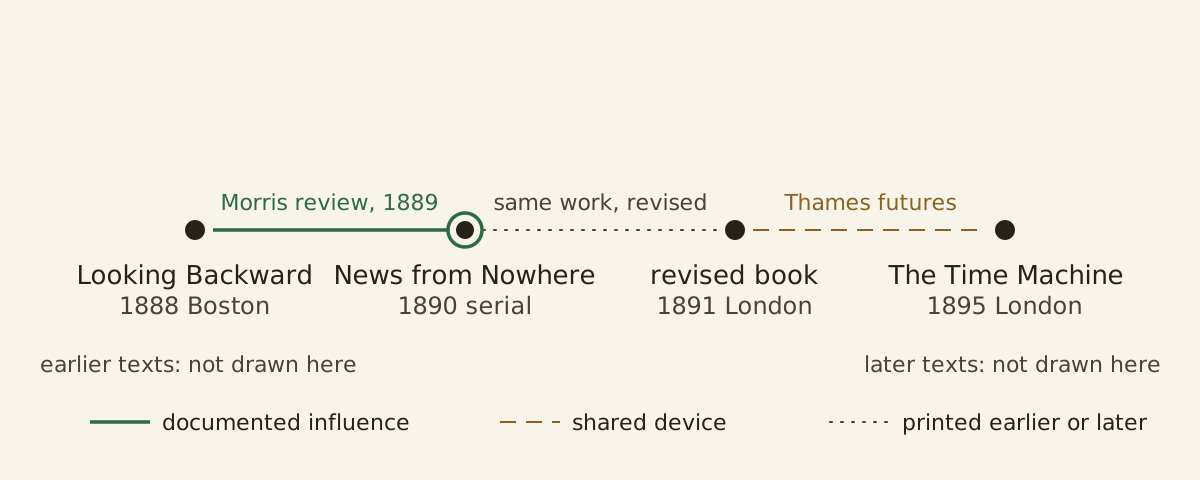
- Solid: documented influence (the later author's own statement, letter, review or note)
- Dashed: shared device (similar texts, no borrowing claimed)
- Dotted: dates only (publication order or other dates; no link claimed)
Lineage strip — four texts in print order; the solid line rests on Morris's 1889 review, the dotted line joins two texts of the same novel and the dashed line marks a shared far-future Thames valley.
Lineage strip: Looking Backward 1888 to The Time Machine 1895 · Genre Fiction Lineage · CC BY 4.0
Reuse credit (CC BY)
"Lineage strip: Looking Backward 1888 to The Time Machine 1895" by Genre Fiction Lineage, https://genrefictionlineage.com/utopia-dystopia/news-from-nowhere/, licensed under CC BY 4.0 (https://creativecommons.org/licenses/by/4.0/)
Text data from William Morris, News from Nowhere (Commonweal serial, 1890; revised text, 1908 Longmans printing) and Edward Bellamy, Looking Backward (Houghton Mifflin printing), both public domain; dates from the Marxists Internet Archive transcription of Commonweal and The Encyclopedia of Science Fiction (single facts)
The solid line records contact, not borrowing. Under this site's cataloguing rules, a later author who names an earlier book in a review counts as documented influence, but the review does not say what, if anything, Morris took from the book. A CSV of the strip's links CSV · provenance note Text data from William Morris, News from Nowhere (Commonweal serial, 1890; revised text, 1908 Longmans printing) and Edward Bellamy, Looking Backward (Houghton Mifflin printing), both public domain; dates from the Marxists Internet Archive transcription of Commonweal and The Encyclopedia of Science Fiction (single facts) gives the evidence for each line.
When did News from Nowhere first appear in print?
The serial began in Commonweal No. 209 on 11 January 1890 and ended in No. 247 on 4 October 1890, a run of 39 weekly issue numbers. Those dates come from the Marxists Internet Archive transcription. SFE's Morris entry gives the same two. The transcriber found no copy of Nos. 237 and 238, so this page cannot say what those two issues printed.
The transcription heads the serial with the subtitle “Being Some Chapters from a Utopian Romance.” Each instalment there is signed “William Morris,” and the last ends “THE END.” The issue dates are in a CSV of the 39 Commonweal issues CSV · provenance note Text data from William Morris, News from Nowhere (Commonweal serial, 1890; revised text, 1908 Longmans printing) and Edward Bellamy, Looking Backward (Houghton Mifflin printing), both public domain; dates from the Marxists Internet Archive transcription of Commonweal and The Encyclopedia of Science Fiction (single facts).
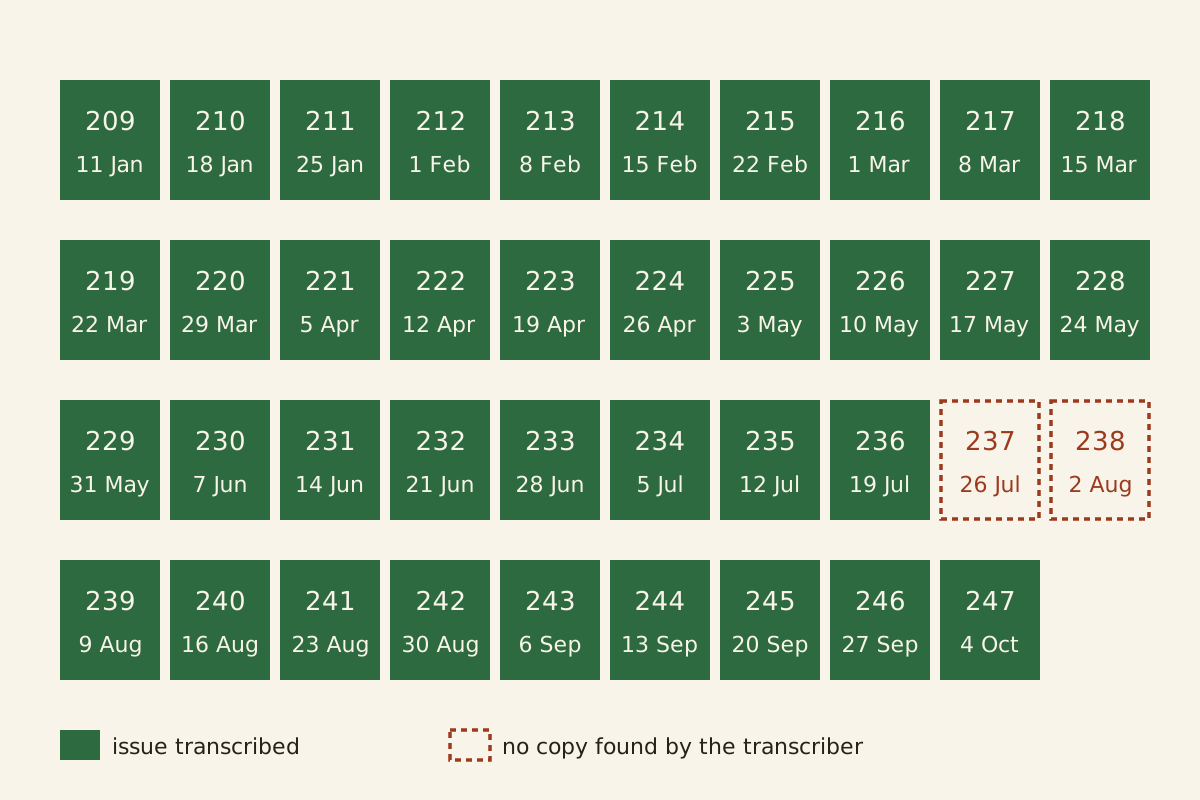
Thirty-nine issues — the weekly Commonweal numbers and dates of the serial, with the two issues missing from the transcription outlined in red.
Commonweal issue numbers spanning the News from Nowhere serial, 1890 · Genre Fiction Lineage · CC BY 4.0
Reuse credit (CC BY)
"Commonweal issue numbers spanning the News from Nowhere serial, 1890" by Genre Fiction Lineage, https://genrefictionlineage.com/utopia-dystopia/news-from-nowhere/, licensed under CC BY 4.0 (https://creativecommons.org/licenses/by/4.0/)
Text data from William Morris, News from Nowhere (Commonweal serial, 1890; revised text, 1908 Longmans printing) and Edward Bellamy, Looking Backward (Houghton Mifflin printing), both public domain; dates from the Marxists Internet Archive transcription of Commonweal and The Encyclopedia of Science Fiction (single facts)
Book editions followed fast. The back of the title page in a 1908 London printing gives the order: “First printed serially in the Commonweal, 1890,” then “Thence reprinted at Boston, Mass., 1890,” then “First English Edition, revised, Reeves & Turner, 1891,” and a Kelmscott Press edition in 1892. SFE names the Boston publisher as Roberts Brothers. On that printed list, the book edition listed ahead of London's came out in Boston, the city where Bellamy set his own future.
What changed between the 1890 serial and the revised text?
Set the serial beside the revised text and the future moves. In the Commonweal instalment of 18 January 1890, the narrator asks how old a bridge at Hammersmith is and hears that it was “built, or at least opened, in 1971.” In the revised text, read here in the 1908 Longmans printing, the same sentence ends “in 2003,” 32 years later. Neither version gives the year of the visit, and the bridge, “not very old,” is one clue.
Other wording shifted too. A carved inscription in the guest-hall marks the site of “the Hammersmith Branch of the Socialist League” in the serial and of “the Hammersmith Socialists” in the revised text, dated May 1962 in both. The chapter count also changed, from 30 in the serial to 32. The revised text adds chapter XXVI, “The Obstinate Refusers,” whose opening lines are not in the serial, and splits the serial chapter “The Upper Waters” so that its later part becomes “The Little River.”
| Passage | Commonweal serial, 1890 | Revised text, 1908 printing |
|---|---|---|
| Bridge at Hammersmith opened | 1971 (No. 210, 18 January) | 2003 (chapter II) |
| Guest-hall inscription | Hammersmith Branch of the Socialist League (No. 211) | Hammersmith Socialists (chapter III) |
| Battle in Trafalgar Square | 1952 (No. 215) | 1952 (chapter VII) |
| Number of chapters | 30 | 32 |
| “The Obstinate Refusers” | absent | chapter XXVI |
| “The Little River” | part of chapter XXVI, “The Upper Waters” | chapter XXVIII |
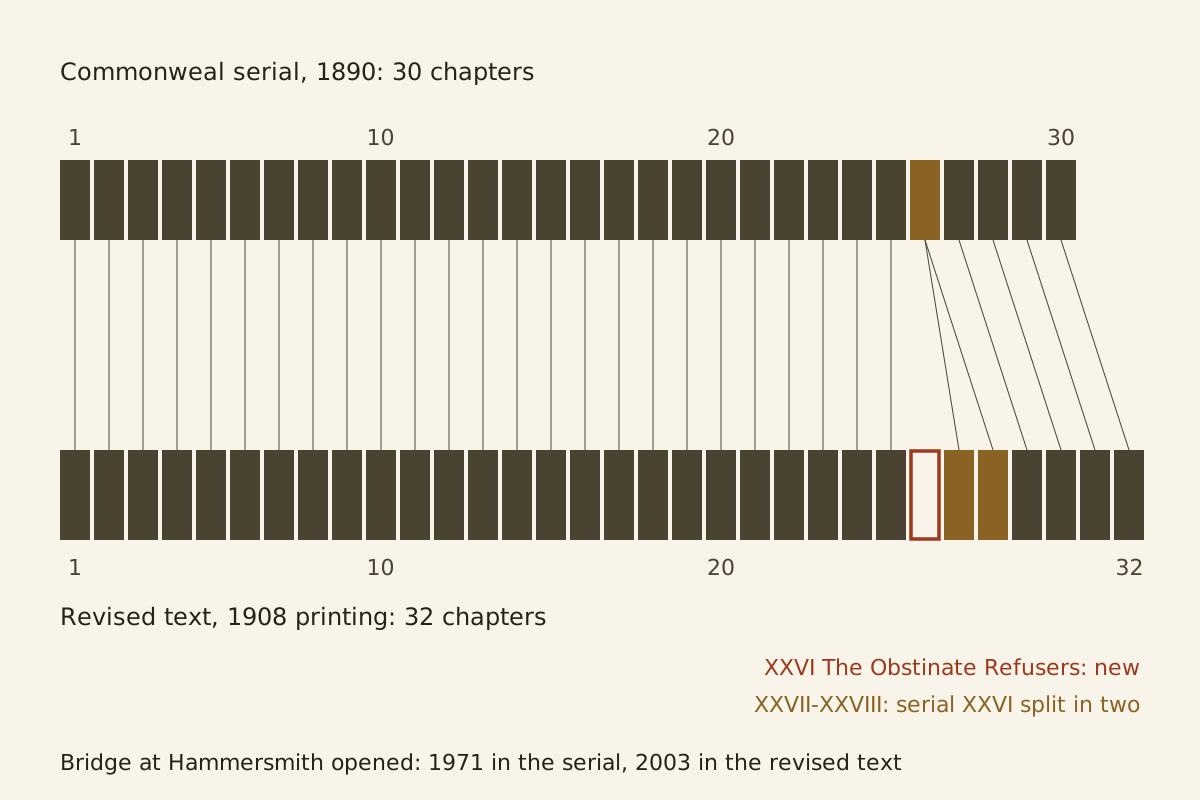
Serial against revised text — each of the 30 serial chapters linked to its place among the 32 of the revised text, with the new chapter and the split chapter marked.
News from Nowhere: chapters of the 1890 serial against the revised text · Genre Fiction Lineage · CC BY 4.0
Reuse credit (CC BY)
"News from Nowhere: chapters of the 1890 serial against the revised text" by Genre Fiction Lineage, https://genrefictionlineage.com/utopia-dystopia/news-from-nowhere/, licensed under CC BY 4.0 (https://creativecommons.org/licenses/by/4.0/)
Text data from William Morris, News from Nowhere (Commonweal serial, 1890; revised text, 1908 Longmans printing) and Edward Bellamy, Looking Backward (Houghton Mifflin printing), both public domain; dates from the Marxists Internet Archive transcription of Commonweal and The Encyclopedia of Science Fiction (single facts)
The copyright page calls the 1891 Reeves & Turner edition “revised,” but that edition was not read for this page, so the revised wording above is quoted from the 1908 printing. Every row is in a CSV of serial and revised readings CSV · provenance note Text data from William Morris, News from Nowhere (Commonweal serial, 1890; revised text, 1908 Longmans printing) and Edward Bellamy, Looking Backward (Houghton Mifflin printing), both public domain; dates from the Marxists Internet Archive transcription of Commonweal and The Encyclopedia of Science Fiction (single facts).
How do the two futures compare?
Both books send a sleeper forward. In Looking Backward, Julian West is put to sleep by a mesmerist in an underground chamber in 1887. He wakes to be told it is “the tenth day of September in the year 2000,” after “one hundred and thirteen years, three months, and eleven days” (chapter III). Morris's narrator goes to bed in Hammersmith on a winter night and wakes on what seems an early June morning, and nobody tells him the date (chapters I–II).
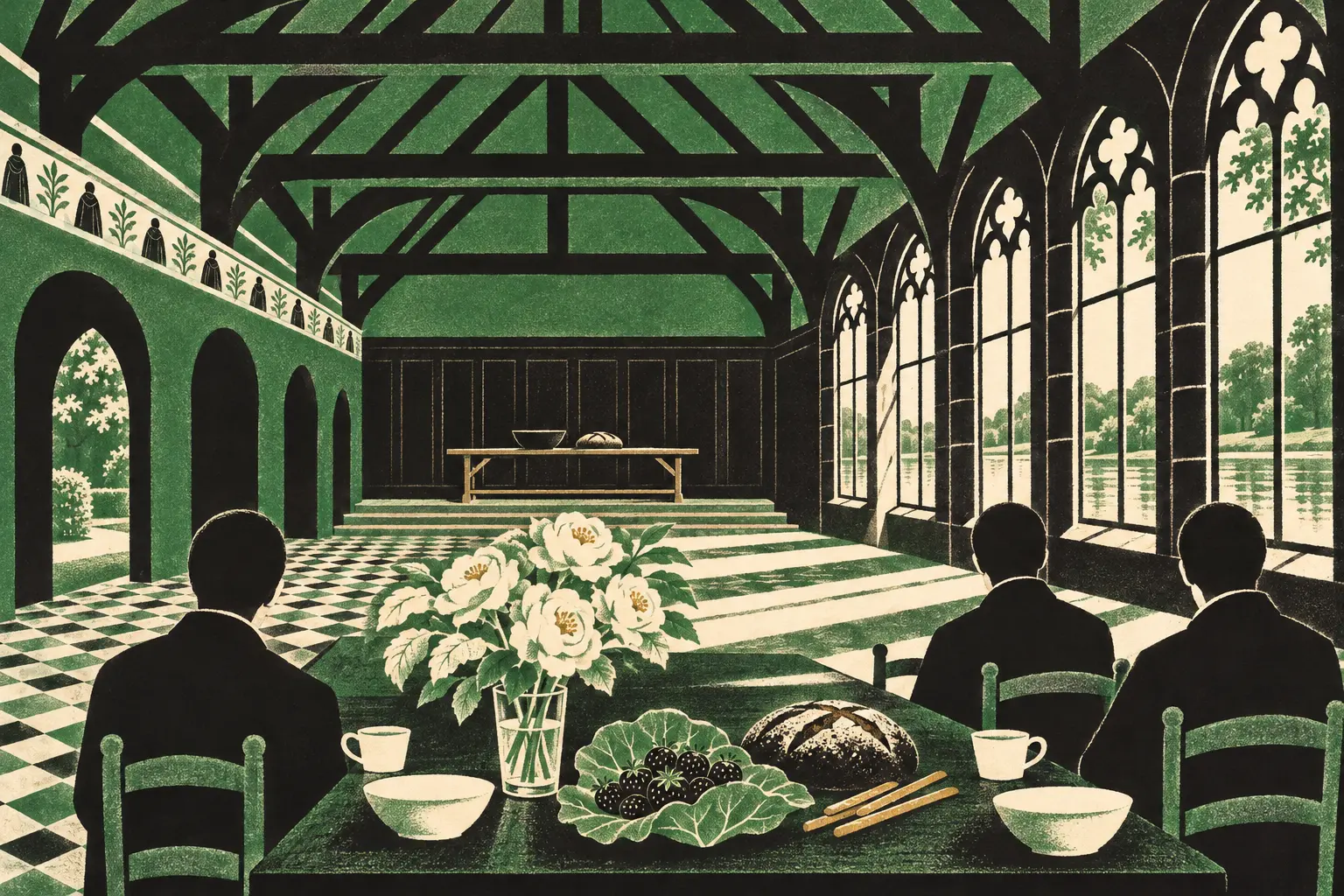
Breakfast at the Guest House — an illustration of the hall in chapter III of News from Nowhere, not a book illustration.
Illustration: Genre Fiction Lineage. Generated scene illustration — not a book illustration, photograph or historical record. No copyright is claimed in the generated imagery; if you reuse it, please credit "Genre Fiction Lineage".
From there the two futures split. Dr. Leete explains that each citizen is issued “a credit card” for the public storehouses (chapter IX). Morris's waterman, offered coins, does not understand the question “How much?” (chapter II). On work, Bellamy's citizens serve in industry from twenty-one to forty-five (chapter VI), and Morris's Hammond says that “all work is now pleasurable” (chapter XV).
| Point | Looking Backward (undated Houghton Mifflin printing) | News from Nowhere (revised text, 1908 printing) |
|---|---|---|
| Getting there | Mesmeric sleep in an underground chamber, 1887 (II–III) | Sleep at home in Hammersmith on a winter night (I–II) |
| Year | 10 September 2000 (III) | Not given; a bridge opened in 2003 is “not very old” (II) |
| Time asleep | 113 years, three months and 11 days (III) | Not stated |
| Setting | Boston (III) | Hammersmith, London and the Thames upriver (II, XXI–XXXII) |
| Guide | Dr. Leete (III) | Dick, a waterman, and old Hammond (II, IX) |
| Money | A yearly credit and a credit card (IX) | Coins offered; “How much?” not understood (II) |
| Work | Industrial service from 21 to 45 (VI) | “all work is now pleasurable” (XV) |
| Ending | West dreams of 1887 and wakes again in 2000 (XXVIII) | The narrator wakes in Hammersmith (XXXII) |
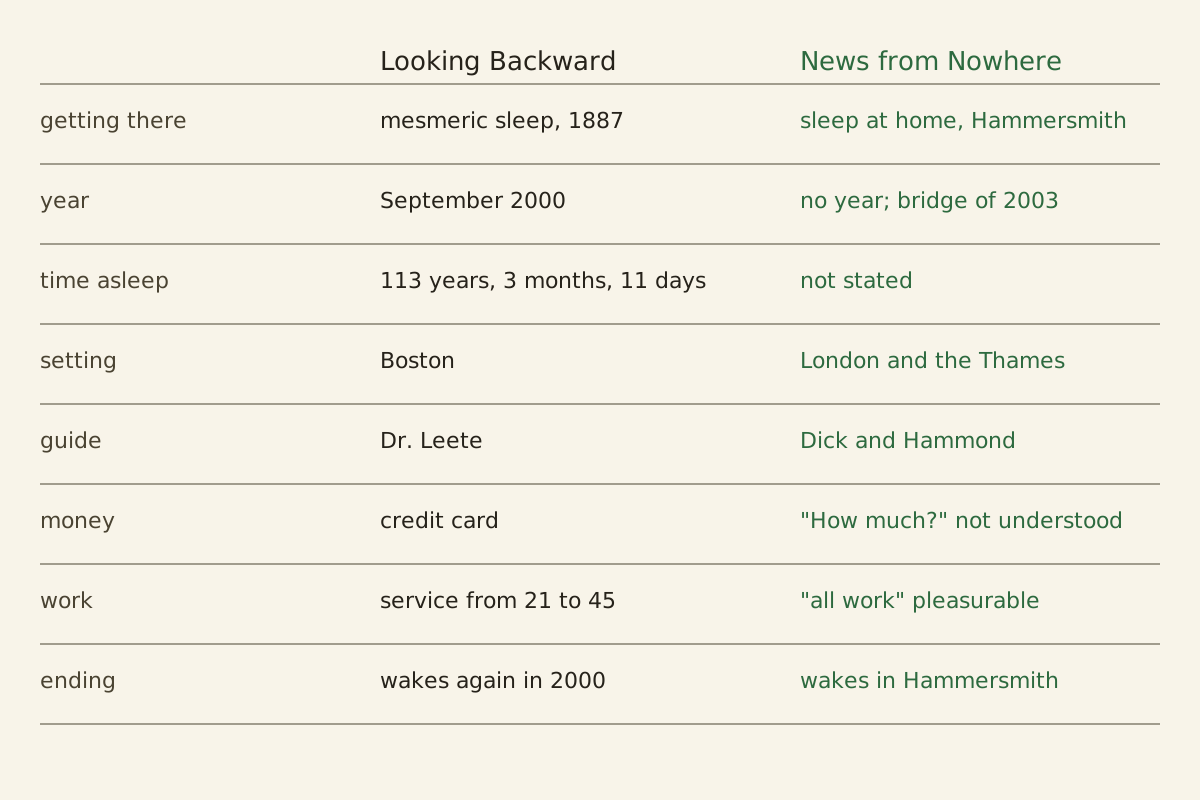
Two futures — the eight rows of the comparison in short form, Bellamy's text on the left and Morris's on the right.
Two futures compared: Looking Backward and News from Nowhere · Genre Fiction Lineage · CC BY 4.0
Reuse credit (CC BY)
"Two futures compared: Looking Backward and News from Nowhere" by Genre Fiction Lineage, https://genrefictionlineage.com/utopia-dystopia/news-from-nowhere/, licensed under CC BY 4.0 (https://creativecommons.org/licenses/by/4.0/)
Text data from William Morris, News from Nowhere (Commonweal serial, 1890; revised text, 1908 Longmans printing) and Edward Bellamy, Looking Backward (Houghton Mifflin printing), both public domain; dates from the Marxists Internet Archive transcription of Commonweal and The Encyclopedia of Science Fiction (single facts)
The endings answer each other. West dreams that he is back in 1887 and wakes to find that “my return to the nineteenth century had been the dream” (chapter XXVIII). Morris's narrator wakes “at dingy Hammersmith” and decides that what he saw “may be called a vision rather than a dream” (chapter XXXII). Each row, with its chapter, is in a CSV of the two-futures comparison CSV · provenance note Text data from William Morris, News from Nowhere (Commonweal serial, 1890; revised text, 1908 Longmans printing) and Edward Bellamy, Looking Backward (Houghton Mifflin printing), both public domain; dates from the Marxists Internet Archive transcription of Commonweal and The Encyclopedia of Science Fiction (single facts).
The sleeper itself was common property, as Morris's review says. Wells used a sleeper again in When the Sleeper Wakes, which began in The Graphic in January 1899, nine years after the serial; it is row 3 of the dystopian novels table (printed later). His earlier The Time Machine (1895) shares a setting instead: the traveller looks down on “the valley of the Thames” in the year 802,701 and finds that “the Thames had shifted, perhaps, a mile” (Heinemann edition, chapter 6). The novel that shares the Thames setting is dated, with its own forerunners, in the Time Machine entry (shared device).
Is News from Nowhere a reply to Bellamy?
The claim that the novel is a reply comes from SFE, which makes it three times. Its Morris entry says the book was “Composed in immediate response” to Bellamy's “highly organized future,” its Bellamy entry says Morris was “instantly driven to retort,” and its Utopias entry calls the novel “the most famous of the UK replies.” Those are SFE's readings. The texts read for this page can test only part of them.
Morris's review is the documented part. It shows that he had read Looking Backward by June 1889 and objected to its working life, its city and its trust in machinery. The novel, in the revised text and in the serial transcription with its two missing issues, never mentions Bellamy or his title.
What does carry over is Morris's own vocabulary. The review rests its case on “pleasure in the work itself,” and by this page's count the revised text uses pleasure or pleasures 78 times; SFE says the word appears “almost 80 times.” The highest counts are in chapter IX, “Concerning Love,” and chapter XXII, with 8 each, and in chapter XV, on the lack of incentive to labour, and chapter XXVII, “The Upper Waters,” with 7 each.
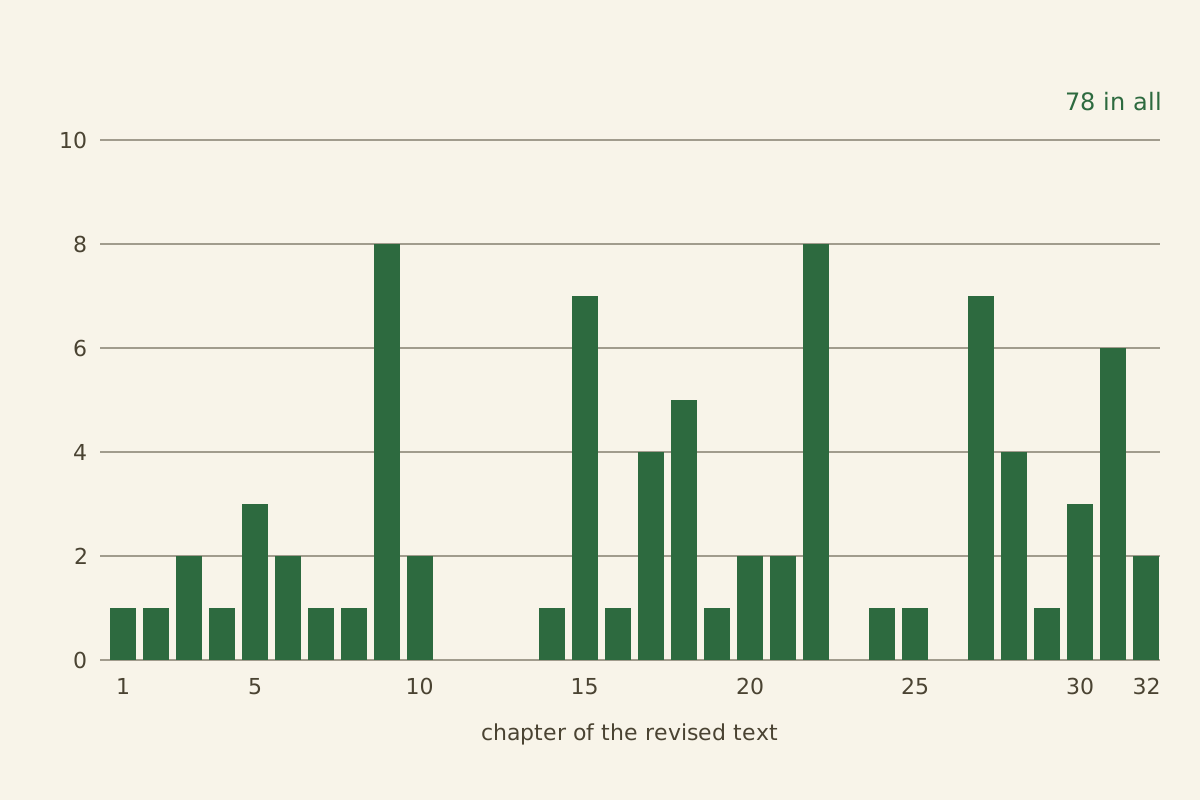
Pleasure, chapter by chapter — how often pleasure or pleasures appears in each of the 32 chapters of the revised text, 78 times in all by this page's count.
The words pleasure and pleasures in News from Nowhere, chapter by chapter · Genre Fiction Lineage · CC BY 4.0
Reuse credit (CC BY)
"The words pleasure and pleasures in News from Nowhere, chapter by chapter" by Genre Fiction Lineage, https://genrefictionlineage.com/utopia-dystopia/news-from-nowhere/, licensed under CC BY 4.0 (https://creativecommons.org/licenses/by/4.0/)
Text data from William Morris, News from Nowhere (Commonweal serial, 1890; revised text, 1908 Longmans printing) and Edward Bellamy, Looking Backward (Houghton Mifflin printing), both public domain; dates from the Marxists Internet Archive transcription of Commonweal and The Encyclopedia of Science Fiction (single facts)
That leaves a documented contact and a shared vocabulary between a review and a novel by the same writer, not a stated purpose. A letter or preface in which Morris calls the novel a reply would add a second piece of evidence to the solid line. The counts are in a CSV of pleasure by chapter CSV · provenance note Text data from William Morris, News from Nowhere (Commonweal serial, 1890; revised text, 1908 Longmans printing) and Edward Bellamy, Looking Backward (Houghton Mifflin printing), both public domain; dates from the Marxists Internet Archive transcription of Commonweal and The Encyclopedia of Science Fiction (single facts).
Which text of News from Nowhere should you read?
Project Gutenberg's eBook #3261 is the revised text, transcribed from the Longmans tenth impression of 1908, and the printing history on the back of its title page is the source for the Boston, London and Kelmscott dates. The 1890 serial survives in the Marxists Internet Archive transcription, with Nos. 237 and 238 missing. A quotation from the free ebook is a quotation from the revised version, and the bridge sentence shows why the serial needs its own citation.
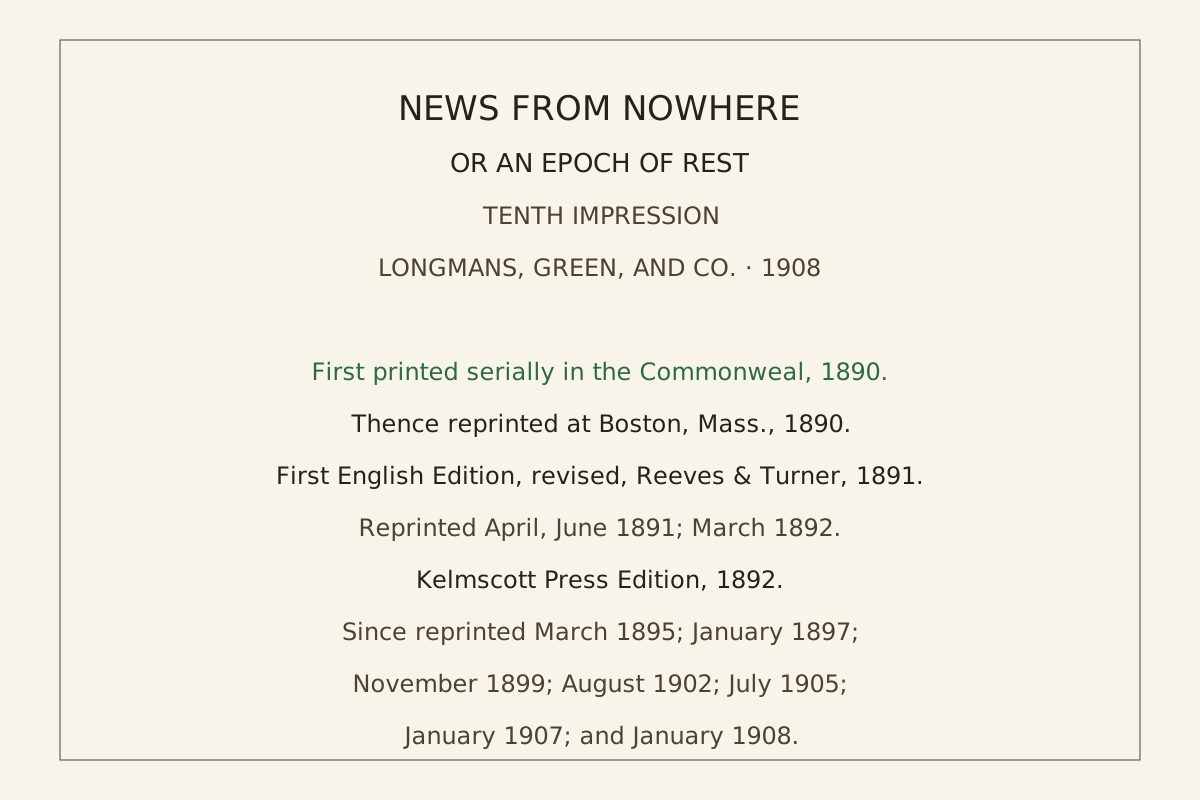
The 1908 printing history — the title and the notes on the back of the title page of the tenth impression, reset in type from the Project Gutenberg transcription.
News from Nowhere, title and copyright page notes of the 1908 tenth impression · Genre Fiction Lineage · CC BY 4.0
Reuse credit (CC BY)
"News from Nowhere, title and copyright page notes of the 1908 tenth impression" by Genre Fiction Lineage, https://genrefictionlineage.com/utopia-dystopia/news-from-nowhere/, licensed under CC BY 4.0 (https://creativecommons.org/licenses/by/4.0/)
Text data from William Morris, News from Nowhere (Commonweal serial, 1890; revised text, 1908 Longmans printing) and Edward Bellamy, Looking Backward (Houghton Mifflin printing), both public domain; dates from the Marxists Internet Archive transcription of Commonweal and The Encyclopedia of Science Fiction (single facts)
The Kelmscott Press edition of 1892 set the same opening on a decorated page. Its opening text page frames the title and chapter I in a border of vines, leaves and grapes, with two large decorated initials.
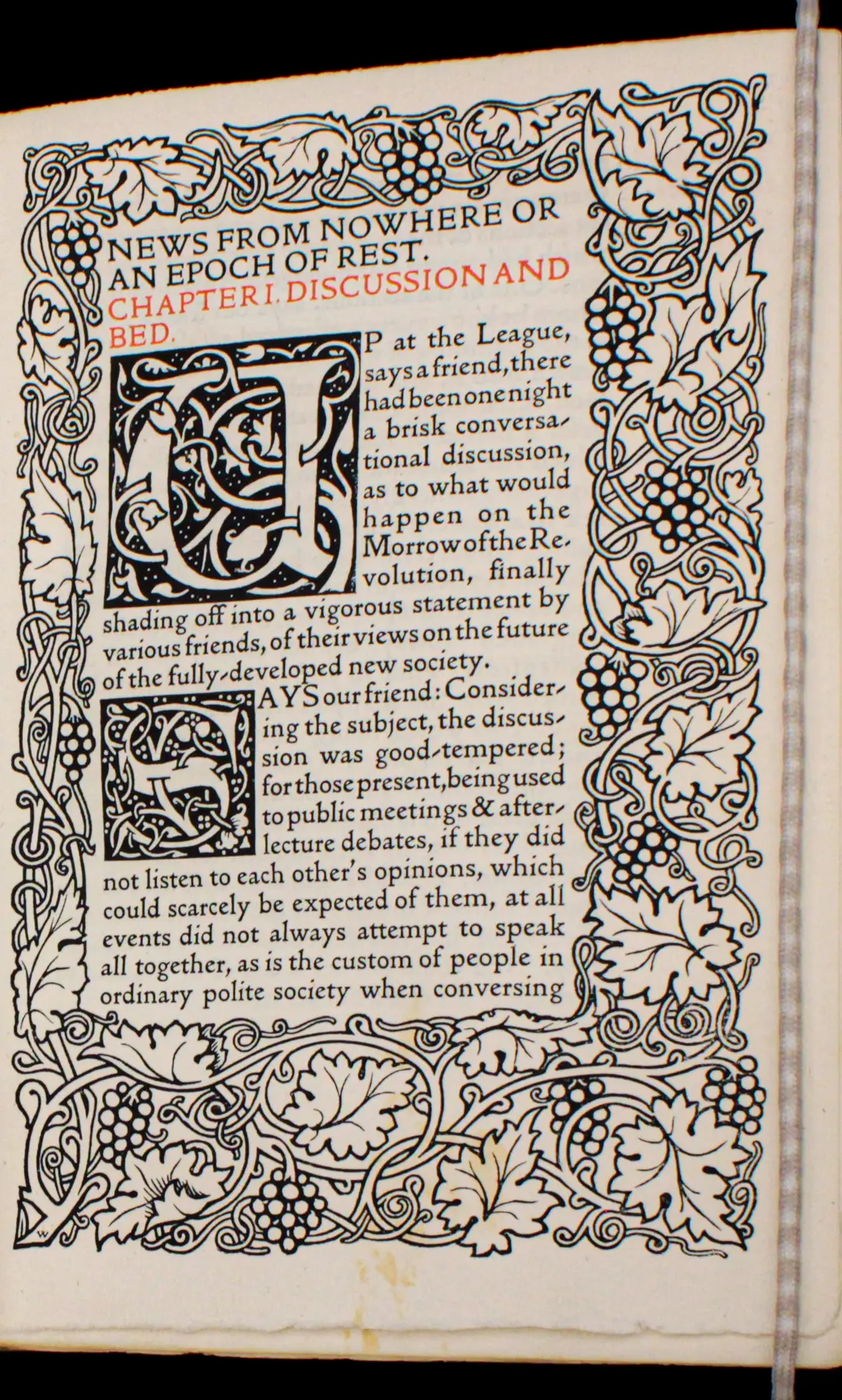
The Kelmscott opening, 1892 — the opening text page of News from Nowhere in the Kelmscott Press edition, from a photograph of a Pequot Library copy; the facing frontispiece is not shown.
"News from Nowhere, Kelmscott Press, 1892: Chapter I" by Southport1639, 2023 — https://commons.wikimedia.org/wiki/File:News_From_Nowhere.jpg — CC BY-SA 4.0 (https://creativecommons.org/licenses/by-sa/4.0/); modified: cropped to the right-hand page (the first text page); the left-hand frontispiece is not used
For Bellamy, eBook #25439 reproduces an undated Houghton Mifflin printing whose introduction, by another writer, speaks of the year 1931. Its copyright page opens “COPYRIGHT, 1887, BY TICKNOR AND COMPANY,” while SFE dates the book to 1888. Bellamy's postscript in that printing cites a Boston Transcript review of 30 March 1888, so the book was in print by then. Project Gutenberg's other text, eBook #624, does not name the edition it follows.
Sources
- 1William Morris, "Looking Backward," Commonweal, Vol. 5, No. 180, 22 June 1889, pp. 194-195, transcribed by Ted Crawford at the Marxists Internet Archive https://www.marxists.org/archive/morris/works/1889/commonweal/06-bellamy.htmRead: full text of the transcription
- 2"Morris, William," in John Clute, David Langford and Graham Sleight (eds), The Encyclopedia of Science Fiction, https://sf-encyclopedia.com/entry/morris_william, accessed 2 November 2026 (entry updated 7 September 2026) https://sf-encyclopedia.com/entry/morris_williamRead: full entry
- 3"Bellamy, Edward," in John Clute, David Langford and Graham Sleight (eds), The Encyclopedia of Science Fiction, https://sf-encyclopedia.com/entry/bellamy_edward, accessed 2 November 2026 (entry updated 13 January 2025) https://sf-encyclopedia.com/entry/bellamy_edwardRead: full entry
- 4"Utopias," in John Clute, David Langford and Graham Sleight (eds), The Encyclopedia of Science Fiction, https://sf-encyclopedia.com/entry/utopias, accessed 2 November 2026 (entry updated 16 March 2026) https://sf-encyclopedia.com/entry/utopiasRead: full entry
- 5William Morris, "News from Nowhere," Commonweal, Vol. 6, Nos. 209-247, 11 January to 4 October 1890, as transcribed at the Marxists Internet Archive https://www.marxists.org/archive/morris/works/1890/commonweal/nowhere_commonweal.htmRead: full text of the transcription (Nos. 237 and 238 not found by the transcriber)
- 6William Morris, News from Nowhere; or, An Epoch of Rest, Project Gutenberg eBook #3261, https://www.gutenberg.org/ebooks/3261 (base: Longmans, Green, and Co., tenth impression, 1908) https://www.gutenberg.org/ebooks/3261Read: full text
- 7Edward Bellamy, Looking Backward: 2000-1887, Project Gutenberg eBook #25439, https://www.gutenberg.org/ebooks/25439 (base: Houghton Mifflin, Riverside Library printing; undated; copyright notices 1887 Ticknor and Company, 1889 Edward Bellamy, 1898, 1915 and 1917 Emma S. Bellamy; the introduction refers to the year 1931) https://www.gutenberg.org/ebooks/25439Read: full text (the 1931 introduction by another writer not used)
- 8The Encyclopedia of Science Fiction, author entries for the 21 writers in the table (bibliographies and birth and death dates); each row of the CSV links its entry https://sf-encyclopedia.com/Read: full entries for all 21 writers
- 9H. G. Wells, The Time Machine (London: William Heinemann, 1895), Chapter 6, transcribed at Wikisource https://en.wikisource.org/wiki/The_Time_Machine_(Heinemann_text)/Chapter_6Read: single chapter
- 10William Morris, "Foreword to Thomas More's Utopia," dated 1893, transcribed at the Marxists Internet Archive https://www.marxists.org/archive/morris/works/1893/utopia.htmRead: full text of the transcription
- 11Jennifer Jenkins and James Boyle, "Public Domain Day 2026," Center for the Study of the Public Domain, Duke Law School https://web.law.duke.edu/cspd/publicdomainday/2026/Read: full pageText licence: CC BY 4.0
- 12Urheberrechtsgesetz § 64 (Allgemeines), gesetze-im-internet.de https://www.gesetze-im-internet.de/urhg/__64.htmlRead: full text of the section
- 13"Bellamy, Edward," Encyclopaedia Britannica, 11th edition (1911), transcribed at Wikisource https://en.wikisource.org/wiki/1911_Encyclop%C3%A6dia_Britannica/Bellamy,_EdwardRead: full entry
- 14William Morris, News from Nowhere (London: Kelmscott Press, 1892), first text page, Pequot Library Special Collections copy, photographed by Southport1639, on Wikimedia Commons (CC BY-SA 4.0) https://commons.wikimedia.org/wiki/File:News_From_Nowhere.jpgRead: the file page and the photograph, viewed in full

Cite this page
Genre Fiction Lineage. “News from Nowhere: Morris Reviewed Bellamy 203 Days Earlier.” Genre Fiction Lineage, published 3 November 2026. https://genrefictionlineage.com/utopia-dystopia/news-from-nowhere/. Accessed [the date you read it].
Next shelf over:
- Utopian Communities: communities that were actually built, with opening and closing dates, beside a utopia that stayed on paper (for comparison).
- Thomas More's Utopia: the book behind the word, in Ralph Robinson's English translation, to which Morris wrote a foreword dated 1893; the translation was printed in 1551 (printed earlier).
- Read the text: News from Nowhere (1908), Project Gutenberg
Related entries
More from Utopias & Dystopias.
Lineage essay
Dystopian Novels: Orwell Read Zamyatin's We in French
20 dystopian novels dated by first appearance in print, 1879–1985: magazine serials, changed titles, hidden authors and later edits. Sourced, with a CSV.
Picture credit
Illustration: Genre Fiction Lineage. Generated scene illustration — not a book illustration, photograph or historical record. No copyright is claimed in the generated imagery; if you reuse it, please credit "Genre Fiction Lineage".
Lineage essay
Utopian Communities: Owen Bought New Harmony, Ready-Built
Robert Owen bought New Harmony ready-built. A dated table of 16 American communities, founded 1825–1846 and later dissolved, each date from an 1870s survey.
Picture credit
"New Harmony on the Wabash" by Karl Bodmer, 1839 — https://commons.wikimedia.org/wiki/File:Karl_Bodmer,_%22New_Harmony_on_the_Wabash%22_2009_26_2v1.jpg — CC0 1.0 (https://creativecommons.org/publicdomain/zero/1.0/)
Edition comparison
Thomas More's Utopia: In English 16 Years After His Death
Thomas More's Utopia was printed in Latin in 1516; the earliest known English edition in USTC is Robinson's of 1551. A dated table of 13 printings to 1715.
Picture credit
"Frontispiece to L'Utopie de Thomas Morus, 1715" by François van Bleyswyck, 1715 — https://commons.wikimedia.org/wiki/File:1715_-_Thomas_More_L'Utopie_-_Nicolas_Gueudeville_-_Frontispice_(e-rara).jpg — Public domain (US: published 1715; Germany and France: the engraver François van Bleyswyck died 1746 and the translator Nicolas Gueudeville 1721 (GND), so 70 years after death have run out; both died before 1914, so no French wartime or died-for-France extension applies); modified: cropped at the bottom edge of the engraved plate to remove a library stamp in the margin below