Science Fiction · Data page
Science Fiction Subgenres: Most of 12 Names Came After Books
Genre Fiction Lineage Published
“Cyberpunk” titled a November 1983 story, 13 months before its first genre record in the Historical Dictionary of Science Fiction. Of the 12 science fiction names in this table, 10 reached print years after the works dated beside them; the exceptions are utopia, coined in Thomas More's 1516 book, and dystopia, used in Parliament in 1868.
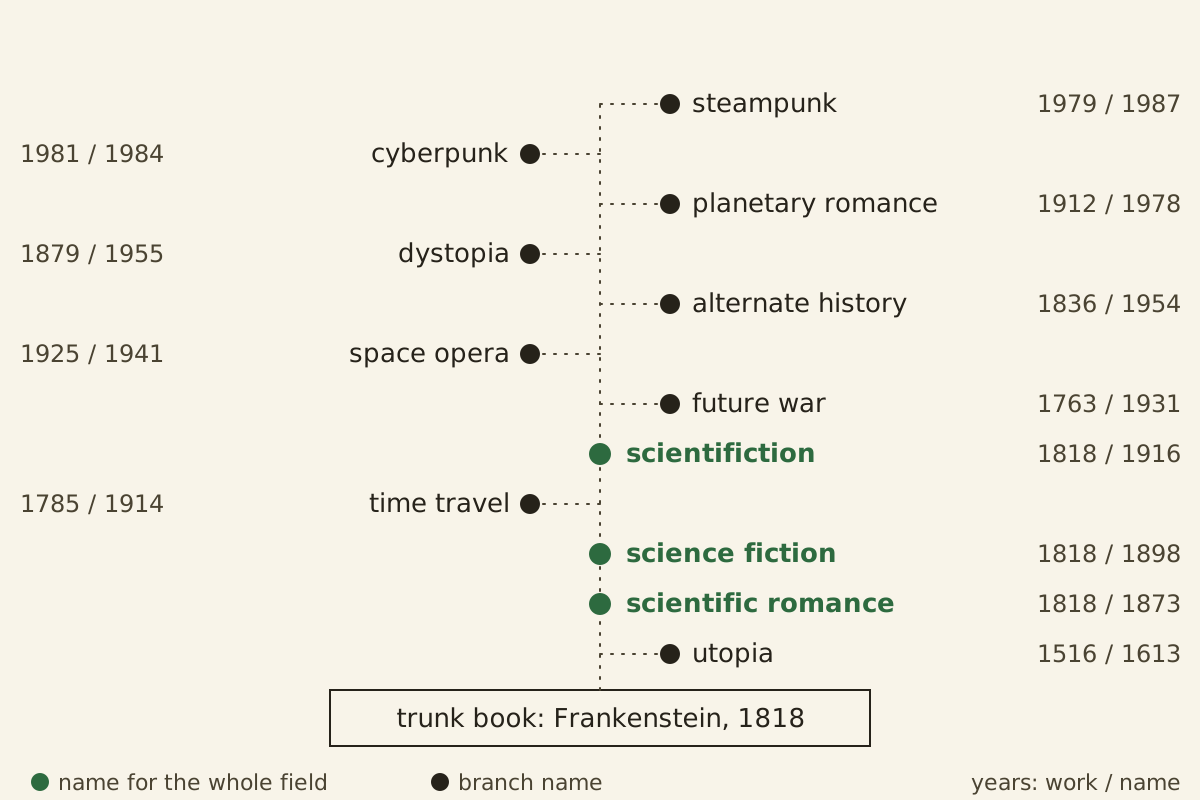
Dated tree of science fiction names — three names for the whole field on the trunk and nine branch names beside it, ordered from the bottom by the year of each name's first record in HDSF.
Dated tree of science fiction names · Genre Fiction Lineage · CC BY 4.0
Reuse credit (CC BY)
"Dated tree of science fiction names" by Genre Fiction Lineage, https://genrefictionlineage.com/science-fiction/subgenres/, licensed under CC BY 4.0 (https://creativecommons.org/licenses/by/4.0/)
Name dates from the citation lines and research notes of the Historical Dictionary of Science Fiction, ed. Jesse Sheidlower (sfdictionary.com); work dates from The Encyclopedia of Science Fiction, eds. John Clute, David Langford and Graham Sleight (sf-encyclopedia.com); entries listed on the entry page
Bruce Bethke's story “Cyberpunk” ran in Amazing Stories for November 1983. The dictionary (HDSF) brackets that printing as a title, and its first entry for the word as a name for a kind of fiction is Gardner Dozois's article in the Washington Post Book World of 30 December 1984. SFE's entry on William Gibson dates the Dozois article to 1983, so the two references disagree by a year. All 12 rows, with both dates and a source for each, are in a CSV of the 12 science fiction names CSV · provenance note Name dates from the citation lines and research notes of the Historical Dictionary of Science Fiction, ed. Jesse Sheidlower (sfdictionary.com); work dates from The Encyclopedia of Science Fiction, eds. John Clute, David Langford and Graham Sleight (sf-encyclopedia.com); entries listed on the entry page.
Which subgenre names came after the books?
Each branch row pairs the earliest work that The Encyclopedia of Science Fiction (SFE) presents as a clear example of that branch with the earliest dated record in the HDSF entry for its name. Both are the earliest known dates. A find in older print would move either one.
In this site's terms, each book is the patient-zero text for its row: the earliest known printing inside one stated range, here the works named in one SFE entry. It is not a claim that later books came from it. Three names cover the whole field, so they share one trunk book, Frankenstein (1818), whose two texts are set side by side in Frankenstein, 1818 and 1831 (for comparison). Brian W. Aldiss called it science fiction's first novel in 1973, as SFE reports, and SFE disputes that claim.
| Name | Work (year) | Name in HDSF (year) | Years between |
|---|---|---|---|
| utopia | More, Utopia (1516) | 1613 | 97 |
| scientific romance | Frankenstein (1818) | 1873 | 55 |
| science fiction | Frankenstein (1818) | 1898 | 80 |
| time travel | Wessel, Anno 7603 (1785) | 1914 | 129 |
| scientifiction | Frankenstein (1818) | 1916 | 98 |
| future war | The Reign of George VI, 1900–1925 (1763) | 1931 | 168 |
| space opera | Dyalhis, “When the Green Star Waned” (1925) | 1941 | 16 |
| alternate history | Geoffroy, Napoléon et la conquête du monde (1836) | 1954 | 118 |
| dystopia | Verne, Les 500 Millions de la Bégum (1879) | 1955 | 76 |
| planetary romance | Burroughs, “Under the Moons of Mars” (1912) | 1978 | 66 |
| cyberpunk | Gibson, “Johnny Mnemonic” (1981) | 1984 | 3 |
| steampunk | Jeter, Morlock Night (1979) | 1987 | 8 |
By HDSF's dates, every name in the table came after its book. Six rows also have an earlier printed use of the word, found in SFE or in HDSF's notes on another sense, and the CSV keeps those in their own columns. Counted from the earliest known printed use instead, 10 of the 12 names still came two or more years after the book. The two exceptions are utopia, which More coined as the title of his Latin book in 1516, and dystopia, where John Stuart Mill's “dys-topians” (12 March 1868) came nearly eleven years before Verne's 1879 serial.
How far apart are book and name?
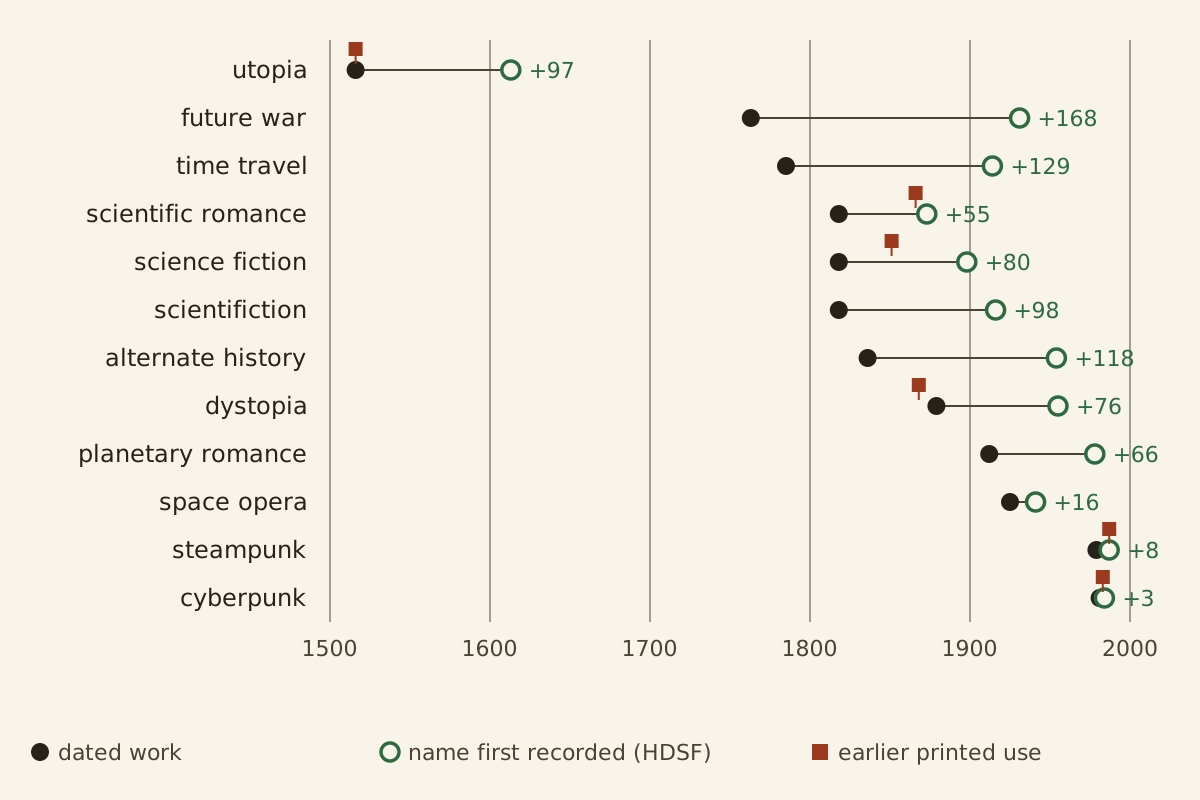
Book to name, in years — each row runs from the dated work to the name's first record in HDSF, with a square where an earlier printed use of the word is known.
Book to name, in years · Genre Fiction Lineage · CC BY 4.0
Reuse credit (CC BY)
"Book to name, in years" by Genre Fiction Lineage, https://genrefictionlineage.com/science-fiction/subgenres/, licensed under CC BY 4.0 (https://creativecommons.org/licenses/by/4.0/)
Name dates from the citation lines and research notes of the Historical Dictionary of Science Fiction, ed. Jesse Sheidlower (sfdictionary.com); work dates from The Encyclopedia of Science Fiction, eds. John Clute, David Langford and Graham Sleight (sf-encyclopedia.com); entries listed on the entry page
The widest gap belongs to future war. An anonymous pamphlet of 1763, The Reign of George VI, 1900–1925, imagined wars to come, and HDSF's first line for the phrase is an editorial note in Wonder Stories for May 1931, 168 years later. The time-travel row, which The Time Machine (for comparison) takes up in full, runs from Johan Herman Wessel's play Anno 7603 (1785) to a philosophy journal of 1914. Even that 1914 line names the activity rather than a kind of story.
The two narrowest gaps are both 1980s names. Gibson's “Johnny Mnemonic” ran in Omni in May 1981, and SFE counts it among the early stories of what was soon called cyberpunk. K. W. Jeter's Morlock Night (1979) was eight years ahead of HDSF's first steampunk line, a Locus interview of May 1987.
Space opera sits in between. SFE gives Nictzin Dyalhis's “When the Green Star Waned” (Weird Tales, April 1925) as an early story the term fits, and dates E. E. Smith's The Skylark of Space to Amazing Stories for August to October 1928. HDSF's first record of the name is a fan magazine, Le Zombie no. 36, January 1941, where Wilson Tucker offered “space opera” as a label for stale spaceship stories. In the genre sense, HDSF's first dystopia line is C. S. Lewis in 1955, a few years after the 1950s magazine serials in Dystopian Novels in Print Order (for comparison).
Where do the names come from?
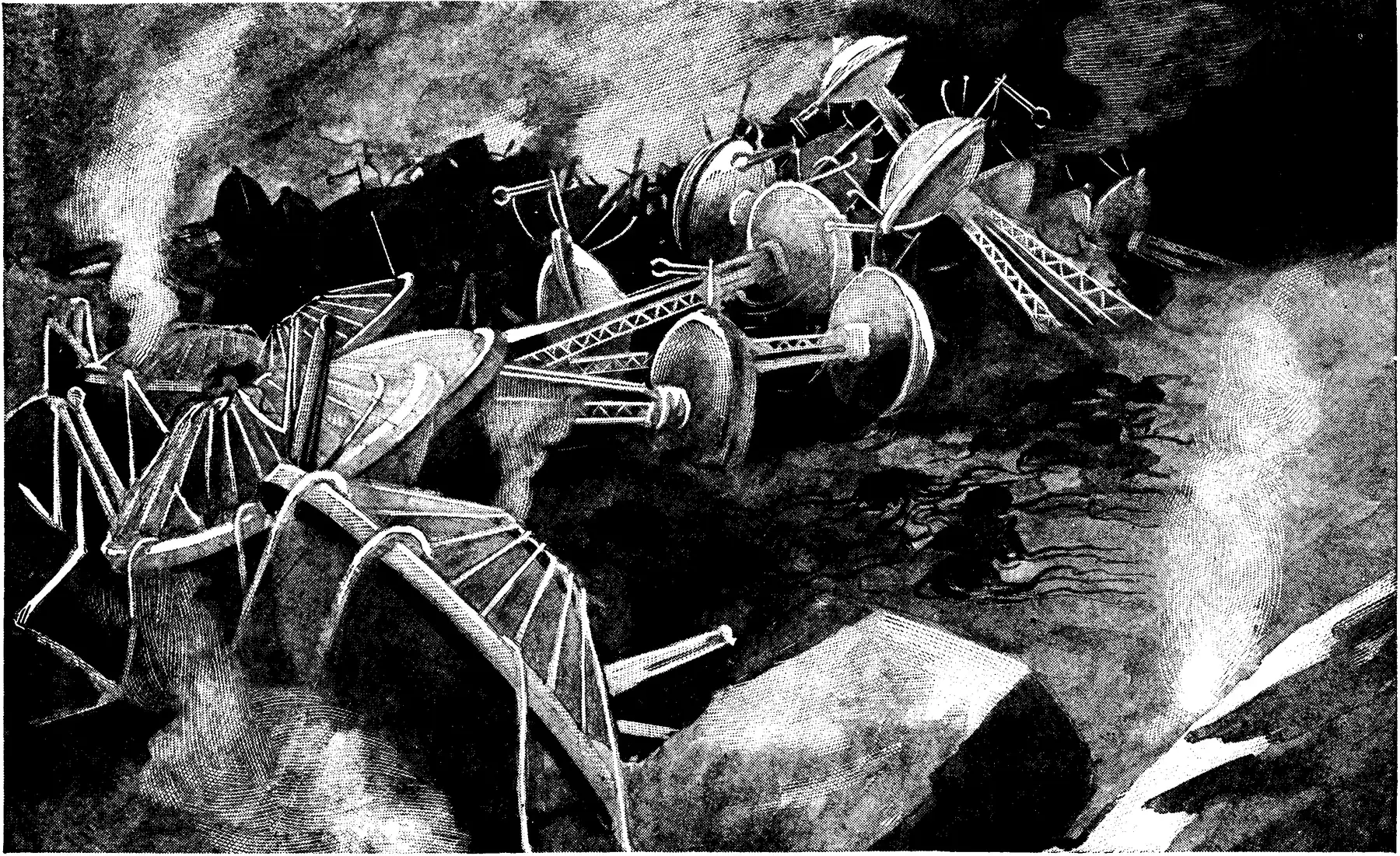
The War of the Worlds, page 279 — Warwick Goble's plate of heaped Martian machines in the 1898 Harper edition of the novel described in HDSF's first genre citation for “science fiction.”
The War of the Worlds, page 279 · Warwick Goble · public domain
Full credit
"The War of the Worlds, page 279" by Warwick Goble, 1898 — https://commons.wikimedia.org/wiki/File:War_of_the_Worlds_pg_279.png — Public domain (US: published 1898 (Harper); Germany and France: Goble died 1943 (dates on the Commons file page of the whole 1898 book), so 70 years after death ran out at the end of 2013 (Germany: UrhG §64; France: CPI L123-1, general rule, not checked against Légifrance); a British illustrator, so the French 'mort pour la France' extension is not considered (general knowledge, not checked); Wells (died 1946) is the author of the text, not the image)
Few of these names began inside the books themselves: HDSF's first line for “science-fiction” in the genre sense is a note in the Bulletin of Pharmacy for October 1898, about a new H. G. Wells romance of a Martian conquest of the earth, a description that fits The War of the Worlds. SFE dates The War of the Worlds to Pearson's Magazine, April to December 1897, with the book in 1898. A pharmaceutical trade journal therefore attached the genre's name to its author 18 months after the serial began.
The other names come from similar places. Hugo Gernsback printed “scientifiction” in Electrical Experimenter in January 1916, and SFE notes that he later dated the coinage to 1915. Russell Letson's introduction to a 1978 reprint fixed “planetary romance,” and SFE credits him with establishing the term. For steampunk, SFE attributes the coinage to Jeter's own letter in the April 1987 Locus.
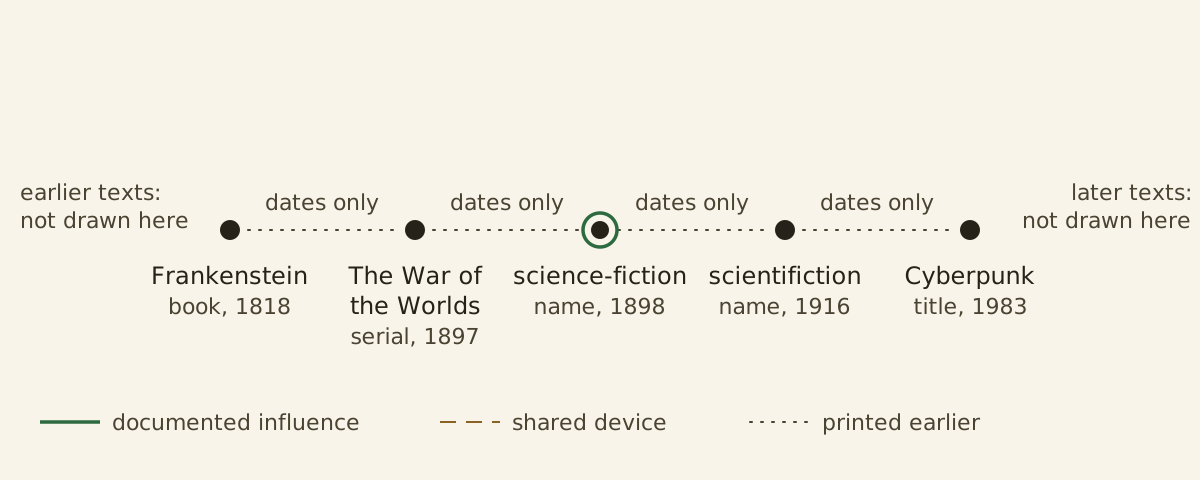
- Solid: documented influence (the later author's own statement, letter, review or note)
- Dashed: shared device (similar texts, no borrowing claimed)
- Dotted: dates only (publication order or other dates; no link claimed)
Lineage strip — two texts and three names in print order, from the trunk book of 1818 to the 1983 story title, with every line resting on dates alone.
Lineage strip: Frankenstein (1818) to the title Cyberpunk (1983) · Genre Fiction Lineage · CC BY 4.0
Reuse credit (CC BY)
"Lineage strip: Frankenstein (1818) to the title Cyberpunk (1983)" by Genre Fiction Lineage, https://genrefictionlineage.com/science-fiction/subgenres/, licensed under CC BY 4.0 (https://creativecommons.org/licenses/by/4.0/)
Name dates from the citation lines and research notes of the Historical Dictionary of Science Fiction, ed. Jesse Sheidlower (sfdictionary.com); work dates from The Encyclopedia of Science Fiction, eds. John Clute, David Langford and Graham Sleight (sf-encyclopedia.com); entries listed on the entry page
None of these links is drawn as influence. The 1898 note shows the label being applied to Wells after the novel appeared, which is a record of naming, not a link between books. The five nodes on the strip come from a CSV of the lineage strip CSV · provenance note Name dates from the citation lines and research notes of the Historical Dictionary of Science Fiction, ed. Jesse Sheidlower (sfdictionary.com); work dates from The Encyclopedia of Science Fiction, eds. John Clute, David Langford and Graham Sleight (sf-encyclopedia.com); entries listed on the entry page.
Sources
- 1“cyberpunk,” Historical Dictionary of Science Fiction, ed. Jesse Sheidlower, https://sfdictionary.com/view/208/cyberpunk, accessed 2 November 2026 https://sfdictionary.com/view/208/cyberpunkRead: entry page; citation lines read, 1983 Bethke title line (bracketed) and first line Dozois, Washington Post Book World, 30 December 1984, p. 9
- 2“Cyberpunk,” in John Clute, David Langford and Graham Sleight (eds), The Encyclopedia of Science Fiction, https://sf-encyclopedia.com/entry/cyberpunk, accessed 2 November 2026 https://sf-encyclopedia.com/entry/cyberpunkRead: full entry
- 3“Gibson, William,” in John Clute, David Langford and Graham Sleight (eds), The Encyclopedia of Science Fiction, https://sf-encyclopedia.com/entry/gibson_william, accessed 2 November 2026 https://sf-encyclopedia.com/entry/gibson_williamRead: full entry
- 4“science fiction,” Historical Dictionary of Science Fiction, ed. Jesse Sheidlower, https://sfdictionary.com/view/209/science-fiction, accessed 2 November 2026 https://sfdictionary.com/view/209/science-fictionRead: entry page; citation lines read, bracketed 1851 Wilson and 1881 lines; first genre-sense line, Bulletin of Pharmacy, vol. 12, no. 10, October 1898, p. 466, and the note it quotes (a new Wells romance of a Martian conquest); editorial note on H. B. Mason
- 5“scientific romance,” Historical Dictionary of Science Fiction, ed. Jesse Sheidlower, https://sfdictionary.com/view/1690/scientific-romance, accessed 2 November 2026 https://sfdictionary.com/view/1690/scientific-romanceRead: entry page; citation lines read, first line 1873, Towle's translation of Marx's introduction to Verne, p. 12; research notes
- 6“Scientific Romance,” in John Clute, David Langford and Graham Sleight (eds), The Encyclopedia of Science Fiction, https://sf-encyclopedia.com/entry/scientific_romance, accessed 2 November 2026 https://sf-encyclopedia.com/entry/scientific_romanceRead: full entry
- 7“scientifiction,” Historical Dictionary of Science Fiction, ed. Jesse Sheidlower, https://sfdictionary.com/view/104/scientifiction, accessed 2 November 2026 https://sfdictionary.com/view/104/scientifictionRead: entry page; citation lines read, first line, Gernsback, Electrical Experimenter, January 1916, p. 474
- 8“Scientifiction,” in John Clute, David Langford and Graham Sleight (eds), The Encyclopedia of Science Fiction, https://sf-encyclopedia.com/entry/scientifiction, accessed 2 November 2026 https://sf-encyclopedia.com/entry/scientifictionRead: full entry
- 9John Clute, "Shelley, Mary Wollstonecraft," in John Clute, David Langford and Graham Sleight (eds), The Encyclopedia of Science Fiction, https://sf-encyclopedia.com/entry/shelley_mary_wollstonecraft, accessed 2 November 2026 https://sf-encyclopedia.com/entry/shelley_mary_wollstonecraftRead: full entry (entry updated 24 August 2026), including the checklist
- 10“utopia,” Historical Dictionary of Science Fiction, ed. Jesse Sheidlower, https://sfdictionary.com/view/174/utopia, accessed 2 November 2026 https://sfdictionary.com/view/174/utopiaRead: entry page; citation lines read, research details only (no citation lines shown): antedating 1613, earliest cite Samuel Purchas, Pilgrimage
- 11"Utopias," in John Clute, David Langford and Graham Sleight (eds), The Encyclopedia of Science Fiction, https://sf-encyclopedia.com/entry/utopias, accessed 2 November 2026 (entry updated 16 March 2026) https://sf-encyclopedia.com/entry/utopiasRead: full entry
- 12Universal Short Title Catalogue, USTC 400360: Thomas More, Libellus vere aureus nec minus salutaris quam festivus de optimo reipublicae statu, deque nova insula Utopia (Louvain: Thierry Martens, 1516) https://www.ustc.ac.uk/editions/400360Read: bibliographic record only
- 13“dystopia,” Historical Dictionary of Science Fiction, ed. Jesse Sheidlower, https://sfdictionary.com/view/159/dystopia, accessed 2 November 2026 https://sfdictionary.com/view/159/dystopiaRead: entry page; citation lines read, first line, C. S. Lewis, "George Orwell" (1955), in On Stories (1982), p. 104; sense n. 2
- 14Brian Stableford, "Dystopias," in John Clute, David Langford and Graham Sleight (eds), The Encyclopedia of Science Fiction https://sf-encyclopedia.com/entry/dystopiasRead: full entry (updated 27 July 2026)
- 15UK Parliament, Hansard, "State of Ireland. Adjourned Debate," HC Deb 12 March 1868, vol 190, cc1459–549 (speech of John Stuart Mill) https://api.parliament.uk/historic-hansard/commons/1868/mar/12/adjourned-debateRead: full debate page
- 16“future war,” Historical Dictionary of Science Fiction, ed. Jesse Sheidlower, https://sfdictionary.com/view/163/future-war, accessed 2 November 2026 https://sfdictionary.com/view/163/future-warRead: entry page; citation lines read, first line, Wonder Stories, May 1931, p. 1442 (inset); 1966 I. F. Clarke line on The Reign of George VI (1763); research note
- 17“Future War,” in John Clute, David Langford and Graham Sleight (eds), The Encyclopedia of Science Fiction, https://sf-encyclopedia.com/entry/future_war, accessed 2 November 2026 https://sf-encyclopedia.com/entry/future_warRead: full entry
- 18“time travel,” Historical Dictionary of Science Fiction, ed. Jesse Sheidlower, https://sfdictionary.com/view/130/time-travel, accessed 2 November 2026 https://sfdictionary.com/view/130/time-travelRead: entry page; citation lines read, first line, W. B. Pitkin, Journal of Philosophy, Psychology and Scientific Methods, 10 September 1914, p. 524
- 19Brian Stableford, Malcolm J Edwards and David Langford, "Time Travel," in John Clute, David Langford and Graham Sleight (eds), The Encyclopedia of Science Fiction https://sf-encyclopedia.com/entry/time_travelRead: full entry (updated 31 August 2026)
- 20“alternate history,” Historical Dictionary of Science Fiction, ed. Jesse Sheidlower, https://sfdictionary.com/view/157/alternate-history, accessed 2 November 2026 https://sfdictionary.com/view/157/alternate-historyRead: entry page; citation lines read, first line, Magazine of Fantasy & Science Fiction, February 1954, p. 40 (no quotation shown)
- 21“Alternate History,” in John Clute, David Langford and Graham Sleight (eds), The Encyclopedia of Science Fiction, https://sf-encyclopedia.com/entry/alternate_history, accessed 2 November 2026 https://sf-encyclopedia.com/entry/alternate_historyRead: full entry
- 22“planetary romance,” Historical Dictionary of Science Fiction, ed. Jesse Sheidlower, https://sfdictionary.com/view/169/planetary-romance, accessed 2 November 2026 https://sfdictionary.com/view/169/planetary-romanceRead: entry page; citation lines read, first line, Russell Letson, introduction to Farmer, The Green Odyssey (1978), p. v
- 23“Planetary Romance,” in John Clute, David Langford and Graham Sleight (eds), The Encyclopedia of Science Fiction, https://sf-encyclopedia.com/entry/planetary_romance, accessed 2 November 2026 https://sf-encyclopedia.com/entry/planetary_romanceRead: full entry
- 24“Burroughs, Edgar Rice,” in John Clute, David Langford and Graham Sleight (eds), The Encyclopedia of Science Fiction, https://sf-encyclopedia.com/entry/burroughs_edgar_rice, accessed 2 November 2026 https://sf-encyclopedia.com/entry/burroughs_edgar_riceRead: full entry
- 25“space opera,” Historical Dictionary of Science Fiction, ed. Jesse Sheidlower, https://sfdictionary.com/view/215/space-opera, accessed 2 November 2026 https://sfdictionary.com/view/215/space-operaRead: entry page; citation lines read, first line, 'B. Tucker', Depts of the Interior, Le Zombie no. 36, January 1941, unpaged; the linked page image was not opened
- 26“Space Opera,” in John Clute, David Langford and Graham Sleight (eds), The Encyclopedia of Science Fiction, https://sf-encyclopedia.com/entry/space_opera, accessed 2 November 2026 https://sf-encyclopedia.com/entry/space_operaRead: full entry
- 27“steampunk,” Historical Dictionary of Science Fiction, ed. Jesse Sheidlower, https://sfdictionary.com/view/594/steampunk, accessed 2 November 2026 https://sfdictionary.com/view/594/steampunkRead: entry page; citation lines read, first lines, Locus, May 1987, pp. 56 and 57 (interview with James P. Blaylock)
- 28“Steampunk,” in John Clute, David Langford and Graham Sleight (eds), The Encyclopedia of Science Fiction, https://sf-encyclopedia.com/entry/steampunk, accessed 2 November 2026 https://sf-encyclopedia.com/entry/steampunkRead: full entry
- 29“Jeter, K W,” in John Clute, David Langford and Graham Sleight (eds), The Encyclopedia of Science Fiction, https://sf-encyclopedia.com/entry/jeter_k_w, accessed 2 November 2026 https://sf-encyclopedia.com/entry/jeter_k_wRead: entry head and the Morlock Night paragraph (entry updated 12 September 2022)
- 30John Clute and Brian Stableford, "Wells, H G," in John Clute, David Langford and Graham Sleight (eds), The Encyclopedia of Science Fiction https://sf-encyclopedia.com/entry/wells_h_gRead: full entry
- 31Warwick Goble, plate on page 279 of H. G. Wells, The War of the Worlds (New York and London: Harper and Brothers, 1898), Wikimedia Commons file War_of_the_Worlds_pg_279.png (scan from Internet Archive item warofworlds1898well) https://commons.wikimedia.org/wiki/File:War_of_the_Worlds_pg_279.pngRead: file page and original file; file page of the whole-book War_of_the_Worlds.djvu for the illustrator credit
- 32Jennifer Jenkins and James Boyle, "Public Domain Day 2026," Center for the Study of the Public Domain, Duke Law School https://web.law.duke.edu/cspd/publicdomainday/2026/Read: full pageText licence: CC BY 4.0
- 33Urheberrechtsgesetz § 64 (Allgemeines), gesetze-im-internet.de https://www.gesetze-im-internet.de/urhg/__64.htmlRead: full text of the section

Cite this page
Genre Fiction Lineage. “Science Fiction Subgenres: Most of 12 Names Came After Books.” Genre Fiction Lineage, published 3 November 2026. https://genrefictionlineage.com/science-fiction/subgenres/. Accessed [the date you read it].
Next shelf over:
- The Time Machine: the time-travel branch, with the machines that were in print before Wells's 1895 book (for comparison).
- Space Opera: one name opened up, from its January 1941 fan-magazine record to the stories it now covers (for comparison).
- Read the text: The War of the Worlds (1898), Project Gutenberg
Related entries
More from Science Fiction.
Lineage essay
The Time Machine: Gaspar's Time Ship Was in Print by 1887
Enrique Gaspar's El anacronópete put a time machine in print in Barcelona in 1887, eight years before Wells. Ten time-travel stories to 1895, dated, with a CSV.
Picture credit
Illustration: Genre Fiction Lineage. Generated scene illustration — not a book illustration, photograph or historical record. No copyright is claimed in the generated imagery; if you reuse it, please credit "Genre Fiction Lineage".
Edition comparison
Frankenstein: In the 1818 Text, Elizabeth Is Victor's Cousin
In the 1818 Frankenstein, Elizabeth is Victor's first cousin; in the 1831 text she is a Milanese nobleman's daughter. Thirteen passages compared side by side.
Picture credit
"Frankenstein observing the first stirrings of his creature" by Wellcome Collection, 1831 — https://commons.wikimedia.org/wiki/File:Frankenstein_observing_the_first_stirrings_of_his_creature._Wellcome_L0027125.jpg — CC BY 4.0 (https://creativecommons.org/licenses/by/4.0/)

Catalogue entry
Space Opera: Earliest Known Printed English Use, 1941
The earliest known use of “space opera” is in a January 1941 fan magazine, per the Historical Dictionary of Science Fiction. The stories it names came first.
Picture credit
Illustration: Genre Fiction Lineage. Generated scene illustration — not a book illustration, photograph or historical record. No copyright is claimed in the generated imagery; if you reuse it, please credit "Genre Fiction Lineage".