Science Fiction · Catalogue entry
Space Opera: Earliest Known Printed English Use, 1941
Genre Fiction Lineage Published
According to the Historical Dictionary of Science Fiction (HDSF), “space opera” is first recorded in Le Zombie, January 1941. The Encyclopedia of Science Fiction (SFE) credits Wilson Tucker with proposing the term that year, as a put-down for worn-out spaceship stories.
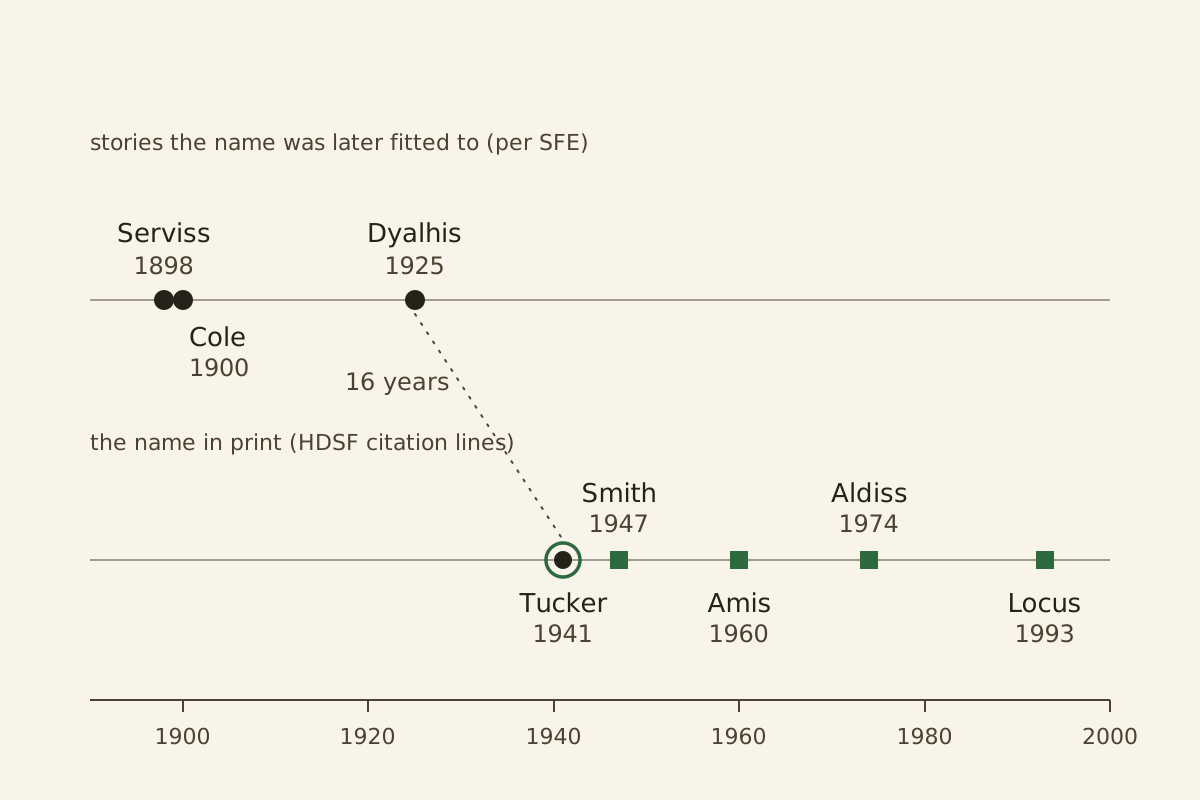
Stories first, name later — the top line holds three stories that SFE fits to the label, and the bottom line holds dated uses of the name recorded by HDSF, from Tucker in 1941 to a 1993 issue of Locus.
Stories first, name later · Genre Fiction Lineage · CC BY 4.0
Reuse credit (CC BY)
"Stories first, name later" by Genre Fiction Lineage, https://genrefictionlineage.com/science-fiction/space-opera/, licensed under CC BY 4.0 (https://creativecommons.org/licenses/by/4.0/)
Dated uses of the name from the citation lines of the Historical Dictionary of Science Fiction, ed. Jesse Sheidlower (sfdictionary.com); stories and placements from The Encyclopedia of Science Fiction, eds. John Clute, David Langford and Graham Sleight (sf-encyclopedia.com), paraphrased; entries listed on the entry page
The stories came first. SFE names Nictzin Dyalhis's “When the Green Star Waned” (Weird Tales, April 1925) as an early story the label suits, nearly 16 years before the name, and says the label can be stretched back, in hindsight, to a newspaper serial of 1898. The dated uses of the name are in a CSV of the name's dated uses CSV · provenance note Dated uses of the name from the citation lines of the Historical Dictionary of Science Fiction, ed. Jesse Sheidlower (sfdictionary.com); stories and placements from The Encyclopedia of Science Fiction, eds. John Clute, David Langford and Graham Sleight (sf-encyclopedia.com), paraphrased; entries listed on the entry page, and the stories are in a CSV of the stories SFE fits to the name CSV · provenance note Dated uses of the name from the citation lines of the Historical Dictionary of Science Fiction, ed. Jesse Sheidlower (sfdictionary.com); stories and placements from The Encyclopedia of Science Fiction, eds. John Clute, David Langford and Graham Sleight (sf-encyclopedia.com), paraphrased; entries listed on the entry page.
When was “space opera” first used?
HDSF's earliest citation is a single bibliographic line: 1941, “B. Tucker,” a piece headed “Depts of the Interior,” Le Zombie no. 36, January, unpaged. Le Zombie was a fan magazine, an amateur paper made by readers rather than by a publisher. SFE calls it the most notable of Tucker's own fan magazines, and says it ran to 67 issues between 1938 and 1975.
Wilson Tucker (1914–2006) went on to write novels, and SFE notes that some of his early stories were signed Bob Tucker, which fits the “B.” in the HDSF line. The 1941 issue itself was not consulted for this page. Its number and month come from the HDSF line, and SFE gives the same year.
HDSF treats the 1941 line as what appears to be the first coinage, and its research notes still ask for anything earlier. That is why this page calls January 1941 the earliest known use of the English term in print, not a proven first.
Why did Tucker call it an opera?
The name borrowed a pattern. SFE explains that Westerns had been called horse operas since the 1920s, and that daytime radio serials, many of them paid for by makers of soap powder, had been called soap operas since 1938.
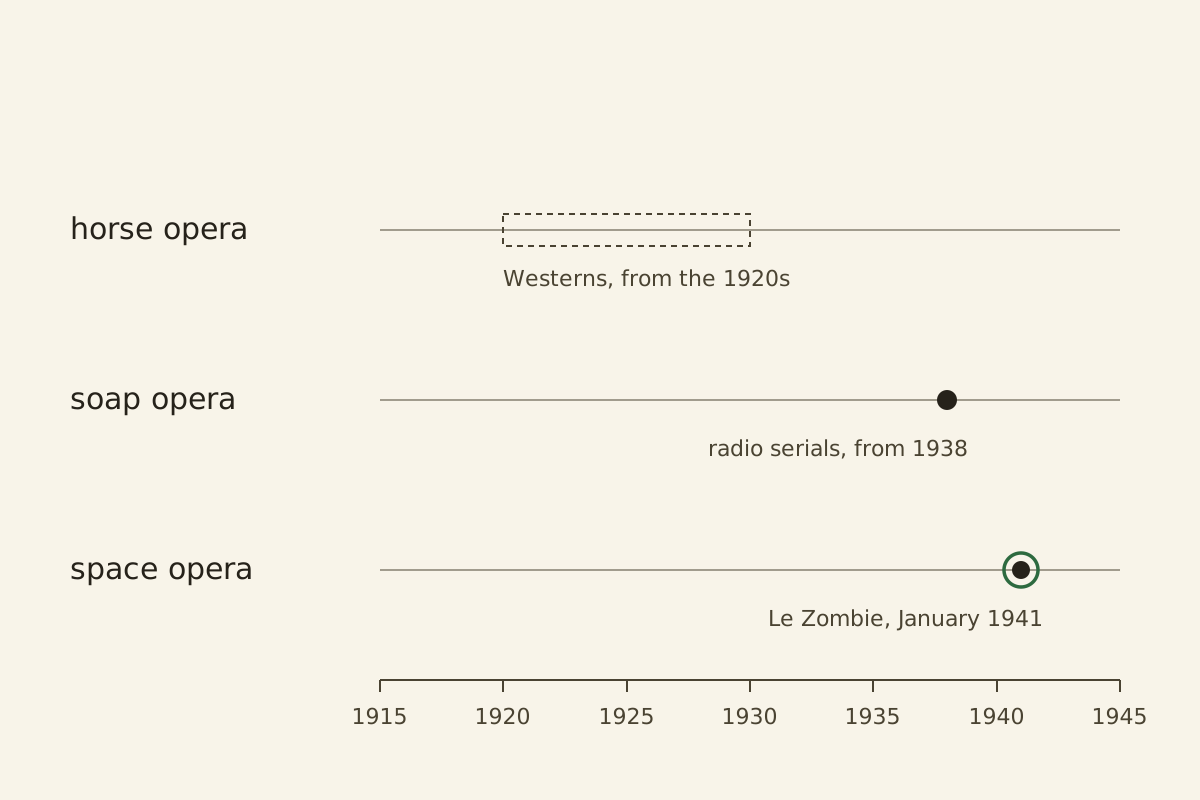
Three opera names — horse opera for Westerns from the 1920s and soap opera for radio serials from 1938, both dated by SFE, then space opera in January 1941, dated by HDSF.
Three opera names · Genre Fiction Lineage · CC BY 4.0
Reuse credit (CC BY)
"Three opera names" by Genre Fiction Lineage, https://genrefictionlineage.com/science-fiction/space-opera/, licensed under CC BY 4.0 (https://creativecommons.org/licenses/by/4.0/)
Dated uses of the name from the citation lines of the Historical Dictionary of Science Fiction, ed. Jesse Sheidlower (sfdictionary.com); stories and placements from The Encyclopedia of Science Fiction, eds. John Clute, David Langford and Graham Sleight (sf-encyclopedia.com), paraphrased; entries listed on the entry page
Tucker's note, as HDSF quotes it, sets space opera beside those two older names and offers it for the tired, formulaic spaceship story. The term began as a complaint. SFE reads it the same way, calling the 1941 coinage a complaint about the clichés of the pulps, the cheap fiction magazines printed on rough wood-pulp paper.

An old-style rocket — an illustration of the kind of spaceship story the name space opera was coined for in 1941, not a magazine cover.
Illustration: Genre Fiction Lineage. Generated scene illustration — not a book illustration, photograph or historical record. No copyright is claimed in the generated imagery; if you reuse it, please credit "Genre Fiction Lineage".
From Tucker, this page quotes only the two words “space opera”; his 1941 note is still protected in Germany and France. The rest of his sentence is described, not copied.
Which stories does the name cover?
SFE applies the name in two steps. First, it says the label could be laid back over early space adventures such as Garrett P. Serviss's Edison's Conquest of Mars and Robert W. Cole's The Struggle for Empire (1900). Serviss's story was a serial, a story printed in parts, and it ran in the New York Evening Journal under the title The Conquest of Mars from 12 January to 10 February 1898. SFE adds that it may hold the earliest battle between spaceships in fiction.
Then SFE narrows the label. Because the name began as a complaint about pulp formula, SFE prefers to keep it for genre science fiction, the kind sold in specialist magazines. It names Dyalhis's “When the Green Star Waned” (Weird Tales, April 1925) as an early story the term suits better.
| Story | First printed | How SFE places it | Calendar years to 1941 |
|---|---|---|---|
| Serviss, Edison's Conquest of Mars (serial title The Conquest of Mars) | New York Evening Journal, 12 January to 10 February 1898 | fitted to the name in hindsight | 43 |
| Cole, The Struggle for Empire | London: Elliot Stock, 1900 | fitted to the name in hindsight | 41 |
| Dyalhis, “When the Green Star Waned” | Weird Tales, April 1925 | an early story the name fits better | 16 |
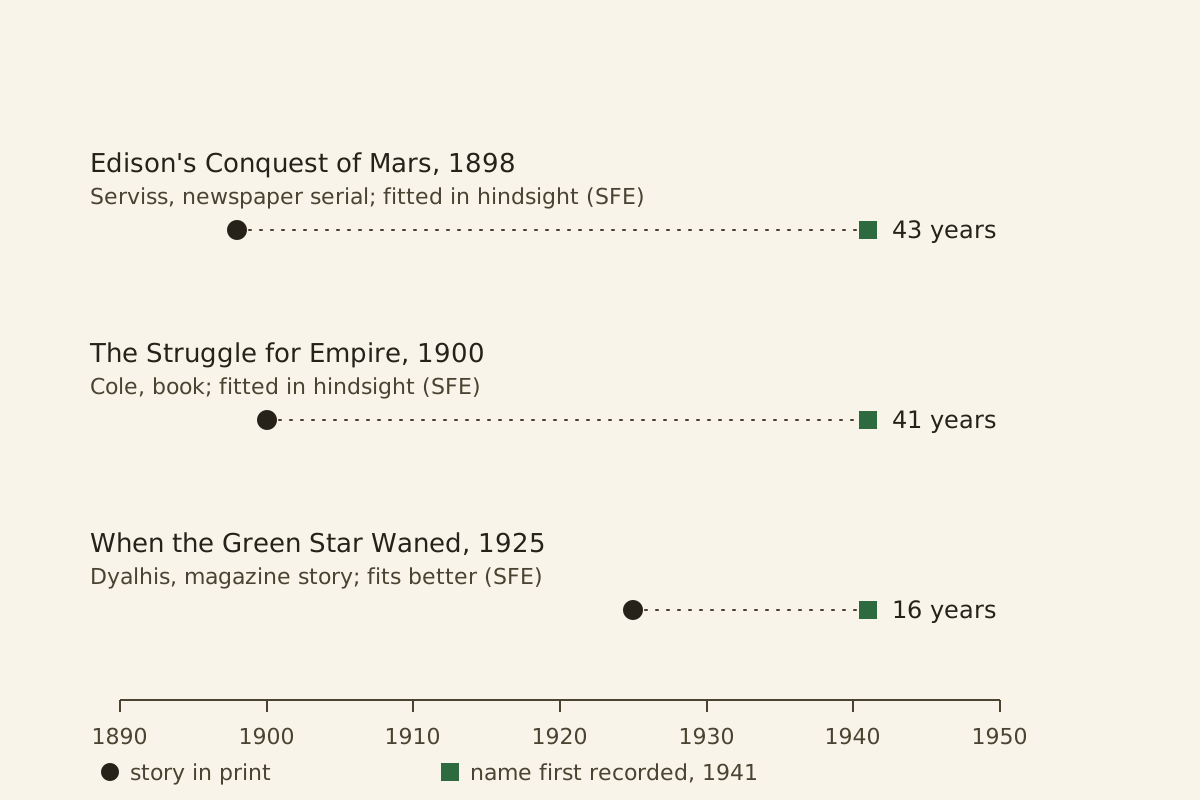
Story to name, in calendar years — each line runs from the year a story was first printed to 1941, the year of the name's first use recorded by HDSF.
Story to name, in calendar years · Genre Fiction Lineage · CC BY 4.0
Reuse credit (CC BY)
"Story to name, in calendar years" by Genre Fiction Lineage, https://genrefictionlineage.com/science-fiction/space-opera/, licensed under CC BY 4.0 (https://creativecommons.org/licenses/by/4.0/)
Dated uses of the name from the citation lines of the Historical Dictionary of Science Fiction, ed. Jesse Sheidlower (sfdictionary.com); stories and placements from The Encyclopedia of Science Fiction, eds. John Clute, David Langford and Graham Sleight (sf-encyclopedia.com), paraphrased; entries listed on the entry page
So any claim about the “first space opera” needs a limit. Within the magazine fiction SFE prefers, Dyalhis's 1925 story is the early example it names, while among all the stories the SFE entry fits to the label, Serviss's 1898 serial comes earliest, and only in hindsight.
E. E. Smith's The Skylark of Space, written with Lee Hawkins Garby, ran in Amazing Stories from August to October 1928, a little over 12 years before the name. SFE says Smith wrote it between 1915 and 1920. The unsigned editors' introduction at the head of the 1928 serial used other words, calling it “the greatest interplanetarian and space flying story that has appeared this year.”
How did the term's sense change?
SFE says the name was soon used for colourful adventure stories of war between planets or star systems, rather than for the stale stories Tucker had in mind. It adds that the term keeps a faint sneer today but is often used with fond nostalgia.
The later HDSF lines show both moods. In 1947, in an essay called “The Epic of Space” in Of Worlds Beyond, a book of essays edited by Lloyd Arthur Eshbach, Smith himself wrote “space-operas” while arguing that most of them fail on logic and motive. Kingsley Amis, in New Maps of Hell (1960), still compared “space-opera” to the horse opera, a Western moved to Mars.
By 1974 Brian W. Aldiss had used Space Opera as the title of an anthology, a book of stories by several writers. In June 1993 Locus called a writer's space operas thoughtful. SFE's history of the stories turns in the 1950s, when the old-style space adventure had come to seem juvenile but lived on in the cheaper pulps. In 1952 Galaxy began “Gravy Planet,” a serial SFE calls a satire, one of the rows in Dystopian Novels in Print Order (for comparison).
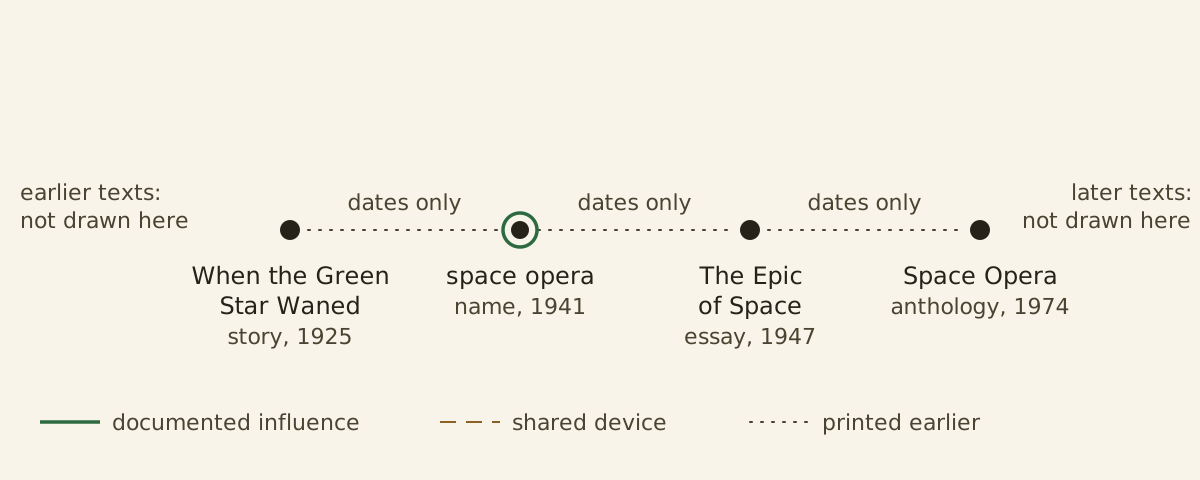
- Solid: documented influence (the later author's own statement, letter, review or note)
- Dashed: shared device (similar texts, no borrowing claimed)
- Dotted: dates only (publication order or other dates; no link claimed)
Lineage strip — a 1925 story, the 1941 name, Smith's 1947 essay and Aldiss's 1974 anthology in print order, with every line resting on dates alone.
Lineage strip: When the Green Star Waned (1925) to Space Opera (1974) · Genre Fiction Lineage · CC BY 4.0
Reuse credit (CC BY)
"Lineage strip: When the Green Star Waned (1925) to Space Opera (1974)" by Genre Fiction Lineage, https://genrefictionlineage.com/science-fiction/space-opera/, licensed under CC BY 4.0 (https://creativecommons.org/licenses/by/4.0/)
Dated uses of the name from the citation lines of the Historical Dictionary of Science Fiction, ed. Jesse Sheidlower (sfdictionary.com); stories and placements from The Encyclopedia of Science Fiction, eds. John Clute, David Langford and Graham Sleight (sf-encyclopedia.com), paraphrased; entries listed on the entry page
None of these links is drawn as influence. The HDSF quotation from Smith's essay shows the word, not where Smith found it. SFE's view that Dyalhis's story shaped later space operas is the encyclopedia's judgment, not a statement by a later author, so the strip records print order only. Its four nodes are in a CSV of the lineage strip CSV · provenance note Dated uses of the name from the citation lines of the Historical Dictionary of Science Fiction, ed. Jesse Sheidlower (sfdictionary.com); stories and placements from The Encyclopedia of Science Fiction, eds. John Clute, David Langford and Graham Sleight (sf-encyclopedia.com), paraphrased; entries listed on the entry page.
Sources
- 1“space opera,” Historical Dictionary of Science Fiction, ed. Jesse Sheidlower, https://sfdictionary.com/view/215/space-opera, accessed 3 November 2026 https://sfdictionary.com/view/215/space-operaRead: entry page, all citation lines and research notes; first line 'B. Tucker', Depts of the Interior, Le Zombie (#36), January 1941, unpaged; later lines used: E. E. Smith 1947 (Of Worlds Beyond, p. 78), K. Amis 1960 (New Maps of Hell, ch. ii, p. 44), B. Aldiss 1974 (Space Opera, introduction, p. 9), Locus June 1993 (p. 5); the linked page image of Le Zombie was not opened
- 2Brian Stableford and David Langford, “Space Opera,” in John Clute, David Langford and Graham Sleight (eds), The Encyclopedia of Science Fiction, https://sf-encyclopedia.com/entry/space_opera, accessed 3 November 2026 https://sf-encyclopedia.com/entry/space_operaRead: full entry (updated 24 August 2026)
- 3John Clute, Peter Nicholls and David Langford, “Tucker, Wilson,” in John Clute, David Langford and Graham Sleight (eds), The Encyclopedia of Science Fiction, https://sf-encyclopedia.com/entry/tucker_wilson, accessed 3 November 2026 https://sf-encyclopedia.com/entry/tucker_wilsonRead: full entry
- 4John Clute and Malcolm Edwards, “Serviss, Garrett P,” in John Clute, David Langford and Graham Sleight (eds), The Encyclopedia of Science Fiction, https://sf-encyclopedia.com/entry/serviss_garrett_p, accessed 3 November 2026 https://sf-encyclopedia.com/entry/serviss_garrett_pRead: full entry
- 5John Clute, “Cole, Robert W,” in John Clute, David Langford and Graham Sleight (eds), The Encyclopedia of Science Fiction, https://sf-encyclopedia.com/entry/cole_robert_w, accessed 3 November 2026 https://sf-encyclopedia.com/entry/cole_robert_wRead: full entry
- 6David Langford, “Dyalhis, Nictzin,” in John Clute, David Langford and Graham Sleight (eds), The Encyclopedia of Science Fiction, https://sf-encyclopedia.com/entry/dyalhis_nictzin, accessed 3 November 2026 https://sf-encyclopedia.com/entry/dyalhis_nictzinRead: full entry
- 7John Clute, “Smith, E E,” in John Clute, David Langford and Graham Sleight (eds), The Encyclopedia of Science Fiction, https://sf-encyclopedia.com/entry/smith_e_e, accessed 3 November 2026 https://sf-encyclopedia.com/entry/smith_e_eRead: full entry
- 8Edward Elmer Smith, in collaboration with Lee Hawkins Garby, The Skylark of Space, Project Gutenberg eBook #20869, https://www.gutenberg.org/ebooks/20869 (source: Amazing Stories, August, September and October 1928) https://www.gutenberg.org/ebooks/20869Read: front matter, transcriber's note, editors' introduction and chapter I
- 9Garrett P. Serviss, Edison's Conquest of Mars, Project Gutenberg eBook #19141, https://www.gutenberg.org/ebooks/19141 (source edition not stated; dated 1898 in the text) https://www.gutenberg.org/ebooks/19141Read: front matter and opening of chapter I; reading link only, because the source edition is not stated (Project Gutenberg #21670, the 1947 Carcosa House book, was also checked)
- 10The Encyclopedia of Science Fiction, author entries for the 21 writers in the table (bibliographies and birth and death dates); each row of the CSV links its entry https://sf-encyclopedia.com/Read: full entries for all 21 writers
- 11Jennifer Jenkins and James Boyle, "Public Domain Day 2026," Center for the Study of the Public Domain, Duke Law School https://web.law.duke.edu/cspd/publicdomainday/2026/Read: full pageText licence: CC BY 4.0
- 12Urheberrechtsgesetz § 64 (Allgemeines), gesetze-im-internet.de https://www.gesetze-im-internet.de/urhg/__64.htmlRead: full text of the section
Cite this page
Genre Fiction Lineage. “Space Opera: Earliest Known Printed English Use, 1941.” Genre Fiction Lineage, published 3 November 2026. https://genrefictionlineage.com/science-fiction/space-opera/. Accessed [the date you read it].
Next shelf over:
- Science Fiction Subgenres: the full dated tree of science fiction names, where HDSF's first record of “science-fiction” in the genre sense dates from 1898 (for comparison).
- The Time Machine: machines built to travel in time, in print by 1887, one of the older branches on the same tree (printed earlier).
- Read the text: Edison's Conquest of Mars (1898), Project Gutenberg
Related entries
More from Science Fiction.
Lineage essay
The Time Machine: Gaspar's Time Ship Was in Print by 1887
Enrique Gaspar's El anacronópete put a time machine in print in Barcelona in 1887, eight years before Wells. Ten time-travel stories to 1895, dated, with a CSV.
Picture credit
Illustration: Genre Fiction Lineage. Generated scene illustration — not a book illustration, photograph or historical record. No copyright is claimed in the generated imagery; if you reuse it, please credit "Genre Fiction Lineage".
Edition comparison
Frankenstein: In the 1818 Text, Elizabeth Is Victor's Cousin
In the 1818 Frankenstein, Elizabeth is Victor's first cousin; in the 1831 text she is a Milanese nobleman's daughter. Thirteen passages compared side by side.
Picture credit
"Frankenstein observing the first stirrings of his creature" by Wellcome Collection, 1831 — https://commons.wikimedia.org/wiki/File:Frankenstein_observing_the_first_stirrings_of_his_creature._Wellcome_L0027125.jpg — CC BY 4.0 (https://creativecommons.org/licenses/by/4.0/)
Data page
Science Fiction Subgenres: Most of 12 Names Came After Books
Twelve science fiction names, from utopia to steampunk, each dated against an early work of its kind. Most of the names reached print years later.
Picture credit
"The War of the Worlds, page 279" by Warwick Goble, 1898 — https://commons.wikimedia.org/wiki/File:War_of_the_Worlds_pg_279.png — Public domain (US: published 1898 (Harper); Germany and France: Goble died 1943 (dates on the Commons file page of the whole 1898 book), so 70 years after death ran out at the end of 2013 (Germany: UrhG §64; France: CPI L123-1, general rule, not checked against Légifrance); a British illustrator, so the French 'mort pour la France' extension is not considered (general knowledge, not checked); Wells (died 1946) is the author of the text, not the image)