Fairy Tale Editions · Edition comparison
Snow White: In the 1812 Grimm Text, the Queen Is Her Mother
Genre Fiction Lineage Published
In the Grimms' first edition of 1812, the queen who wants Snow White dead is her own mother. In the second edition of 1819, that mother dies when the child is born, the king remarries after a year, and the jealous queen is a stepmother.
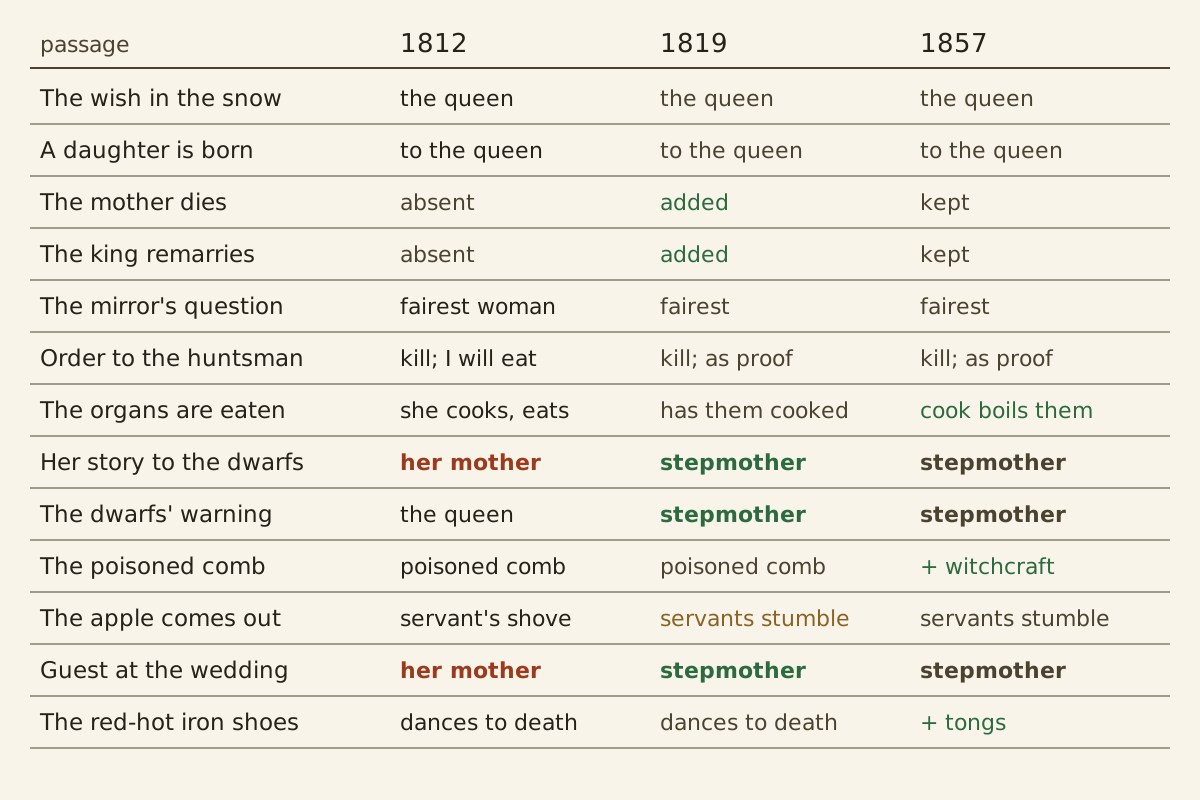
Thirteen passages, three editions — what the Grimms' 1812, 1819 and 1857 texts print at each point of the tale, from the wish in the snow to the iron shoes.
Snow White: thirteen passages in three Grimm editions, 1812–1857 · Genre Fiction Lineage · CC BY 4.0
Reuse credit (CC BY)
"Snow White: thirteen passages in three Grimm editions, 1812–1857" by Genre Fiction Lineage, https://genrefictionlineage.com/fairy-tales/snow-white/, licensed under CC BY 4.0 (https://creativecommons.org/licenses/by/4.0/)
Texts: Jacob and Wilhelm Grimm, Kinder- und Haus-Märchen, vol. 1 (Berlin, 1812), 2nd edition (Berlin, 1819) and 7th edition (Göttingen, 1857), No. 53, transcribed at German Wikisource
The mirror, the huntsman, the dwarfs, the poisoned apple and the red-hot iron shoes are in all three texts. Those texts are the Berlin first edition of 1812, the Berlin second edition of 1819 and the seventh edition, published in Göttingen in 1857, so the later two came 7 and 45 years after 1812. Each passage, with the German, an English translation and its page, is in the CSV of 13 passages in three editions CSV · provenance note Texts: Jacob and Wilhelm Grimm, Kinder- und Haus-Märchen, vol. 1 (Berlin, 1812), 2nd edition (Berlin, 1819) and 7th edition (Göttingen, 1857), No. 53, transcribed at German Wikisource.
Who is the queen in the 1812 text?
The tale is No. 53 in the first volume of Kinder- und Haus-Märchen, published in Berlin by the Realschulbuchhandlung with the year 1812 on its title page, on pages 238 to 250. It opens in winter with a queen sewing at a window framed in black ebony. She pricks her finger, three drops of blood fall on the snow, and she thinks “hätt ich doch ein Kind so weiß wie Schnee, so roth wie Blut und so schwarz wie dieser Rahmen” (“if only I had a child as white as snow, as red as blood and as black as this frame”; Genre Fiction Lineage translation). The next sentence begins “Und bald darauf bekam sie ein Töchterlein” (and soon afterwards she had a little daughter; Genre Fiction Lineage translation).
Nothing in the 1812 text replaces her. The same queen owns the mirror, and when it names the seven-year-old girl as fairer, she calls a huntsman: “da stichs todt, und zum Wahrzeichen bring mir seine Lunge und seine Leber mit, die will ich mit Salz kochen und essen.” In English: “stab her dead there, and as proof bring me her lungs and her liver, which I will cook with salt and eat” (Genre Fiction Lineage translation). The huntsman spares the girl and kills a young boar instead, and the queen cooks and eats its lungs and liver.
The text names the relationship twice more: on page 242, where the girl tells the dwarfs “wie seine Mutter es habe wollen umbringen” (how her mother had wanted to kill her), and on page 249, where “Sneewittchens gottlose Mutter” (Snow White's godless mother; both Genre Fiction Lineage translations) is invited to the wedding. In the 2,442 words of the 1812 tale, Mutter (mother) appears twice and Stiefmutter (stepmother) not at all.
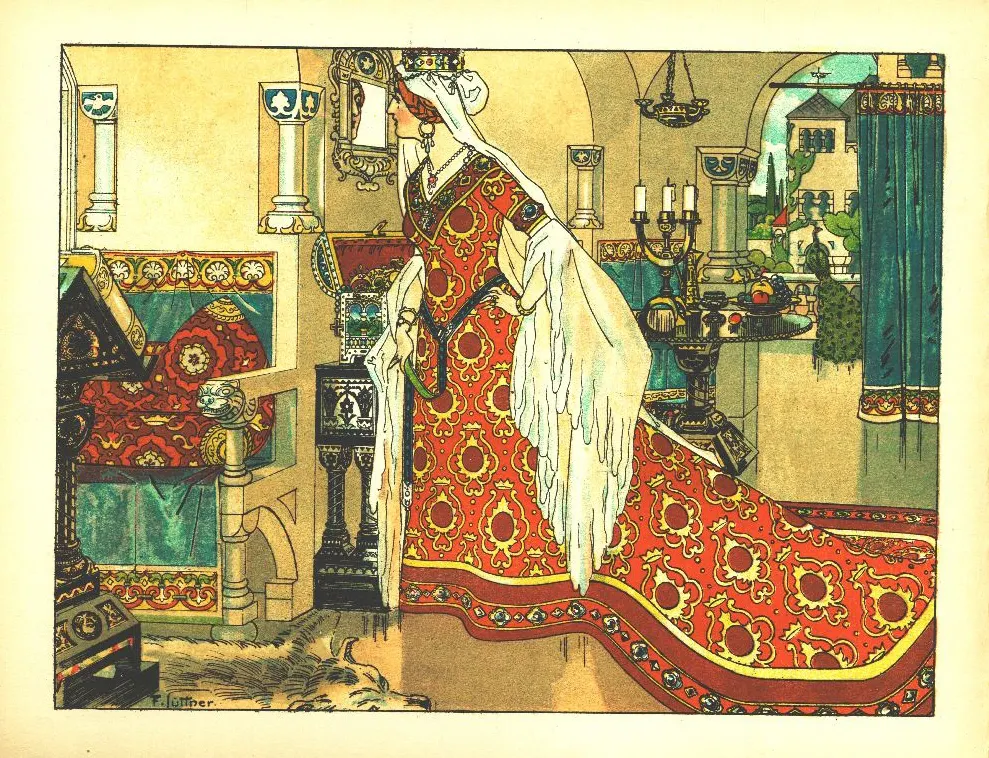
The queen at her mirror — Franz Jüttner's plate for a Mainz picture book of about 1905 to 1910, signed F. Jüttner; the book's own text is not compared on this page.
The queen at her mirror · Franz Jüttner · public domain
Full credit
"The queen at her mirror" by Franz Jüttner, 1905 — https://commons.wikimedia.org/wiki/File:Franz_J%C3%BCttner_Schneewittchen_1.jpg — Public domain (US: published in Mainz between 1905 and 1910 (Commons file page), before 1931; Germany and France: Jüttner died 1926 (GND), so 70 years after death have run out; he was German, so the French died-for-France extension is not assessed (not checked))
Naming the edition before quoting it is the rule this site also follows in dystopian novels in print order (for comparison). In this tale it matters from the first page, because the opening paragraph sets the queen's place in the family.
What changed in 1819?
The second edition came out in Berlin from G. Reimer, and its title page reads “Zweite vermehrte und verbesserte Auflage” (second enlarged and improved edition; Genre Fiction Lineage translation). Seven years after 1812, Sneewittchen is still No. 53, now on pages 262 to 274. The wish, the drops of blood and the birth stay, and then come two new sentences: “Und wie das Kind geboren war, starb die Königin. Ueber ein Jahr nahm sich der König eine andere Gemahlin.” In English: “and when the child was born, the queen died; after a year the king took another wife” (Genre Fiction Lineage translation).
From that point the queen with the mirror is the second wife, and where the 1812 text had Mutter, in the girl's story to the dwarfs and at the wedding, the 1819 text has Stiefmutter. The dwarfs' warning, which in 1812 named only “der Königin” (the queen), becomes “hüt dich vor deiner Stiefmutter” (beware of your stepmother; both Genre Fiction Lineage translations).
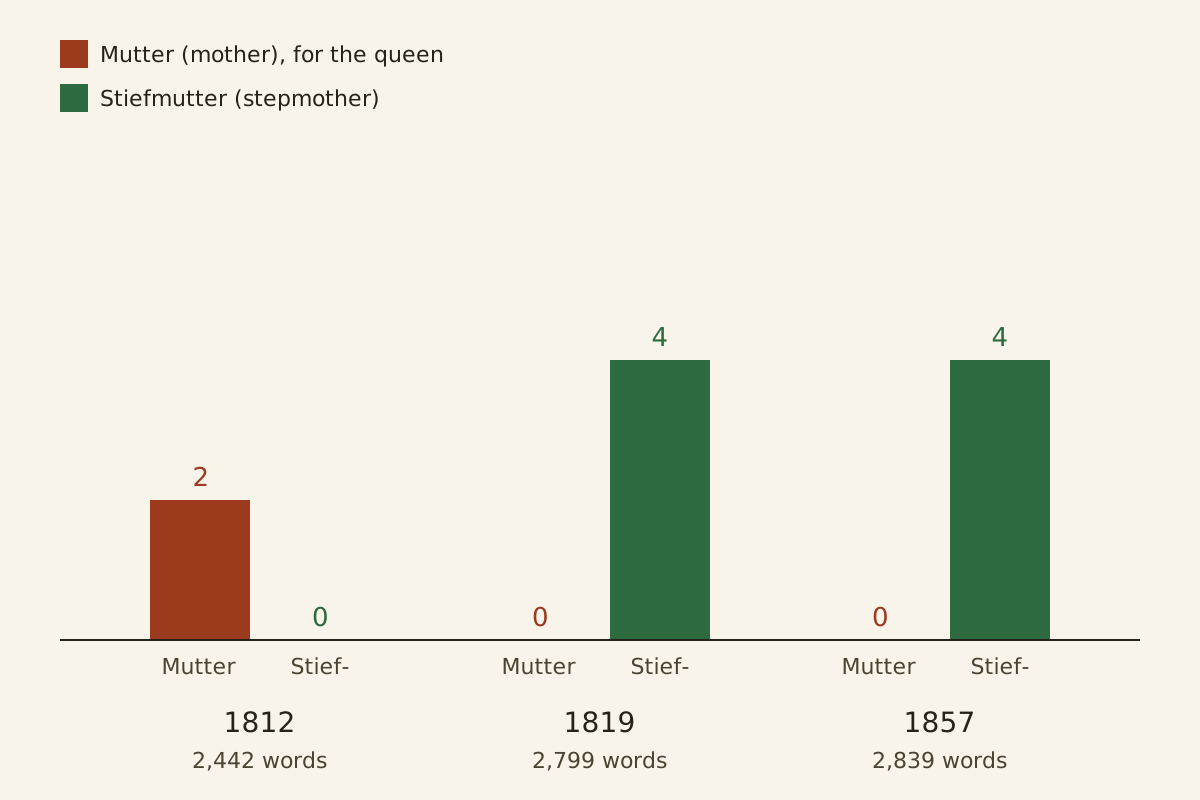
Mother and stepmother — how often each edition's text of the tale uses Mutter and Stiefmutter, with the length of each text in words.
Snow White: Mutter and Stiefmutter in three Grimm editions · Genre Fiction Lineage · CC BY 4.0
Reuse credit (CC BY)
"Snow White: Mutter and Stiefmutter in three Grimm editions" by Genre Fiction Lineage, https://genrefictionlineage.com/fairy-tales/snow-white/, licensed under CC BY 4.0 (https://creativecommons.org/licenses/by/4.0/)
Texts: Jacob and Wilhelm Grimm, Kinder- und Haus-Märchen, vol. 1 (Berlin, 1812), 2nd edition (Berlin, 1819) and 7th edition (Göttingen, 1857), No. 53, transcribed at German Wikisource
Across the tale, Mutter drops from two uses to none and Stiefmutter rises from none to four, while the text grows from 2,442 to 2,799 words. The counts leave out the heading and the notes, and the CSV of word counts in three editions CSV · provenance note Texts: Jacob and Wilhelm Grimm, Kinder- und Haus-Märchen, vol. 1 (Berlin, 1812), 2nd edition (Berlin, 1819) and 7th edition (Göttingen, 1857), No. 53, transcribed at German Wikisource gives the counting rule. The table sets the changed passages side by side; the English is the site's own, and the German is in the passages CSV.
That CSV sorts each later passage by its kind of change: added, relation changed, mechanism changed, wording or same. The order to the huntsman is a wording row. Its words change, but no person, object or event comes or goes. The other second-edition passages, which change only in wording or stay the same, such as the wish and the comb, are left out of the table but are in the CSV.
| Passage | Grimm 1812 | Grimm 1819 |
|---|---|---|
| The queen's death | absent | the queen dies at the birth (p. 263) |
| The king remarries | absent | after a year he takes another wife (p. 263) |
| Order to the huntsman | kill her; bring lungs and liver, “which I will cook with salt and eat” (p. 239) | kill her; bring lungs and liver as proof (p. 264) |
| Her story to the dwarfs | her mother wanted to kill her (p. 242) | her stepmother wanted to kill her (pp. 266–267) |
| The dwarfs' warning | beware of the queen (p. 242) | beware of your stepmother (p. 267) |
| The apple comes out | a servant shoves her in the back (p. 249) | the servants stumble over a bush (p. 273) |
| Guest at the wedding | her godless mother (p. 249) | her godless stepmother (p. 273) |
One change in 1819 has nothing to do with the family. In 1812 a servant, angry at carrying the coffin about all day, lifts the dead girl out and “gab ihm mit der Hand einen Stumpf in den Rücken” (gave her a shove in the back with his hand; Genre Fiction Lineage translation), and the bite of apple flies out of her throat. In 1819 the prince's servants, carrying the coffin on their shoulders, stumble over a bush. The jolt does the same work.
What stayed the same?
Most of the tale's working parts are in both texts: the queen asks her mirror seven times in each, the huntsman spares the girl, the dwarfs take her in, and the queen comes three times in disguise, with laces, a poisoned comb and a poisoned apple. The glass coffin with her name in gold letters is in both, and so is the ending, in which the queen must dance in red-hot iron slippers until she is dead.
The 1819 queen still eats what she believes are the girl's organs; her order no longer says she will, but a later sentence reports it: “Die ließ sie in ihrer Gier gleich in Salz kochen, aß sie auf,” in her greed she had them boiled in salt at once and ate them up (Genre Fiction Lineage translation). The killing order, the eating and the death in the iron shoes all pass from the mother of 1812 to the stepmother of 1819.
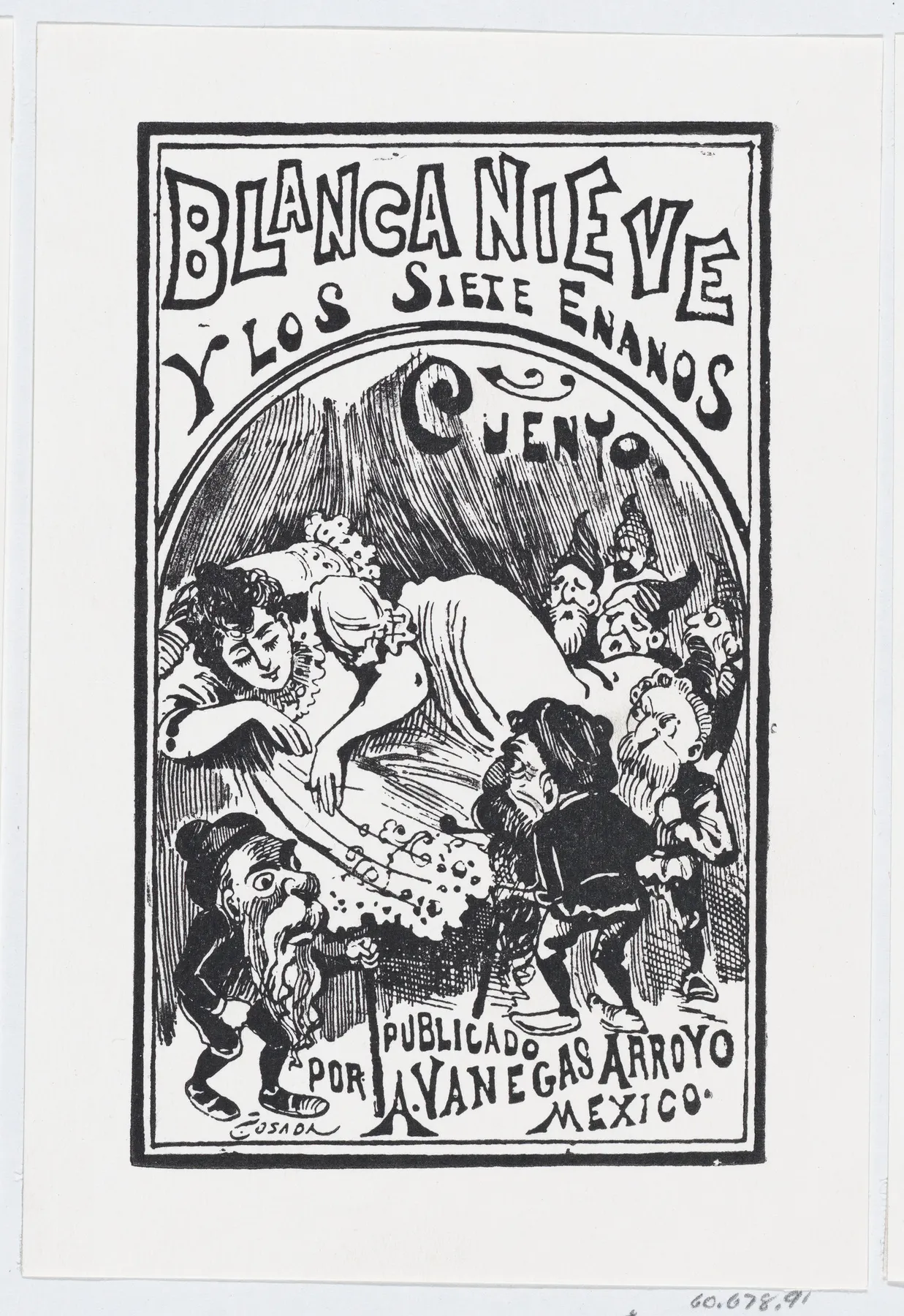
Blanca Nieve y los siete enanos — José Guadalupe Posada's cover for a booklet published in Mexico City by Antonio Vanegas Arroyo, dated by the Metropolitan Museum of Art about 1900 to 1910.
"Blanca Nieve y los siete enanos" by José Guadalupe Posada, 1900 — https://commons.wikimedia.org/wiki/File:Snow_White_and_the_Seven_Dwarfs_MET_DP869499.jpg — CC0 1.0 (https://creativecommons.org/publicdomain/zero/1.0/)
Posada's cover belongs to a later popular printing in Spanish, and the booklet's text is not read for this page; the illustration shows the dwarfs gathered round the sleeping girl, a scene that both Grimm texts print.
Did the Grimms say why they changed it?
Not in the texts this page read. The 1819 preface does make two general statements about the revision. On page VIII the editors write “Dabei haben wir jeden für das Kinderalter nicht passenden Ausdruck in dieser neuen Auflage sorgfältig gelöscht” (“in this new edition we have carefully deleted every expression not suited to childhood”; Genre Fiction Lineage translation). On page XIV they say the first volume is “fast ganz umgearbeitet” (almost entirely reworked; Genre Fiction Lineage translation), but neither passage names Sneewittchen or mentions mothers, so the preface cannot be read as the reason for this change.
The Grimms had recorded a stepmother telling by 1812. Their note to No. 53, printed at the back of the 1812 volume on pages XXXII to XXXIV, lists other tellings, and the one it calls a third begins “Ein König verliert seine Gemahlin, mit der er eine einzige Tochter Sneewittchen hat und nimmt eine andere” (a king loses his wife, with whom he has an only daughter, Snow White, and takes another; Genre Fiction Lineage translation). In that telling the new queen hates “das Stiefkind” (the stepchild; Genre Fiction Lineage translation). The note shows the Grimms knew such a telling, but it does not say that the 1819 text took its opening from it.
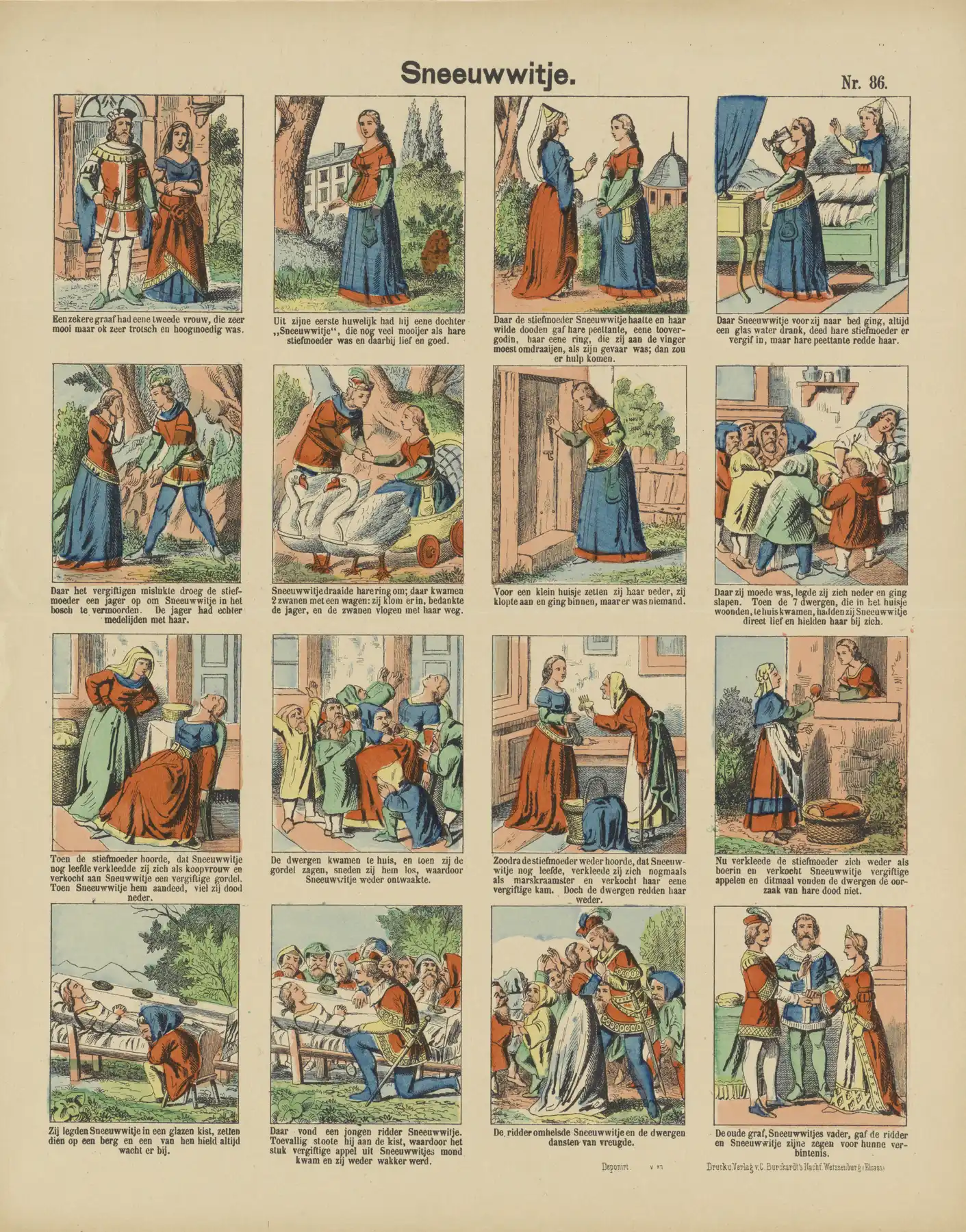
Sneeuwwitje, No. 86 — a hand-coloured sheet of sixteen pictures with Dutch captions by an anonymous printmaker, published in Wissembourg by C. Burckardt's successors and dated by the Rijksmuseum about 1889 to 1906.
"Sneeuwwitje, No. 86" by anonymous printmaker (published by C. Burckardt's successors), 1889 — https://commons.wikimedia.org/wiki/File:Sneeuwwitje_(titel_op_object),_RP-P-OB-200.892.jpg — CC0 1.0 (https://creativecommons.org/publicdomain/zero/1.0/)
The sheet tells a version of its own. Its first caption reads “Een zekere graaf had eene tweede vrouw” (a certain count had a second wife; Genre Fiction Lineage translation), while later panels add a godmother's ring and two swans that carry the girl away, none of which is in the three Grimm texts. It is one more printing with a stepmother, not evidence of where the Grimms' change came from.
Is the 1812 text darker?
The claim that the 1812 text is darker can be tested on this pair. On violence the two texts match: both queens order the killing, eat the organs they are brought, try three times to kill the girl and die dancing in red-hot shoes. What 1819 takes away is the killer's tie to the girl, a mother in 1812 and a stepmother afterwards, together with the servant's shove, which becomes a stumble. The result covers Sneewittchen in these two editions only.
What does the 1857 text keep?
The seventh edition, published in Göttingen by Dieterich with 1857 on its title page, keeps the 1819 family 45 years after 1812. The mother dies at the birth, the king remarries after a year, and Stiefmutter appears four times in 2,839 words. Four further editions came between 1819 and 1857, in 1837, 1840, 1843 and 1850, according to the Wikisource list of editions. This page does not compare them.
The 1857 text adds detail to the queen's attacks. She makes the comb “mit Hexenkünsten, die sie verstand” (with witchcraft, which she understood), a cook now boils the organs before “das boshafte Weib aß sie auf” (the wicked woman ate them up; both Genre Fiction Lineage translations), and the iron slippers are carried in with tongs. The servants' stumble and the glass coffin on the mountain stay as they were in 1819.
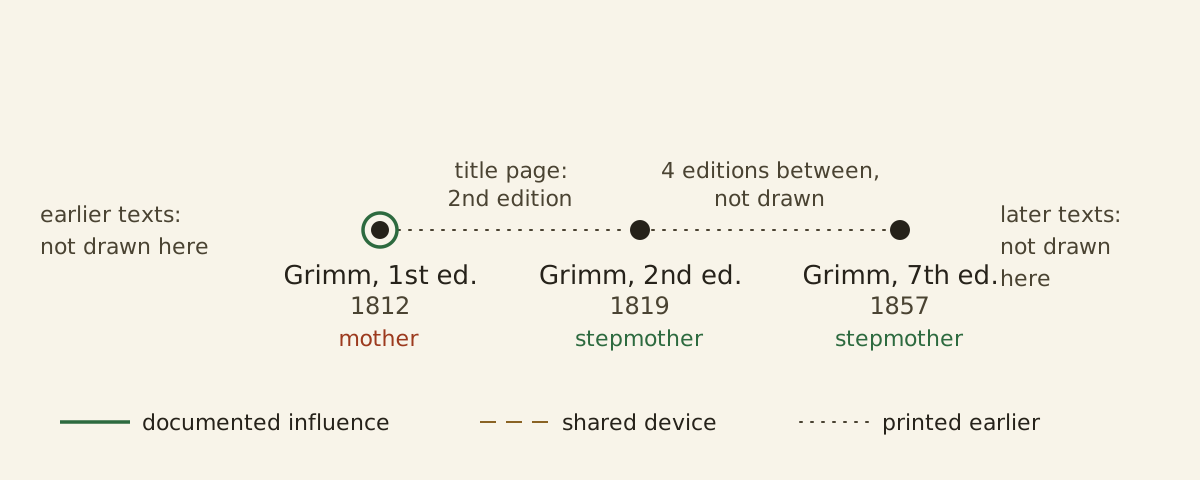
- Solid: documented influence (the later author's own statement, letter, review or note)
- Dashed: shared device (similar texts, no borrowing claimed)
- Dotted: dates only (publication order or other dates; no link claimed)
Lineage strip — three editions of one tale, joined by dotted lines for printing order; the 1819 title page calls the second edition enlarged and improved, and the four editions between 1819 and 1857 are not drawn.
Lineage strip: the Grimms' Sneewittchen, 1812–1857 · Genre Fiction Lineage · CC BY 4.0
Reuse credit (CC BY)
"Lineage strip: the Grimms' Sneewittchen, 1812–1857" by Genre Fiction Lineage, https://genrefictionlineage.com/fairy-tales/snow-white/, licensed under CC BY 4.0 (https://creativecommons.org/licenses/by/4.0/)
Texts: Jacob and Wilhelm Grimm, Kinder- und Haus-Märchen, vol. 1 (Berlin, 1812), 2nd edition (Berlin, 1819) and 7th edition (Göttingen, 1857), No. 53, transcribed at German Wikisource
The Grimms' note in their second volume, printed in Berlin in 1815, points further back. It says to compare Musäus's Richildis, “der den Reim etwas anders hat” (which has the rhyme somewhat differently; Genre Fiction Lineage translation), so the Grimms knew that text by 1815. Richildis is not read for this page, and the strip leaves it out. The links and their evidence are in the CSV of the lineage links CSV · provenance note Texts: Jacob and Wilhelm Grimm, Kinder- und Haus-Märchen, vol. 1 (Berlin, 1812), 2nd edition (Berlin, 1819) and 7th edition (Göttingen, 1857), No. 53, transcribed at German Wikisource.
Sources
- 1Jacob and Wilhelm Grimm, Kinder- und Haus-Märchen [vol. 1] (Berlin: Realschulbuchhandlung, 1812), title page, transcribed at Wikisource https://de.wikisource.org/wiki/Kinder-_und_Haus-M%C3%A4rchen_Band_1_(1812)Read: title page (transcribed from the scan page p_001; transcription checked twice against the scan)
- 2Jacob and Wilhelm Grimm, “Sneewittchen (Schneeweißchen),” No. 53, in Kinder- und Haus-Märchen, vol. 1 (Berlin, 1812), pp. 238–250, with the notes to No. 53 in vol. 1 (1812), pp. XXXII–XXXIV, and vol. 2 (1815), pp. LXVI–LXVII, transcribed at Wikisource https://de.wikisource.org/wiki/Sneewittchen_(Schneewei%C3%9Fchen)_(1812)Read: full text of the tale and both notes (transcription checked twice against the scan)
- 3Jacob and Wilhelm Grimm, Kinder- und Haus-Märchen, vol. 1, 2nd edition (Berlin: G. Reimer, 1819), title page and preface, transcribed at Wikisource https://de.wikisource.org/wiki/Kinder-_und_Haus-M%C3%A4rchen_Band_1_(1819)Read: title page and two sentences of the preface, pp. VIII and XIV (preface read in full for any mention of Sneewittchen; transcription checked twice against the scan)
- 4Jacob and Wilhelm Grimm, “Sneewittchen,” No. 53, in Kinder- und Haus-Märchen, vol. 1, 2nd edition (Berlin, 1819), pp. 262–274, transcribed at Wikisource https://de.wikisource.org/wiki/Sneewittchen_(1819)Read: full text of the tale (transcription checked twice against the scan)
- 5Jacob and Wilhelm Grimm, Kinder- und Hausmärchen, vol. 1, 7th edition (Göttingen: Dieterich, 1857), title page, transcribed at Wikisource https://de.wikisource.org/wiki/Kinder-_und_Haus-M%C3%A4rchen_Band_1_(1857)Read: title page (transcription checked twice against the scan)
- 6Jacob and Wilhelm Grimm, “Sneewittchen,” No. 53, in Kinder- und Hausmärchen, vol. 1, 7th edition (Göttingen, 1857), pp. 264–273, transcribed at Wikisource https://de.wikisource.org/wiki/Sneewittchen_(1857)Read: full text of the tale (transcription checked twice against the scan)
- 7“Schneewittchen,” list of the Grimms' editions of the tale, Wikisource https://de.wikisource.org/wiki/SchneewittchenRead: full page (an editors' list, used as a finding aid)
- 8Jacob and Wilhelm Grimm, Kinder- und Haus-Märchen, vol. 2 (Berlin: Realschulbuchhandlung, 1815), title page, transcribed at Wikisource https://de.wikisource.org/wiki/Kinder-_und_Haus-M%C3%A4rchen_Band_2_(1815)Read: title page
- 9Gemeinsame Normdatei (GND), Deutsche Nationalbibliothek, records for Jacob Grimm (118542257), Wilhelm Grimm (118542265), Franz Jüttner (117229156) and José Guadalupe Posada (11874156X), via lobid.org https://lobid.org/gnd/118542257Read: authority records (life dates)
- 10Jennifer Jenkins and James Boyle, "Public Domain Day 2026," Center for the Study of the Public Domain, Duke Law School https://web.law.duke.edu/cspd/publicdomainday/2026/Read: full pageText licence: CC BY 4.0
- 11Urheberrechtsgesetz § 64 (Allgemeines), gesetze-im-internet.de https://www.gesetze-im-internet.de/urhg/__64.htmlRead: full text of the section
Cite this page
Genre Fiction Lineage. “Snow White: In the 1812 Grimm Text, the Queen Is Her Mother.” Genre Fiction Lineage, published 3 November 2026. https://genrefictionlineage.com/fairy-tales/snow-white/. Accessed [the date you read it].
Next shelf over:
- Little Red Riding Hood: another tale from the same 1812 volume, where the Grimms' note names Perrault's 1697 text (printed earlier).
- Fairy Tales by Perrault and the Grimms: which of Perrault's 1697 tales the Grimms kept, edition by edition (printed earlier).
- Read the text: Sneewittchen (1812), Wikisource
Related entries
More from Fairy Tale Editions.
Lineage essay
Little Red Riding Hood: Perrault's 1697 Text Has No Hunter
Perrault's 1697 Little Red Riding Hood ends with the wolf eating her; the huntsman's rescue is in the Grimms' 1812 text. Three texts compared stage by stage.
Picture credit
"Little Red Riding Hood meets the wolf" by Gustave Doré, 1867 — https://commons.wikimedia.org/wiki/File:Little_Red_Riding_Hood_(136547615).jpg — Public domain (US: published in Paris in 1867; Germany and France: Doré died 1883 (GND), and the engraver signing Pannemaker was at work by 1867 (presumed out of copyright from his working years; first name and dates not checked), so 70 years after death have run out); modified: cropped from the full book page, desaturated and contrast adjusted on Wikimedia Commons before download
Edition comparison
Fairy Tales by Perrault: Matched Against Grimm, 1812 to 1857
Perrault's 1697 book has eight prose tales; the Grimms' notes pair seven with tales in their 1812 edition, and two of those are absent from 1819 to 1857.
Picture credit
"Puss in Boots by the river" by Gustave Doré, 1867 — https://commons.wikimedia.org/wiki/File:Puss_in_Boots_(136548352).jpg — Public domain (US: published in Paris in 1867; Germany and France: Doré died 1883 (GND), and the engraver signing Pannemaker was at work by 1867 (presumed out of copyright from his working years; first name and dates not checked), so 70 years after death have run out); modified: cropped from the full book page, desaturated and contrast adjusted on Wikimedia Commons before download
Lineage essay
Rapunzel: The Grimms' 1812 Note Names Schulz, Not La Force
The Grimms' 1812 note says Schulz told Rapunzel in 1790 from an oral source; a 1913 reference dates La Force's Persinette, with 14 of 17 stages alike, earlier.
Picture credit
"Rapunzel (eene soort salade), No. 69: the climb" by anonymous printmaker (published by C. Burckardt's successors), 1889 — https://commons.wikimedia.org/wiki/File:Rapunzel_(eene_soort_salade)_(titel_op_object),_RP-P-OB-200.889.jpg — CC0 1.0 (https://creativecommons.org/publicdomain/zero/1.0/); modified: one of the sixteen pictures cropped from the full sheet with its printed frame line, without its caption; no other change