Fairy Tale Editions · Lineage essay
Rapunzel: The Grimms' 1812 Note Names Schulz, Not La Force
Genre Fiction Lineage Published
The Grimms' 1812 Rapunzel note says Friedrich Schulz told the tale in 1790, without doubt from an oral source. Charlotte-Rose de La Force's French “Persinette,” sharing 14 of 17 plot stages compared here, was in print before them according to Bolte and Polívka (1913), so the claim that Rapunzel began as a French literary tale stands beside the Grimms' account.
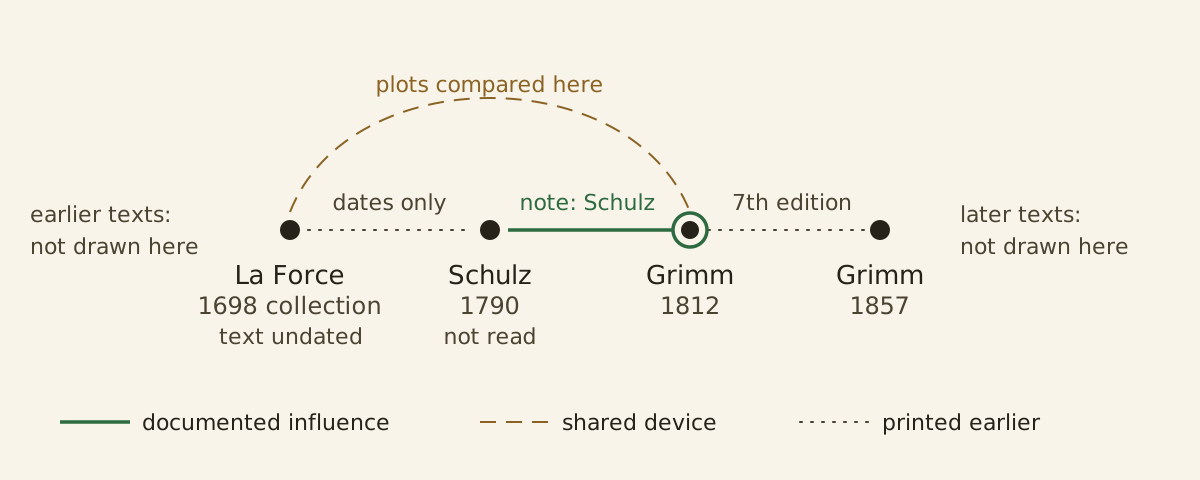
- Solid: documented influence (the later author's own statement, letter, review or note)
- Dashed: shared device (similar texts, no borrowing claimed)
- Dotted: dates only (publication order or other dates; no link claimed)
Lineage strip — four texts in print order; the solid line rests on the Grimms' 1812 note judging Schulz's telling, the dashed arc on the plot comparison below, and the dotted lines on dates alone.
Lineage strip: Persinette, Schulz, Grimm 1812 and 1857 · Genre Fiction Lineage · CC BY 4.0
Reuse credit (CC BY)
"Lineage strip: Persinette, Schulz, Grimm 1812 and 1857" by Genre Fiction Lineage, https://genrefictionlineage.com/fairy-tales/rapunzel/, licensed under CC BY 4.0 (https://creativecommons.org/licenses/by/4.0/)
Texts: Jacob and Wilhelm Grimm, Kinder- und Haus-Märchen, vol. 1 (Berlin, 1812), 2nd edition (Berlin, 1819) and 7th edition (Göttingen, 1857), No. 12, and the notes of 1812 and 1856, transcribed at German Wikisource; Charlotte-Rose de La Force, Persinette, in Les Fées, Contes des Contes (Amsterdam: Pierre Mortier, undated; 1711 per the Wikisource catalogue), transcribed at French Wikisource
Schulz's 1790 text, which could test both accounts, has not been read for this page. The text of “Persinette” read here comes from an Amsterdam printing by Pierre Mortier whose title page prints no year, and Wikisource catalogues it as 1711. Her collection Les contes des contes is recorded in the Universal Short Title Catalogue (USTC) under Paris, 1698, but that record lists no contents. Each link on the strip, with its evidence, is in the CSV of lineage links and their evidence CSV · provenance note Texts: Jacob and Wilhelm Grimm, Kinder- und Haus-Märchen, vol. 1 (Berlin, 1812), 2nd edition (Berlin, 1819) and 7th edition (Göttingen, 1857), No. 12, and the notes of 1812 and 1856, transcribed at German Wikisource; Charlotte-Rose de La Force, Persinette, in Les Fées, Contes des Contes (Amsterdam: Pierre Mortier, undated; 1711 per the Wikisource catalogue), transcribed at French Wikisource.
What did the Grimms say about Schulz in 1812?
The Grimms printed Rapunzel as No. 12 in the first volume of Kinder- und Haus-Märchen, published in Berlin by the Realschulbuchhandlung in 1812, on pages 38 to 43. Notes to the tales sit at the back of the volume; the one to No. 12 runs from page VIII to page IX. It opens with an Italian comparison: “im Pentamerone II, 1. (Petrosinella), wo vieles anders und besonders die zweite Hälfte lebendiger ist, als im deutschen Märchen” (“in the Pentamerone II, 1 (Petrosinella), where much is different and the second half especially is livelier than in the German tale”; Genre Fiction Lineage translation).
Then the note turns to a German predecessor: “Dieses hat schon Friedr. Schulz in s. kleinen Romanen Bd. 5. Lpz. 1790. S. 269-88. nur zu weitläuftig erzählt, wiewohl ohne Zweifel aus mündlicher Sage.” In English: “Friedr. Schulz already told this one in his Kleine Romane, vol. 5, Leipzig 1790, pp. 269–88, only at too great length, though without doubt from an oral source” (Genre Fiction Lineage translation). The next sentence adds, “Wie weit übertrifft es dennoch seine übrigen Märchen!” (“How far it still surpasses his other tales!”; Genre Fiction Lineage translation).
That note counts as written contact: the later editors give Schulz's book, volume, place, year and pages and judge his telling, too long but better than his other tales, so they had read it. On that basis this site's cataloguing rules draw Schulz to the Grimms as documented influence. The note does not say that the Grimms took their own text from Schulz, and it does not mention La Force. Between Schulz's volume and the Grimms' 1812 volume lie 22 years.
The same back-of-volume notes name a French author for another tale: the note to No. 26 names Perrault, as Little Red Riding Hood (for comparison) shows. For Rapunzel the only French remark concerns a different book, a tale in Büsching's collection that, according to the note, shares some features with theirs at first “geräth aber bald nachher heraus und in den französischen Stil” (“but soon goes astray and into the French style”; Genre Fiction Lineage translation).
Did the Grimms change their view by 1856?
They repeated it. By 1856 the notes filled a separate volume, whose scanned title page reads third volume, third edition, Göttingen, Dieterich, 1856. Its note to No. 12, on page 22, begins “Fr. Schulz erzählt dieses Märchen in seinen kleinen Romanen (Leipz. 1790) 5, 269–88” (“Fr. Schulz tells this tale in his Kleine Romane (Leipzig 1790) 5, 269–88”; Genre Fiction Lineage translation) and keeps the verdict, “wiewohl ohne Zweifel aus mündlicher Ueberlieferung” (“though without doubt from oral tradition”; Genre Fiction Lineage translation).
Forty-four years after the first note, the Grimms still called Schulz's source oral. A search of the whole notes section on that Wikisource page finds neither “Persinette” nor “La Force.” The 1856 note closes with the Italian comparison again: “Im Pentamerone ist es Petrosinella (2, 1)” (“In the Pentamerone it is Petrosinella (2, 1)”; Genre Fiction Lineage translation).
Who wrote Persinette, and when was it printed?
The author is Charlotte-Rose de Caumont de La Force, whose dates in the German national authority file (GND) are 1650 to 1724. The USTC has two entries for her Les contes des contes, “Paris, chez Simon Benard, 1698,” and both point to the same copy in the Bibliothèque nationale de France. Neither record lists the tales inside, so the catalogue cannot show that “Persinette” was in the 1698 book.
The text read here comes from a different printing, transcribed at Wikisource from a scan. Its title page names the book Les Fées Contes des Contes and its author only as “Mademoiselle de ***,” gives the place as “À AMSTERDAM” and the bookseller as “Chez Pierre Mortier, Libraire,” and prints no year. Wikisource's catalogue entry for the book gives 1711, so this page uses that date only with that label. The table of contents puts “Persinette” second, on page 42, and the tale runs to page 57.
What does the 1913 reference add?
Later printings are known here only through a reference work of 1913. On page 97 of their first volume of notes to the Grimms' tales, Johannes Bolte and Jiří Polívka list among French versions “Mlle de la Force († 1724), Persinette,” with a German translation in Das Cabinet der Feen, vol. 8 (Nuremberg, 1765), and a printing in the Bibliothèque universelle des romans for March 1776. On their account, a German “Persinette” was in print 25 years before Schulz's volume, although this page has not read either printing.
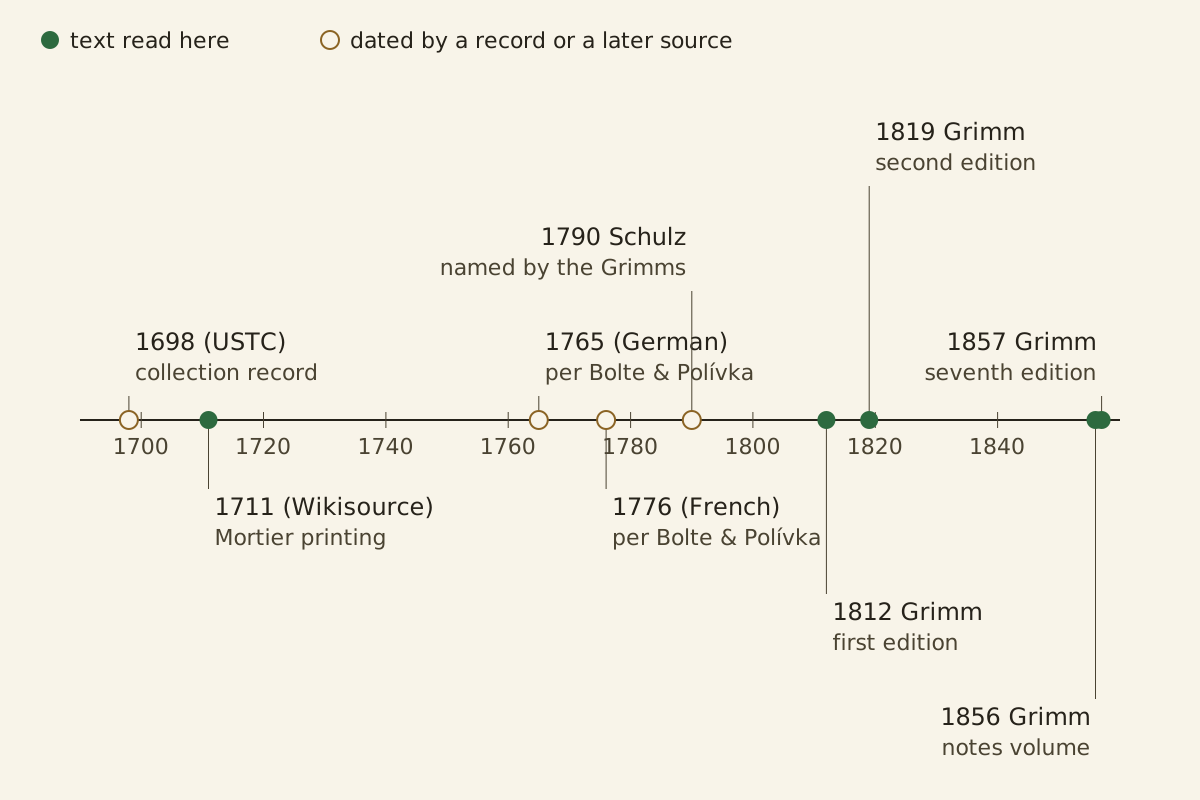
Rapunzel and Persinette in print — nine dated printings from the 1698 collection record to the Grimms' seventh edition; filled points are texts read for this page, hollow points dates taken from a catalogue or a later book.
Rapunzel and Persinette in print, 1698–1857 · Genre Fiction Lineage · CC BY 4.0
Reuse credit (CC BY)
"Rapunzel and Persinette in print, 1698–1857" by Genre Fiction Lineage, https://genrefictionlineage.com/fairy-tales/rapunzel/, licensed under CC BY 4.0 (https://creativecommons.org/licenses/by/4.0/)
Texts: Jacob and Wilhelm Grimm, Kinder- und Haus-Märchen, vol. 1 (Berlin, 1812), 2nd edition (Berlin, 1819) and 7th edition (Göttingen, 1857), No. 12, and the notes of 1812 and 1856, transcribed at German Wikisource; Charlotte-Rose de La Force, Persinette, in Les Fées, Contes des Contes (Amsterdam: Pierre Mortier, undated; 1711 per the Wikisource catalogue), transcribed at French Wikisource
Each date, with the basis for it and what this page could read, is in the CSV of dated printings, 1698 to 1857 CSV · provenance note Texts: Jacob and Wilhelm Grimm, Kinder- und Haus-Märchen, vol. 1 (Berlin, 1812), 2nd edition (Berlin, 1819) and 7th edition (Göttingen, 1857), No. 12, and the notes of 1812 and 1856, transcribed at German Wikisource; Charlotte-Rose de La Force, Persinette, in Les Fées, Contes des Contes (Amsterdam: Pierre Mortier, undated; 1711 per the Wikisource catalogue), transcribed at French Wikisource.
How close are the two plots?
Set the Mortier printing of “Persinette” beside the Grimms' 1812 text and the two stories run in the same order. A young wife craves a plant from a fairy's walled garden, parsley (persil) in French and rampion (Rapunzeln) in German, and her husband, caught taking it, promises the fairy the child. The girl is named after the plant and shut, around the age of twelve, in a tower with no door. The fairy climbs up by the girl's hair after calling “Persinette, descendez vos cheveux, que je monte” (“Persinette, let down your hair, so that I may climb up”; Genre Fiction Lineage translation), in German “Rapunzel, Rapunzel! laß mir dein Haar herunter” (“Rapunzel, Rapunzel! Let down your hair for me”; Genre Fiction Lineage translation).
By this page's count, 14 of 17 plot stages appear in both texts, and the three that do not are all in “Persinette.” Her prince marries her at once: “il luy proposa de l’épouser sur l’heure ; elle y consenti” (“he proposed to marry her on the spot; she consented”; Genre Fiction Lineage translation). After the reunion, enchanted food and beasts torment the family until “la Fée fut attendrie” (“the fairy was moved”) and drives them to the king's palace, and a verse moral addressed to “Tendres époux” (“tender spouses”; both Genre Fiction Lineage translations) closes the tale.
| Plot stage | “Persinette” (Mortier printing) | Grimm 1812 |
|---|---|---|
| A married couple expect a child | p. 43 | p. 39 |
| The wife craves a plant from the garden | p. 43 | p. 39 |
| The garden belongs to a fairy | p. 43 | p. 39 |
| The husband promises the child | p. 45 | p. 40 |
| The child is named after the plant | p. 45 | p. 40 |
| Shut in a tower with no door at about twelve | pp. 45–46 | p. 40 |
| The fairy calls and climbs the hair | p. 47 | p. 40 |
| A prince learns the call and climbs up | p. 49 | p. 41 |
| They marry in the tower | p. 50 | absent |
| The fairy learns she is pregnant | p. 50 | p. 41 |
| Hair cut, girl sent into a wilderness | p. 51 | p. 42 |
| A boy and a girl born in exile | p. 51 | p. 42 |
| The cut hair lures the prince up | p. 52 | p. 42 |
| The prince falls and is blinded | p. 52 | p. 42 |
| Her tears restore his sight | p. 54 | pp. 42–43 |
| The fairy relents and takes them to the king | p. 56 | absent |
| A verse moral | p. 57 | absent |
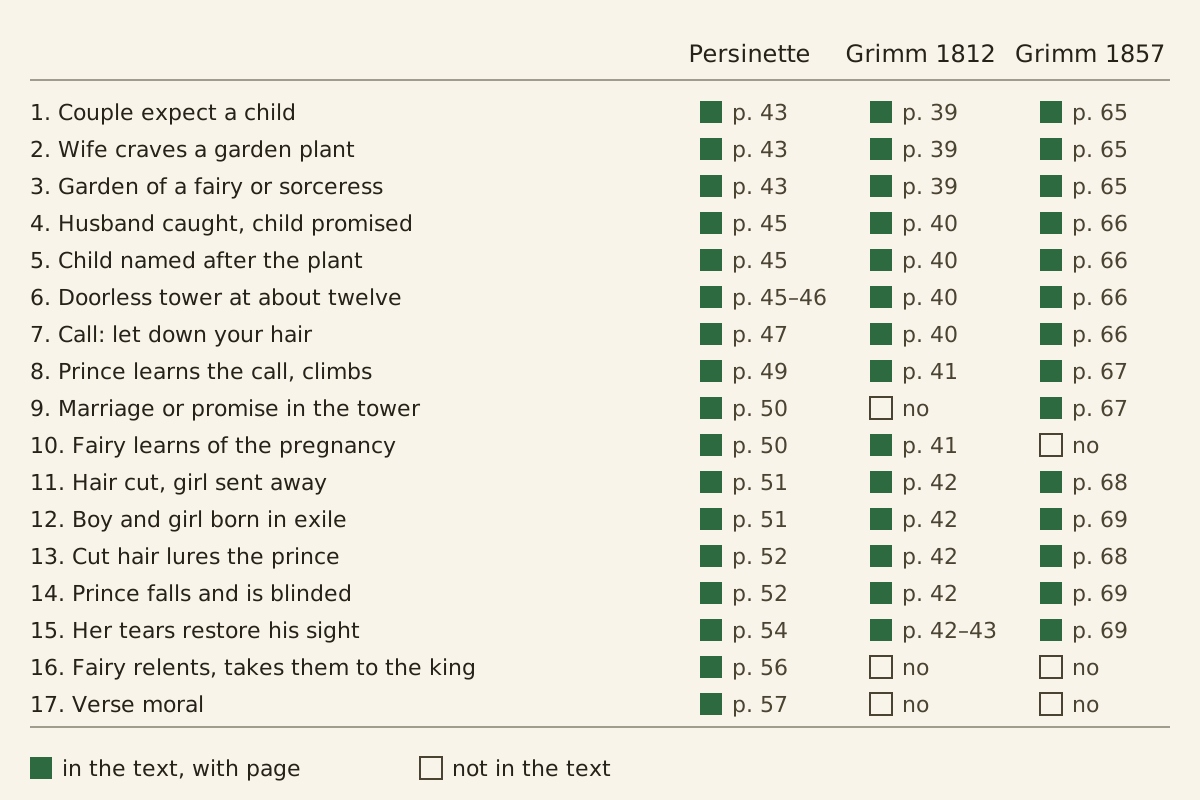
Seventeen plot stages — which events the Mortier printing of “Persinette” and the Grimms' texts of 1812 and 1857 print, with the page of each.
Persinette and Rapunzel: seventeen plot stages · Genre Fiction Lineage · CC BY 4.0
Reuse credit (CC BY)
"Persinette and Rapunzel: seventeen plot stages" by Genre Fiction Lineage, https://genrefictionlineage.com/fairy-tales/rapunzel/, licensed under CC BY 4.0 (https://creativecommons.org/licenses/by/4.0/)
Texts: Jacob and Wilhelm Grimm, Kinder- und Haus-Märchen, vol. 1 (Berlin, 1812), 2nd edition (Berlin, 1819) and 7th edition (Göttingen, 1857), No. 12, and the notes of 1812 and 1856, transcribed at German Wikisource; Charlotte-Rose de La Force, Persinette, in Les Fées, Contes des Contes (Amsterdam: Pierre Mortier, undated; 1711 per the Wikisource catalogue), transcribed at French Wikisource
The stages, with the original sentence, a translation and the page for each text, are in the CSV of plot stages in three texts CSV · provenance note Texts: Jacob and Wilhelm Grimm, Kinder- und Haus-Märchen, vol. 1 (Berlin, 1812), 2nd edition (Berlin, 1819) and 7th edition (Göttingen, 1857), No. 12, and the notes of 1812 and 1856, transcribed at German Wikisource; Charlotte-Rose de La Force, Persinette, in Les Fées, Contes des Contes (Amsterdam: Pierre Mortier, undated; 1711 per the Wikisource catalogue), transcribed at French Wikisource.
Where do the two texts differ?
The details differ even where the stages match. Persinette's hair is “trente aunes” (“thirty ells”) long, while Rapunzel's falls “zwanzig Ellen” (“twenty ells”), and La Force's tower is silver, “une Tour d’argent au milieu d’une forêt” (“a silver tower in the middle of a forest”; all three Genre Fiction Lineage translations), where the Grimms' tower is simply high. In the French text the fairy sees for herself that the girl is pregnant, whereas in the German one the girl gives herself away. Under this site's rules a shared plot is a shared device, not proof that one text came from the other, and neither text names the other.
Oral tale or French literary tale?
Two claims about where Rapunzel came from can be set side by side, and this page does not choose between them. The first is the Grimms' own, written in 1812 and repeated in 1856: Schulz's telling came “without doubt” from oral tradition. It is the only statement about Schulz's source in the texts read here, and it comes from the editors who printed the tale.
The second is the claim that Rapunzel is La Force's literary tale, carried into German in print. Three kinds of evidence bear on it: “Persinette” was in print before 1790 on the dates above, at least in the 1765 German translation that Bolte and Polívka list; the plots match in 14 of 17 stages; and Schulz's telling falls between the two texts in time. None of these is a document in which Schulz or the Grimms name La Force.
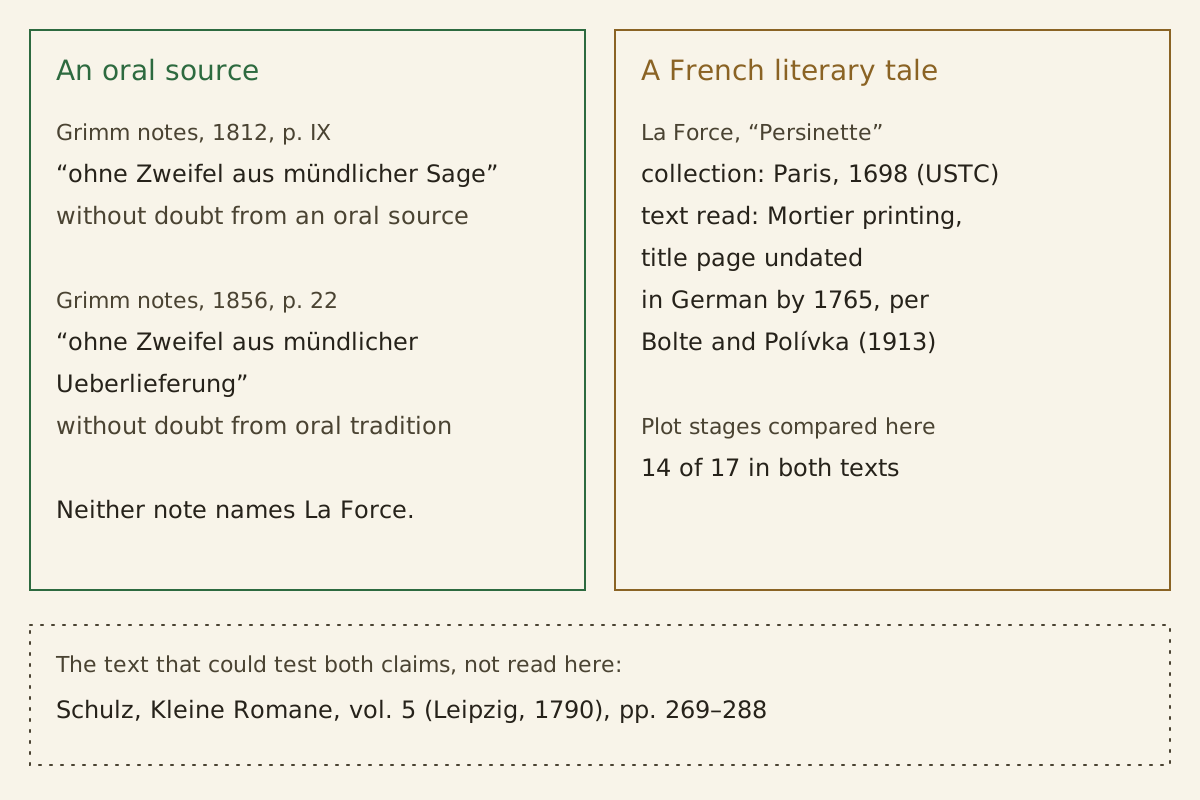
Two claims about Schulz's source — the Grimms' words on the left, the printing and plot evidence for the French tale on the right, and the one text that could test both, unread, below.
Rapunzel: two claims about Schulz's source · Genre Fiction Lineage · CC BY 4.0
Reuse credit (CC BY)
"Rapunzel: two claims about Schulz's source" by Genre Fiction Lineage, https://genrefictionlineage.com/fairy-tales/rapunzel/, licensed under CC BY 4.0 (https://creativecommons.org/licenses/by/4.0/)
Texts: Jacob and Wilhelm Grimm, Kinder- und Haus-Märchen, vol. 1 (Berlin, 1812), 2nd edition (Berlin, 1819) and 7th edition (Göttingen, 1857), No. 12, and the notes of 1812 and 1856, transcribed at German Wikisource; Charlotte-Rose de La Force, Persinette, in Les Fées, Contes des Contes (Amsterdam: Pierre Mortier, undated; 1711 per the Wikisource catalogue), transcribed at French Wikisource
What could test it?
Schulz's own text is the one that could test both claims. If his 1790 tale follows “Persinette” sentence by sentence, the literary claim gains close textual evidence, although under this site's rules only Schulz naming La Force would make it documented influence. If it does not, the Grimms' account stands where they left it. No copy of Kleine Romane was found through the sources this site can read, so the question stays open on this page.

One window, no door — an illustration of the tower that Persinette and Rapunzel share, not a book illustration.
Illustration: Genre Fiction Lineage. Generated scene illustration — not a book illustration, photograph or historical record. No copyright is claimed in the generated imagery; if you reuse it, please credit "Genre Fiction Lineage".
What changed between 1812 and 1857?
The Grimms kept revising the collection. The 1857 title page calls its first volume the seventh edition (“Siebente Auflage”), published in Göttingen by Dieterich 45 years after the 1812 volume. The tale is still No. 12, now on pages 65 to 69. Set beside the 1812 text, it shows the tame edit in one aspect, the sexual one: the hint that Rapunzel is pregnant.
In 1812 Rapunzel gives herself away to the fairy: “sag’ sie mir doch Frau Gothel, meine Kleiderchen werden mir so eng und wollen nicht mehr passen” (“do tell me, Frau Gothel, my little clothes are getting so tight and won't fit any more”; Genre Fiction Lineage translation). In 1857 the slip is about weight instead: “sie wird mir viel schwerer heraufzuziehen, als der junge Königssohn” (“you are much heavier for me to pull up than the young prince”; Genre Fiction Lineage translation). The 1857 text also adds a proposal before the visits, and Rapunzel “sagte ja und legte ihre Hand in seine Hand” (“said yes and laid her hand in his”; Genre Fiction Lineage translation).
The change is narrow. The twins are still born in the wilderness in 1857, where the prince finds Rapunzel “mit den Zwillingen, die sie geboren hatte” (“with the twins she had borne”; Genre Fiction Lineage translation). The 1819 second edition, on page 68, already has the heavier-to-pull line and adds that the two “hatten sich herzlich lieb, wie Mann und Frau” (“loved each other dearly, like husband and wife”; Genre Fiction Lineage translation). The softening therefore began seven years after the 1812 volume.
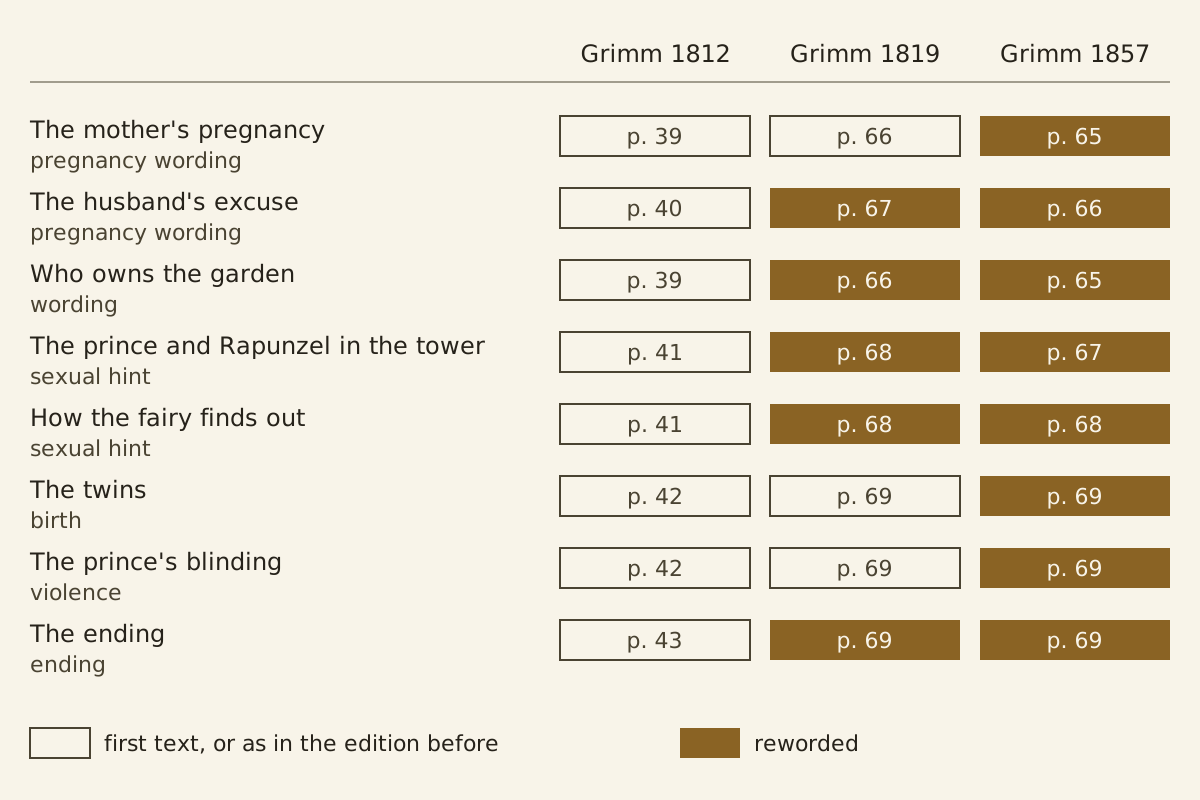
Eight passages, three editions — where the Grimms' 1819 and 1857 texts of Rapunzel reword the edition before them, with the page of each passage.
Rapunzel: eight passages in three Grimm editions · Genre Fiction Lineage · CC BY 4.0
Reuse credit (CC BY)
"Rapunzel: eight passages in three Grimm editions" by Genre Fiction Lineage, https://genrefictionlineage.com/fairy-tales/rapunzel/, licensed under CC BY 4.0 (https://creativecommons.org/licenses/by/4.0/)
Texts: Jacob and Wilhelm Grimm, Kinder- und Haus-Märchen, vol. 1 (Berlin, 1812), 2nd edition (Berlin, 1819) and 7th edition (Göttingen, 1857), No. 12, and the notes of 1812 and 1856, transcribed at German Wikisource; Charlotte-Rose de La Force, Persinette, in Les Fées, Contes des Contes (Amsterdam: Pierre Mortier, undated; 1711 per the Wikisource catalogue), transcribed at French Wikisource
| Passage | 1812 text | 1819 text | 1857 text |
|---|---|---|---|
| The husband's excuse | his wife's “Schwangerschaft,” pregnancy (p. 40) | his wife's “Gelüsten,” craving (p. 67) | craving, in his own words (p. 66) |
| The two in the tower | “lived merrily and happily for a good while” (p. 41) | adds “like husband and wife” (p. 68) | a proposal: she “said yes” (p. 67) |
| How the fairy finds out | tight clothes (p. 41) | heavier to pull up “than the young king” (p. 68) | heavier to pull up “than the young prince” (p. 68) |
| The twins | born in the wilderness (p. 42) | born in the wilderness (p. 69) | still there (p. 69) |
| The prince's eyes | lost in the fall (p. 42) | lost in the fall (p. 69) | “thorns he fell into pierced his eyes” (p. 69) |
Did the later text soften everything?
It did not. In 1812 the prince survives the fall, but “die beiden Augen hatte er sich ausgefallen” (“he had lost both his eyes in the fall”), while in 1857 “die Dornen, in die er fiel, zerstachen ihm die Augen” (“the thorns he fell into pierced his eyes”; both Genre Fiction Lineage translations). On violence the later text is more explicit, so the tame edit here covers the pregnancy hint only. All eight passages, in German with translations and pages, are in the CSV of the 1812, 1819 and 1857 passages CSV · provenance note Texts: Jacob and Wilhelm Grimm, Kinder- und Haus-Märchen, vol. 1 (Berlin, 1812), 2nd edition (Berlin, 1819) and 7th edition (Göttingen, 1857), No. 12, and the notes of 1812 and 1856, transcribed at German Wikisource; Charlotte-Rose de La Force, Persinette, in Les Fées, Contes des Contes (Amsterdam: Pierre Mortier, undated; 1711 per the Wikisource catalogue), transcribed at French Wikisource.
The preface reprinted in the 1857 volume is dated Cassel, 3 July 1819, the year of the second edition. On page XI it says that “jeden für das Kinderalter nicht passenden Ausdruck” (“every expression unsuitable for childhood”; Genre Fiction Lineage translation) was carefully deleted in that new edition. It names no tale, so it is a general statement and not a documented reason for this change. Naming the edition before quoting it is the same rule Dystopian Novels in Print Order (for comparison) applies to novels that changed between printings.
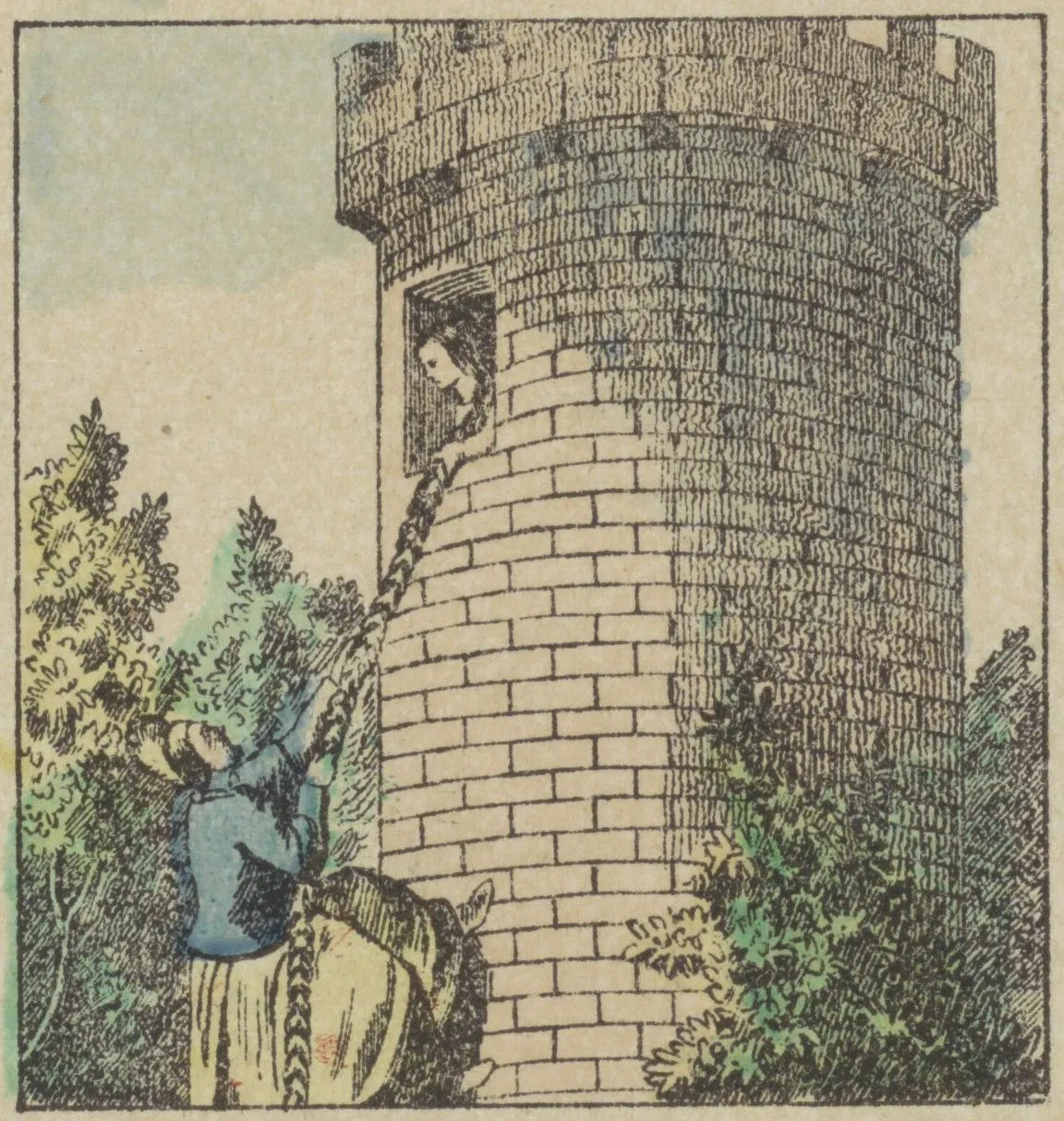
The climb — one of sixteen pictures on a hand-coloured sheet with Dutch captions, “Rapunzel (eene soort salade)” (“Rapunzel (a kind of salad)”; Genre Fiction Lineage translation), published in Wissembourg by C. Burckardt's successors and dated by the Rijksmuseum about 1889 to 1906.
Rapunzel (eene soort salade), No. 69: the climb · anonymous printmaker (published by C. Burckardt's successors) · CC0 1.0
Full credit
"Rapunzel (eene soort salade), No. 69: the climb" by anonymous printmaker (published by C. Burckardt's successors), 1889 — https://commons.wikimedia.org/wiki/File:Rapunzel_(eene_soort_salade)_(titel_op_object),_RP-P-OB-200.889.jpg — CC0 1.0 (https://creativecommons.org/publicdomain/zero/1.0/); modified: one of the sixteen pictures cropped from the full sheet with its printed frame line, without its caption; no other change
The captions on that sheet tell a version without the pregnancy at all. Its witch simply learns that a prince visits every day, no children appear in the captions, and the last caption has the pair marry “zeer spoedig” (“very soon”; Genre Fiction Lineage translation) once they reach his kingdom.
Sources
- 1Jacob and Wilhelm Grimm, Kinder- und Haus-Märchen, vol. 1 (Berlin: Realschulbuchhandlung, 1812), title page, transcribed at Wikisource https://de.wikisource.org/wiki/Kinder-_und_Haus-M%C3%A4rchen_Band_1_(1812)Read: title page (transcription checked twice against the scan)
- 2Jacob and Wilhelm Grimm, “Rapunzel,” No. 12, and the note “Zu Rapunzel,” in Kinder- und Haus-Märchen, vol. 1 (Berlin, 1812), pp. 38–43 and notes pp. VIII–IX, transcribed at Wikisource https://de.wikisource.org/wiki/Rapunzel_(1812)Read: full text of the tale and its notes of 1812 and 1815 (transcription checked twice against the scan)
- 3Scan of the title page of Kinder und Hausmärchen, vol. 3, 3rd edition (Göttingen: Dieterich, 1856), on Wikimedia Commons https://commons.wikimedia.org/wiki/File:Kinder_und_Hausm%C3%A4rchen_(Grimm)_1856_III_p_003.jpgRead: the scanned title page, viewed in full
- 4Jacob and Wilhelm Grimm, Kinder- und Hausmärchen, vol. 3, 3rd edition (Göttingen, 1856), “Anmerkungen,” note to No. 12, p. 22, transcribed at Wikisource https://de.wikisource.org/wiki/Kinder-_und_Haus-M%C3%A4rchen_Band_3_(1856)/AnmerkungenRead: the note to No. 12; the whole notes page searched for Persinette and La Force (no hits)
- 5Charlotte-Rose de La Force, “Persinette,” in Les Fées, Contes des Contes (Amsterdam: Pierre Mortier, undated; 1711 per the Wikisource catalogue), pp. 42–57, transcribed at Wikisource https://fr.wikisource.org/wiki/PersinetteRead: full text of the tale and its verse moral
- 6Les Fées, Contes des Contes, “Par Mademoiselle de ***” (Amsterdam: Pierre Mortier), title page and “Le libraire au lecteur,” transcribed at Wikisource https://fr.wikisource.org/wiki/Page:Caumont_-_Les_F%C3%A9es_contes_des_contes.pdf/10Read: transcribed title page (scan page 10) and the bookseller's note (page 12); scan pages 9, 255 and 256 also read, none with a printed date
- 7Wikisource catalogue entry for Les Fées, Contes des Contes (Livre page) https://fr.wikisource.org/wiki/Livre:Caumont_-_Les_F%C3%A9es_contes_des_contes.pdfRead: catalogue entry (editorial data, not the printed book)
- 8Universal Short Title Catalogue, records 6165686 and 6165687: Charlotte Rose de Caumont de La Force, Les contes des contes (Paris: Simon Bénard, 1698) https://www.ustc.ac.uk/editions/6165686Read: bibliographic records only (no list of contents)
- 9Johannes Bolte and Jiří Polívka, Anmerkungen zu den Kinder- und Hausmärchen der Brüder Grimm, vol. 1 (Leipzig: Dieterich, 1913), p. 97, transcribed at Wikisource https://de.wikisource.org/wiki/Seite:Grimms_M%C3%A4rchen_Anmerkungen_(Bolte_Polivka)_I_097.jpgRead: the page on No. 12 (named secondary source)
- 10Jacob and Wilhelm Grimm, Kinder- und Hausmärchen, vol. 1, 7th edition (Göttingen: Dieterich, 1857), title page and preface, transcribed at Wikisource https://de.wikisource.org/wiki/Kinder-_und_Haus-M%C3%A4rchen_Band_1_(1857)Read: title page and the preface sentence on p. XI (transcription checked twice against the scan); the preface on pp. IX–XVII is dated "Cassel am 3ten Julius 1819" (p. XVII), i.e. the second-edition preface reprinted (checked 2026-11-03 in the saved page)
- 11Jacob and Wilhelm Grimm, “Rapunzel,” No. 12, in Kinder- und Hausmärchen, vol. 1, 7th edition (Göttingen, 1857), pp. 65–69, transcribed at Wikisource https://de.wikisource.org/wiki/Rapunzel_(1857)Read: full text of the tale (transcription checked twice against the scan)
- 12Jacob and Wilhelm Grimm, Kinder- und Haus-Märchen, vol. 1, 2nd edition (Berlin: G. Reimer, 1819), title page, transcribed at Wikisource https://de.wikisource.org/wiki/Kinder-_und_Haus-M%C3%A4rchen_Band_1_(1819)Read: title page (transcription checked twice against the scan)
- 13Jacob and Wilhelm Grimm, “Rapunzel,” No. 12, in Kinder- und Haus-Märchen, vol. 1, 2nd edition (Berlin, 1819), pp. 66–69, transcribed at Wikisource https://de.wikisource.org/wiki/Rapunzel_(1819)Read: full text of the tale
- 14Anonymous printmaker, Rapunzel (eene soort salade), No. 69 (Wissembourg: C. Burckardt's successors, about 1889–1906), Rijksmuseum RP-P-OB-200.889, on Wikimedia Commons https://commons.wikimedia.org/wiki/File:Rapunzel_(eene_soort_salade)_(titel_op_object),_RP-P-OB-200.889.jpgRead: file page and the full-size original, captions read on the image
- 15Gemeinsame Normdatei (GND), Deutsche Nationalbibliothek, records for Charlotte-Rose de Caumont de La Force (118638262), Friedrich Schulz (100316875), Jacob Grimm (118542257) and Wilhelm Grimm (118542265), via lobid.org https://lobid.org/gnd/118638262Read: authority records (life dates)
- 16Jennifer Jenkins and James Boyle, "Public Domain Day 2026," Center for the Study of the Public Domain, Duke Law School https://web.law.duke.edu/cspd/publicdomainday/2026/Read: full pageText licence: CC BY 4.0
- 17Urheberrechtsgesetz § 64 (Allgemeines), gesetze-im-internet.de https://www.gesetze-im-internet.de/urhg/__64.htmlRead: full text of the section


Cite this page
Genre Fiction Lineage. “Rapunzel: The Grimms' 1812 Note Names Schulz, Not La Force.” Genre Fiction Lineage, published 3 November 2026. https://genrefictionlineage.com/fairy-tales/rapunzel/. Accessed [the date you read it].
Next shelf over:
- Fairy Tales by Perrault and the Grimms: another French writer who printed tales before the Grimms, checked tale by tale against their editions and notes (for comparison).
- Snow White: another tale from the same 1812 volume, changed in the Grimms' 1819 edition (for comparison).
- Read the text: Rapunzel (1812), Wikisource
Related entries
More from Fairy Tale Editions.
Lineage essay
Little Red Riding Hood: Perrault's 1697 Text Has No Hunter
Perrault's 1697 Little Red Riding Hood ends with the wolf eating her; the huntsman's rescue is in the Grimms' 1812 text. Three texts compared stage by stage.
Picture credit
"Little Red Riding Hood meets the wolf" by Gustave Doré, 1867 — https://commons.wikimedia.org/wiki/File:Little_Red_Riding_Hood_(136547615).jpg — Public domain (US: published in Paris in 1867; Germany and France: Doré died 1883 (GND), and the engraver signing Pannemaker was at work by 1867 (presumed out of copyright from his working years; first name and dates not checked), so 70 years after death have run out); modified: cropped from the full book page, desaturated and contrast adjusted on Wikimedia Commons before download
Edition comparison
Snow White: In the 1812 Grimm Text, the Queen Is Her Mother
In the Grimms' 1812 Snow White the jealous queen is her own mother; the 1819 edition makes her a stepmother. Thirteen passages compared in three editions.
Picture credit
"Blanca Nieve y los siete enanos" by José Guadalupe Posada, 1900 — https://commons.wikimedia.org/wiki/File:Snow_White_and_the_Seven_Dwarfs_MET_DP869499.jpg — CC0 1.0 (https://creativecommons.org/publicdomain/zero/1.0/)
Edition comparison
Fairy Tales by Perrault: Matched Against Grimm, 1812 to 1857
Perrault's 1697 book has eight prose tales; the Grimms' notes pair seven with tales in their 1812 edition, and two of those are absent from 1819 to 1857.
Picture credit
"Puss in Boots by the river" by Gustave Doré, 1867 — https://commons.wikimedia.org/wiki/File:Puss_in_Boots_(136548352).jpg — Public domain (US: published in Paris in 1867; Germany and France: Doré died 1883 (GND), and the engraver signing Pannemaker was at work by 1867 (presumed out of copyright from his working years; first name and dates not checked), so 70 years after death have run out); modified: cropped from the full book page, desaturated and contrast adjusted on Wikimedia Commons before download